





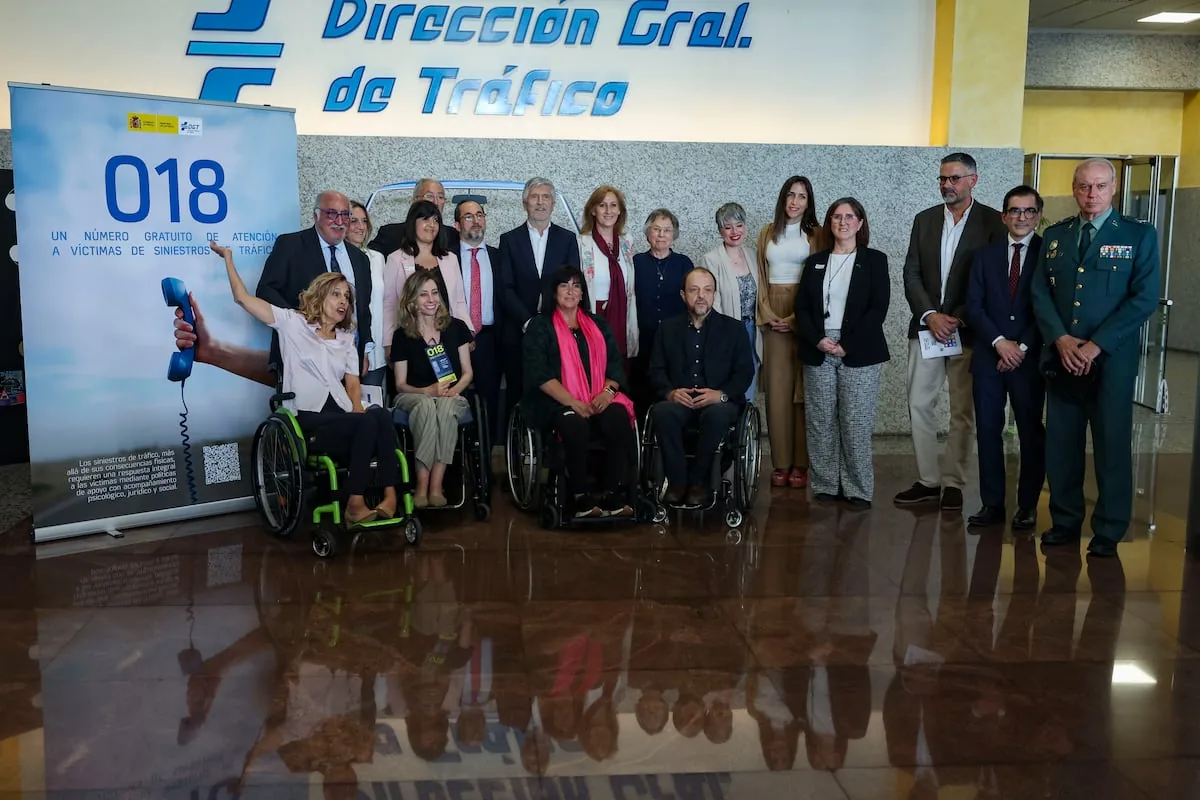
“Hopefully, no one will have to pick it up.” With these words, the president of the Stop Accidents association, Jeanne Picard, summarized the launch of 018, the new helpline for victims of traffic accidents inaugurated by the Directorate-General for Traffic (DGT) and presented this Thursday by the Minister of Interior, Fernando Grande-Marlaska.
Read more A Chinese website is selling medical information of 500,000 volunteers from a UK database
The 018, which is already operational, is free of charge and has national coverage, and will be available from 8:00 to 21:00 every day of the year. It will be staffed by social workers, psychologists, and lawyers. These professionals, who have been trained to assist this type of victim, will provide information on useful procedures and resources after an accident, such as associations and support services; they will offer personalized guidance and advice – such as available psychological, social, legal, and medical resources – and commit to follow-up in cases of serious accidents for one year. Service will be provided in 50 languages, in addition to Spain’s co-official languages.
“Therefore, 018 not only offers direct assistance but also facilitates access to an existing support network, which will strengthen the work of associations and ensure that no victim is left without information, without accompaniment, and without the possibility of receiving specialized and continuous care,” Grande-Marlaska reported.
Access can be gained by dialing 018, via WhatsApp at 645 713 823, by email at victimastrafico@dgt.es, or through the form on the DGT website: https://www.dgt.es/nuestros-servicios/atencion-a-victimas/telefono-atencion/
“It is a key service as a first point of contact through which victims receive information, psychological guidance, basic legal advice, and emotional support in dramatic moments,” explained the Minister of Interior. He insisted that “telephone assistance reduces barriers such as fear, geographical distance, lack of economic resources, or ignorance of available procedures, and its confidential nature creates an environment of greater trust for the victim.”
The director of the National Traffic Observatory, Álvaro Gómez, explained that it is not an emergency phone —“for that, 112 already exists,” he clarified—, nor a therapeutic care service, nor a substitute for personalized legal defense. The 018 is a pioneering service that joins specific traffic victim support services already operating in other countries such as Argentina and Colombia, according to the Ministry of Interior. In Spain, at a regional level, the Information and Assistance Service for Traffic Victims (SIAVT) also specifically exists in Catalonia, with a very consolidated track record.
“A special and very emotional day”
Jeanne Picard described this day as “a special and very emotional day.” “It’s been 25 years of demanding and asking for this helpline, even at a national level. Finally, the day has come. There are no words to express the pain of a father or mother who has just lost their child,” she emphasized, after which she recounted moments experienced by victims of a road accident, such as the police call, finding out about the accident through social media, not being able to hug a family member anymore, justice arriving late, or spending up to six hours in the emergency room. Picard became so emotional that she had to pass the floor to another colleague from Stop Accidents.
The representatives of the five associations who attended the presentation at the DGT headquarters expressed great satisfaction with the launch of the service. They see it as a measure to overcome the difficulties that arise after suffering a road accident, especially due to the legal process of many cases, the pain of losing a loved one, and the large number of procedures that need to be undertaken. They also recalled that it is a “historical demand” that has been launched after years of requests.
“This service can be the first voice a person hears whose life has changed at a moment when one can be very vulnerable. The aim is that no victim feels lost or alone,” highlighted Elena Fernández, from DYA.
“Their help is fundamental when victims leave the hospital and don’t know what social resources are available in Spain. We welcome it, and it is much anticipated. It seemed like we wouldn’t achieve it, but it’s here now,” added Mar Cogollos, director of the Aesleme association.
Special operation for the Spanish Motorcycling Grand Prix
The Directorate-General for Traffic (DGT) will launch a special surveillance and assistance operation from Thursday, April 23, to April 26, for the thousands of motorcyclists who will travel to the Jerez-Ángel Nieto circuit for the Spanish Motorcycling Grand Prix. The operation aims to facilitate mobility and guarantee the safety of fans attending the competition. During these days, there will be increased surveillance, also using helicopters and drones, to control the most frequented routes to access Jerez and the circuit. In 2025, 480,304 displacements were registered during the Grand Prix. For the 2026 edition, a similar figure, close to 500,000, is expected, according to the DGT.
In the provinces of Ciudad Real and Badajoz and at various points in the Andalusian community, surveillance points will be established, where agents will focus on helmet and seatbelt use, speeding, driving under the influence of alcohol or drugs, illegal overtakes, and reckless or negligent driving. Approximately 450 agents from the Civil Guard’s Traffic Group will participate.
The maximum speed allowed will be monitored by fixed and section speed cameras installed on the road. The Civil Guard will establish checkpoints in the morning, afternoon, and night periods to ensure compliance with established limits. Alcohol and drug controls will also be increased from this Thursday in the vicinity of the circuit to deter consumption associated with driving.