









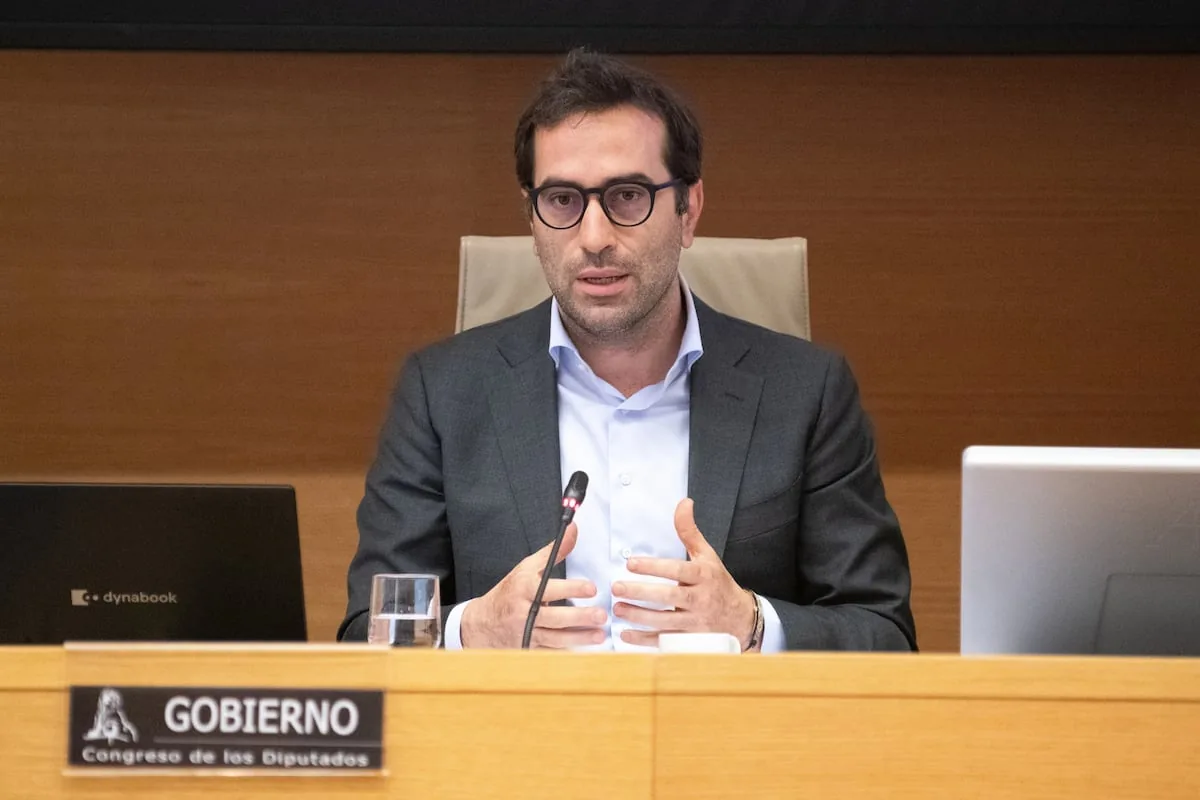
The Spanish Government is in the final phase of preparing España Crece, the new sovereign fund it plans to launch in the second half of the year. The instrument is designed to prolong the investment momentum associated with European funds, which end this year. The Minister of Economy, Carlos Cuerpo, stated this Thursday that “in the coming weeks” transfers from the Treasury will begin. The objective is to finalize the investment strategy of this fund with the European Commission in May and have it operational in the second quarter of the year, as planned.
Read more The Government orders the transfer of 7 billion dollars from private funds to Colpensiones
During his appearance in Congress, the First Vice-President specified that the fund aims to mobilize up to 120 billion euros through public-private collaboration schemes. The fund will have an initial endowment of 13.3 billion euros from the loans of the Recovery, Transformation and Resilience Plan. Of that total, 10.5 billion will be channeled through the Official Credit Institute (ICO) to strengthen its financing capacity and facilitate the leveraging of private capital.
The design of the fund, which will be ready before July, contemplates a multiplier effect close to one-to-one between public and private investment. Under this scheme, the Executive seeks to expand the scale of projects beyond the temporary limits set by Brussels, which consider 2026 as the deadline.
Investment priorities are structured into four areas: improving business competitiveness and resilience, digitalization of small and medium-sized enterprises, energy transition, and affordable housing development. This last area concentrates a large part of the planned effort, with an estimated mobilization of over 23 billion euros aimed at expanding the rental supply.
The launch of the fund coincides with the final phase of the execution of the Recovery Plan. The Government maintains August 2026 as the deadline to meet the milestones committed with the European Commission and ensure the full disbursement of funds before the end of the year. Spain has so far received 71.4 billion euros after the first five approved tranches. The Executive is working on the approval of the sixth disbursement, worth 7.3 billion, which would raise the execution level above 75% of the total allocated, as detailed by Cuerpo. Official planning foresees requesting a seventh tranche in September and completing the reception of resources in December.
Its effect on national GDP
Just a few months before the Next Generation program ends, more precise estimates of its impact on the Spanish economy are beginning to emerge. A study by Funcas and Afi published this Thursday specifies that European funds account for between 10% and 14% of the average annual growth of real GDP between 2021 and 2025. The percentage, although significant, indicates that there have been other factors ―among which tourism and the increase in the labor force stand out― that have served as drivers for the good economic performance of recent years.
Read more The Army arrests three trusted men of Aureliano ‘El Guano’ Guzmán, El Chapo’s brother, in Durango
The deployment of resources has followed a clear sectoral concentration. Manufacturing, with a prominent weight of automotive and the battery value chain, along with information technologies and construction, gather more than 60% of the committed funds. In the case of the technological sector, the volume of aid has reached unusual levels, up to around 29% of its gross value added prior to the pandemic.
As Cuerpo acknowledged this Thursday, the Funcas report emphasizes that the administrative calendar does not mark the end of its economic effects. Thanks to the Simplification Addendum approved at the end of 2025, the spillover effect of the funds will formally extend until 2036 thanks to the channeling of resources through financial vehicles and loan funds, such as the España Crece Fund or the loan scheme managed by the EIB, whose operational life allows for reinvesting returns and executing projects over the next decade.
Despite these figures, experts maintain a cautious tone and point out a series of structural deficiencies that have limited the promised transformative effect. One of the most incisive criticisms included in the report is the so-called “substitution effect,” as it is estimated that a significant part of the investments financed by the program would have occurred anyway with companies’ own resources, which reduces the net impact of the stimulus. Added to this is a more contained business investment response than expected, which by the end of 2025 was still 3.3 points below pre-pandemic levels.
Productivity, the great endemic ill of the Spanish economy, also does not seem to have reacted with the expected strength. Although it is the only one of the major European economies where real productivity per hour has increased compared to its previous trend, the additional advance is barely 0.4 points, a very modest result when compared to the volume of resources injected. The report attributes this result to the structural weakness of the business fabric, as the funds have been concentrated in large companies (0.4% absorb almost 46% of the committed funds), while micro-enterprises and SMEs, which represent 99% of the ecosystem, proportionally access the same resources.
Despite these data, Cuerpo insisted today that “70% of the beneficiaries are micro-SMEs and SMEs,” which have received 43% of the total volume of allocated funds, and stressed that “the figures reflect a genuine transformation of our economy.”
Read more A man murders his ex-partner in Seseña and then commits suicide