








There are areas in Santa Ana, California, where English is secondary. The proliferation of taquerias, cowboy clothing stores, remittance businesses, and butcher shops reflect the deep influence of Mexican culture. In that atmosphere of nostalgia and surrounded by dozens of relatives who emigrated from Michoacán, Juan Carlos Valencia González took his first steps, who is poised to become the new boss of the Jalisco New Generation Cartel (CJNG). On this side of the border, some do not see him as a feared 41-year-old capo but as a close relative spoken of in hushed tones.
Read more Eric Swalwell’s «double life»: from his fight against Trump to being accused of rape
Valencia González’s Californian origin is also that of the CJNG. Santa Ana, the cradle of this narco nicknamed R3, was one of the first U.S. territories where the cartel operated freely. From Mexico, his stepfather Nemesio Oseguera Cervantes, El Mencho, grew the organization on the very streets of California where Valencia sold heroin. R3’s maternal uncles, known as Los Cuinis, were essential in that expansion and became the financial arm of the CJNG. By 2015, the cartel already controlled a third of the lucrative drug distribution, neighboring Los Angeles. Additionally, it had gained significant influence in other places, including the border town of San Ysidro, Riverside, Bakersfield, San Francisco, and Sacramento, warned a report the DEA released that year.
California is home to several of Mencho’s relatives, including his youngest daughter Laisha Michelle and one of his brothers. Los Cuinis also have close relatives spread from south to north. The DEA has them well identified and has not hesitated to contact them to comply with legal procedures. All act with extreme caution and, as far as is known, the U.S. Government has not linked them to illicit activities.
After Mencho’s death in February, the rise to the throne of his stepson seemed natural. R3’s half-brother was extradited in 2020 and is now serving a life sentence in a high-security U.S. prison.
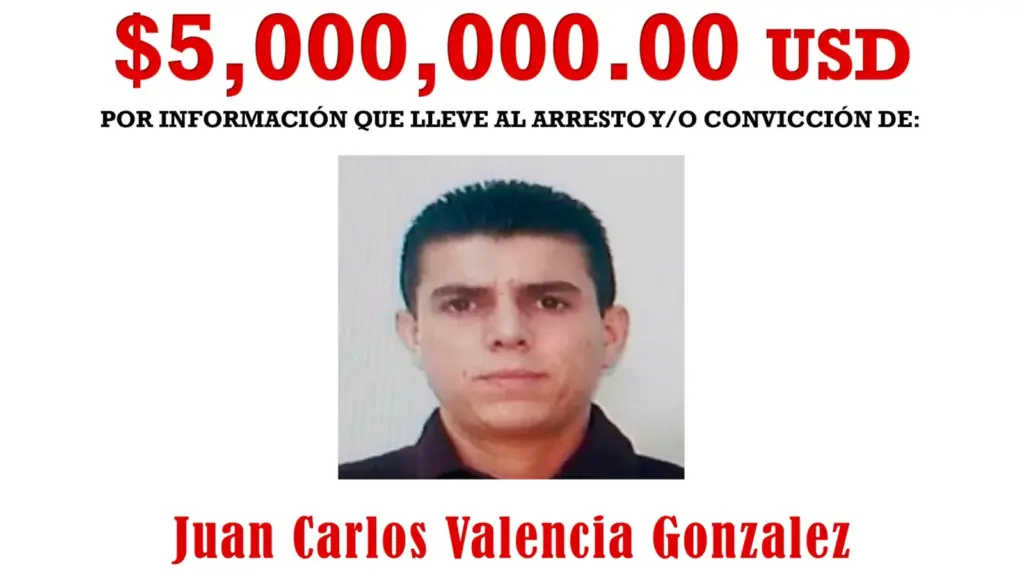
The new capo of capos of the CJNG inherited an illicit enterprise that distributes drugs in at least 40 countries, possesses the largest arsenal in Mexico, and generates hundreds of millions of dollars annually, according to authorities. The $5 million reward offered in 2021 by the State Department had crowned his arrival at the top. His judicial process, based in a Washington D.C. court for trafficking massive amounts of cocaine and methamphetamines, was the result of the so-called Operation Pinky and Brain, led by the DEA office in Los Angeles.
R3’s mother, Rosalinda González Valencia, and several of her siblings emigrated to California as teenagers. None resumed their studies in the United States. “I had to work from the age of 14… in the fields, in packing plants, cleaning houses, babysitting, and in restaurants, all to get ahead,” she wrote in a letter that is part of a court file.
Her first son, Juan Carlos, was born in a Santa Ana hospital on September 12, 1984. The biological father is Armando Valencia Cornelio, who went from being an avocado producer to one of the founders of the Milenio cartel, predecessor of the CJNG. The relationship was brief. Two years later, in 1986, Rosalinda gave birth in San Francisco to a daughter of her new partner, El Mencho: Jessica Johanna Oseguera González. In the same city, Rubén and Laisha Michelle would later be born. At that time, El Mencho was a low-level drug dealer captured by authorities twice, in 1986 and 1989. He was deported after serving his second sentence. His wife and children returned with him to Mexico.
The bankrupt brother
A large family portrait decorates the living room of a two-story house in San Jacinto, 100 kilometers east of Los Angeles. In the center of the portrait, there is a man wearing a hat similar to Mencho’s. It is his older brother, Marín Oseguera Cervantes. Their paths took different directions, but they never completely separated. Marín housed his nieces, Jessica Johanna and Laisha Michelle, for a time. The house was used in February 2020 as collateral in a failed attempt to free the former from a legal process.
Jessica Johanna frequently visited her uncles and used Marín’s address when applying for a U.S. passport and a California driver’s license. The young woman then had serious problems. Federal agents had arrested her in a court in the capital, where she attended to be present at a hearing for her brother Rubén. She was charged with managing six companies sanctioned for laundering CJNG money. Among the businesses was a tequila brand about to be launched internationally and a chain of Japanese restaurants present in Jalisco.
Marín Oseguera’s home, protected with several surveillance cameras, has five bedrooms, four bathrooms, and a total area of 3,100 square feet. It was built in 2005 and is valued at over $547,000, according to Zillow. The brother of Mencho did not always do well. In June 2013, he had only $38 in his pocket and a debt of $117,000, spread over 13 credit cards, loans to finance the purchase of two cars, and three unpaid medical bills, according to a bankruptcy declaration he and his wife, Azucena Oseguera, filed in court. Their income was limited: he worked installing granite countertops in kitchens, and she took care of children. Both were paid in cash. At that time, they lived in a house in Perris, Riverside County, with a monthly rent of $1,600. The couple reported an income of $38,000 in 2012, low for the very high cost of living in the state.
Read more Johan Vásquez, the gladiator of Navojoa and Javier Aguirre
Mencho’s brother arrived in California when he was 15 years old. His wife Azucena assured in a brief conversation with this newspaper at the end of 2024, at the entrance of their home, that Marín had no connection of any kind with who was then one of the most wanted narcos. She emphasized that her husband kept a low profile and earned an honest living. “He is very separate from what his brother is… We do know his nieces, yes, they came here, lived here, but we have not had contact with them for a long time for personal reasons,” she said. “One cannot speak ill of family,” she emphasized. EL PAÍS visited Marín Oseguera’s house again after Mencho’s death, but no one answered the door.
A couple of anecdotes about Jessica Johanna in California were told by Azucena Oseguera in a letter addressed to a judge. The first, when her niece traveled to Los Angeles at 15 to buy clothes she sold in Mexico. The second, preparing food while visiting her uncle Marín’s home. “She had the food ready when we came home from work,” she said.
In early 2015, three federal agents, including one from the DEA, visited the home for the first time as part of the criminal case Jessica Johanna faced. Mencho’s sister-in-law received them and, after they showed her a photo of the capo, she confirmed they were indeed her relatives. Marín was not home. The next day, he called the investigators and met them at a café. They talked about the Treasury sanctions on his niece’s businesses, and he asked if it would be a crime to pay the legal defense of his sister-in-law Rosalinda’s brother, Abigael González Valencia, El Cuini, then imprisoned in Mexico.
“The OFAC (Office of Foreign Assets Control) investigator answered Marín’s questions and asked him to explain OFAC’s prohibition to any of his relatives who were U.S. citizens. Marín said he would,” the court document describes that meeting.
In those days, for the same purpose, those three federal agents also visited the home in Orange County of El Cuini’s daughter, Marlyn González Lara; and the capo’s brother, José María González Valencia, who was not at his home in Santa Ana nor at a nearby racetrack but was later found at a ranch in Hemet (near Marín Oseguera’s residence). According to the file, the government also contacted by mail other relatives of that narco living in California: his other children Jasmine and Alexis González Lara; and his sister Berenisse González Valencia. El Cuini was extradited in August and is now negotiating a plea deal.
Azucena Oseguera stated in that 2024 conversation, behind the door of her home: “We communicate with everyone who lives here.” But she insisted several times that they were not involved in organized crime. “We all work… We lead a life where we do not want publicity,” she said seriously.
—It must be hard to be Mencho’s relative —she was told.
—Yes, I think so. But we are very separate from everything.
The house of Pasión Azul
Laisha Michelle, Mencho’s youngest daughter, became independent after living with her uncle Marín. She did so after her partner, Cristian Fernando Gutiérrez Ochoa, identified as a high-profile CJNG operator, faked his own death with the help of his father-in-law. His plan was to cross the border to live secretly with Laisha Michelle under another identity. The couple settled in a luxurious two-story house valued at $1.2 million, in the heart of a private community in Riverside. It was acquired through a financial scheme using Pasión Azul, a tequila company financed by the cartel, as a front, stated the U.S. federal prosecutor’s office.
Mencho’s son-in-law used a false name, Luis Miguel Martínez, and tried to obtain a California driver’s license with it. He drove a high-end car used to evade anti-narcotics police who were spying on him. His flight ended in November 2024, when he was arrested. More than two million dollars in cash, jewelry, and watches were found when searching his house.
During intelligence operations, DEA agents discovered that Laisha Michelle ran a café with a Mexican touch called El Rincón La Chulis, located in a small shopping plaza in the city of Perris, not far from her residence. On one side, there is a taqueria and on the other, a hair salon. It is a small and modest business compared to the Japanese restaurants her older sister had in Guadalajara. The menu at Laisha’s establishment offers sandwiches, crepes, and chilaquiles. A phrase decorating the place says: “Life is short, eat a torta.”
Read more Bargain in sight: the yoga and pilates bag with mat holder that is a hit costs less than €18