







EL PAÍS offers the América Futura section openly for its daily and global informative contribution on sustainable development. If you want to support our journalism, subscribe here.
Read more El Mencho and the R3: the family trail that connects the Cartel Jalisco bosses in California
A simple internet search including the term “El Niño phenomenon” these days leads to a large number of articles accompanied by the words “alert” and “super Niño.” The reason? Recently, scientific organizations, such as the World Meteorological Organization (WMO) and the National Oceanic and Atmospheric Administration (NOAA), indicated that La Niña, which had been occurring weakly, would give way to neutral conditions and that, by the end of the year, could lead to an El Niño warming episode. The forecast has raised particular interest not only because, indeed, it helps countries prepare, but because some media have given it alarming nicknames, including “Godzilla Niño” or talking about the possibility of it becoming one of the most intense phenomena in centuries.
But since meteorology is a science of variables, it is important to understand what is known and what is not about this Niño, as well as what it could mean for Latin America and the Caribbean. El Niño events like those experienced in 2023 caused droughts, heat waves, wildfires, and extreme rains throughout the region, impacting health, food, and energy.
What is known: there will be a ‘Niño’
“El Niño is coming and this allows us to know that we have to prepare,” clarifies Bárbara Tapia Cortés, from the World Meteorological Organization. According to the most recent NOAA report – from April 13 – neutral conditions will remain between April and June 2026, with an 80% chance, and El Niño is expected to develop between May and July with a 61% probability, persisting until at least the end of 2026. In fact, for the quarter from November this year to January 2027, the chances of El Niño are 90%. Unlike other meteorological phenomena, explains the expert, “El Niño can be predicted in advance and we, as a population, have six months of alert to take action.”
What is uncertain: its strength
El Niño phenomena — as well as its counterpart, La Niña — are declared when the ocean surface temperature at a specific point in the Pacific, right in the middle, remains 0.5°C above the historical average value for three months. Depending on how much that value rises, starting at 0.5°C and possibly exceeding 2°C, it is defined whether it is a weak, moderate, strong, or very strong Niño. And, by the end of the year, the possibility of any of these options happening remains 25%. In official terminology, adds Tapia, adjectives like “super Niño” or “Godzilla Niño” do not exist. They have been, then, nicknames given to the possibility of a very strong Niño that, so far, has a 1 in 4 chance of occurring.
Why is there a sense of alert?
The first thing, as the meteorologist says, is that given the uncertainty about how strong it may become, the best is to prepare. Climate scientist Tom Di Liberto, from Climate Central, also explains that the amount of warm water in the Pacific Ocean is substantial compared to other years. “Models are predicting very marked oscillations. And although the percentages are not absolute certainty, they are much higher than usual for this time of year,” he said during a press conference. “When talking about risk, it is better to prepare for any scenario,” he also warned.
Read more Eric Swalwell’s «double life»: from his fight against Trump to being accused of rape
How will it impact Latin America and the Caribbean?
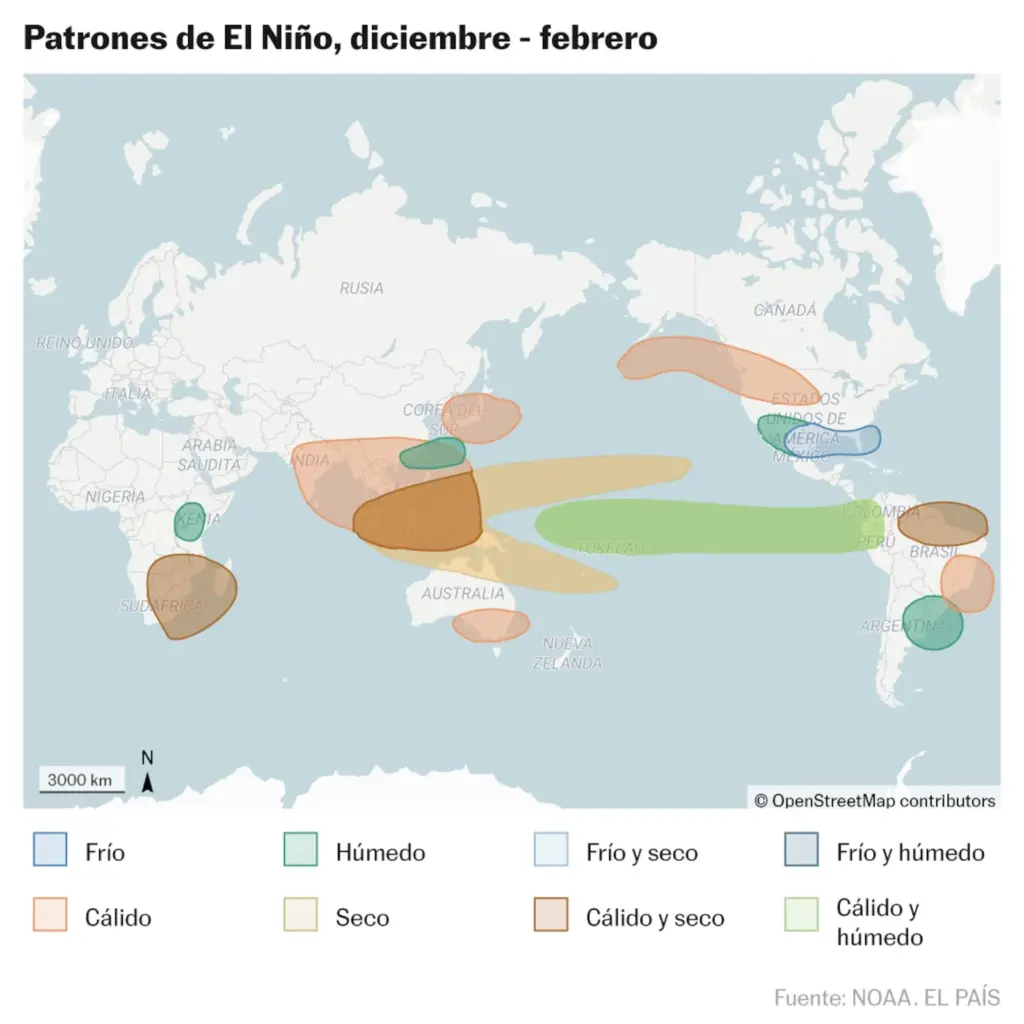
There is another point on which experts agree: no Niño behaves the same as another and, in each region, country, or even city, its impact changes. This is because El Niño or La Niña are only one of the variables that play a role in the weather. Also, a Niño during the months of June to August — summer for the northern hemisphere — does not behave the same as at the end of the year — when it is winter in the United States and Europe. Clarifying this, however, according to NOAA, the pattern of a Niño in mid-year is that it generates warm conditions for Ecuador, Peru, southeastern Brazil, and northern Chile, and humidity in the center of the latter country. In Central America, the Caribbean, and northern Colombia and Venezuela, its effect is heat and drought.
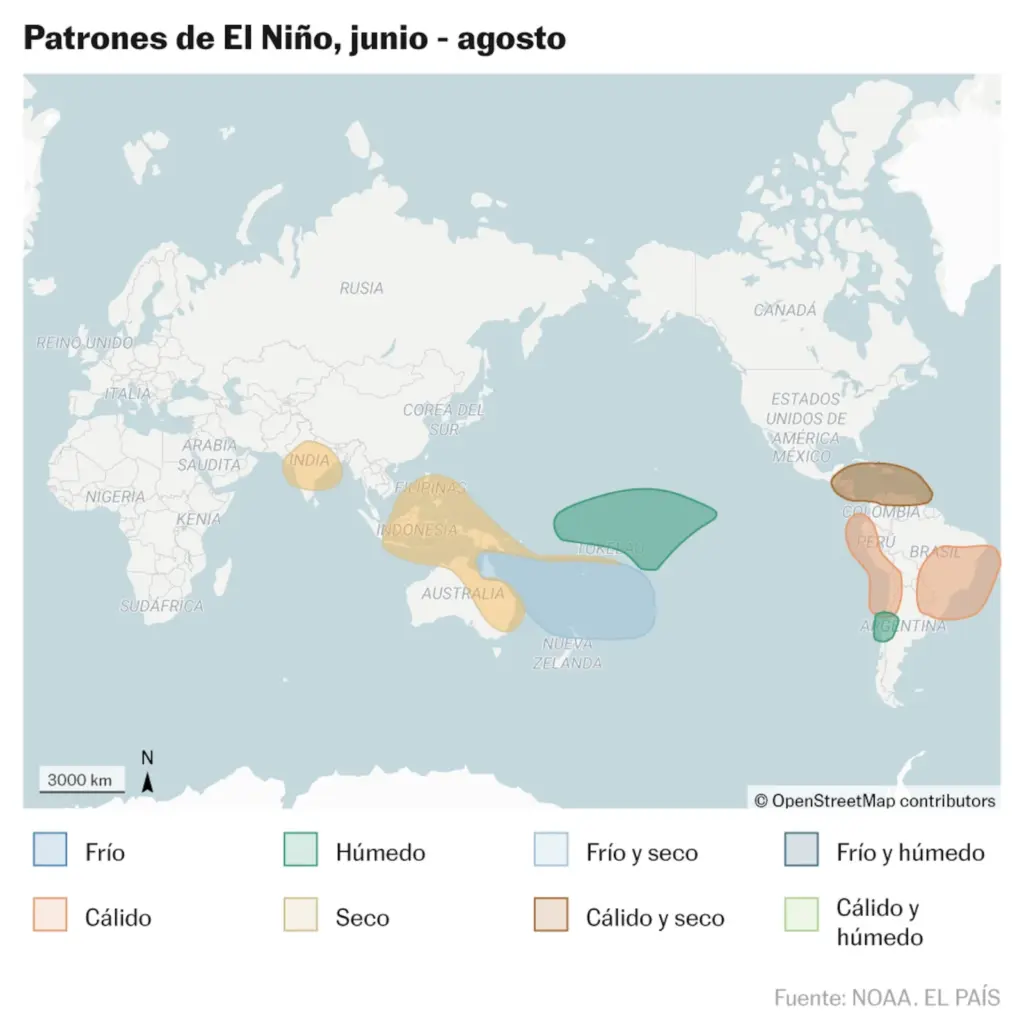
When it occurs at the end of the year, on the other hand, the trend is that it generates warm and humid conditions on some Pacific coasts of Colombia, Peru, and Ecuador; drought in northern Brazil, Guyana, Suriname, and French Guiana; heat in southeastern Brazil, and humidity in the south of the latter country, Uruguay, and northeastern Argentina.
“The recommendation is to closely follow what local authorities say because we are certain that El Niño is coming,” recalls Tapia. And it is these authorities who can ground the phenomenon to the conditions of each place.
‘El Niño’ and hurricanes
The question about how El Niño will impact the hurricane season — in the Pacific Ocean it begins in mid-May and, in the Atlantic, in June — can only be answered based on trends seen with other phenomena. “Each Niño is different,” insists Di Liberto. Generally, El Niño reduces hurricane activity in the Atlantic, while making the season more active in the Pacific. But in a climate change context, which has warmed the ocean surface by about 0.9°C since the late 19th century, according to the WMO, the known logics about El Niño and La Niña could be more extreme or different.
Read more Johan Vásquez, the gladiator of Navojoa and Javier Aguirre