








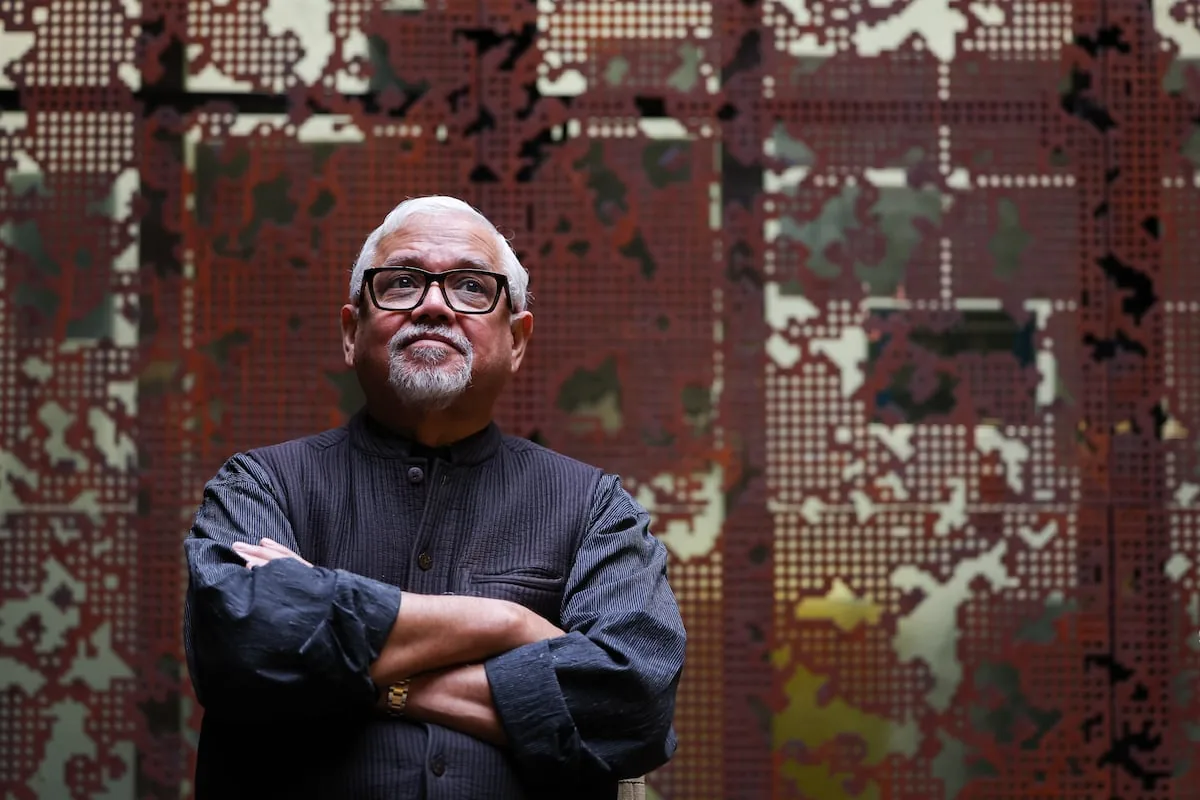
Bengali writer Amitav Ghosh (69 years old, Kolkata, India) says that the lifeboat ethic is a racist theory that states that someone on a lifeboat has the right to prevent others from getting on to avoid sinking. However, the author of The Glass Palace or The Nutmeg’s Curse, who lives in New York and participated on the 24th in an event at CaixaForum in Madrid on the climate emergency, believes that rich countries would make a big mistake if they think they can shelter themselves from global warming and the current polycrisis by leaving the rest aside. In his new essay, The Great Derangement (Capitán Swing), Ghosh reflects on the current lack of reaction to the disaster and offers a different approach to climate change than usual, beyond the Western perspective.
Read more Leyla Kazim spent a year in the office without working and nobody noticed
Q. Will future generations wonder if we were crazy?
A. Yes, absolutely. I’m sure they will. After World War II, children used to ask their parents what they had done during the conflict. In the same way, our children and grandchildren will ask us what we did while the world was collapsing. We have lost a lot and are on our way to losing much more.
Q. Why do you think writers and artists are complicit in what you call the great derangement?
A. We are all complicit in various ways. As artists and writers, one aspect of our complicity is that we have not reflected the grave reality in our work, especially in the last 30 years, when most greenhouse gases have been emitted into the atmosphere.
Q. Are there no good books that deal with climate change?
A. Not all environmental problems are reduced to climate change; there are also species extinction and more. That said, yes, there are. One of the most outstanding books that reflects this multidimensional crisis is Flight Behavior [Migratory Behavior], by Barbara Kingsolver. Another excellent book is The Overstory [The Clamor of the Forests], by Richard Powers. There are more.
Q. Is the increasing individualism of the modern world a barrier to addressing climate change?
A. Climate change is a collective problem; it must be addressed collectively at all levels, but we live in an increasingly individualistic world. If we look at young people today, many can barely relate to each other. They have become so accustomed to being glued to their phones that they find it difficult even to communicate.
Q. Why do you claim that the discourse on climate change is Eurocentric?
A. It is Eurocentric on several levels. Almost all scientific work on climate change comes from the Western world, from the United States and Europe. Because of this, attention tends to focus on Western problems. Much of the data collected on climate change distorts reality in various ways. For example, studies on heat responses are conducted using data from Western people.
Q. However, you state that most potential victims of climate change are in Asia. Is that not so?
A. Yes, because Asia has enormous concentrations of inhabitants. The population of Tuvalu, a small Pacific island that is slowly disappearing, is around 10,000 people. In contrast, the flooding of a single island in Bangladesh, Bhola, affected more than half a million people. Due to the enormous concentrations of population in Asia, there is also an enormous concentration of risk.
Q. What is the lifeboat ethic?
A. That idea was proposed by the theorist Garrett Hardin, a far-right racist thinker with eugenicist tendencies. According to him, if someone is on a lifeboat and others try to get on, they have every right to prevent them. He compared this to what the United States and other rich countries should do with migrants. It is a racist and far-right approach to the crisis we face. Basically, it proposes condemning a large number of people to death.
Q. Isn’t this what some politicians in Western countries are advocating now?
A. This is a very exclusionary, almost genocidal, approach to this polycrisis. And it won’t work because the population of the West will also be severely affected; a higher GDP will not protect it. The best example of this was COVID. Theoretically, the countries best prepared for the pandemic were those with the most resources, but that was not the case. Countries like Italy, the United Kingdom, and the United States were severely affected. In contrast, comparatively, some African countries like Ghana managed the pandemic quite better. I believe it is an illusion to think that the West will be protected from these environmental problems. GDP is a misleading indicator; it says nothing about resilience.
Q. Who are least prepared for a large-scale crisis?
A. It’s somewhat contradictory, because the richest people in the West could preserve their wealth. We already see Mark Zuckerberg, Peter Thiel, and other big tech entrepreneurs building shelters to survive the end of the world. They are designed to be completely self-sufficient for four or five years. So they are already preparing for a disaster. In the United States, the doomsday shelter industry has expanded greatly; you can now buy one for as little as $35,000. But I believe that the most vulnerable people will actually be those in the middle class, both in the West and in the Global South, because they don’t adapt as working-class people do. At least, working-class people usually adapt to difficult circumstances.

Q. What do you mean?
A. I’ll give an example: in recent years, there have been very dangerous storms in the United States. Warnings are issued well in advance, and people leave for other places, but many don’t go. Why? Because they are middle-class people. Their entire lives are invested in real estate, which ties them to the place. If they leave, they risk falling into poverty. The same will happen in India, in places like Mumbai. Those are the most vulnerable people. They might know how to use a computer, but apart from that, they have very few life skills.
Q. Asian countries are potential victims, but also responsible for the crisis. Today, China is the world’s largest emitter of greenhouse gases, and India is the third.
A. Yes, but those are absolute figures. Per capita, both China and India have much lower emissions than the United States and other countries. Saudi Arabia and other oil powers are the countries with the highest carbon footprint per capita. Generally speaking, it is true that Asia, particularly China and India, are large emitters. But when I myself have asked people severely affected by climate change in India, Indonesia, and other places if they don’t think they should try to reduce their carbon footprint, the answer is always: “Why? Others with a much larger footprint got rich when we were weak and poor; now it’s our turn.”
Q. Is it possible for all inhabitants of the planet to live like Americans or Europeans?
A. No. But we cannot forget that, for decades, Americans and Europeans told Asians to live like them. The concept of poverty and wealth at the World Bank is totally linked to fossil fuels and their consumption. The main goal after the dissolution of the Soviet Union, in the early nineties, was for everyone to live like Westerners. The reality is that if every person in India had two cars, the world would burn. Mahatma Gandhi understood this and warned about industrial capitalism. There were also Chinese thinkers who understood it. But it was the West that imposed the criterion of opulence, that ostentatious lifestyle. And now, they tell Asians: “No, you shouldn’t do what we did; you must do it differently.”
Q. What alternative is there?
A. It must be said that China is very different from India, because it has been a pioneer in renewable energies. And now it installs more alternative energy plants than the rest of the world combined. Regarding the imitation effect of Westerners, this opens up hope: if the West changed its way of life, if it adopted alternatives like those advocated by young people like Greta Thunberg, then people from other parts of the world would also want that lifestyle.
Q. Do you have hope then?
A. As Gramsci said, we must have pessimism of the intellect and optimism of the will. I think that’s the only thing we can say right now, because everything is going in the wrong direction. The United States is immersed in an unprecedented crisis; no one has seen polarization like what exists in the country today. I believe that what truly threatens Americans right now are problems related to the standard of living. Today, the average age of first-time homebuyers in cities like New York, Chicago, or San Francisco is around 50. And in Europe, where the climate issue was very important until now, they are now only talking about rearmament.
Read more The tension between the PNV and the socialists explodes over an AI joke about Aitor Esteban