








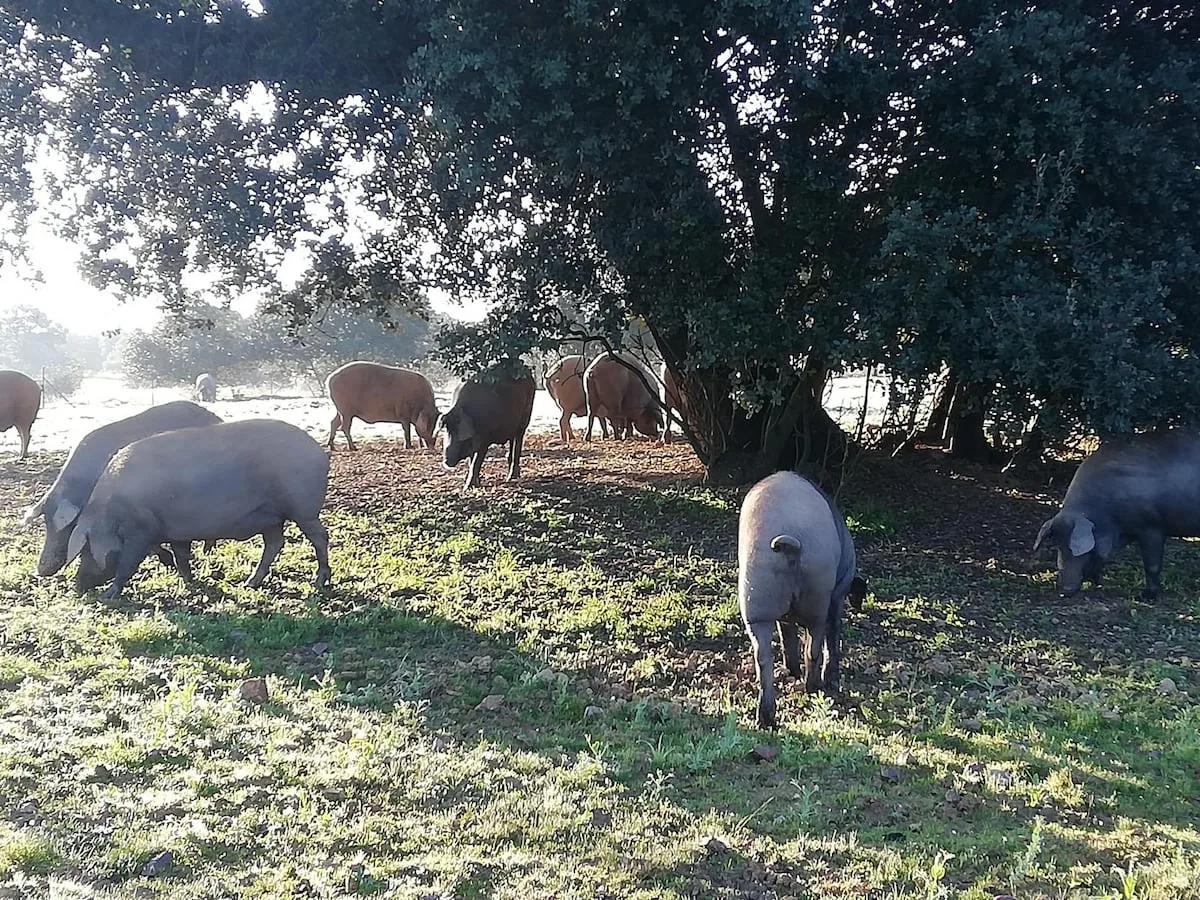
The Ministry of Agriculture, Fisheries and Food has fully entered the war between Iberian ham producers with a serious warning to the Guijuelo Designation of Origin, from Salamanca: they will not be able to use the term Iberian on the labeling if the quality standard is not met. The conflict stems from the new Protected Geographical Indication (PGI) ‘Embutidos Guijuelo’ which is currently in the objection phase by the community of Castilla y León, until May 31, and which contemplates reducing the minimum Iberian breed percentage that products must have to be considered Iberian.
Read more Vox will now exercise control over unaccompanied migrant minors in Extremadura
The Official State Gazette (BOE) of last March 31 published Guijuelo’s registration request for the inscription of this new figure or differentiated quality seal that includes loin, lomito, chorizo, and salchichón, a decision that has reopened the producers’ struggle to certify racial purity or the true acorn-fed ham. The other three ham designations of origin in Spain, the Andalusian ones of Jabugo and Los Pedroches and Dehesa de Extremadura, consider that this measure breaks the sector’s rules of the game by not including the information required by Spanish labeling legislation, and warn of its impact due to the loss of consumers.
The Ministry of Agriculture was aware of the content of the PGI specifications before its publication and provided technical observations. Among them, it was warned that the specifications do not mention compliance with the quality standard, “so if the final product does not comply with this standard, it will not be able to use the term ‘Iberian’ on the labeling,” indicate ministerial sources.
It was also pointed out the convenience of specifying that females must not only be Iberian but also registered in the Genealogical Book, as well as properly specifying the sales denomination of each product on the labeling.
The publication of the registration request for the new PGI was made by resolution of the Agrarian Technological Institute of Castilla y León, which continues the procedure. Since it is a PGI with an autonomous territorial scope, the competent authority at the national phase is the corresponding autonomous community, while the role of the Ministry of Agriculture, Fisheries and Food in this procedure is exclusively to forward the complete file to the European Commission.
“The ministry’s position is one of institutional neutrality within the framework of its competences. In any case, this neutrality is conditioned on not using the term ‘Iberian’ on final products that do not comply with the current quality standard,” assure the consulted sources.
Read more NASA confirms from space the accelerated sinking of Mexico City: more than two centimeters per month
Guijuelo’s decision to register a new PGI comes after last September the modification of the Guijuelo PDO specifications was published, which reduced the minimum Iberian breed from 75% to 50% for its hams. Thus, it will be enough for the animal to be 50% Iberian breed. This is allowed by the standard, but the protected designations of origin had prevented it in their specifications to bet on quality and exclusivity.
On April 13, the Spanish Government contacted the European Commission regarding the modification of the Guijuelo PDO. The communication includes, among other things, a standard amendment that introduces a change in the product specification by establishing the minimum Iberian breed proportion (50%). But Commission sources say that these types of amendments are the competence of Member States and take effect in the country of origin from the moment the corresponding national decision is made public.
In any case, the Iberian war in Spain is also causing concern among community authorities, who have shown their worry about the impact this reduction in product quality marketed may have among consumers, a practice that, according to the consulted sources, is also occurring in other European countries.
In fact, the issue of preserving the integrity of geographical indications has been the subject of recent exchanges between the Commission and all Member States. The debates have focused on the evolution of practices that may affect the link between products and their geographical origin, as well as the need to maintain vigilance over the application of the existing geographical indications framework to maintain its guarantees.