









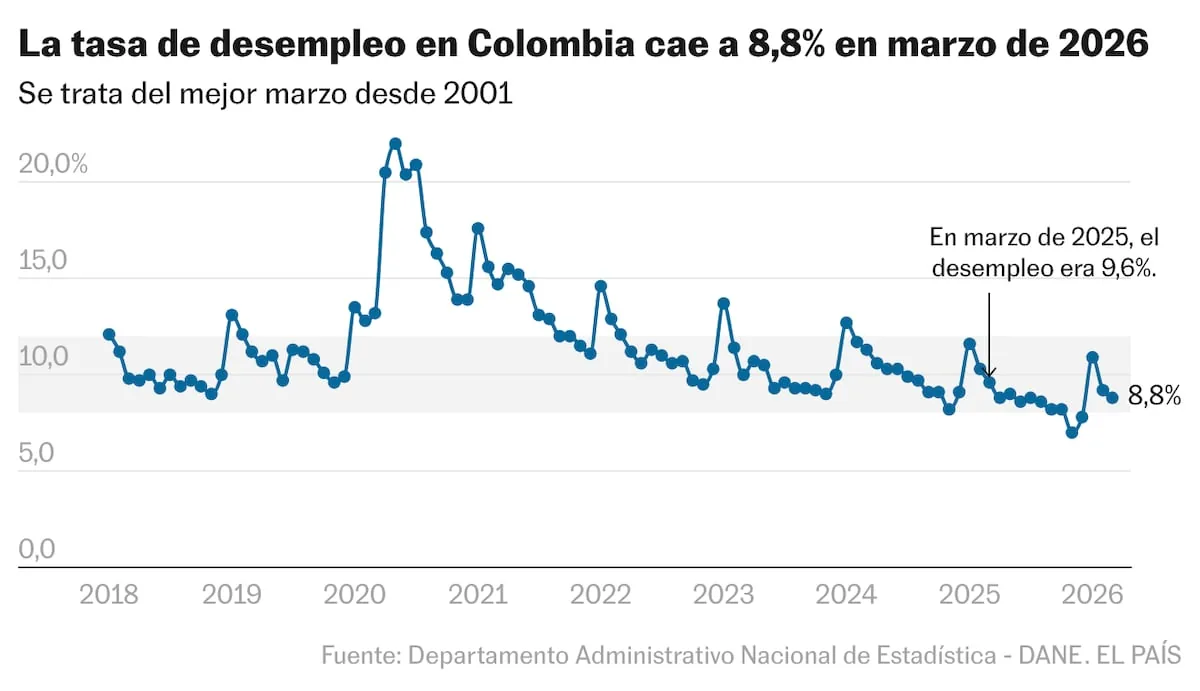
DANE revealed on the morning of this Thursday the unemployment rate for March 2026, completing the picture for the first quarter of the year. The result was a rate of 8.8%, a drop of 0.8 percentage points compared to the same month of the previous year. It is the best figure for a March since 2001 and reinforces the sustained downward trend in unemployment that Colombia has enjoyed since 2024.
The March figure consolidates a positive first quarter. So far in 2026, the national unemployment rate averages 9.6%, almost one point less than the same period a year ago (10.5%). The total employed reached 24.4 million in March, 650,000 more than in the same month of 2025. However, the composition of the new employment raises questions: the sector that drove the most was public administration, education, and health, with 369,000 new jobs, while manufacturing lost 166,000 and agriculture also had 242,000 fewer jobs compared to a year ago.
Self-employment also grew again, adding 457,000 additional workers compared to March last year, which keeps informality as the pending challenge of the Colombian labor market. On the other hand, the geography of unemployment remains deeply unequal. In the first quarter of 2026, Quibdó recorded the highest rate in the country: 26%, more than triple the national average. It was followed by Riohacha (14.7%) and Cartagena (13.8%). At the opposite end, Villavicencio (8.0%), Bucaramanga (8.4%), and Manizales (8.5%) had the lowest figures. Bogotá closed at 8.8%, below the national average.
Read more Vox will now exercise control over unaccompanied minor migrants in Extremadura
This Thursday’s figure comes at a time of macroeconomic pressure. Mauricio López, director of the Economic Research Center at the University of Antioquia, points out that the growth of the Colombian economy is not consistent with the unemployment rates reported by DANE. “The economy has been growing very little and that does not correspond with the very low unemployment rates we are seeing,” he tells EL PAÍS.
A recent analysis by Corficolombiana finds that the sectors that created seven out of ten new jobs in 2025 — entertainment, commerce, public administration — barely contributed a fifth of the economic growth that year. Employment grows where the economy produces little, and that has a cost: productivity per worker fell 0.8% in 2025, when the historical average is an increase of 1.6% per year. In practice, this means that more people are working but generating less value, which puts downward pressure on real wages and reduces companies’ margin to create formal and stable employment.
Read more NASA confirms from space the accelerated sinking of Mexico City: more than two centimeters per month