


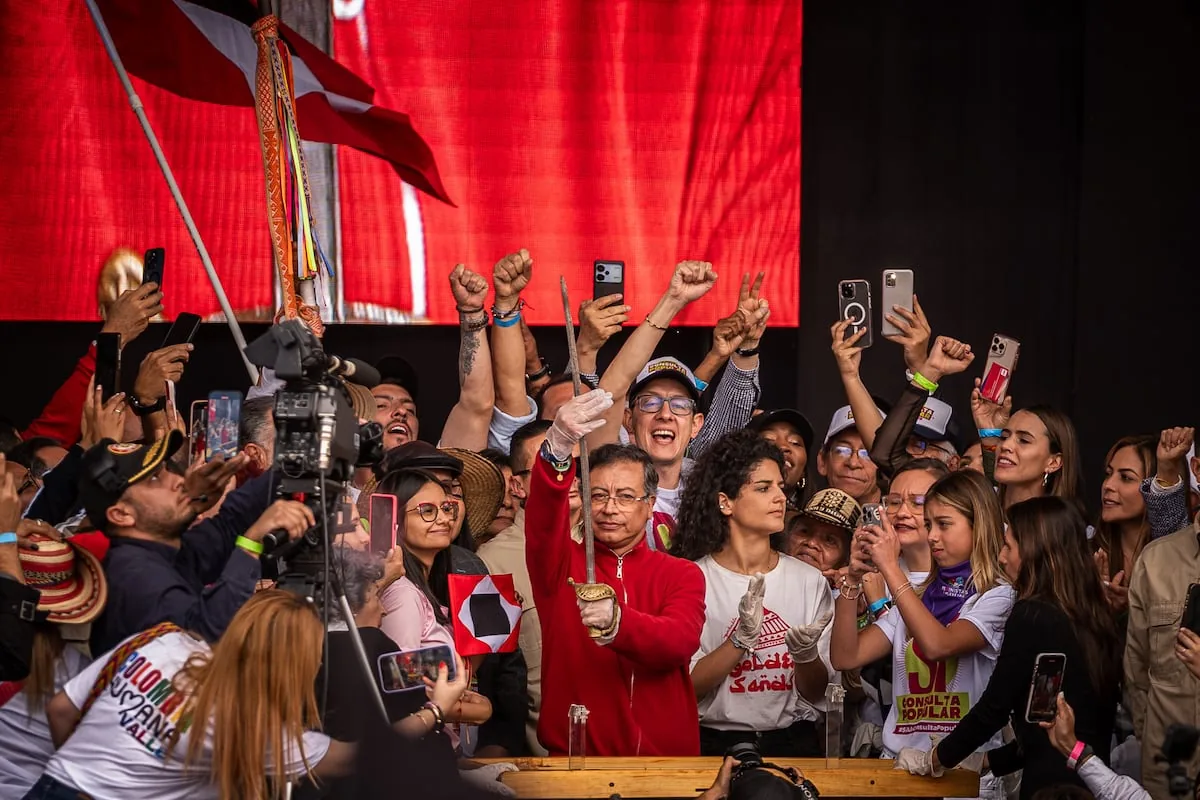
President Gustavo Petro is preparing to give his last May Day speech as head of state this Friday. This is a special date for the leftist, who over the past three years has used it as a platform to defend his ideas and counterattack his rivals. On this occasion, he will be in Medellín, where he has already announced that he will convene the National Constituent Assembly, the preliminary step to reform the 1991 Constitution. The idea, which has been widely criticized, seeks to modify, in his words, the Colombian “political system” and approve the social reforms “that were not allowed in Congress.” On the other hand, the officialist presidential candidate, Iván Cepeda, will win the first round of the elections on May 31, according to the latest poll published this Thursday by the firm Guarumo. However, unlike what polls have calculated for several months, he would lose in a possible second round against the Uribist candidate, Paloma Valencia. In a scenario where he faced the far-right lawyer Abelardo de la Espriella, Cepeda would have a minimal advantage of 0.2% in the votes. On Wednesday, another poll, AtlasIntel for the magazine Semana, indicated that the leftist presidential candidate has 37.4% voting intention. He is followed by the far-right candidate Abelardo de la Espriella with 29.4% and in third place the also senator Paloma Valencia with 20.9%.

Petro prepares to give his last May Day speech
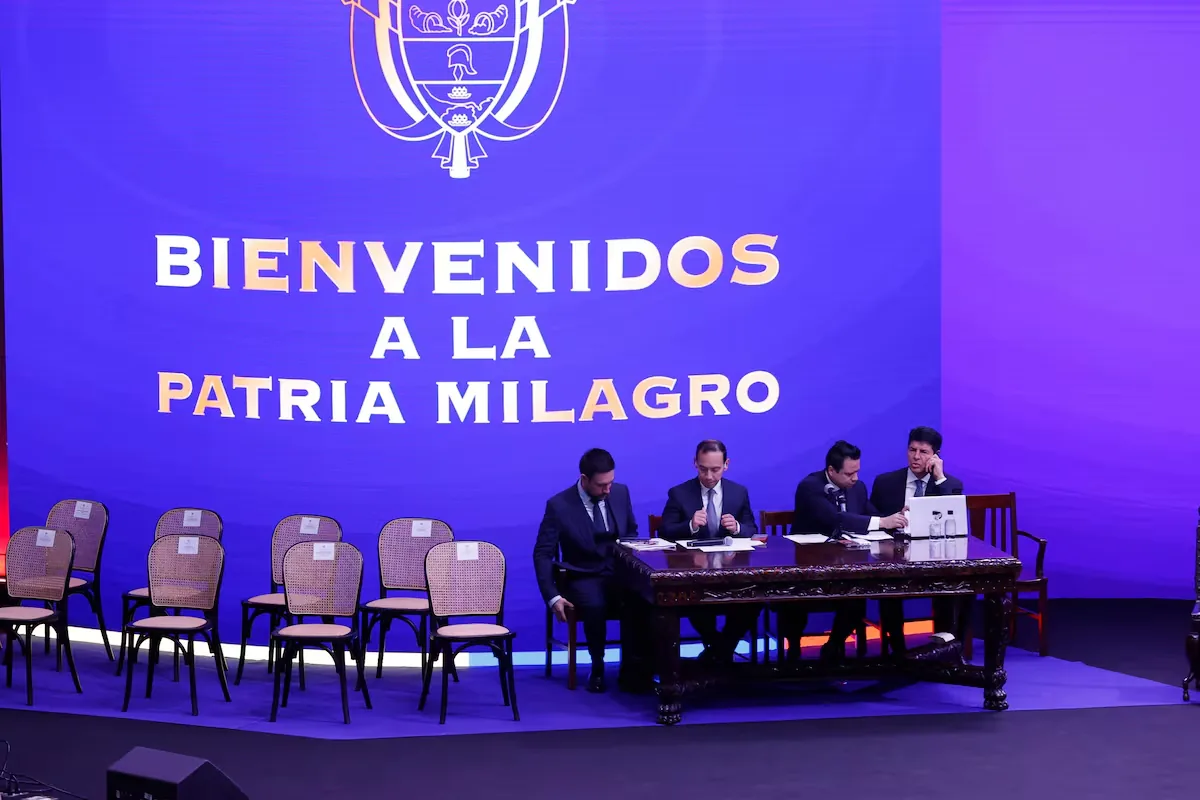
President Gustavo Petro is preparing to give his last May Day speech as head of state this Friday. This is a special date for the leftist, who over the past three years has used it as a platform to defend his ideas and counterattack his rivals. On this occasion, he will be in Medellín, where he has already announced that he will convene the National Constituent Assembly, the preliminary step to reform the 1991 Constitution. The idea, which has been widely criticized, seeks to modify, in his words, the Colombian “political system” and approve the social reforms “that were not allowed in Congress.”
Abelardo de la Espriella’s campaign distances itself from former commander Eduardo Zapateiro, accused of sexual harassment
Former commander Eduardo Zapateiro will stop advising Abelardo de la Espriella’s presidential campaign, in which he participated as coordinator of the Army reserve. Through a statement, Defenders for the Homeland, as De la Espriella’s movement is called, assured that the decision was made by mutual agreement: “We consider that the right thing is for General Zapateiro to fully concentrate his efforts on his defense and to prove his innocence before the Colombian justice system.”
The candidate distances himself from Zapateiro after the Prosecutor’s Office filed a request for an indictment hearing against him for the alleged crime of sexual harassment, for events that allegedly occurred when he was commander of the National Army. Although the movement recognizes the trajectory and contributions he made to the campaign, it was emphatic in reiterating that it defends women: “Women who serve the homeland, especially those who are part of the Military Forces, deserve safe environments, free from any form of harassment or intimidation. This principle admits no exceptions or nuances.”
The public media system agrees to hold three debates with presidential candidates before the first round
Colombia’s public media system agreed this Thursday to hold a series of three presidential debates with candidates before the first round. The announcement, signed by the manager of RTVC, came after Claudia López, Sergio Fajardo, Luis Guilberto Murillo, and other presidential hopefuls requested televised meetings. Moderators and methodology are yet to be defined.

Father of murdered Miguel Uribe Turbay criticizes Uribism for pointing to the Governor of Nariño in the judicial case
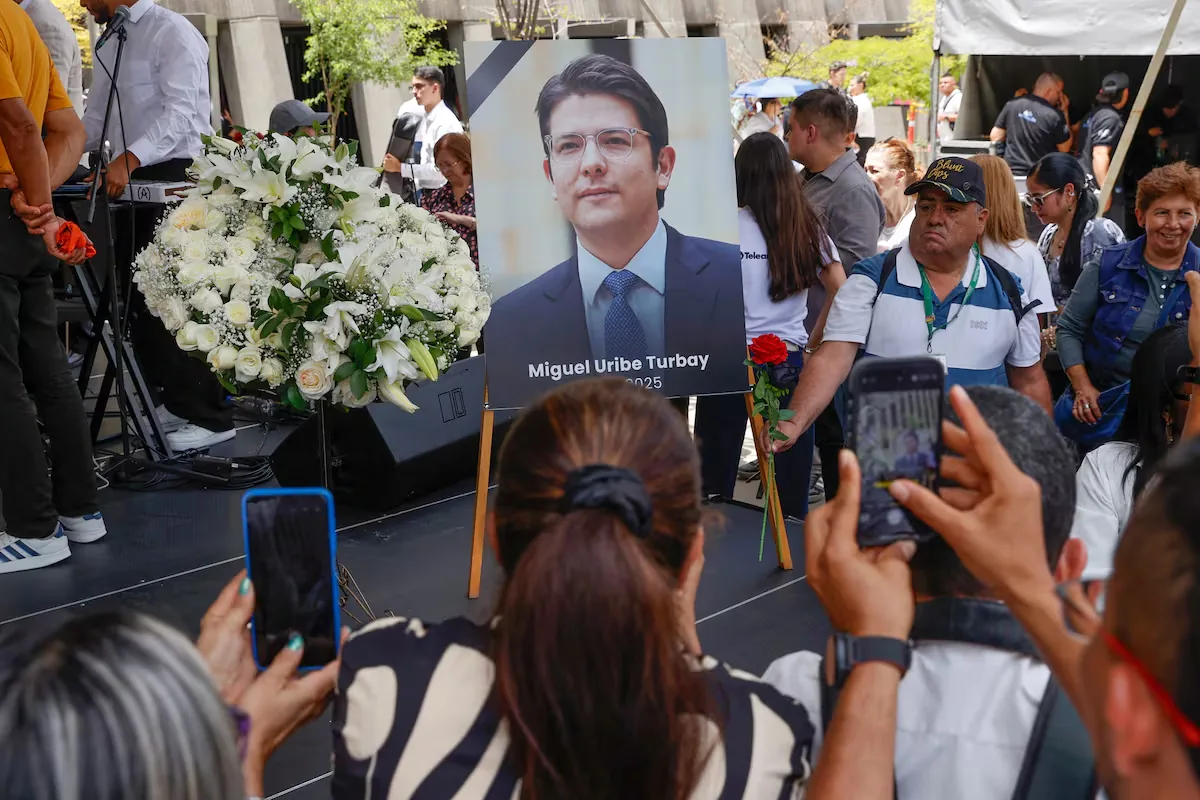
Miguel Uribe Londoño, father of Senator Miguel Uribe Turbay, murdered last year, criticized someone who was an ally of his son for years: former president Álvaro Uribe. He criticizes him because Uribism has suggested since yesterday, by publishing an anonymous letter on social media, that the Governor of Nariño, Luis Escobar, is behind the crime. This is an accusation that the Prosecutor’s Office has not made, which has pointed to the Second Marquetalia as the perpetrators of the crime. “What has circulated from Álvaro Uribe Vélez’s circle is irresponsible and deeply disrespectful,” says the former senator’s father. “You cannot play with anyone’s reputation and good name, as was done with mine. The accusations against Governor @LuisAlfonsoEsc based on an anonymous source are unfounded.” Uribe Londoño also criticized that the founder of the Uribist party and its presidential candidate, Álvaro Uribe and Paloma Valencia, claim to represent the flags of the murdered senator. “And one more thing, it is an abuse by the Democratic Center, its leader, and its candidate to use my son Miguel’s name in their campaign. I carry the flags,” he added.
Miguel Uribe Londoño, who is a presidential candidate, divorced from the Democratic Center in December. Álvaro Uribe expelled him from the party considering that the father of his star senator wanted to support the far-right candidate, Abelardo de La Espriella. He decided to run alone for the presidency, but for now, he does not reach 1% in voting intention.

Álvaro Uribe: “The constituent assembly withers the private sector”
Former president Álvaro Uribe referred this Thursday to Petro’s plan to convene a Constituent Assembly to reform the 1991 charter. “The constituent assembly promoted by Petro and Cepeda withers the private sector, as seen in Cepeda’s government program,” he said in a tweet.
The leader of the Democratic Center has considered that Petro’s proposal demands pure state monopolies, such as health: “They annul the private sector, use public hospitals for corruption and to finance campaigns, bankrupt the Cancer Institute, and intend for all citizens to become slaves to exclusive, inefficient, and thieving government health care.”
On the other hand, Uribe distanced himself from his candidate Paloma Valencia’s idea of becoming Minister of Defense if she wins the Presidency. “I am already very old. Paloma is such a capable woman that she can take the Ministry of Defense to the Presidency and exercise it herself.”
Cepeda wins first round but loses second to Valencia, according to new Guarumo poll
Historical Pact presidential candidate Iván Cepeda has the highest voting intention for the first round of the elections on May 31, according to the latest Guarumo poll published this Thursday. However, contrary to the trend in several polls, he would be defeated in the second round by the Uribist candidate, Paloma Valencia, and would be in a technical tie with far-right lawyer Abelardo de la Espriella.
According to the firm’s figures, in the first round Cepeda would obtain 38% of the votes. He is followed by De la Espriella with 23%, and further behind, Valencia, very close, with 22.8%. Sergio Fajardo (2.5%) and Claudia López (2.4%) appear far behind. All other candidates have less than 2%. Blank votes would reach 7.2%. For the second round, Guarumo indicates that Valencia would obtain 44.6% of the votes, above Cepeda’s 40.1%. In a possible scenario facing Cepeda against De la Espriella, the senator would get 40.6%, while the lawyer would achieve a very close 40.4%.
The Guarumo poll coincides with all others in recent months, which give Cepeda as leader and winner in the first round. However, it differs from most of them in the second-round scenarios, where they also grant victory to the officialist senator. The most recent were published by Invamer and GAD3 last Sunday and Monday.
The Guarumo poll is based on interviews with 4,680 adults intending to participate in the elections, in 74 cities and municipalities across the country, in rural and urban settings. The regional distribution of the surveys was as follows: Bogotá, 17.7%; Caribbean, 18.6%; Coffee Axis, 17.9%; Pacific, 16.2%; and Southeast, 29.6%.
Hollman Morris invites candidates to specify details for a possible RTVC-moderated debate
The manager of Colombia’s public media system Radio Televisión Nacional de Colombia (RTVC), Hollman Morris, has made public a letter inviting presidential candidates to attend a meeting this Thursday to define the details of a possible debate. The call comes after seven candidates officially requested the media system to organize the debates contemplated in the Electoral Guarantees Law. Sergio Fajardo, Claudia López, Carlos Caicedo, Luis Gilberto Murillo, Mauricio Lizcano, Roy Barreras, and Sondra Macollins requested that the three televised spaces, up to sixty minutes each, required by law be guaranteed.
Among the applicants are none of the poll leaders. Senator Iván Cepeda has avoided debates and replaced them with public squares, arguing distrust of traditional media, which he has labeled as part of the establishment. Meanwhile, Abelardo de la Espriella and Paloma Valencia have shown willingness to discuss but have not attended these spaces, citing Cepeda’s absence. For now, this remains a campaign without debates. RTVC’s proposal opens a door for the main candidates to debate among themselves in front of cameras and present their proposals to the public.

Iván Cepeda leads AtlasIntel poll with 37.4%; Abelardo de la Espriella follows with 29.4%
Senator Iván Cepeda, the leftist presidential candidate, leads with 37.4% voting intention in the AtlasIntel poll for Semana magazine, released this Wednesday. He is followed by far-right candidate Abelardo de la Espriella with 29.4% and in third place the also senator Paloma Valencia with 20.9%. Former mayors Sergio Fajardo (4.1%) and Claudia López (1.9%) appear next. This is a somewhat different picture compared to two other recent polls, although all agree on the top three. In the Invamer poll, published Sunday, Cepeda appears with 44.3%, closer to the possibility of a first-round victory, followed by De la Espriella (21.5%) and Valencia (19.8%) in a technical tie. In another poll, GAD3 released Monday, Cepeda has 36%, De la Espriella 21%, and Valencia 13%.
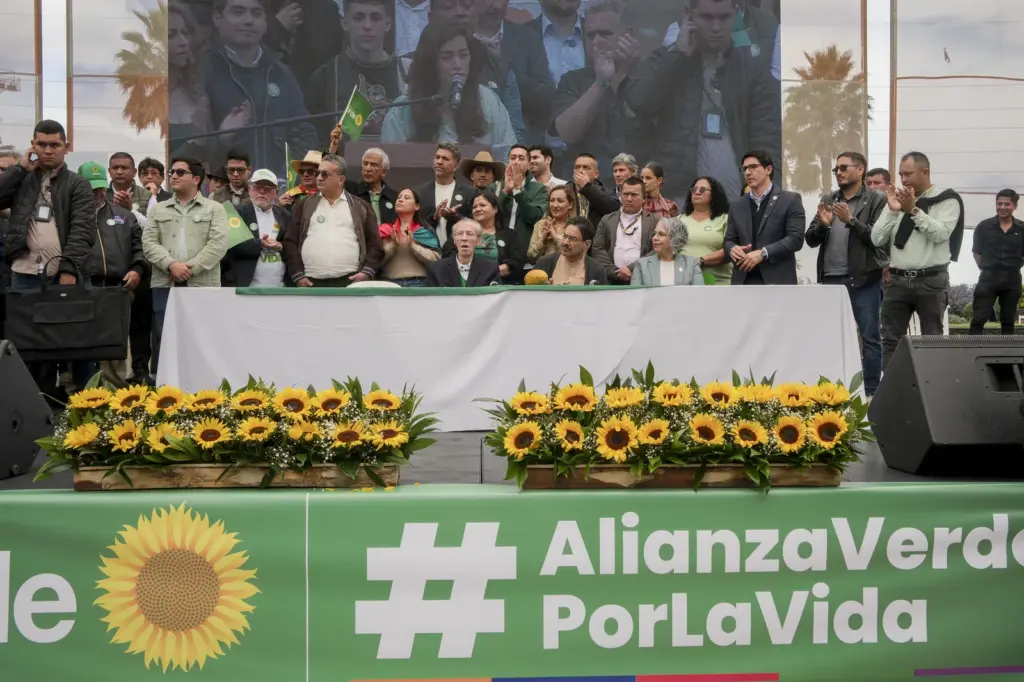
Green Party adhesion event to Iván Cepeda and Aída Quilcué’s campaign, in Bogotá, this Wednesday. / MARIANO VIMOS
The Green Party joins Iván Cepeda’s campaign, with the Constituent Assembly as a point of friction
The Green Alliance, the fragmented party that was once the main reference of the political center, has formalized this Wednesday its arrival to Senator Iván Cepeda’s campaign, the leftist presidential candidate leading all polls to succeed Gustavo Petro. It did so alongside hundreds of militants at an event in Bogotá, with the presence of Cepeda and his vice-presidential running mate, indigenous senator Aida Quilcué. On stage, they were also accompanied by Antonio Navarro and Carolina Espitia, co-presidents of the Green Party, and also senator María José Pizarro, Cepeda’s debate leader. The long-awaited adhesion of the Greens comes after the promised programmatic agreement announced two weeks ago was finalized.
The idea of convening a Constituent Assembly, which President Petro has insisted on, emerged as a last hurdle to seal the agreement, but in the end, it was just a mention, without Cepeda explicitly renouncing to promote that initiative. The Greens intend to push for a national agreement that allows social reforms to be processed through Congress, as Cepeda also proposes, and have reiterated that they consider a Constituent Assembly “inconvenient” at this time. Despite that statement, there were people collecting signatures for the Constituent Assembly promoted by the Government at the event.
It is a path similar to the agreement Cepeda sealed last month with former Interior Minister Juan Fernando Cristo, of liberal origin, and his party En Marcha. That was the first gesture of openness from the officialist Historical Pact with the purpose of building a broader electoral coalition for the first round on May 31, which they have named Alliance for Life. Both Cristo and representatives of the Greens distanced themselves from the unusual signature collection.
After Cepeda, two right-wing candidates appear in the polls: the ultra Abelardo de la Espriella and also senator Paloma Valencia, from the Democratic Center, the party founded by former president Álvaro Uribe. The day before, the Liberal Party formalized its support for Valencia’s candidacy.
Paloma Valencia and Juan Daniel Oviedo clash over the option of Álvaro Uribe being Minister of Defense
The differences between Paloma Valencia and her vice-presidential candidate, Juan Daniel Oviedo, are increasingly palpable. The Uribist and the centrist have clashed publicly after the presidential hopeful proposed opening the possibility of former president Álvaro Uribe being her Minister of Defense.
At an event in Antioquia over the weekend, Valencia proposed her political godfather as leader of this portfolio with the idea that the former president repeats his “democratic security” policy, widely criticized for human rights violations and cases known as false positives.
In response to the suggestion, Oviedo said he does not believe “that is the message.” “I told her last night, but she must be respected,” he said in a radio interview.
The tension escalated on Tuesday night. In a conversation with journalists, Valencia asserted: “I am the president, I am the one who will appoint the ministers, and the country must get used to it: we will have Uribist ministers and centrist ministers.”
The Uribist candidate makes a difficult balance since winning the right-wing primary and choosing Oviedo, a more moderate figure, as her vice. From the hard right, she is criticized for appealing to centrist voters, while from the center, her approach is seen as a facade to attract undecided voters. The clash shows that the candidates still have issues to resolve.
The Liberal Party officially supports Paloma Valencia’s candidacy
Candidate Paloma Valencia has gained the support of the Liberal Party. This Tuesday, several local media outlets reported that the party decided to officially back her candidacy, as agreed in a meeting of the party’s congressional members with their leader, former president César Gaviria. The support is announced after Valencia met last Tuesday with several Liberal politicians, and after María Paz Gaviria, daughter of the former president, also joined her political project. Some Liberals, however, have expressed affinity with officialist Iván Cepeda and have requested independence to support the proposal of their choice.
With Liberal support, Valencia practically secures backing from all traditional parties: the Party of the U, the Conservative Party, and a bloc of the Radical Change membership.
Paloma Valencia announces she will sue Aida Quilcué “for blaming the opposition for terrorism”
Uribist candidate Paloma Valencia, from the Cauca department, went against the other Caucan in the electoral contest today: Aida Quilcué, leftist vice-presidential candidate. The two represent opposite poles of the department: the first comes from the economic and political elite, the second from the indigenous movement. However, both have expressed solidarity with the victims of the attack on a main road in the department, which claimed at least 20 lives and left 36 injured. But Valencia criticized the way Quilcué associated her presidential campaign with the attacks. Quilcué’s words, in a video on her social media, say that first “the AUC banners appear saying people can no longer support this government of change; then the attack happens, in Cali, Popayán, and Jamundí; and then presidential candidate Paloma Valencia announces that President Uribe will be Minister of Defense.”
“Now it turns out that the guerrillas have become Uribists,” Valencia wrote on her social media, since guerrilla dissidents are blamed for the attack. “I will sue Aida Quilcué for blaming the opposition for the terrorism shaking the Southwest. It is they, Cepeda and this government, who have to face the disaster of their total peace.”
Paloma Valencia travels to Popayán to show solidarity with victims of terrorist attack
Uribist candidate Paloma Valencia changed her schedule and traveled this Tuesday to Popayán, the capital of Cauca department, where one of the worst terrorist attacks against civilians in the country occurred over the weekend. At least 20 people died and many more were injured.
Valencia, born in Popayán, sent a message to the Caucan people: “You are not alone. Here you have a woman ready to work together and recover security.” The candidate has also questioned the government’s figures on violence reduction.
“In Colombia, we have a 102% increase in kidnappings and 14,000 additional homicides in 2025. Petro is lying to this country,” she denounced before journalists.
Read more In debt to the Early Childhood Education cycle 0-3
Regarding the attack, Valencia said its author, alias Marlon, was appointed by the government as a peace manager. “Cepeda and Aida Quilcué cannot now blame the right and suggest that the guerrilla became Uribist,” she added.
Colombia Elections
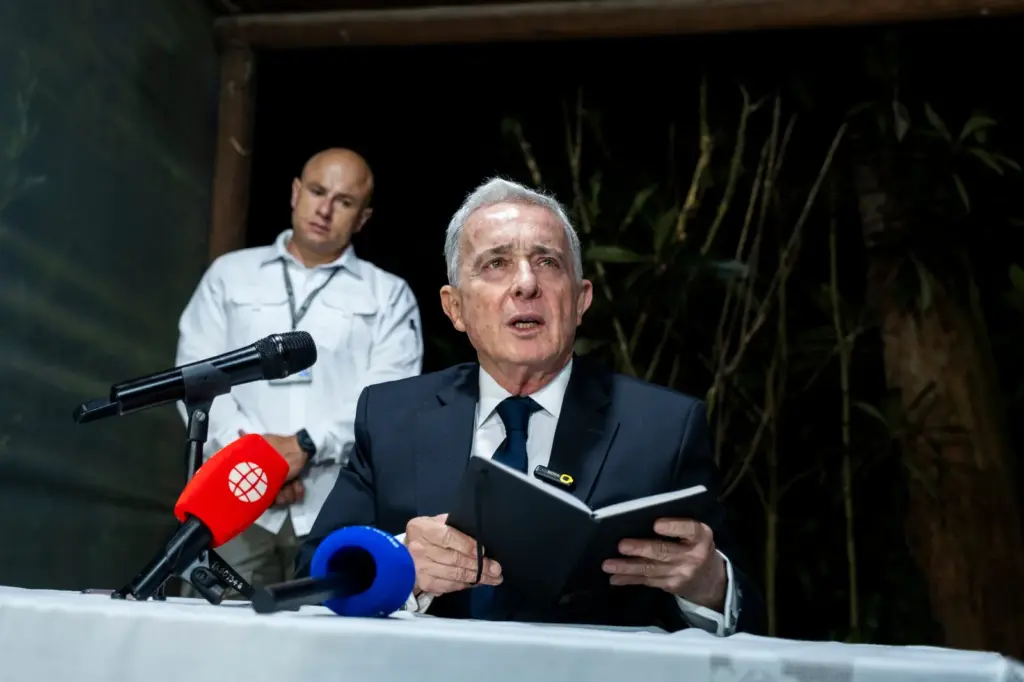
Uribism raises its tone against De la Espriella in a fight for right-wing voters
Polls released this Sunday and Monday show that the tightest race in the first round of the presidential election on May 31 is between two right-wing candidates. While the left goes unified and comfortably, as it seems to have a secured place in the second round with Senator Iván Cepeda, Uribist Paloma Valencia and ultra candidate Abelardo de La Espriella have a technical tie, both around 20% voting intention. This context explains why the campaigns are dedicating part of their time and energy to clashing with each other. These are not programmatic or friendly fights; the tone resembles a criminal complaint. Valencia’s main advisor and political godfather, former president Álvaro Uribe, has accused two advisors in De La Espriella’s campaign of conspiracy and threats. His sons, Tomás and Jerónimo, have joined in, accusing the ultras of running a smear campaign on social media. While the far-right candidate calls for calm — “I hold no grudges nor have complaints,” he writes on X — his advisors prepare a counteroffensive.
Read the full story at this link.
Paloma Valencia denounces that the Government informed her of a “terrorist plan” to assassinate her
Candidate Paloma Valencia announced this Monday to the media that she was informed by the Ministry of Defense, Interior, and National Police of a “terrorist plan” to assassinate her. “A terrorist group has put a price on my head again,” she said at a press conference.
The Uribist candidate said she is not giving this information to ask for more guarantees but to reaffirm that she is a “brave woman” and that if she wins, she will “conquer security.” “We will not bow to the violent. This country must know that those who should be scared are them. Colombia cannot continue with a government that has become an accomplice to narco-terrorism.”
Valencia highlighted that she had the government’s approval to make this complaint public. The threats have been made by FARC’s Front 42, dissidents led by alias Buchetula. The candidate said that 2 billion pesos have already been paid for the action.
Seven presidential candidates demand RTVC organize the debates indicated by the electoral guarantees law
Presidential candidates Sergio Fajardo, Claudia López, Carlos Caicedo, Luis Gilberto Murillo, Mauricio Lizcano, Roy Barreras, and Sondra Macollins have signed and published a letter this Monday demanding RTVC, the public media network, organize the debates indicated by the electoral guarantees law. The candidates argue that this law gives them the right to participate in three televised debates of up to 60 minutes during the electoral contest. “Not holding the debates implies for the citizen the cost of voting blindly, without having been able to contrast proposals, answer impartial questions,” the letter says in one of its paragraphs.
The request is made amid a campaign in which, unprecedentedly, there have been very few relevant face-to-face debates between candidates. In fact, the leader in all polls, officialist Iván Cepeda, had openly shown reluctance to participate in such meetings, at least until last week, when he proposed a debate with the two candidates following him in the polls, far-right Abelardo de la Espriella and Uribist Paloma Valencia. According to the candidates who signed the letter this Monday, when candidates evade debates, the citizens are the most harmed.
The proposal of the seven candidates is that, since there are 13 candidates competing for the Presidency, the group be divided into two for two debates. The rules and topics to be discussed will be jointly agreed upon by the campaign teams. “What is at stake is whether Colombians go to the polls with enough information to decide freely,” the letter says.
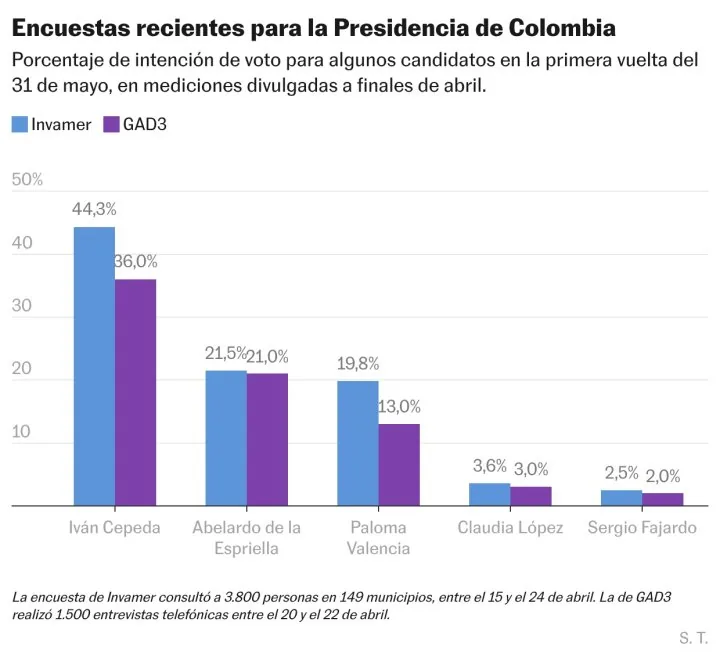
Invamer and GAD3 confirm Iván Cepeda’s first place but differ on the gap between Abelardo de la Espriella and Paloma Valencia
Iván Cepeda, the candidate of the officialist Historical Pact, remains the clear leader in polls for the May 31 presidential first round, but the distances between the top three differ in the two most recent surveys. In the Invamer study, published Sunday, the leftist candidate has 44.3%, less than six points from the possibility of a first-round victory, as he proposes in his speeches, while his pursuers appear in a technical tie. Far-right Abelardo De la Espriella has 21.5% and Senator Paloma Valencia 19.8%, in a very close fight for second place that can give a spot in the second round.
In another poll, GAD3 released this Monday, Cepeda has 36% voting intention, further from the desired 50%. De la Espriella, with 21%, maintains a wider lead in that survey over Valencia, who remains at 13%. While Invamer conducted 3,800 surveys in 149 municipalities, with a margin of error of 1.89%, GAD3 conducted 1,500 telephone interviews with a margin of error of 2.61%.
Iván Cepeda leads with 36% in GAD3 poll, Abelardo de la Espriella holds second place with 21%
Leftist Senator Iván Cepeda leads with 36% voting intention in the GAD3 poll released this Monday. He is followed by far-right candidate Abelardo de la Espriella with 21%, a wide lead over third place held by Senator Paloma Valencia with 13%. Claudia López (3%) and Sergio Fajardo (2%) appear next. This is a somewhat different picture from the day before in the Invamer poll, where Cepeda appears with 44.3%, closer to the possibility of a first-round victory, followed by De la Espriella with 21.5% and Valencia with 19.8%, representing a technical tie for second place.
Francia Márquez: “It seems the State’s capacity to guarantee security has disappeared”
Vice President Francia Márquez, of Cauca origin, expressed her condolences to the victims of the attack on the Pan-American Highway, which occurred Saturday afternoon, through a tweet on X. In it, she directly addressed “the violent”: “Enough of taking the people’s lives,” she said. The official explained in a harsh statement that “it is not possible that criminal groups are winning against the State” and demanded that Defense Minister Pedro Sánchez take the necessary actions to stop this wave of terrorism. “It seems the State’s capacity to guarantee public order and security has disappeared,” she lamented.
In the document, she warned that since she took office in August 2022, she has requested in person and through statements the strengthening of security in the southwest of the country. “The actions of illegal groups seem uncontrollable, reflecting that the response has not been effective enough.”
De la Espriella and Valencia blame Petro for the escalation of violence in Cauca
A series of terrorist attacks in Cauca department keep the country on edge. The most recent occurred this Saturday early afternoon on the Pan-American Highway, leaving at least 14 dead and nearly 40 injured. Just 24 hours earlier, the southwest of the country was terrified by a failed attack on military facilities in Cali and another attack without victims on a battalion in Palmira.
As images of Saturday’s brutal attack circulated on social media, right-wing presidential candidates took the opportunity to push their main electoral promise: a hard hand. On one side, right-wing Paloma Valencia, from the Democratic Center, directly pointed to Gustavo Petro’s government as responsible for the violence escalation in the region. “This is a government complicit with the violent; it frees them, like Calarcá, to put them on stages, to hold parties in prisons, and to go out to plant bombs and kill us,” she said at a public event, referring to Petro’s negotiation policy called total peace. Valencia also proposed former president Álvaro Uribe as her Minister of Defense in a possible government and assured that with her, “this vagabondage of total peace ends, where criminals are indulged. Total peace ends and total security arrives.” Uribe has not responded so far.
Abelardo de la Espriella, the far-right candidate, raised the tone. “I hereby declare all those bandits military targets. When I arrive, I will hunt them like the vermin they are and will bring down the full weight of the State on you,” he said on his social media. Regarding previous Cauca attacks, the criminal lawyer directly challenged the president: “Petro, what are you playing at? Terrorizing the people of Valle del Cauca? Declaring internal commotion? This is all your fault: you handed the country and the southwest to the bandits.”
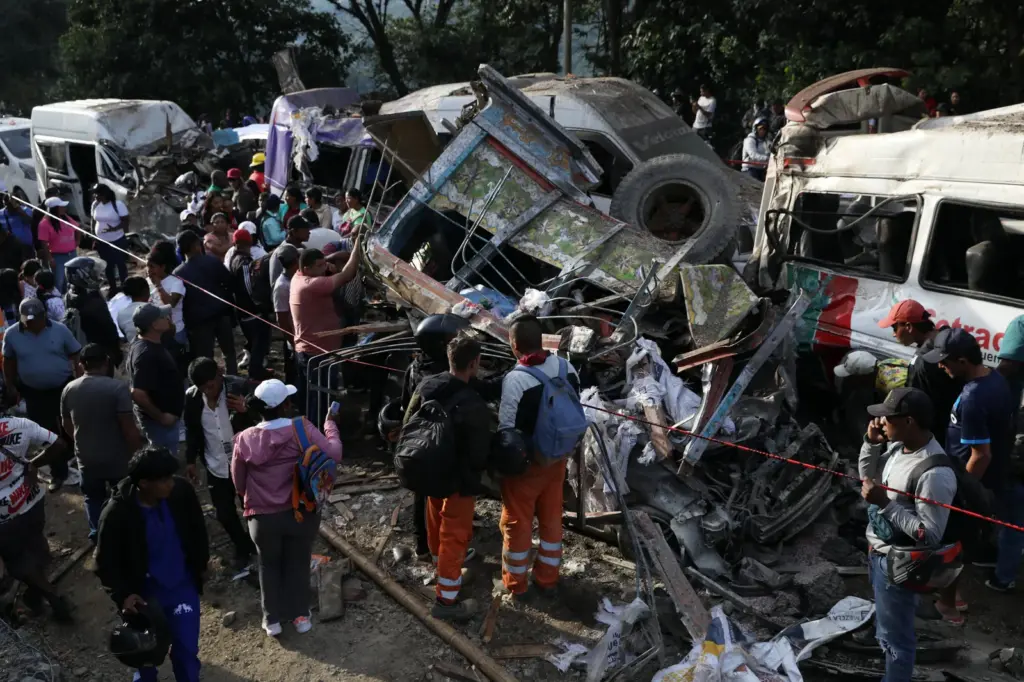
Attacks
A terrorist attack on the Pan-American Highway causes at least 14 dead and nearly 40 injured
Early Saturday afternoon, a bomb exploded on Colombia’s main southwest highway, the Pan-American Highway, in the Cauca department. Several vehicles were affected by the explosive device, which killed at least 14 people and injured 38, according to the governor of Cauca, Octavio Guzmán, on social media. The attack occurred in an area called El Túnel in the municipality of Cajibío. The Army has announced it is verifying the possibility of other bombs on the road, which connects Colombia and Venezuela with the rest of South America. President Gustavo Petro has pointed to alias Marlon, one of the leaders of the FARC dissidence commanded by Iván Mordisco, as responsible. The group has become the president’s main military target.
Read more about this news here.
Colombia Elections
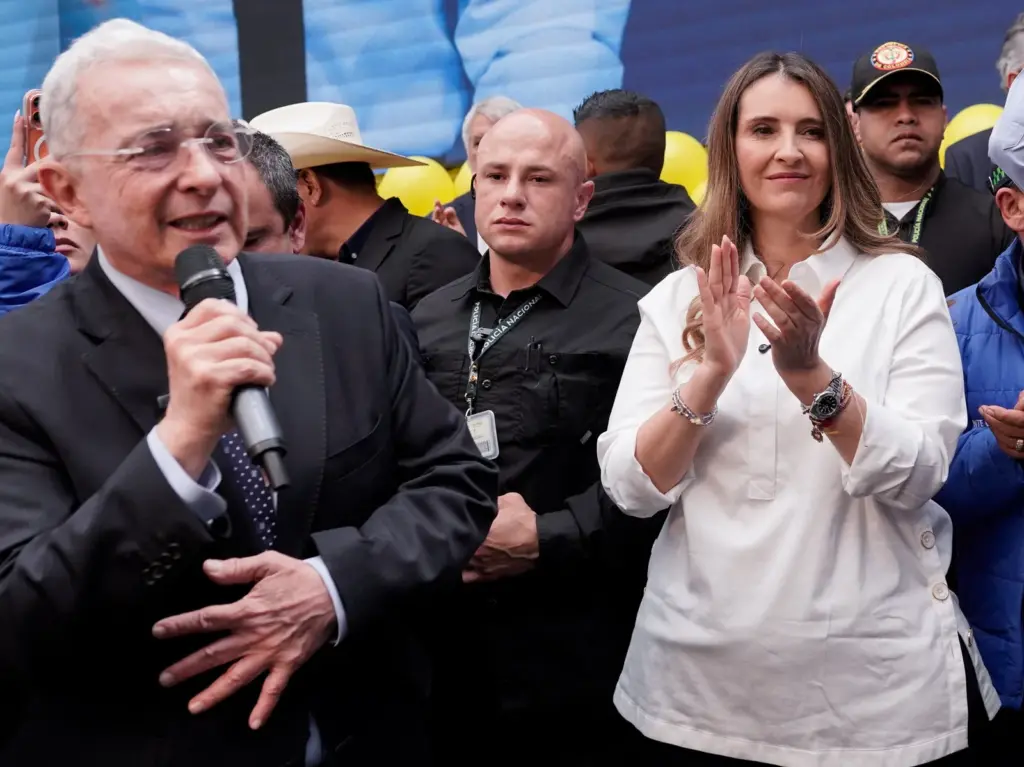
Paloma Valencia proposes former president Álvaro Uribe as her Minister of Defense
Presidential candidate Paloma Valencia wants former president Álvaro Uribe, her political godfather and head of the Colombian right, as her Minister of Defense. At a campaign event in Antioquia, a right-wing stronghold and Uribe’s home region, Valencia warned that with her, “this vagabondage of total peace ends, where criminals are indulged. Total peace ends and total security arrives.” On a Saturday marked by an attack by FARC dissidents against civilian travelers on a road in the southwest, Valencia posted a video on her social media with part of that speech: “I have a minister in mind and I need Antioquians to convince me. I want President Uribe defending democratic security.” Uribe has not responded so far.
Read more about this news here.
The Green Alliance joins Iván Cepeda’s campaign: “Not one step back”
The Green Alliance will support Iván Cepeda’s presidential candidacy. The national leadership approved a programmatic agreement with 34 votes in favor, three against, and one abstention. “With this decision, plus seven programmatic axes with ideas and proposals that have been part of the Green Party’s DNA, we join this presidential campaign. For love of Colombia, for life, not one step back,” announced Boyacá congressman Jaime Raúl Salamanca on X. The agreement includes “defending the 1991 Constitution and its implementation,” as well as “not supporting any attempt at presidential reelection.” These are two red lines the party set 10 days ago when it approved starting negotiations to join Cepeda’s campaign.
“We celebrate this decision of the Green Party, welcome to the Alliance for Life and the winning team with #IvanyAidaEnPrimera,” wrote María José Pizarro, senator and debate leader for the leftist candidate, on her social media. Meanwhile, the centrist sector of a strongly divided party lamented the national leadership’s decision. “My Green Party has just mostly approved joining Iván Cepeda and the Pact’s campaign, making it clear that we cannot campaign for anyone else. Terrible and painful mistake. Absolute disappointment. Claudia and De La Espriella are the same to them,” commented Bogotá councilor Julián Sastoque, referring to the impossibility of the party’s elected parliamentarians supporting centrist Claudia López’s presidential candidacy.
De la Espriella denounces that posts where his campaign asks for money are false
Far-right candidate Abelardo de la Espriella has assured this Tuesday that several posts where his campaign asks for financial support are false. “The Defenders of the Homeland movement calls on citizens not to attend to these types of requests and to verify information only through official channels,” he said in a statement.
The posts De la Espriella refers to, made by a group known as the municipal committee of Defenders of the Homeland in Carmen de Bolívar, directly contradicted one of his campaign’s banners: economic independence. The candidate denies support from traditional parties and also, according to him, from large economic groups. “Campaign financing comes exclusively from own resources and loans obtained from the financial system,” he emphasized.
Abelardo de la Espriella will sue the decree by which Petro’s government orders transferring 7 billion dollars from private funds to Colpensiones
Far-right candidate Abelardo de la Espriella has requested the provisional suspension of Decree 0415, by which the Ministry of Labor has ordered transferring 25 trillion pesos (about 7 billion dollars) to Colpensiones, the state company in charge of managing pensions for millions of Colombians. De la Espriella considers that there has been an overreach and that the norm has legal defects that put citizens’ savings at risk.
With this forced transfer, Petro’s government materializes its pension reform without legal certainty about its constitutionality. The measure establishes that private administrators must move 50% of the resources within a maximum of 20 business days from its entry into force, and the remaining 50% in the following 10 days. That is, the resources must be transferred before the May 31 presidential first round.
De la Espriella considers that this provision contradicts a previous law that establishes that these resources must remain in individual accounts managed by pension funds until the affiliate consolidates their pension right. “We will not allow them to use workers’ money for their corruption and political fest,” the candidate said in a statement.
Two Colombian right-wing congressmen announce Bernie Moreno will be an observer in the elections
Democratic Center congressmen Marelen Castillo and José Jaime Uscátegui have assured through a video shared on social media that Republican Senator Bernie Moreno will be an observer in the May 31 presidential first round. The announcement was made after Colombians met with Moreno, a U.S. citizen born in Colombia.
During his visit to Washington, the right-wing party congressmen also presented a report to the Inter-American Commission on Human Rights about the lack of electoral guarantees in Colombia, due to increased political violence and the expansion of armed groups in the country. Security risks and possible fraud have also been raised by the left. President Petro himself has spoken about the possibility of fraud.
Uscátegui says in the video that Moreno’s visit “is a guarantee because it has to be an open and transparent process before the eyes of the world. It is a reason for peace of mind for Colombia and the United States.”
De la Espriella’s movement leads the nomination of jurors for the first round
Defenders of the Homeland, the movement founded by far-right Abelardo de la Espriella, leads the nomination of jurors for the first electoral round, with 17,961 citizens registered. The candidate announced this Thursday in a statement highlighting his supporters’ commitment to “monitoring the electoral process” and reflecting “a high level of mobilization and citizen participation.”
According to De la Espriella’s revealed count, the other parties with the highest number of jurors registered are the leftist Historical Pact, with 16,460 nominees, and the Uribist Democratic Center, with 3,394. The small Colombian Democratic Party has 32.
The ultra campaign has emphasized that its process “has been driven by citizens seeking to guarantee respect for the popular will at the polls.”
Read more This is how the transition from mutual insurance to Social Security will be