









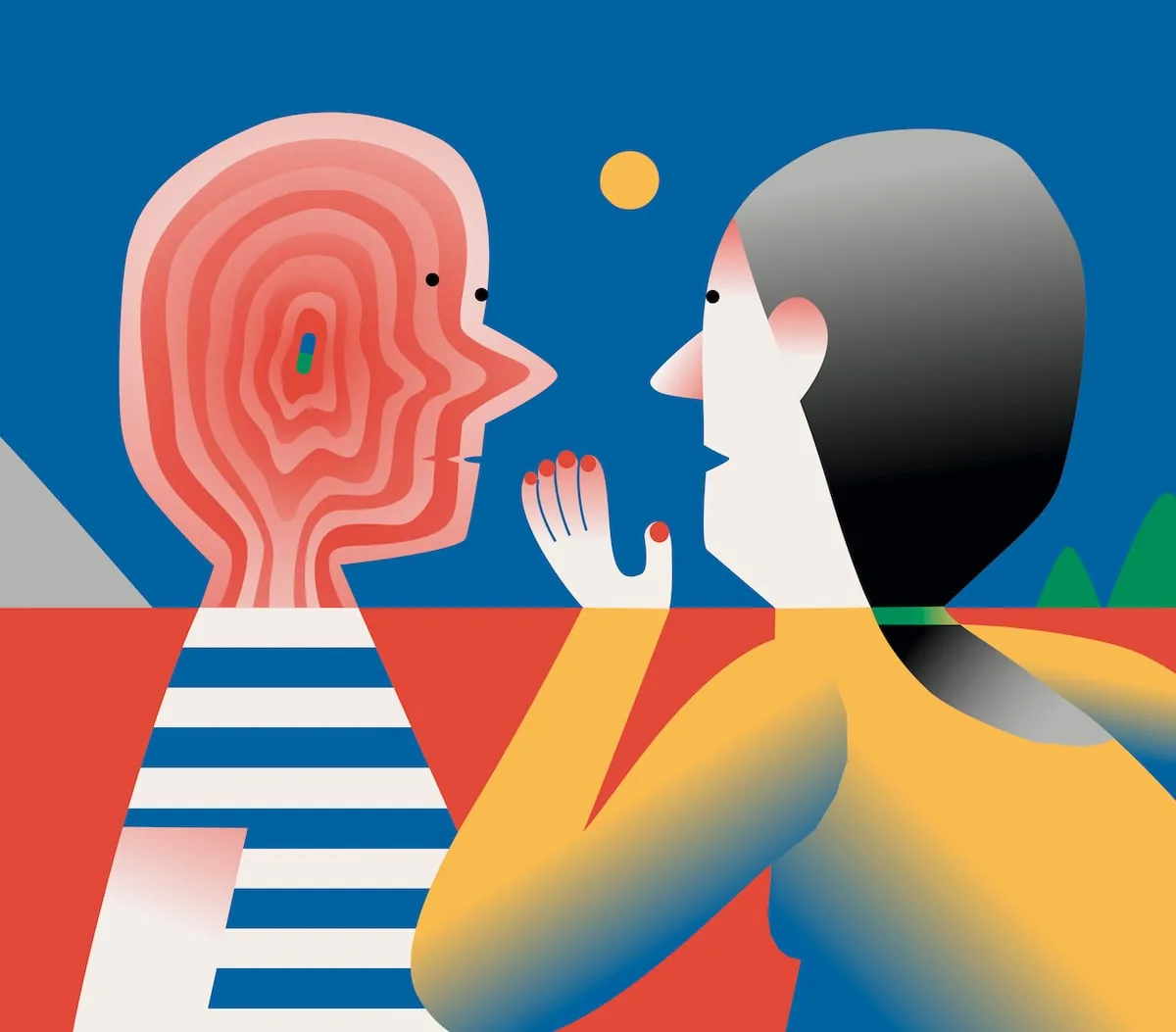
A visual artist came to the office with a mix of urgency and mistrust. Her doctor had recommended medication, but she wanted a second opinion. She wanted to relieve insomnia, anxiety, and intrusive thoughts, but feared that the drug would extinguish the spark that fueled her work. “I’m afraid of losing my creative edge,” she said. In another consultation, a patient confessed to me: “I don’t want to take antidepressants because I feel they will change me, that I will stop recognizing myself.” He was not afraid of side effects, but something deeper: the suspicion that the medication also acts on identity. Ultimately, every treatment is an intervention where body, mind, and personal history converge. It requires listening, respect, and time. What heals is not just the drug, but the possibility of saying: “This helps me, but I am still me.”
From the Austen Riggs Center in Massachusetts, psychiatrist David Mintz proposes a broader approach he calls “psychodynamic psychopharmacology,” according to which drugs do not act in a biological vacuum, but within a psychological, relational, and symbolic framework. The patient’s interpretation can enhance or interfere with the effect. It is not just a chemical matter, but also a message. For some, it is a capitulation, an admission of fragility, or a transgression of self-sufficiency; for others, a symbol of external control or an echo of childhood, when they felt unable to express resistance.
Mintz recalls the enthusiasm of the 1990s, when U.S. President George H. W. Bush announced the “decade of the brain” and predicted that mental illnesses would be eradicated in 10 years. That simplistic optimism, based on biomedicine, ended up stripping many psychiatric patients of their agency and relegated them to a passive position, waiting for a “cure me.” For Mintz, this is the greatest disadvantage when trying to improve. Just as children stop clinging to their teddy bear — to which they attributed calming powers — when they internalize the qualities they had conferred on it, the power that has been channeled to the drug must be returned to the person. If medication is expected to solve everything, there is a risk of transferring all responsibility for change to it and condemning the person to chronicity.
Evidence supports this integrative view: between 50% and 80% of the response to medication is due to psychological factors. Expectations, previous experiences, unexpressed ambivalences, and above all, the quality of the doctor-patient relationship are influencing factors. A Swiss study with more than 130 people revealed that mental representations condition adherence: fear of harm, loss of control, or feeling alienated were the most frequent themes, while the idea of benefit appeared fifth. For many, the medication is not just a therapeutic tool, but an object loaded with symbolic ambivalence. The metaphors they use to describe it — crutches, poisons, emotional patches — reveal a tension between the desire for relief and the fear of transformation. This ambivalence is even present in its etymology: pharmakon means both remedy and poison, and pharmakos was the scapegoat sacrificed in a ritual to purify the community.
Read more Feijóo will campaign in Andalusia with his own agenda parallel to that of Juan Manuel Moreno
In patients with a good relationship with their doctor, the placebo can be more effective than the antidepressant in patients who do not trust him
The most surprising finding of a recent meta-analysis on the effects of placebo in patients with depression was that up to 80% of the benefits associated with antidepressants can be explained by the placebo effect — they are not sugar, they activate real physiological processes —. Another disturbing fact is that they can also generate adverse effects or “nocebo effect,” such as anxiety, insomnia, or somatic symptoms, when the person receiving the treatment anticipates harm or distrusts it. This supports Mintz’s idea that the patient’s expectations can have more influence than the active ingredient of the drug. In patients with a good relationship with their doctor, the placebo can be more effective than the antidepressant in patients who do not trust their doctor. And, by the way, studies have shown that when the doctor explains it from the beginning, the placebo effect is not nullified.
“When the relationship between doctor and patient is affected by cuts in national health systems, the most powerful part of the treatment is lost,” Mintz reiterates, adding that, under pressure, doctors also tend to simplify and prescribe medications to cope with their own sense of helplessness, although they might have preferred a more comprehensive approach. Ultimately, it is not only important what is prescribed, but also how it is prescribed: what seems like a detail concentrates the conflicts that cross the person’s life. Perhaps that is why Kipling warned in 1923: “Words are, of course, the most powerful drug that mankind possesses.”
Read more “Sentencias: no constan”: behind the most sought-after paper at the Moroccan consulate