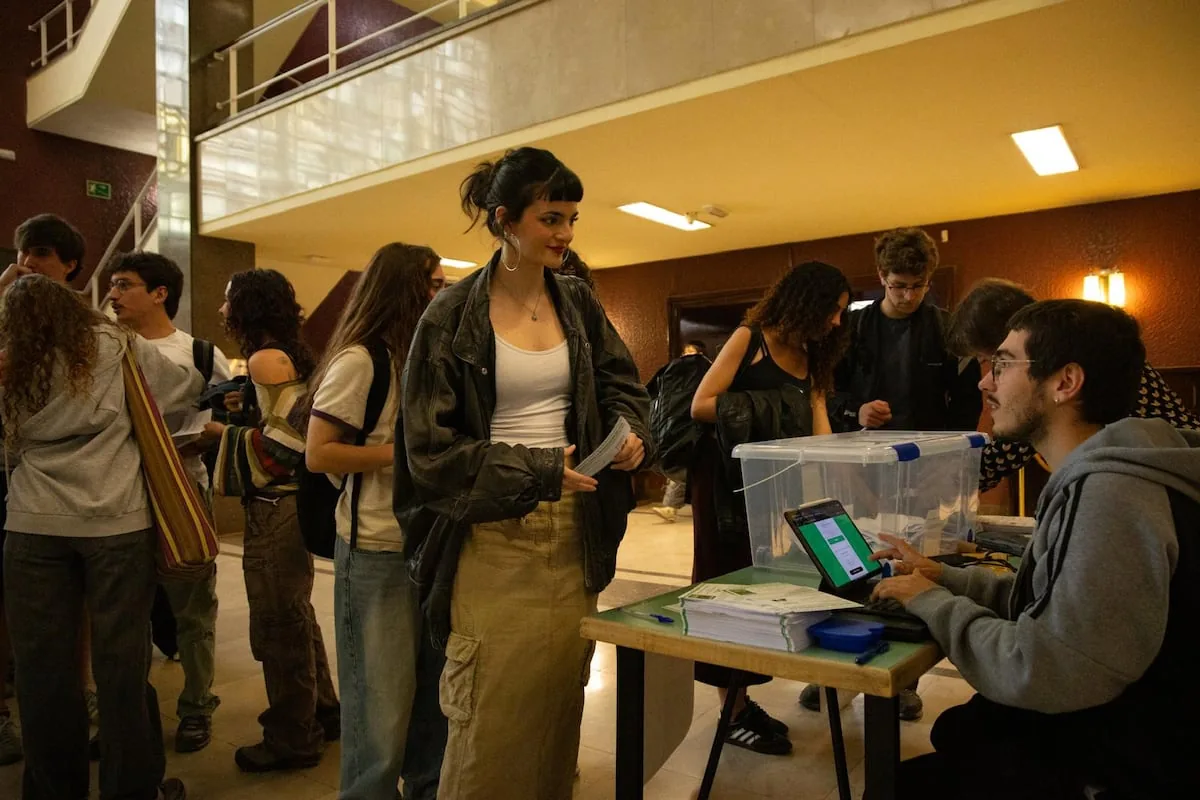






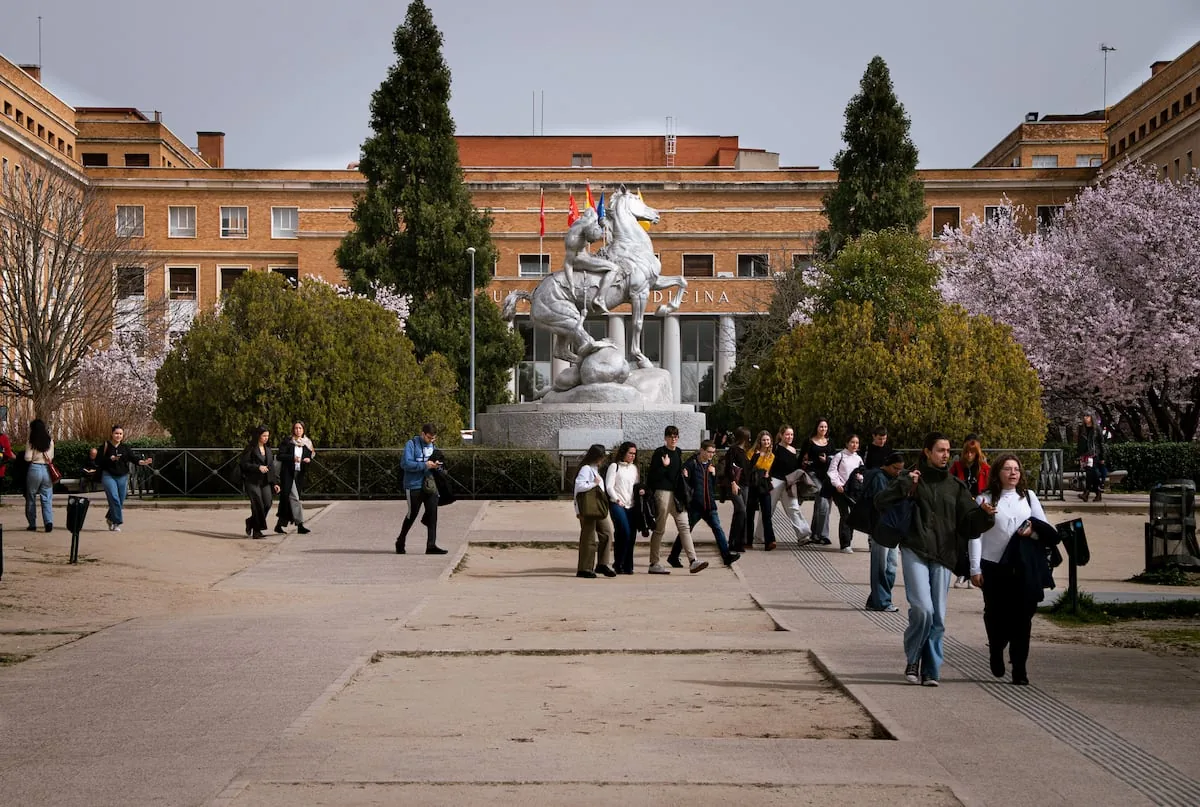
Today, April 16, at the Complutense University of Madrid (UCM), a public consultation organized by the UCM Platform for the Public is taking place. The university community is asked if they are willing to immediately suspend the so-called Economic and Financial Plan (PEF). This is the euphemism used to refer to the adjustment plan to which the Rectorate has submitted in the face of the Government of the Community of Madrid’s (CM) chainsaw. A savage cut that directs its bites against public universities amid the region’s economic boom.
The Rectorate, in a plot twist that makes the nature of the past agreement of the Conference of Rectors of the Public Universities of Madrid (CRUMA) with Isabel Díaz Ayuso even clearer, has tried to obstruct the consultation by sending directives to the centers not to authorize the use of the institution’s facilities, furniture, or ballot boxes. They argue that the referendum ignores institutional hierarchy and attempts to subvert the executive decisions of the UCM.
However, the consultation proposes a collective deliberation about a possible future action, the suspension of the PEF. On the other hand, it is evident that it does not seek to obtain a legally valid result, and it has never been announced as such, but rather it is a symbolic consultation within the framework of actions against the cuts. It aims to highlight both the lack of listening to the university community and the broad opposition to the plan. It is part of a series of actions that will culminate on April 19 in the demonstration called from all educational levels in the region.
The position of the rectorates is now clearly aligned on the other side, with those who attack the public university
It is surprising that not long ago CRUMA was reproaching the Ayuso Government for several aspects of the failed Madrid law on Higher Education, Universities, and Science (LESUC). Considered unconstitutional by the university community, among other sanctions, its first drafts contemplated fines of up to one million euros for organizing an “illegal referendum,” a figure that was reduced to 300,000 euros in the latest texts. “The law does not satisfy us,” declared Joaquín Goyache, the rector, in December, including among the aspects he did not agree with precisely the “sanctions.”
One of the issues that most worries the Platform is that, after the agreement signed in March with Ayuso, the position of the rectorates is now clearly aligned on the other side, with those who attack the public university.
The good news is that not all deanships have yielded to the pressures against the consultation. And above all, there is a broad and diverse grassroots organization mobilized that, through admirable teamwork and participation, has been preparing it for weeks. From creating original posters or scripts for videos and texts, to IT solutions that guarantee online that no one votes twice, to collecting ballot boxes and ballots, the legal defense of the right to peaceful free expression, or the communication of the consultation, various knowledges emanating from our own centers have been put at the service of a democratic response appropriate to the challenge posed.
Because the PEF was approved in a Governing Council that carries an authoritarian legacy so typical of universities. It has up to 15 members chosen by the rector. There are two representatives from the colonized Social Council, a former president of El Corte Inglés, and a former general director of Repsol. Among the representatives chosen by the Faculty Assembly, there are 11 permanent faculty members, two temporary, five students, and two members of the technical management and services staff (PTGAS). Added to this are 10 deans, two department heads, and one from a university institute. It is, therefore, a body only partly the result of representation. And this arises from a class weighting that in any university classroom we could hardly call democratic.
Read more Orbán’s fall exposes Vox
While this Council approved the PEF in its meeting on February 17, various workshops were organized at the Faculty of Political Science and Sociology to debate the plan. About 300 students and 30 speakers came to talk about the University we dream of in light of 40 years of neoliberalism. Among the proposals was the drafting of an open letter to the rector to legally denounce the CM for underfunding, signed by more than 1,000 people, four unions, and nearly 30 research groups. This referendum was also proposed there, a proposal developed by the university movement until building today’s consultation.
The agreement that the rectors and Ayuso sold as historic was actually more of the same. It was worrying from the start to see that the post-truth typical of ayusismo had accomplices in our own rectorates. The plan they sold as a milestone actually meant going from 0.4% of GDP in public funding to 0.45%, knowing that the LOSU demands reaching a minimum of 1% by 2030. Besides not solving the serious problems of our infrastructures and continuing cuts in research and scholarships, at UCM it was soon announced that new faculty positions would be frozen, which would force centers to eliminate dozens of groups in several degrees for the following academic year, threatening the closure of several master’s programs.
The consultation is thus also framed as a concrete response to this latest attack. And it has really been surprising that there is an attempt to censor it. It seems they do not want to know what is thought of the PEF on campus, or that they are bothered by the example of community, university, and democratic self-organization in defense of the public. The contrast with the process carried out to approve the cuts surely grates too much.
We know well that cuts always ride by cutting down democracy in their path
Perhaps the most worrying thing has been the spread of fear across campuses. In such a precarious academic career, with students having a whole life ahead, reading the rectorate’s communications in the terms we have seen these days is unacceptable. What is intended with the consultation is a civic and democratically impeccable action, I would even say formative. Since its beginnings, science and democracy have been based on honest and sincere criticism, without any fear. And so we must protect them from institutions, always respecting fundamental rights.
We know well that cuts always ride by cutting down democracy in their path. They do not want to listen to those who suffer their blows. Sadly fleeting in most cases, democracy in any case has both an unexpected potential and resilience. This consultation will therefore go ahead.
Let us hope that the process and the results themselves make the various UCM authorities reflect on the need to realign again with their university community in defense of the public and the values that underpin us. If they continue applying cuts functional to Ayuso’s oligarchic, class, and reactionary project, without posing the slightest political or judicial battle, they will be demonstrating that they do not represent us in any sense. And it is better then that they return to their classes.