




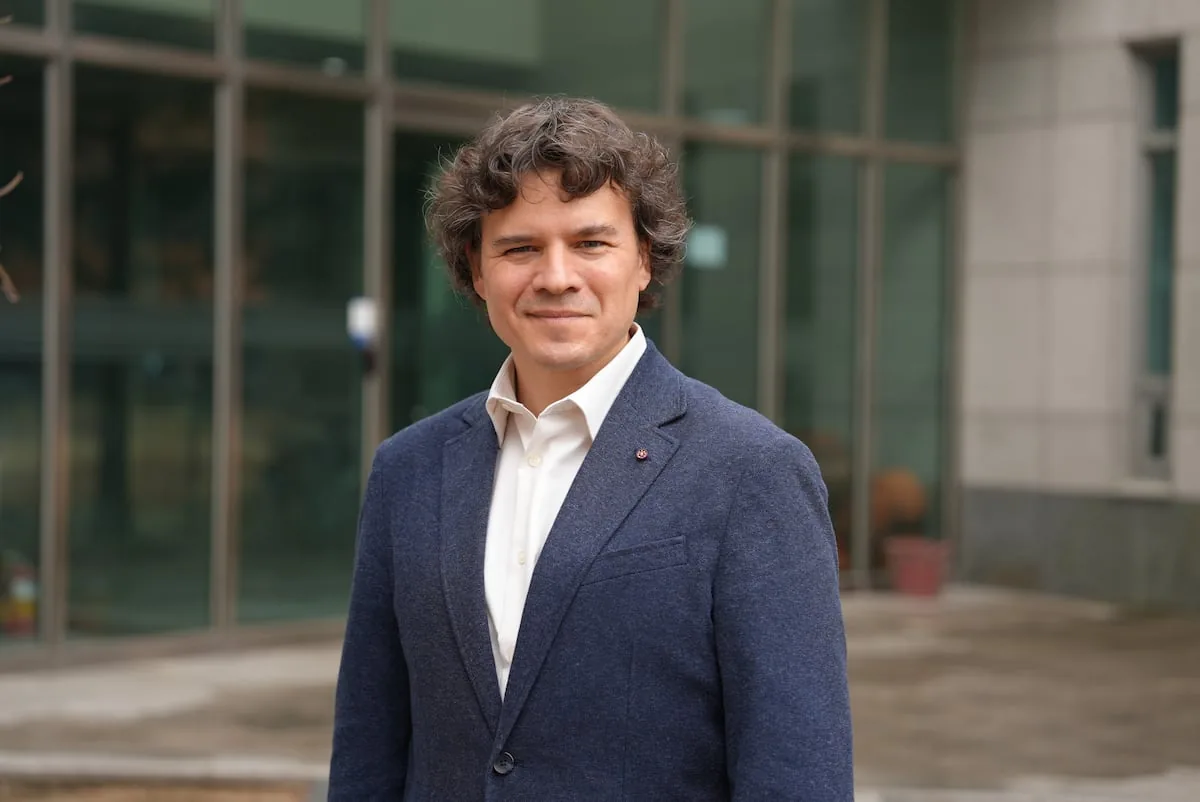
Medieval alchemists pursued a chimera for centuries: the philosopher’s stone, a material capable of transforming common metals, such as lead and iron, into coveted gold. Spanish physicist Pablo Jarillo Herrero is in the running for the Nobel Prize because he has discovered something similar: a “reverse philosopher’s stone.” It is not a substance that transmutes any mundane element into a jewel, but an unlikely material that “becomes all things,” according to the scientist.
Read more Elvis Crespo, singer: “With ‘Suavemente’ alcoholism came into my life”
Jarillo Herrero, born in Valencia 49 years ago, explains that by sticking adhesive tape to graphite ―the main component of a pencil lead― one can obtain a surprising ultrathin material: graphene, a sheet of carbon one atom thick. In 2011, Canadian physicist Allan MacDonald predicted that if two layers of graphene were superimposed but slightly rotated at a “magic angle” of 1.1 degrees, unexpected electronic properties would emerge. Jarillo Herrero’s team at the Massachusetts Institute of Technology (MIT) achieved in 2017 what MacDonald considered “almost science fiction,” that longed-for reverse philosopher’s stone. This January, both won the BBVA Foundation Frontiers of Knowledge Award in Basic Sciences, endowed with 400,000 euros. In 2020, they were awarded the Wolf Prize, often a precursor to the Nobel in Physics.
The Spanish researcher has named a new field of physics: twistronics, which studies the properties that arise when ultrathin stacked sheets of different materials are twisted, like a lasagna. Two graphene layers rotated at the magic angle can behave as a superconductor, facilitating electricity transport without losses. With more layers or other configurations, other properties arise: magnetism, insulation, even ferroelectricity, which is a kind of internal electric polarization that can be modified, ideal for producing more efficient supercomputers and boosting artificial intelligence.
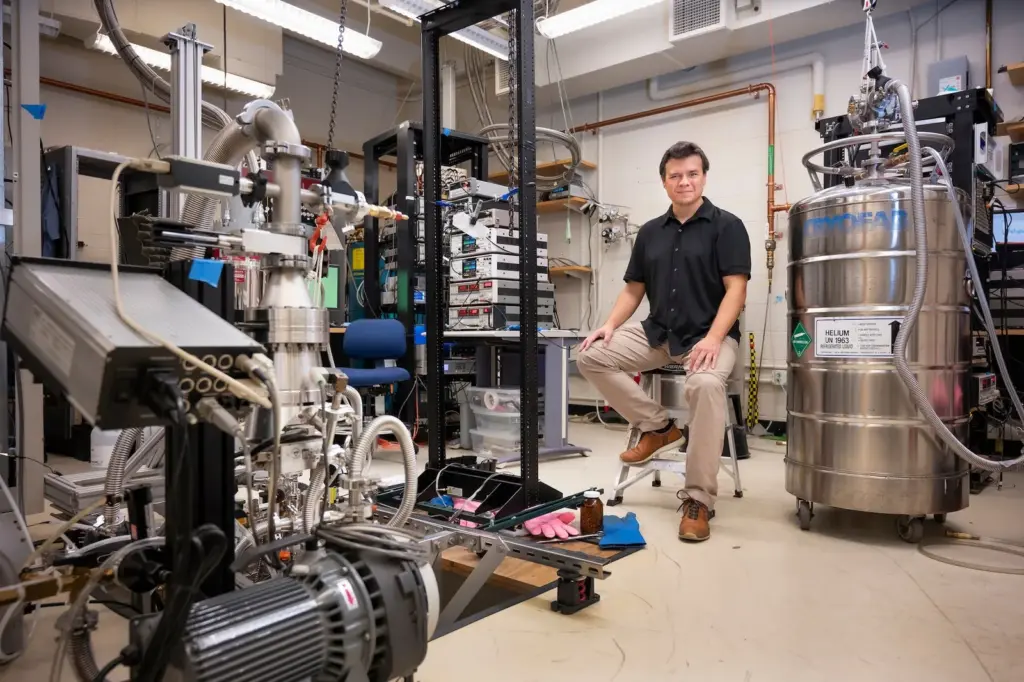
In Jarillo Herrero’s laboratory, they do not only work with the amazing graphene. They also work with other nanomaterials, such as sheets of transition metal dichalcogenides, which, when twisted, generate similar properties and “could one day replace silicon,” the semiconductor element of electricity that is the fundamental ingredient of modern computing. The Spanish physicist would be thrilled to win the Nobel, but it does not keep him awake at night, he assures via videoconference from the US city of Cambridge.
Question. What is a reverse philosopher’s stone?
Answer. In the Middle Ages, people tried to find the philosopher’s stone, a stone that would turn materials into gold. When I explain that with magic angle graphene you can make many phases of matter, sometimes they tell me this is similar to the philosopher’s stone. And yes, it is similar in spirit, because you can transform one thing into another, but in reality it is the opposite: using a single material we can obtain all the properties of matter, like magnets, ferroelectric materials, superconductors, insulators, etc. Instead of finding the material that turns everything into gold, we have found the material that becomes all things, in quotes. It is not an exact analogy, but it can help to understand how amazing this is. The reverse philosopher’s stone.
Q. You often say that under the microscope, graphene looks like chicken wire.
A. Yes, exactly, they are small hexagons. Graphene is chicken wire made of carbon atoms.
Q. What are you capable of doing with a pencil and adhesive tape?
A. We literally use a graphite crystal, very similar to pencil lead, and tape to make magic angle graphene and experiments with all these behaviors of matter.
Q. Can you turn graphite from a pencil lead into a magnet?
A. Yes. In fact, graphite, even without twisting it, with a slightly changed structure, can become a magnet and a superconductor at very low temperatures.
Q. Who came up with the name twistronics?
A. Well, the official version is that the first person to put it in writing was a Harvard colleague, Tim Kaxiras, in a 2017 study. The unofficial version is that Tim Kaxiras and I were members of the Integrated Quantum Materials Center. One day we were talking, sitting next to each other, and I said to him: “It would be very cool, very neat, if we called this twistronics, because it is doing electronics with twists.” I don’t know if he remembers, but I vividly remember that conversation. I think it stuck in his mind and, at some point, they published that study and called it twistronics. So I think I proposed it, but if anyone has the trademark right, it’s Tim Kaxiras [laughs]. It’s not very important either.
Twistronic materials could be a revolution”
Q. When you both won the Frontiers Award, Allan MacDonald said what you had done was “almost science fiction.” Why was it so difficult?
A. MacDonald and his postdoctoral researcher [Israeli physicist Rafi Bistritzer, also a Wolf Prize winner] predicted a change in the electronic properties of graphene at that magic angle, but they did not know it could be superconducting or insulating. When we published our results in 2018, no one expected it. Everyone was amazed and the field took off. The other part of science fiction is putting a material one atom thick and twisting it on top of another at a precise angle of 1.1 degrees. In hindsight it seems easy, but it took us eight years of work. In these moiré structures, besides the angle, it is very important that the two sheets have perfect separation, that they are very parallel. There cannot be even one extra atom of thickness. Doing it relatively simply is a bit of science fiction.
Q. Is it called moiré because it is like the moiré effect? Those ripples that striped shirts seem to make on television.
Read more It’s not just sex, it’s not just affection: Is polyamory normal?
A. Exactly. In mathematics it is a well-known phenomenon. When you have two periodic structures and rotate them, you form a superstructure, a moiré pattern.
Q. On your laboratory’s website, you boast of “shaping the future of technology.” How do you imagine that future in 10 or 20 years?
A. Well, 10 or 20 years is relatively soon for me. I prefer to talk about 30 or 40 years. We have this reverse philosopher’s stone, but today it is not very useful for technology, because we do not know how to make thousands or millions of these devices, all identical. I would love that, in 10 years, which will probably be more like 20, 30 or 40 years, the technology to make twistronics on a large scale would be developed. Then we could use it in all kinds of applications where magnets, ferroelectric materials, superconductors, etc., are needed, using a few materials and playing with their angles. That would be great. Right now we can do practically everything, but, for example, we cannot do it at room temperature. There are also many applications where it may not matter too much to have to cool to low temperatures, like quantum computers [supercomputers that operate with the rules of quantum mechanics]. Google and IBM use aluminum as a superconductor and it has to be cooled a lot. These twistronic materials could revolutionize all these applications and make them much more powerful if we manage to manufacture them on a large scale.
I’m not sure Trump knows much about science, despite his uncle being an extremely prestigious MIT professor”
Q. Have you received any tempting offers to return to Spain? For example, with a National Twistronics Center in Valencia.
A. Tempting, no, honestly no. I have been asked many times, but there has never been an offer for which I seriously considered returning to Spain. It would have to be a proposal with research and personal conditions similar to those I have at MIT: salary, flexibility, etc. And that, today, the Spanish system does not allow. Neither public nor private, and this would have to be done in a public-private way. MIT is a private university, but with a lot of public funding for research. In Spain, they do not realize what is needed to do top-level research.
Q. What do you mean?
A. Everyone is very clear that to do top-level football, to have Real Madrid or Barcelona, you have to hire the best in the world and give them the conditions to train, but also personal conditions and very competitive salaries. It seems that in the world of science, this is not understood. Europe has to get its act together, and Spain even more. In the news we see every day how important it is to have your technological independence, so that other countries do not run over you.
Q. Spanish engineer Darío Gil, Undersecretary of Science at the US Department of Energy, said in January in EL PAÍS that President Donald Trump believes in science. Do you think so too?
A. Science is very broad. Trump’s advisors have convinced him that it is worth investing in some aspects. For example, in quantum technologies or artificial intelligence. And there are other aspects of science, which are not minor by any means, like climate change or health, in which his advisors have convinced him that it is not so important or convenient for the US in the short term. In the long term, this will have enormous negative repercussions for the US and the planet. I’m not sure Trump knows much about science, despite his uncle [John G. Trump] being an extremely prestigious MIT professor, winner of the US National Medal of Science for inventing applications in nuclear medicine.
I would say the scientific and technological impact of MIT is much greater than that of the 100 Spanish universities combined”
Q. You are one of the few Spanish scientists who could win the Nobel.
A. Well, I suppose. I keep getting awards that many people who later won the Nobel also received. I would be thrilled, but it is not something that keeps me awake. There are three or four Spaniards in the running for these major international awards and it happens that I am one of them. Well, very well, we’ll see what happens [laughs]. If Spain wants to have more Nobel Prizes, what needs to be done is no secret: bet on young people, on meritocracy, be intellectually ambitious, just like we are in football, tennis, or restaurants. Provide resources and recruit international talent. It is obvious, but very difficult to do.
Q. Why?
A. Very few institutions have internalized radical meritocracy. In none of the MIT committees I have been on has it ever crossed anyone’s mind not to give the position to the best. It is inconceivable. And it is very different to say it than to live it, when you have to analyze the case of a colleague. You know their family, their children, you have friendship, and in a vote, you have to say: “This person has to be fired, because although they are very good, they are not extremely good, which is the standard we have here at MIT to keep you as a researcher.” There are very few places where people are willing to do this. It is very uncomfortable.
Q. Very harsh.
A. It is exactly the same as at Real Madrid. If a player seems very good but does not make the cut, you have to let them go. You have to bet on radical meritocracy, without slipping up. Many countries ask: “If we want to make an MIT, what do we have to do?” When I tell them the resources needed, almost all get scared, but there are countries that say: “Do you need 50 billion? I’ll put it.” And I answer: “Well, I forgot to tell you that the 50 billion is the easy part of making MIT. The hard part is talent, human capital, recruiting and nurturing it.” Many times I go to Spain and see laboratories better equipped than mine, but they don’t have the people I have. MIT is a university that in Spain would be small. It has about 4,500 undergraduate students and 7,000 doctoral students, but produces more patents, just MIT alone, than all Spanish universities, public and private, and the Spanish National Research Council combined. When you have the right human capital, you can do 100 times more than what you do. I would say, and here I will be undiplomatic, that the scientific and technological impact of MIT is much greater than that of the 100 Spanish universities combined.