









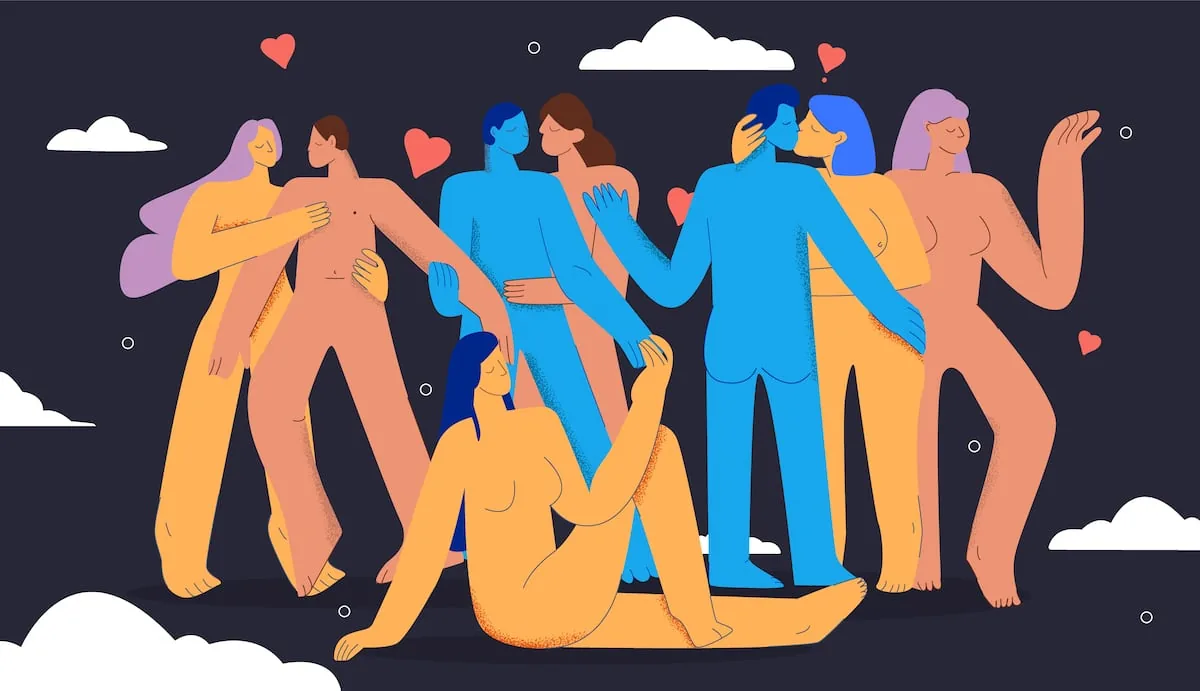
According to the RAE, polyamory is an “erotic and stable relationship between several people with the consent of all of them.” It started as something for queer and feminist people debated in academic and activist spaces. But it has been in the media for a decade now, so it’s rare not to have had a beer talking about the topic. Even if it’s just to mock it. Some even claim it has gone out of fashion. As if it were bell-bottom pants.
A person I love, with whom I have never had sex and with whom we have planned several times to get married (on the condition that he can have sex with all the men he wants and I with all the women I want) is unwell. So much so that he needs continuous care and someone to make decisions on his behalf. I know where he keeps everything, what he would do in each situation, his future plans, how much he smokes, what he doesn’t say, and what matters to him. We have known each other since we were fourteen (thirty-eight years ago) and with three others we had a plan: a plot of land in Almería, individual cabins, a pool, and a common space to cook, eat, drink, and party until osteoporosis and arthritis let us. Together until death.
But now his life has been forcibly taken out of the private sphere and all the instances that have to decide who decides for him ask us the same question: What degree of kinship do you have? In the ICU I said “family” and they didn’t ask more—because in the ICU they look at you tenderly and understand that being there legitimizes you to be there—but as things have become pragmatic and chronic, they have been pushing us out to the meager space of “friends.” Now we see him in shifts, when we are allowed, and he is almost always with people who get paid to be with him or who were never with him when he was himself.
I have two female friends and a male friend who share their own home, a business, finances, trivial decisions, and present plans. I don’t know nor care if they have sex, but I know they spend hangovers on the couch watching movies, know each other’s medical appointments, and coordinate costumes at carnivals and all vacations. That is commitment. They spend their lives dodging giving explanations about what they are, who is with whom, why they want a triple room, why they have a joint account, or how they will manage when someone has a “real” partner.
The person with whom I have an (I know the cynics hate that word, that’s why I use it) affective and sexual bond and a bitch, does not live in my house, we don’t have a joint account, nor are we always the first option to organize vacations.
Is this polyamory?
Well, I don’t know.
To avoid polilovesplaining, we spoke with three women who know a lot about the theory and practice of polyamory: singer Eddie Circa; Roma de las Heras, author of “Relational Anarchy, a graphic novel,” and Sandra Bravo, author of “If I Have Loved You, I Don’t Remember.”
Perhaps the first step—which serves for any path toward critical thinking—would be to stop thinking in terms of normality and strangeness, and start talking about monogamies and non-monogamies. And thus we can slide down the slide of curiosity, without the burden of judging before knowing.
Eddi Circa says that “about the monogamous thinking that governs our sentimental relationships, you only need to understand one thing: that the pillar it rests on is the idea of the couple as the apex in the relational hierarchy.” She refers to the fact that the basis of monogamy—which we still take for granted in relationships unless otherwise stated—is “not so much sexual exclusivity as the hierarchy of affections.” We have everything ordered and don’t have to decide much: “The couple before the friends.” According to the singer, “understanding and trying to modify, destroy, or reorder this hierarchy is already doing polyamory.” So it turns out we are polyamorous, friends (I tell the previous ones, you manage yours yourself).
Do we know what polyamory is?
I ask in a friends’ chat what they would be interested in reading in an article about polyamory. The answers surprise me because, more than concrete doubts, I find that they are not very clear about what it is. “It has been linked a lot to promiscuity, to the idea of body consumption, of not caring. It’s still very much a cliché,” opines Sandra Bravo. One of my friends says “open couples?” and agrees with Roma de las Heras, who considers that “the model most represented is the one that most resembles the classic monogamous couple: a central couple that suddenly decides to open the relationship or meets someone and wants to try an open relationship.” But it’s not that, at least not only that. Sandra Bravo points out that “there are people who live polyamory from a politicized perspective, but there is also the idea that it is just another option while I am looking for my soulmate.”
It’s not easy to get a definition from them, because people who think a lot about something that means everything to them don’t tend to summarize, but Eddie Circa thinks that “polyamory comes to de-hierarchize the sentimental relationships in our lives, to weave a more sincere, loyal, and material love with our friends, to connect with the world, to recover a collectivity that in the capitalist framework has been reserved and relegated to the traditional couple.” Phew, that makes you want to sign up, right?
They call it polyamory, but do they mean sex?
“Orgy but with love?” says one of my friends in the chat. But no. Polyamory doesn’t necessarily have to do with sex, contrary to what another friend in the chat thinks: “it’s having consensual relations with several people at the same time and everyone knows, right?”, which is what most people think. In fact, when asked if they consider themselves polyamorous, even though (as far as I know) there is no sex between them, my friend from the triad is clear: “we self-define as a triad, this being a response to the recurring questioning of our bond.” Speaking about the sexual aspect, “I have known polyamorous relationships of other people where sex was a structuring or destructive element; in our case, it is neither structuring nor destructive,” he points out. One of the two women in the triad goes along the same line: “I do think we are polyamorous because compared to normativity our relationship is healthier and built outside the system, seeking a different, collective, and respectful way of living together but without the sexual-affective bond. Although in reality normative couples touch each other less than we do,” and she laughs. The other woman in the polyamorous trio has a similar opinion: “it is our life choice, as travel companions and chosen family. Always trying to add, improve ourselves as individuals and as a triad. We live like this by choice and it works for us.”
It seems that in polyamorous life options there is much more than promiscuity and open couples. In fact, all the interviewees agree that it is an anti-system political option.
What is transformative about polyamory?
“It proposes ways of sharing life in structures and thoughts beyond the norms of the sacred number two,” says Eddie Circa. “Polyamorous bonds challenge the monogamous model based on chaining couple after couple until finding eternity.” And statistics—and our own experiences—show that forever relationships almost never happen anymore, but many people (I refer to “Love is Blind”) still look for them. For the singer, polyamorous bonds “are the opportunity not to break our hearts so many times looking without finding, to move in with your girlfriend and after four years break up, go through a very sad mourning, and start from zero to build something meaningful with the next person.”
For Roma de las Heras, “the non-normative has to do with questioning that hierarchy of romantic relationships over other relationships. For example, if I have a friendship of twenty years with whom I go every summer for a week of vacation because it is our ritual, and I start a six-month romantic relationship, why should the priority for planning vacations automatically be the romantic relationship?” See? You don’t need to have orgies or open relationships to practice polyamory.
Sandra Bravo opines that “many non-monogamous activists break many other norms, like seeking alternative consumption and food forms or supporting certain political struggles,” and in this she agrees with Circa and De las Heras, polyamory is a political proposal. In fact, Bravo states: “it doesn’t seem anti-system to me that a person declares themselves polyamorous and then stays silent about the genocide in Israel or says they are anti-feminist.” These positions fit with the origin of polyamory in feminist and queer spaces, which have been trying for decades to break the system of oppression against women and dissidents, precisely pointing to the pillar of this systemic violence: marriage. And sexual exclusivity (and the tacitly assumed obligation of sex) on which it is built. Even today, the greatest risk practice for a woman—in terms of the possibility of being murdered—is not being promiscuous, nor going out at night, nor walking in lonely areas, but pairing with a man.
Can you do polyamory with men?
According to Roma de las Heras, “there is social rejection towards the discourse of polyamory, especially among many women because, historically, men have had impunity to make harmful decisions in relationships: infidelities, parallel families, etc. So some see the discourse of polyamory as a way to justify male impunity with new words. That’s why it’s important to introduce responsibility and a feminist perspective in these conversations.” Bravo is clear about why women distrust practices that imply changes in social norms: “because we are the ones who have rethought intimate relationships, inequalities within intimacy, and the renegotiation of romantic love as a mandate. Because this system leaves us in a more vulnerable position.” One of my friends is more pragmatic in the chat: “Ugh polyamory, what a drag, right?? Put up with more than one???”
While Eddie Circa states she is unaware of men’s culture “I’m not interested, I’m interested in men stopping being men and learning female culture, queer culture, and the culture of otherness,” Sandra Bravo has a more hopeful perspective: “there are women who are attracted to guys. I am bisexual, and I’m not that way on a whim, that’s how my desire is configured. Saying they are the problem is burdening the rest of the identities with the idea that we are beings of light and that we do everything perfectly, and that’s not true.” She agrees with Bravo’s analysis: “what I do believe is that we need feminist guys, who review their privileges, who care without putting on a medal and without asking how they have to care, generous in love and sex. And I want to think that this transformation is possible.” Although Bravo recognizes the specific difficulties of “women who like men, well, they relate to people who have been educated in an environment that supports the idea that they can do whatever they want within intimate relationships.”
Seen this way, it is much more interesting, promising, difficult, and revolutionary than it seemed, and it gives reason to Eddie Circa and her reference to reggaeton artist Tony Dize, nobody promises beyond time anymore, nobody believes in the eternal. “So, what do we do? Do we let ourselves be carried away by these nostalgic thoughts that can lead us to somewhat reactionary positions that sanctify the lives of our grandmothers and pursue a love forever? Or do we investigate new models with which to live a shared, happy, and peaceful life?”
Read more Mónica García and Emilio Delgado, two different ways of trying to save the left
Alright, let’s investigate.