







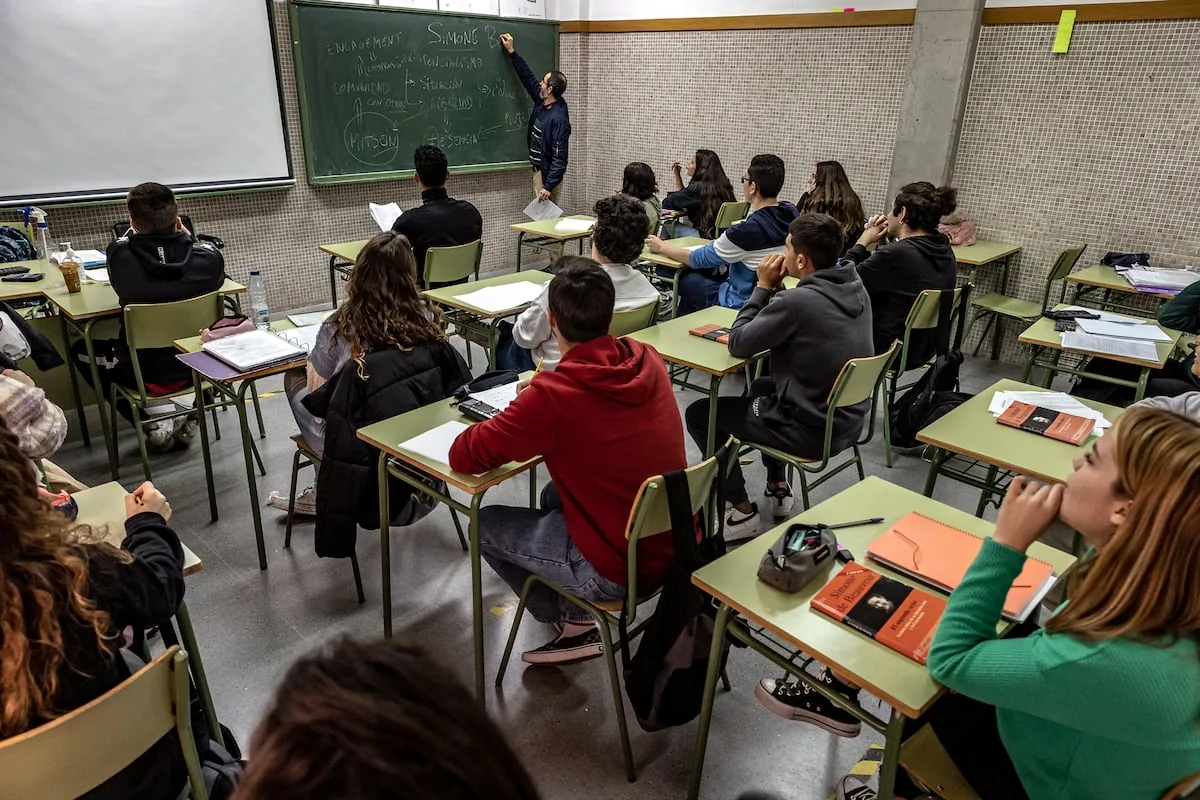
The Minister of Education, Milagros Tolón, presented this Wednesday before the State Observatory for School Coexistence the first framework protocol against bullying and cyberbullying for all of Spain. The protocol includes a procedure to respond in the same way to bullying situations throughout the country, will allow the creation of a common registry of bullying cases (broken down into their different manifestations) with the aim of improving the design of measures to combat it, and includes several innovations. It incorporates the response to new forms of bullying derived from the use of generative AI, such as deepfakes. And it foresees that educational centers will directly contact specialized public bodies, such as the National Cybersecurity Institute and the Spanish Data Protection Agency, to receive “technical and legal advice” and to achieve “the removal of sensitive content published on the internet without consent.”
Read more Spar Girona continues to surpass itself and reaches its first EuroLeague semifinals
The proposed protocol will soon be submitted to the plenary session of the State Observatory for School Coexistence, a body made up of representatives of teachers, students, families, and autonomous communities. There it will be approved, barring surprises, by assent, sources from the body indicate, since the issue has been worked on both with representatives of the educational community and the regional governments. “It is not just another document, it is a roadmap to act better, earlier, and with more guarantees,” the minister stated.
The educational community has received the ministry’s proposal favorably, although with nuances. “Improving protocols and moving towards a common model for the entire State is positive. But in the end, everything falls on the teachers. Self-harming behaviors, xenophobia, bullying cases… And without sufficient support structures, such as adequately staffed guidance teams, and the necessary resources, this agreement could be just paper,” warns Ramón Carrillo, representative in the Observatory of the STES union. Tolón pointed out that the new protocol is part of a broader government strategy aimed at enhancing emotional well-being in schools, for which, initially, the ministry will double the funding of the program it has for this purpose, increasing its contribution to 10 million euros.
Bullying cases, especially the most dramatic ones, such as the suicide of Sandra, 14 years old, last October in a school in Seville, regularly shake Spain. Despite this, and the demands of victim family associations, the country lacks a common framework for action. A deficit that, according to experts, causes differences in measures and response times to this type of aggression. And it generates gaps in homogeneous information, making it difficult to diagnose the problem and evaluate the measures adopted to combat it. The explanation for this heterogeneity ― there is no void; all autonomous communities have had their own protocols for some time ― is, on one hand, that school organization competencies are transferred to the autonomous communities, and, on the other, a historical deficit of leadership by the Ministry of Education in this matter (10 years ago, its then head, the Popular Íñigo Méndez de Vigo, announced the creation of a state registry of cases) that is now intended to be corrected.
Application
The protocol presented this Wednesday will not, therefore, be automatically applied in educational centers, as the Government lacks the capacity to impose it. But previous examples in other serious challenges, such as health protocols to prevent covid infections in schools, have shown that a quasi-federal educational system like Spain’s can adopt efficient harmonized measures (the country became a reference in the OECD for how to reopen schools during the pandemic). Then, the school health protocols of, for example, the Balearic Islands and Galicia were not identical, but shared their core points, and the ministry hopes the same will happen now.
Read more First step to impose fines of nearly a million against train graffiti artists in Catalonia
The delay in establishing a common framework ― which experts and observers consider incomprehensible given the magnitude of the problem ― has various causes. The State Observatory for School Coexistence, the body that naturally should have taken on the mission, was created in 2007, in the first term of the government led by socialist José Luis Rodríguez Zapatero. In the following decade, however, marked by education cuts following the financial crisis, and already with the Popular governments led by Mariano Rajoy, the body’s activity declined to the point that towards the end of the decade, with the PSOE again in the ministry, it was necessary to approve new regulations, since the terms of its members’ appointments had expired without renewal. Since then, the body’s activity has progressively resumed. And besides funding studies, publishing guides, and organizing congresses, it has developed the protocol presented this Wednesday. The document is based, in addition to the available evidence and international guides, on examples of good practices already present in the autonomous communities, among which territories like La Rioja or Catalonia are usually considered especially advanced.
The state protocol proposes a series of action guidelines summarized in eight steps, starting with the duty of any member of the educational community (or “external agents such as social services”) to immediately report to the school management any bullying situation they know of. The following steps, which include adopting precautionary measures, gathering information and evidence, analysis and decision-making, notifications (to families, separately, within less than 24 hours, and also: to the regional education department, to educational inspection, to an official registry, to specialized resources, to the Prosecutor’s Office if there are indications of a crime…), the development of an intervention plan (within a maximum of 10 days), monitoring and evaluation of the case (for at least six months), and finally, closing the file, do not imply major novelties compared to what the autonomous communities generally already have regulated.
Viralized assaults
However, the novelty is added that schools will be able to seek help from bodies with technical knowledge beyond what schools and institutes handle, such as the Data Protection Agency and the National Cybersecurity Institute. Or the fact that, when determining that it is indeed a case of bullying ― for which several criteria usually must be met simultaneously ― in the case of cyberbullying “repetition or persistence” is not always necessary, with “a single viralized act” possibly being enough. The protocol proposes that schools pay special attention to students who, according to evidence, suffer bullying more frequently, such as foreigners, those belonging to ethnic minorities, LGTBI, or with disabilities. And it advocates improving teacher training on the subject and creating common resources that all schools and institutes can use.
The approach of the action guide, Tolón highlighted, is restorative. That is, it not only protects the victim and punishes the aggressor, but tries to make the bully recognize the harm caused, “understand the real impact of their actions on the victim” and try to repair it. And it proposes a preventive strategy that tries to establish the so-called “culture of peace” in schools, involving the kids and their families in creating a climate of empathy, and carrying out joint actions with institutions and social groups in the area where the school is located. Nuria Manzano, professor at the Faculty of Education of the UNED, expert in school bullying, considers many of the points included in the proposal relevant. And she adds that, in her opinion, it should be accompanied “by an explanatory and awareness campaign for the population, to dismantle limiting beliefs and prejudices that even parents have.”
Read more EL PAÍS strengthens its leadership among general press in the midst of global informational upheaval