
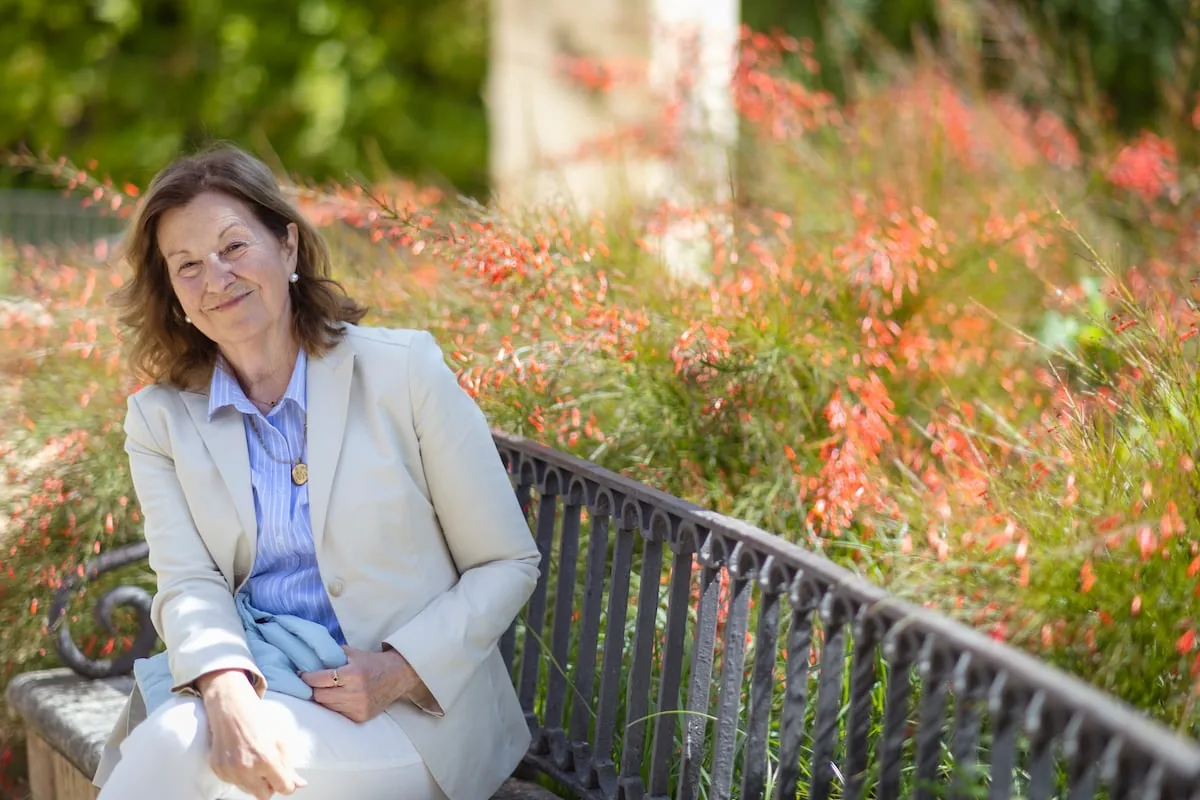
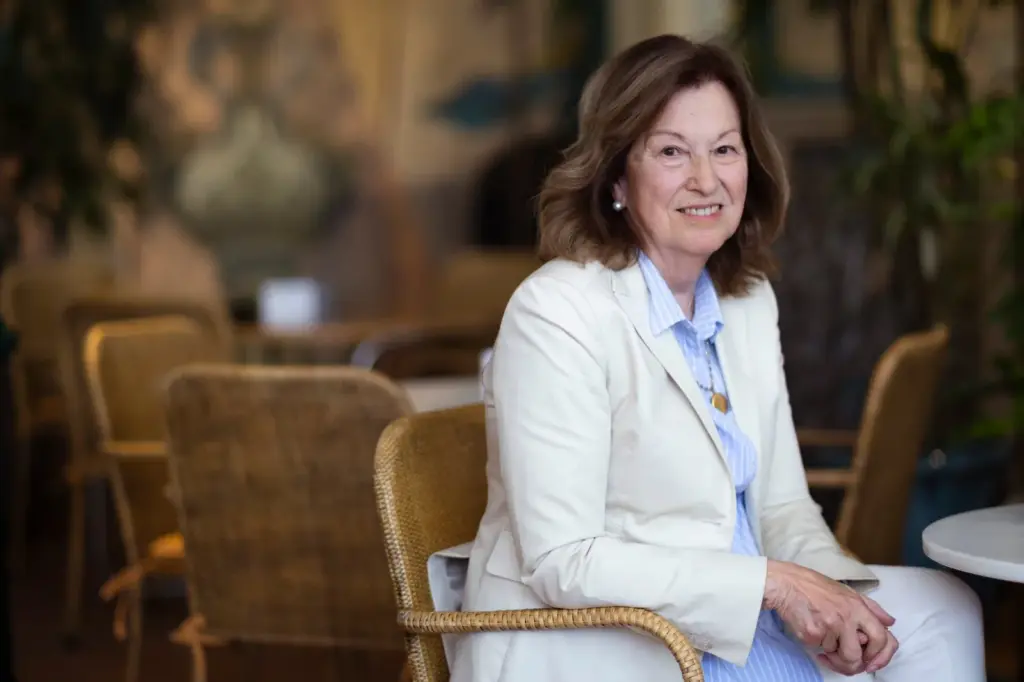
Carmen Romero (Seville, 79 years old) is constantly being called upon to participate in events of the PSOE groups in the Andalusian campaign. Romero was a member of the UGT Education Federation, a deputy for Cádiz (1989-2004), and a Member of the European Parliament (2009-2014). She was married to former Prime Minister Felipe González. She believes that the right-wing takes advantage of the criticisms from González and Alfonso Guerra against President Pedro Sánchez. “The right uses this situation. They see that there is a division, a particular action by some leaders against Pedro Sánchez, and it is evident that they use it.”
Question. She is being called from many places. Why do you think they are calling her now?
Answer. I think it is because we are living through a stage of a strong offensive by the far right against women and equality policies, and they want the presence of some women who played a certain role a few years ago.
Q. When María Jesús Montero asked you to present your candidacy, how did you interpret it? Because some read it as a counterpoint to Felipe González having been at an event with President Moreno.
A. I think she knows the importance of women’s vote in the Andalusian elections and that it is a tribute to the women of my generation, that’s how I interpreted it.
Q. You said at that event that in uncertain times one must look to the past, what did you mean?
A. One must reaffirm everything we have done, because I am convinced it was a past that modernized Spain and allowed women to make enormous progress. To defend a legacy, especially for young people.
Q. Do you think people of your generation do not defend that legacy?
A. Yes, of course they do, but the offensive now is very strong, and right now the collaboration of everyone is needed.
Q. Why have you always stayed in the background? Have you never wanted the spotlight?
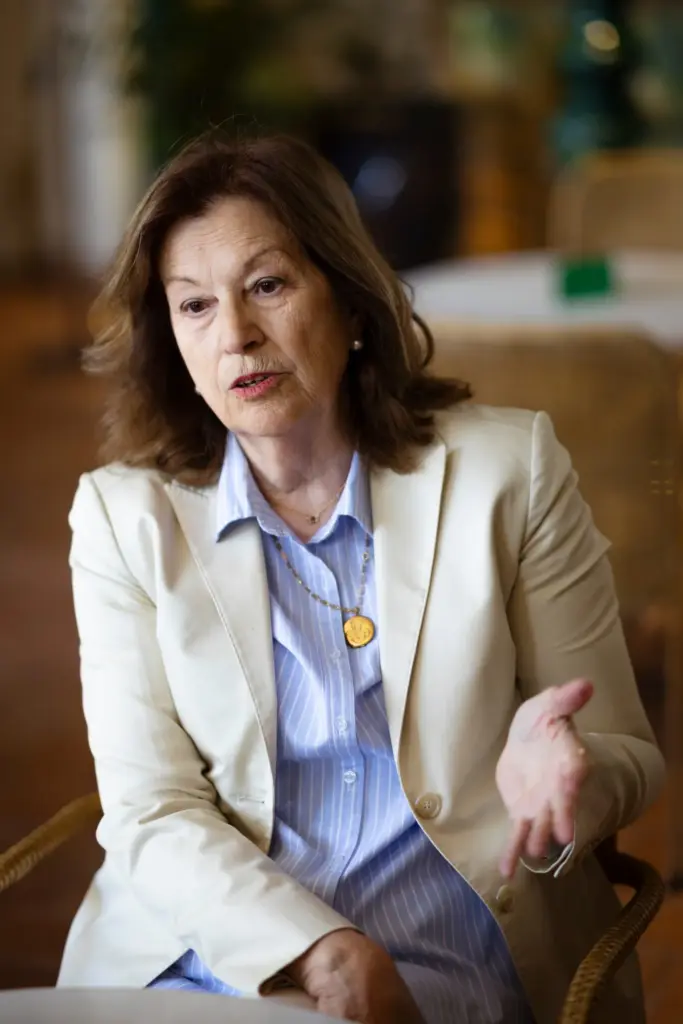
A. I think that is not true, I was a public figure when I was a parliamentarian and I gave thousands of press conferences when I was a parliamentarian, when I had a political job. When I don’t have a political job, then I defend my privacy. Privacy is a treasure. Also, I am very much against what Italians call tuttologists: those who know everything and talk about everything. You can give your opinion on what you know, but on what you don’t know I prefer silence.
Q. But it seems as if you protect yourself.
A. Yes, yes, indeed. It’s not that it appears, it’s that it is true.
Q. You appear in the famous tortilla photo, the group of socialists that raised the PSOE of Andalusia and Spain. What do you remember from that stage?
A. I remember everything. Now that I am in front of the University [the interview takes place in a bar next to the University of Seville], the University was witness to this beginning… I remember the first demonstration we did which was against the American invasion of the Panama Canal. It was in 1963, I think. And even then we started to mobilize a bit. It was a very combative generation because there was a certain conviction that the dictatorship was already ending. Then that push had to be given. All the marginalization of exile and all the forces that had been enduring the terror of the dictatorship were also beginning to rise.
Q. Have people of your generation turned their backs on Pedro Sánchez?
A. It may be that some do not agree with Pedro Sánchez, but there are also others who do.
Q. Luis Yáñez often says that the disagreements of Felipe González and Alfonso Guerra with Sánchez are not so much due to a political position as because they are bothered that the president does not count on them. You, who know them well, what do you think?
A. Times change and perhaps they do not feel as protagonists today as they once were. But it is evident that life evolves and that the protagonism now belongs to young people.
Q. In the period 1993-1996, they almost ended Felipe González’s government. To end it “the stability of the State was almost touched,” said the then director of Abc.
A. Indeed, after the Expo.
Q. Are we living a similar stage?
A. I think the current stage is much more difficult. Yes, because we have been flooded by a predatory, savage capitalism that is also global. Usually, at the end of a political cycle there is always very strong pressure. But in Pedro Sánchez’s case this pressure has existed since the beginning, because there was talk of lack of legitimacy. I mean this right-wing has not accepted this government from the start.
Q. The PP now has Felipe González and Alfonso Guerra in its pantheon and contrasts them with what they call sanchismo, a kind of deviation of socialism.
A. Yes, they use it.
Q. Use whom?
A. The right uses this situation. They see that there is a division, a particular action by some leaders against Pedro Sánchez, and it is evident that they use it.
Q. Do you think they are using Felipe González and Alfonso Guerra?
A. Well, I think the right finds it convenient that this position exists, because in reality what the right has always used is division on the left, the typical divide and conquer tactic.
Read more Loaded oil tankers without buyers: the blind spot that the closure of Hormuz puts on the map
Q. You lived almost 14 years in La Moncloa (1982-1996). You worked as a high school teacher and had institutional acts. Why did you stop teaching?
A. Because it was already too much work for me and I had been in teaching for a long time, 17 years. The truth is I wanted to change soon because it was very difficult to combine both jobs. I also took a leave because I wanted to do some translations and literary critiques that I did at that time. That kind of work was more compatible with life in Moncloa for me.
Q. In 2014 you retired from politics, why?
A. I had a serious cancer, from which I recovered.
Q. Did you have assistants during your time in La Moncloa?
A. Yes, of course. I had two assistants.
Q. And what exactly did they do?
A. Well, what they do is help you with your work because logically you have to perform functions you have not learned, you need advice and logically they are there to help you. When PP governments arrived, they had, besides two assistants, a press chief that I never had, and in Rajoy’s case they increased the assistants. We have been more austere.
Q. Do you think there should be some regulation for the spouses of presidents?
A. I have always been and am against a statute for a consort. Why a special statute? That means invading the private life of a person who has not been elected. If they have not been elected, they are not obliged to perform certain functions and if they do, they do it generously. What I do think can be studied and debated in Parliament is the declaration of assets of a consort. But not only in the case of the prime minister’s wife, maybe also in some other cases… vice presidents or certain important state officials.
Q. As the political debate is currently framed, consorts could not dedicate themselves to private activity.
A. When there are conflicts of interest it is difficult. Conflicts of interest must be avoided.
Q. Have you ever experienced harassment situations like the one we have seen with Begoña Gómez?
A. No. Fortunately, the right did not use harassers, as is happening now. Because the case that happened to the president’s wife is not a case of a journalist’s interview, it is a case of harassment. And also by a person who has been recruited by the Popular Party.
Q. You went to Ferraz when the Prime Minister took five days of reflection after proceedings were opened against his wife.
A. It was an act of solidarity with him, because I am sensitive to these issues, I have lived them and I know what it means to defend a family. If the right really believes in democracy, what is petty is to attack the family of a president. That cannot be consolidated in the future.
Q. Did that happen to your family?
A. We had cases with my children, yes. They were of another kind, but they also could not have their normal day.
Q. And do they still suffer from that?
A. Yes, of course. That leaves marks, of course.
Q. At Montero’s presentation you claimed the PSOE stage in the Junta. Do you think socialist leaders have done so?
A. I think there was a very strong trauma in the socialist party due to the ERE case. And after the acquittal, there is still a background of a stage that has been very difficult, because it has been lived with much pain. Especially those who have been unjustly imprisoned and who need rehabilitation from us, a dignification of their work and a restoration of their honor. There were specific, evident and clear cases of corruption, but what was unacceptable was that generalization to an entire government.
Q. And why did the PSOE remain silent?
A. Out of respect for justice that the implicated themselves requested.
Q. You have lived in Madrid for many years, how do you analyze Moreno’s management?
A. I think these years have meant a huge setback and a very notable deterioration in public services. More than half a million Andalusians have resorted to private health insurance because public health has not worked. Private vocational training centers have tripled. And not to mention the problem universities have had with very strong underfunding. Andalusia has a historic delay and needs a much greater boost. When Moreno promises stability… What is needed is not stability, on the contrary, what is needed is to promote profound changes.
Q. You have been a Member of the European Parliament. What role should the European Union play in the face of the breaking of rules by the United States?
A. The European Union is at its worst moments. We have seen this in the positions they are taking regarding Ukraine, the Middle East, and Trump. The current position of the United States clearly aims to weaken Europe. We are having a very strong ultra offensive in France and Germany, which are the two leading countries after World War II in what was the great European encounter.
Q. How do you analyze Pedro Sánchez’s role on the international scene?
A. Right now he is a leader who is highly valued for the position he has taken regarding the Iran conflict and before that, with Gaza. He has many capabilities because he has been able to foresee what could happen, he has had foresight.
Read more Extradited ‘Pequeño J’, the Peruvian drug trafficker accused of a triple femicide in Argentina
Q. You have no doubt you will vote for him, right?
A. Of course!