
The energy world has been different for the past two months. The crude oil market has shifted from a substantial surplus, which forced the Organization of the Petroleum Exporting Countries (OPEC) cartel to keep its own production in check to prevent prices from falling, to a highly critical situation: overnight, with the closure of the Strait of Hormuz, almost a fifth of global production has disappeared. Practically half of that amount has been offset, both by increased shipments through the few pipelines connecting the Persian Gulf countries to the outside world and by the still nascent production increases in fossil giants outside that region. But the shortfall remains enormous.
Read more Extradited ‘Pequeño J’, the Peruvian drug trafficker accused of a triple femicide in Argentina
Every barrel counts in this sudden shortage, which has driven crude prices to levels not seen since the Russian invasion of Ukraine in 2022. But it was not always like this. The oil market even has a term for cargoes that found no buyer: floating reserves. These are ships full and ready for delivery but without a clear destination, either because there was no immediate customer, because the seller was waiting for better prices, or simply due to logistical bottlenecks. They could remain stationary for up to a week straight, sometimes longer. With the anchor dropped.
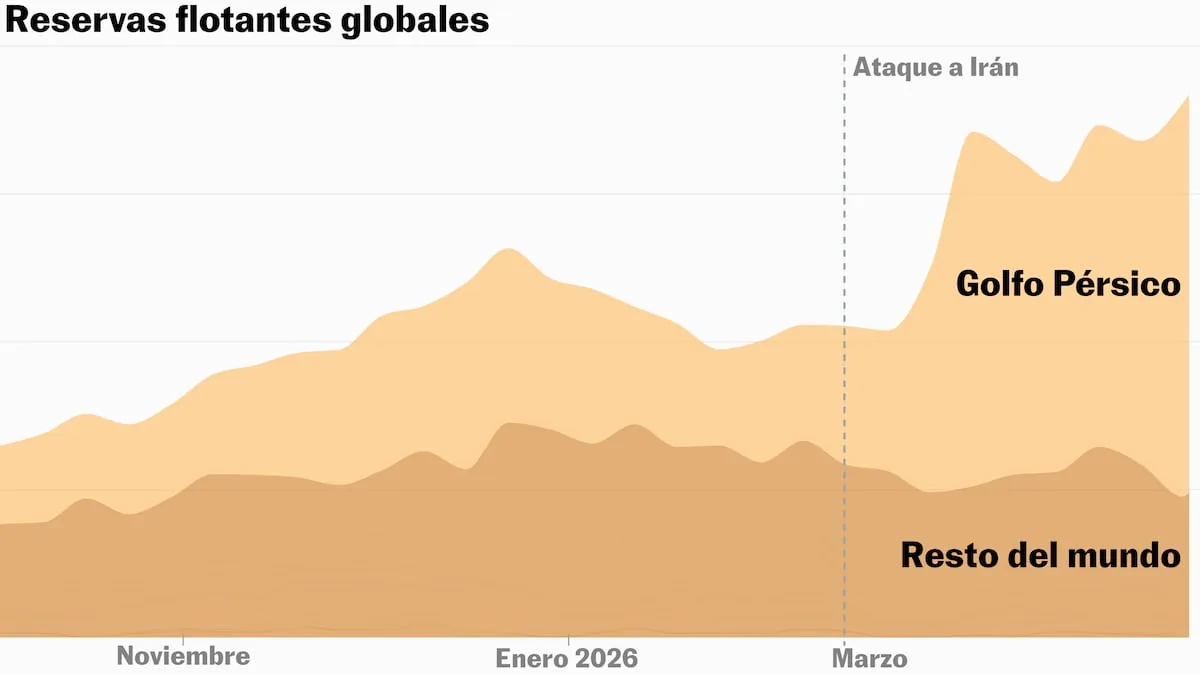
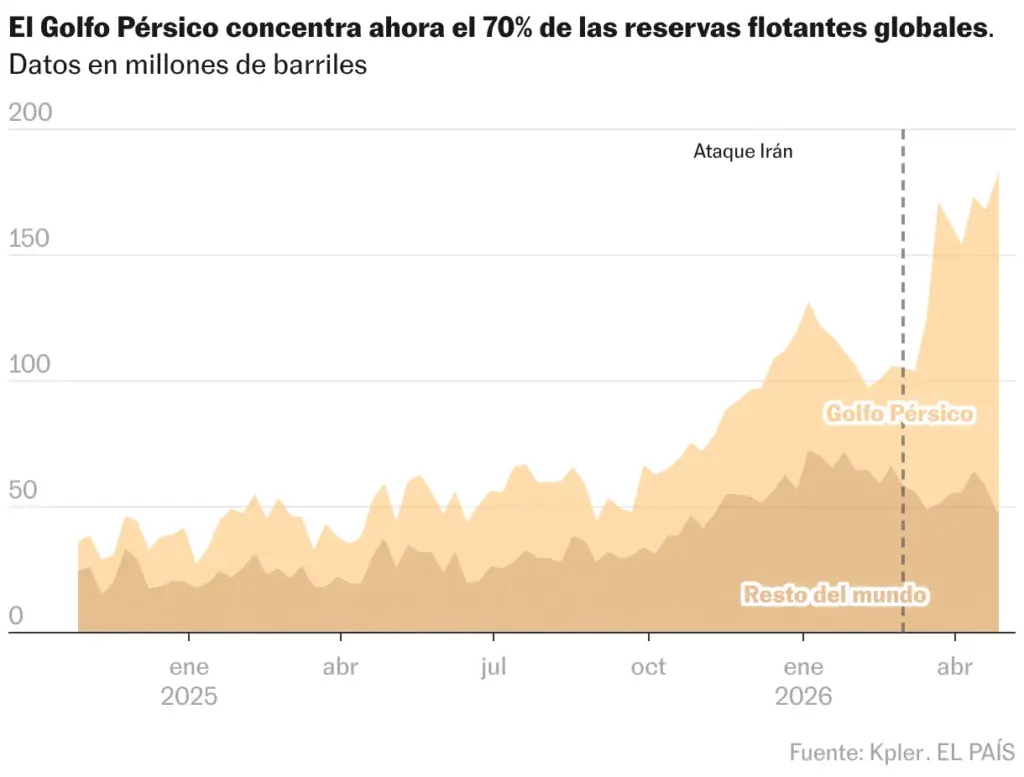
Under normal conditions, as before the United States and Israel declared war on Iran on February 28, these tankers are a marginal part of the market: they transport barely a hundred million barrels, just enough to cover one day of global demand. Now, however, with the market upside down and increasing difficulties for importing countries to supply their refineries, floating reserves have taken on a dual fundamental role.
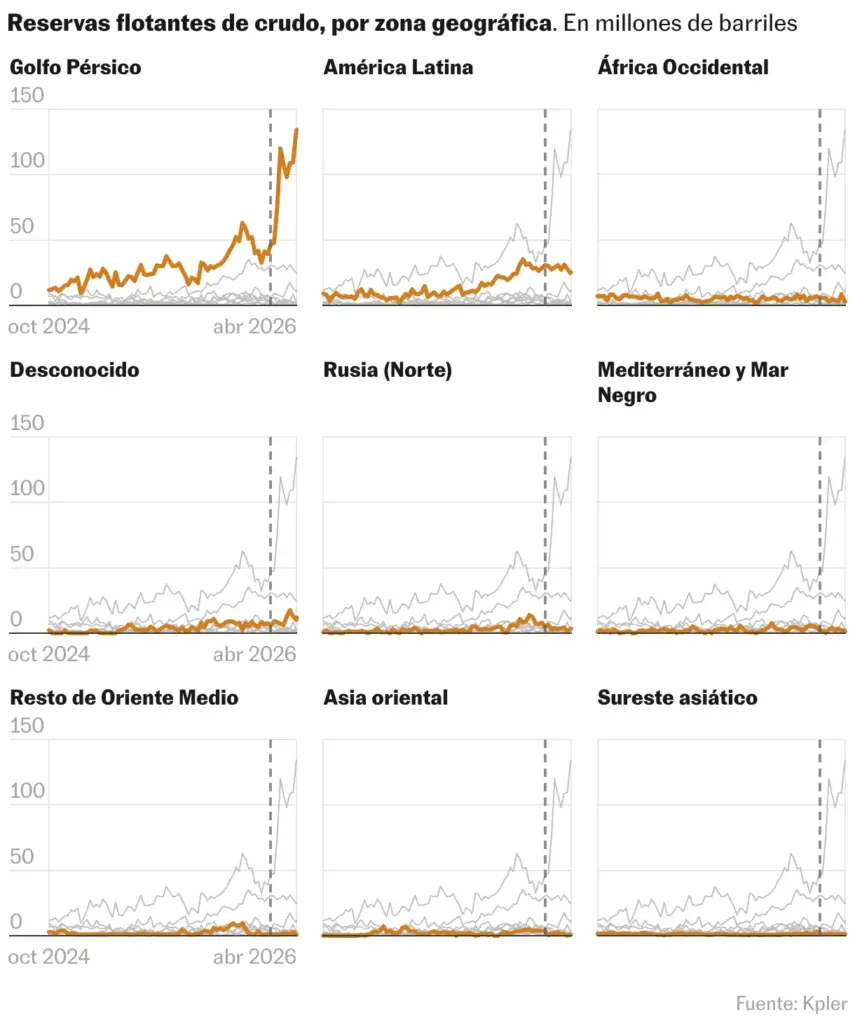
On one hand, Gulf countries continue loading ships despite the closure of the Strait of Hormuz, largely to release what they keep pumping, which swells these inventories while awaiting an agreement between Washington and Tehran that has yet to materialize. Floating reserves in the region, including Iranian crude—a country that, after the double US blockade of the strait, struggles to store what it extracts and does not sell: its onshore tanks are almost completely full—have nearly tripled in two months of blockade, surpassing 130 million barrels, according to data provided to EL PAÍS by the specialized firm Kpler.
On the other hand, outside the strait, oil that no one wanted before is finding buyers much more easily: a tanker full of crude today has an exponentially higher value than at the beginning of the year. With the war against Iran entering its third month, inventories have already decreased by 15% elsewhere in the world, according to Kpler figures.
“In this crisis, reserves have become the main market adjustment mechanism,” writes Natasha Kaneva, head of commodity strategy at the US investment bank JP Morgan, in a recent client analysis. “Unlike a typical disruption, where spare production capacity can be quickly mobilized, the location of the shock [Middle East] and the magnitude of current supply losses mean that adjustment must come from barrels already stored. Simply put, stocks are acting as the buffer of the global oil system.” A cushion that, however, has limits.
The most striking decline is recorded in West Africa, where crude without a buyer has halved since the lockdown on Hormuz. Russian oil, now freed from US sanctions to cushion the impact on price—the only thing that matters to Donald Trump, who fears his electorate will turn against him in the midterm elections to be held on November 3—cuts its floating reserves by a quarter, reversing the upward trend of previous months. This data allows one to infer something clearly: in times of scarcity, its oil, once toxic in the West, is easily finding buyers.
Something similar happens in Latin America, one of the regions in the world with the largest volumes of floating reserves. After several months of increase, a trend accentuated by the US blockade of Venezuela at the end of 2025, the recent closure of Hormuz has completely reversed the trend: since late February, crude loaded on ships awaiting buyers has fallen by a fifth.
Crude without origin
While the rest of the market shrinks, crude without declared origin doubles to 12 million barrels. Much of it is legal oil that, due to being mixed or resold several times, has lost its traceability.
Read more Doku’s feat amends Guéhi’s disaster at City, which draws against Everton
However, part of it comes from what the market calls “the ghost fleet.” These are tankers dedicated to evading international sanctions by disguising oil of banned origin, such as Iranian, making it appear as crude from another source. In the case of Iranian oil, it is often transshipped across the border with Iraq to pass it off as Iraqi.
One of the few tankers that had managed to cross Hormuz since the start of the war was the Kylo, a ship already sanctioned by the US and UK, among other countries, after transporting Iranian and Russian crude. Since the start of the war, the Kylo crossed the strait not once but twice. It entered the Gulf at the end of March, loaded in Iran, and left again in the first week of April. This tanker from a company based in the Marshall Islands docked in Singapore at the end of April, bound for China. Since April 28, it has not updated its position.
15 million barrels of diesel at sea
Not all floating reserves are crude. Derivatives—already refined products, ready for consumption in cars, ships, planes, or industry—now account for at least 15% of the cargo on tankers ready for delivery. Kpler tracks the evolution of inventories of gasoline, diesel, and aviation fuel, three key fuels for the global economy. Joint floating reserves have risen from less than 25 million barrels to about 30 million by the end of April, a boost largely influenced by ships held in the Middle East. No other region shows a comparable increase.
Diesel is the derivative with the greatest weight in global floating reserves. This product exceeds 15.5 million barrels stored at sea, 15% more than at the beginning of April, although it has fallen in most regions. In Europe, the starting point was very low, barely about 200,000 barrels, which explains that it has quadrupled, surpassing 800,000. Still a drop in the ocean compared to the dozens of millions of barrels in the major origin zones, such as the Black Sea, Russia, and yes, also the Gulf.
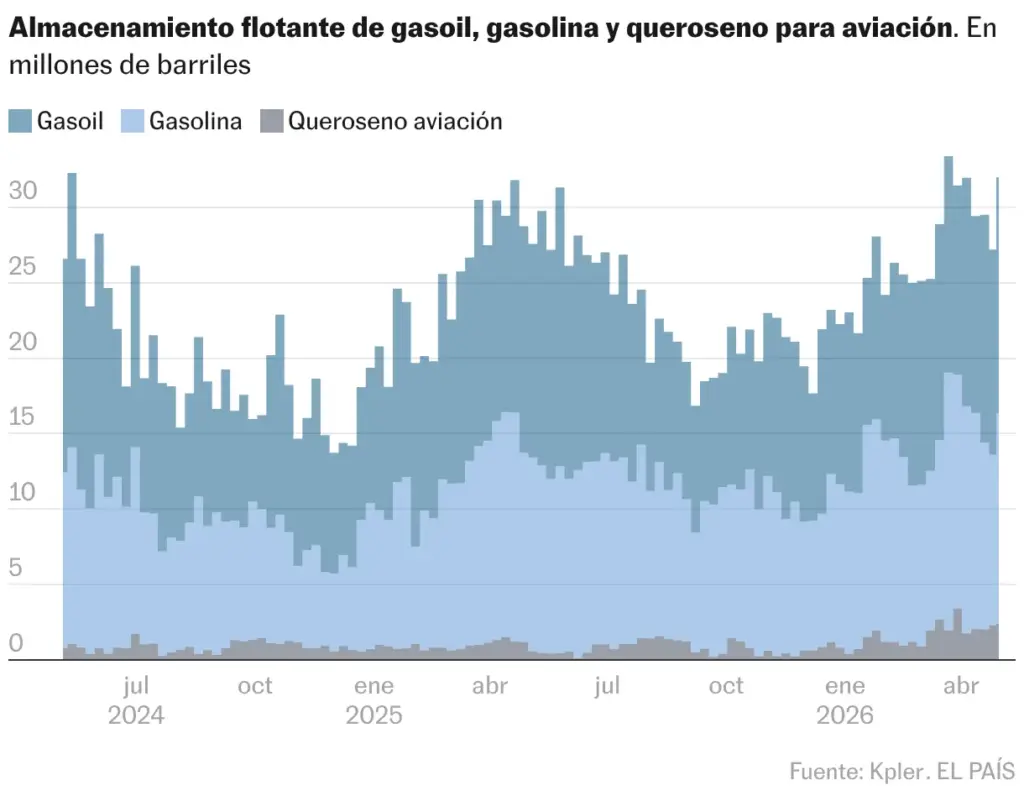
Floating gasoline reserves, meanwhile, approached 14 million barrels by the end of April, a third more than at the start of the war. Unlike diesel, gasoline started from a high base in Europe at the beginning of the war.
The story is different for aviation fuel, which has been the subject of increasing alerts from the International Energy Agency (IEA) due to flight cancellations already announced worldwide and a growing risk of shortage in Europe starting in summer, when consumption rises due to increased vacation activity.
Kerosene has never had much weight in floating reserves: it usually hovered just above one million barrels, while diesel and gasoline usually exceeded 10 million. Now, with the jam in Hormuz, it reaches 2.4 million barrels on the water. Mostly, however, within the Gulf and therefore inaccessible to the market. A jewel kept under double lock. The big question now is whether Trump and the ayatollahs keep a copy of the keys.
Read more The Prosecutor’s Office summons 50 people involved in the CIA agents’ operation to testify