









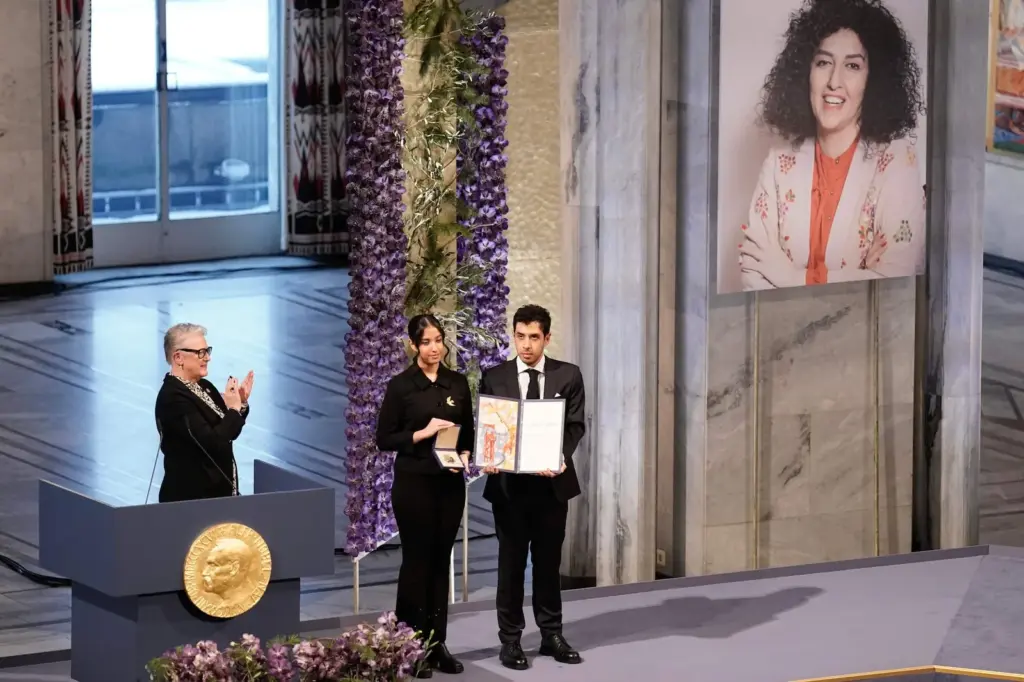
“The last time I heard my mother’s voice was the night before last December 12, when she was arrested for the fourteenth time,” says the daughter of Narges Mohammadi. The 2023 Nobel Peace Prize laureate, now 54 years old, has dedicated her entire life to defending human rights in Iran. In total, she has spent nearly 10 years in prison, interspersed with brief periods of freedom. These years have come at a high personal and health cost. She currently remains unconscious in a coronary care unit bed in a hospital in the province of Zanyán, her hometown, the same place where the prison she has spent the last 140 days in is located.
Kiana and Ali Rahmani, her 20-year-old twin children, answered questions from EL PAÍS through an intermediary, stating that denying their mother access to proper cardiac care “goes far beyond negligence.” For Ali, not transferring her to a hospital in Tehran for proper diagnosis and specialized care constitutes “a deliberate form of torture.” Despite her serious health condition, she receives only basic care such as an oxygen mask and monitoring.
According to their account, all their requests for medical care were denied, despite their mother having a fragile heart with a stent and hypertension, as well as suffering daily headaches and constant chest pain accompanied by nausea.
The cost of Mohammadi’s activism has not only been physical: it has also deeply affected her personal and family life. When her husband, journalist and activist Taghi Rahmani, said goodbye to her in 2012 to go into exile in Paris, he never imagined that their separation would last so long. “You marry to be by someone’s side, and not being able to be together is another pressure. You endure it, but it’s very difficult,” Rahmani recounts in a video call. He himself spent 14 years in prison in Iran while Mohammadi fought for his freedom and that of other political prisoners.
Activism was what brought Mohammadi and Rahmani together when they met in 1996 and is also what keeps them apart today.
When in 2011 he suggested she leave Iran, she decided to stay. “I insisted a lot and waited a year. During that time I even suffered an attack: a motorcycle ran me over and fled. They wanted to kill me. She insisted that I leave Iran. I asked her to come with me, but she didn’t want to. Later she said: ‘I don’t know how to do activism outside the country, I don’t like it.’ And honestly, I understand, she’s right,” Rahmani explains. For him, the distance and the 14 years that separate them are a consequence of the “injustice” caused by the regime.
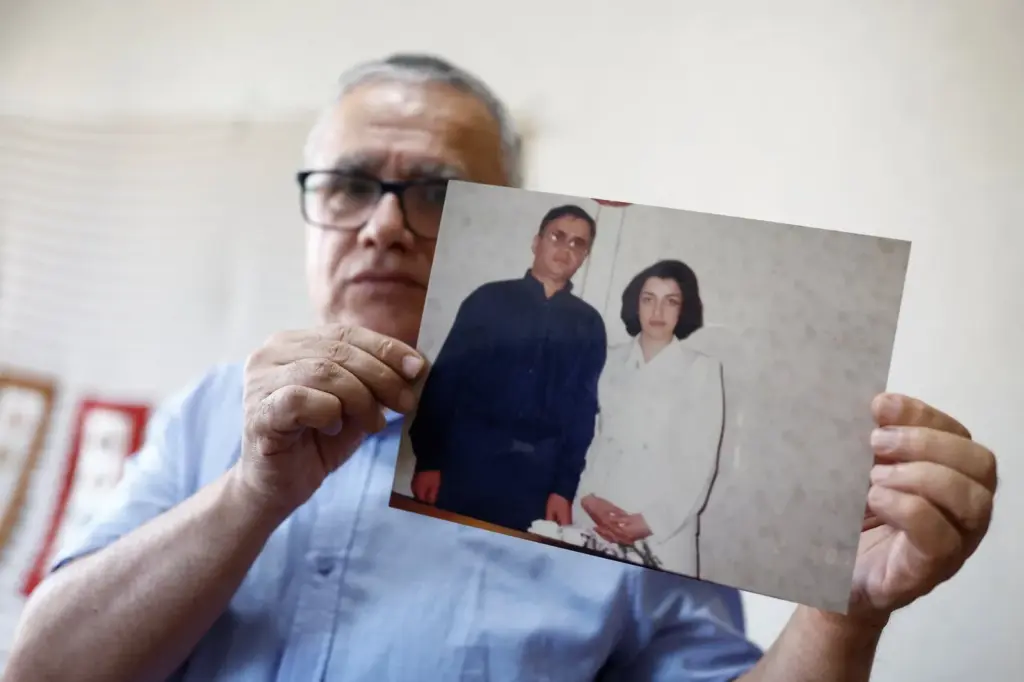
One of Rahmani’s most cherished memories is of a day when neither of them was in prison. “Our children were small. We were in Tehran, it was drizzling lightly. I suggested going into a restaurant to eat, for the first time. She said: ‘No need, let’s just eat some sandwiches right here.’ For that brief moment, there was less psychological pressure and less surveillance. There was calm… Although later everything turned back into a storm,” he recounts.
That separation has also marked their relationship with their children. “It has been almost 10 years since the last time I could see or hug her. For much of my life, my parents have been in prison,” says Kiana.
Read more Goodbye to stains on car upholstery with this biodegradable cleaner that will leave it like new
“Growing up without my mother has been deeply painful,” adds her twin brother, Ali. Still, he assures that his bond with her has always been very strong. “Since I was about five years old I understood that in her there was a ‘second woman,’ someone who fights for the right to life, dignity, and freedom,” he explains. Both share the presidency of the Narges Mohammadi Foundation, based in Paris. With their mother constantly threatened and imprisoned several times, they joined their father in exile 10 years ago, when they were still children.
Mohammadi was first imprisoned when she was still a Physics student at the International University of Qazvin, where she began her activism. Since then, she has faced 10 trials and received 10 sentences to several years in prison. Of the latest, handed down in February after her December arrest, she still has 18 years left to serve. She faces charges such as “assembly and conspiracy against national security” or “propaganda against the State.”
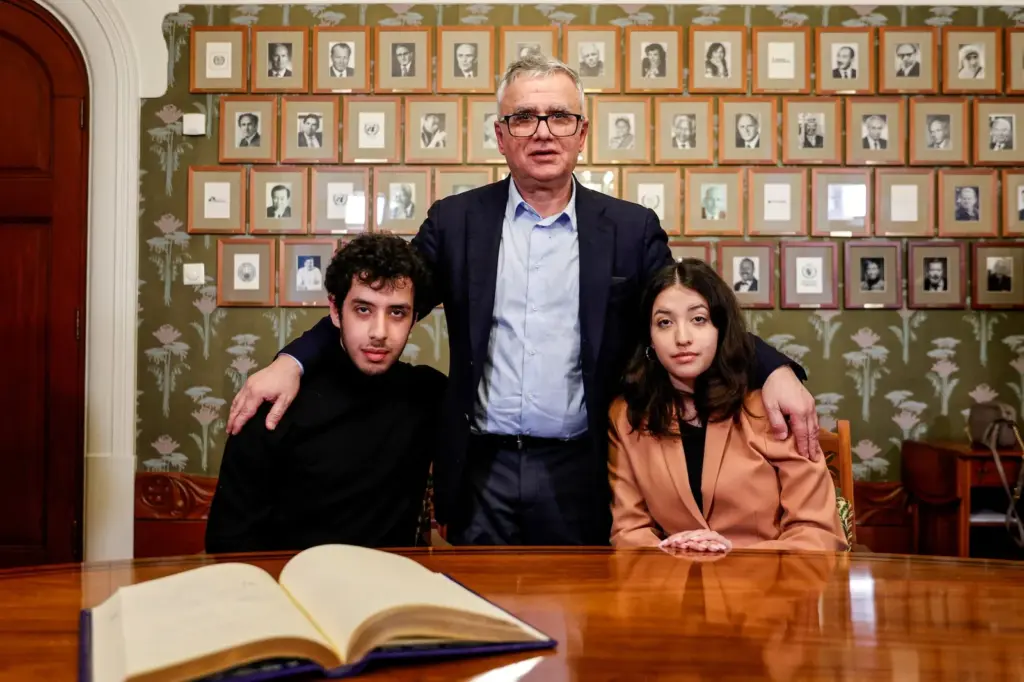
Kiana states that her brother, her father, and she do everything possible to keep their mother’s voice alive outside Iran. Despite everything and the memories of arrests witnessed firsthand, their memories of her as a mother are full of love and warmth. “When she was with us, she was completely present. We laughed a lot and played together.”
“I tried, in Persian media and also internationally, to constantly reflect her situation of injustice and her activities. Narges has a characteristic: she tries to be the voice of those who do not have one.” For Rahmani, supporting Mohammadi is supporting all political prisoners “because she wants to be the voice of all of them,” he adds. He recalls that the regime is taking advantage of the war situation to accelerate the execution of many political prisoners.
Still, he fears for her life. “We are really worried, because the regime’s resistance under these conditions can seriously endanger Narges’ life,” he warns.
From exile, his daughter Kiana sums up the family’s wish: “We hope to be able to reunite with our mother, to hug her again, for her to be able to visit us in Paris.” She adds that, besides the release of political prisoners, she wishes that other children do not have to live through a situation like the one she has suffered for so many years: “That they are not separated from their parents in this way.”