








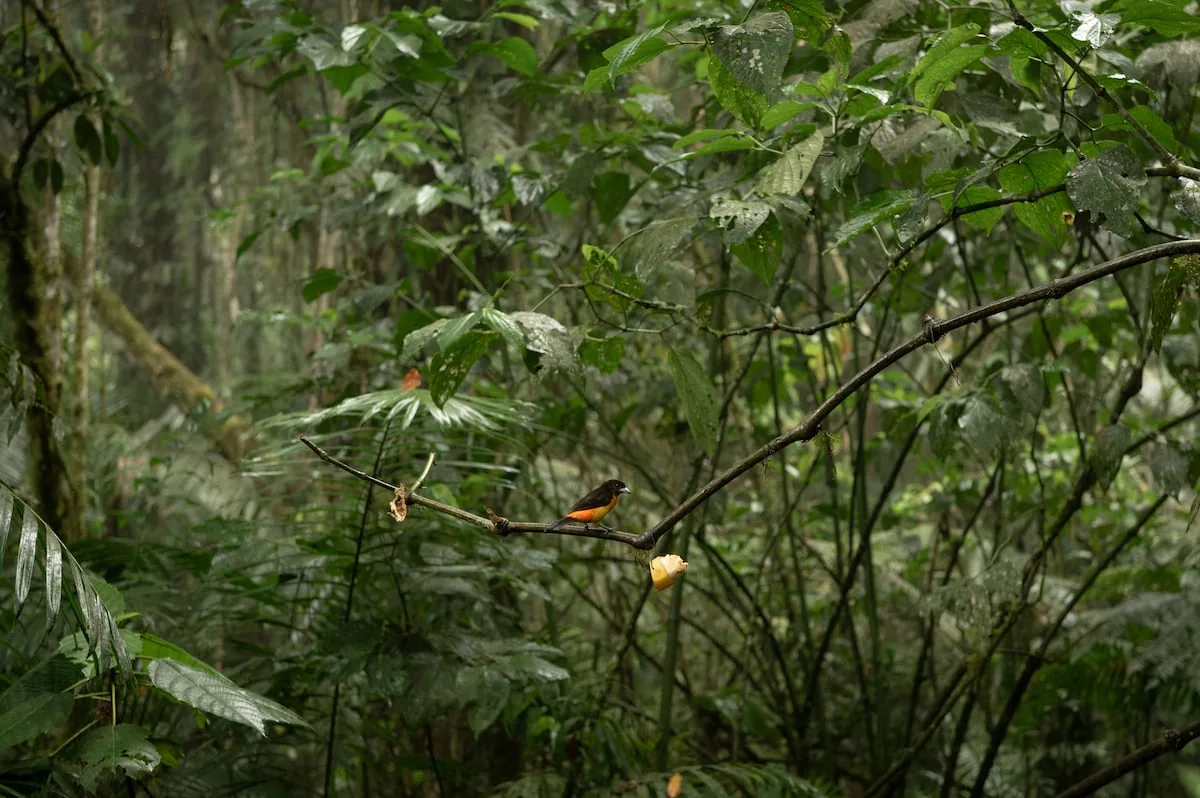
“Colombia is the most bird-diverse country in the world.” The phrase could well be a national slogan, one we could repeat to our children as the greatest pride of their land. Many Colombians—in the whirlwind of bad news—forget to observe or, better yet, listen to the country of little birds that surrounds us even amid and despite the sounds of bullets or bombs. And that, the enormous diversity, was what the report by American journalist Anderson Cooper on the renowned CBS program ’60 Minutes’ recalled this week. “Colombia is home to about 2,000 bird species, more than anywhere else on Earth. Decades of conflict kept people away from many areas, preserving bird habitats. Now birdwatchers are arriving en masse,” he said in the introduction to twelve exciting minutes that allowed viewers to see the magnificence of Colombian forests.
Read more Valencia Basket rises again in the hell of Athens and extends the fight to be in the Final Four
Amid the cold political campaign and unbearable social media fights, let’s talk about little birds. First, about the diversity in Colombian territory. The country has more than 1,912 registered species, 79 of them endemic, and is a key point in the migratory routes of the Western Hemisphere. Birdwatchers go after gems like the multicolored tanager, the ruddy quail-dove, the sword-billed hummingbird, or the golden-ringed tanager — the latter is the one the journalist was able to see. “Now you belong to a cult of mortals who have seen it,” Diego Calderón Franco, researcher and birdwatching guide, told him, aware that these are unique moments to capture the beauty of their colors and plumage. The chances of experiencing such moments increase in Colombia, which concentrates 20% of all bird species on the planet.
For at least a decade, it is true, the possibility of sustainable tourism has increased and the number of birdwatchers has multiplied. Today there are — note this — 27 nature reserves where birdwatching can be done any month of the year: the Aviary of Cartagena, Los Nevados National Park, Las Tángaras, the Sun Hummingbird, the Sierra Nevada de Santa Marta, among others. In Cali, the 12th edition of the Colombia Birdfair was just held, which brought together 7,000 people and secured the capital of Valle as the joint venue for the World Bird Fair and the South American Bird Fair in 2027.
Not least, this Saturday, May 9, the Global Big Day is held, organized by the Cornell University Ornithology Lab / E-bird to celebrate World Migratory Bird Day. It is a simultaneous event in which citizens, enthusiasts, and experts from around the world dedicate themselves to recording bird species on this digital platform. This year the goal is to record 8,000 species and have more than 1.7 million people participating. Colombia joins under the motto ‘A country that flies united’.
Although, as Cooper says in his report, the Peace Agreement with the now-defunct FARC guerrilla helped open spaces for birdwatching, and even former combatants of that guerrilla became birdwatching guides or bird photographers, we cannot forget that the conflict in Colombia persists. Precisely in those more remote areas there is still the presence of dissident groups and others that exert social control, and deforestation has increased. Added to this, the new forms of war — now carried out with drones — as well as extensive livestock farming, could scare away and put at risk those birds that produce so much pride. In some regions, due to birdwatchers’ interest, many communities are conserving the forests where they can see them.
In the ’60 Minutes’ report, biologist Calderón narrated that birds “saved him” when he was kidnapped by the FARC in 1996. He dedicated himself to watching them, listening to them, and noting every detail. It is worth thinking that one day birds might save the country and the ugly, noisy verbs of conflict might be replaced by kinder ones like walking, observing, birdwatching.
Two recommendations:
- The book Field Guide to the Birds of Colombia, by Miles McMullan. From Rey Naranjo Publishing.
- The free app Merlin Bird ID from the Cornell Lab, which allows you to record the birds you encounter and listen to thousands of bird sounds.
Other stories
This is a brief selection of other recommended news from EL PAÍS América Colombia:
Rita Segato in Colombia: “Men have to mock the mandate of masculinity.”
In an interview with EL PAÍS, the feminist questions the limits of progressivism in the region and discusses the place of some women within governments in Latin America.
Nicolás Samper: “A 48-team World Cup is no longer a World Cup, it’s an invitational where a lot of money is made.”
The Bogotá journalist publishes ‘The goalkeeper who died on the field,’ a collection of short stories about little-known anecdotes in the world of football with the intention of reviving the spark of a sport increasingly driven by business.
Investors bet against Colombia after the Banco de la República’s decision to keep the interest rate unchanged.
The peso, bonds, and the Colombian Stock Exchange feel the blow. JP Morgan recommends selling the local currency due to the “politicization of monetary policy.”
The United States increases pressure on Mexico and Colombia in its new drug control strategy.
The Trump Administration proposes a more aggressive approach with the demand for measurable results from other countries.
Petro lashes out at Congress to push his Constituent Assembly: “The cavernous forces blocked the reforms.”
The president promises to present five million signatures to the Legislature that convenes on July 20, to advance his project to amend the 1991 Constitution.
On Friday, a new installment of the electoral campaign follow-up.
If this newsletter has been forwarded to you and you want to receive the next ones in your email, you can sign up here. For any comments or suggestions you can write to boletines@elpais.es