







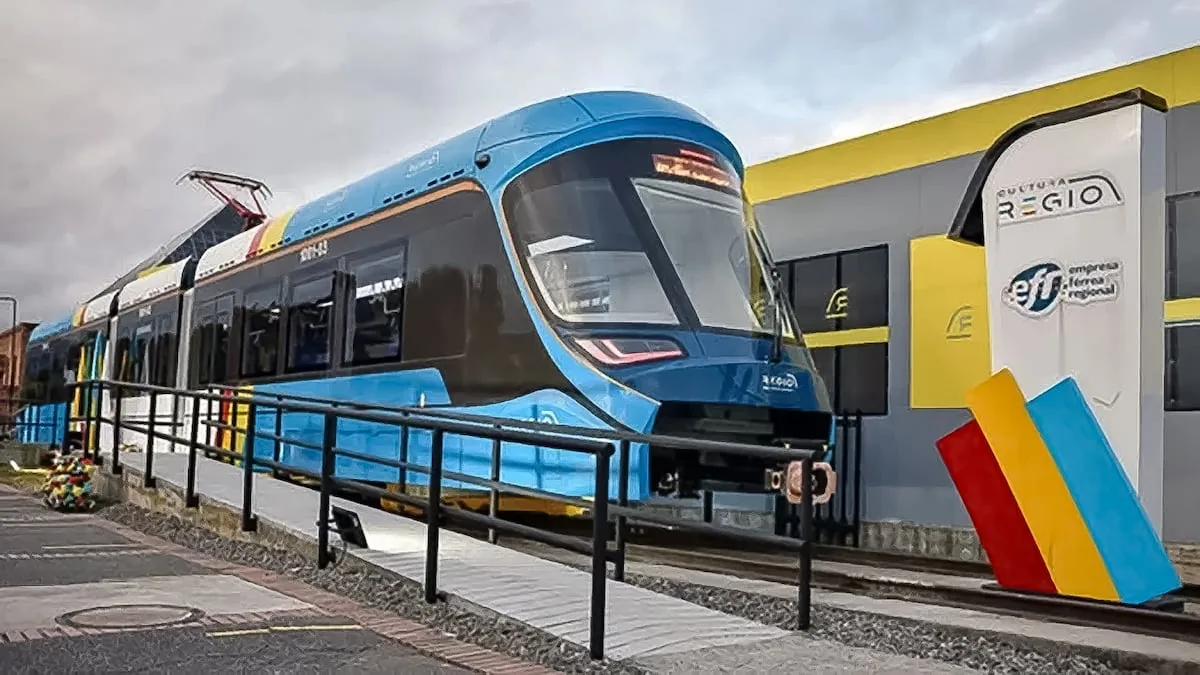
Bogotá was left behind by the train. Six months after the deadline to finalize the financing mechanisms for the Regiotram del Norte, the railway project that will connect Bogotá with several municipalities in the Sabana Centro, such as Zipaquirá, and will help with the mobility of about 11 million inhabitants of the region, the Mayor’s Office has still not signed the tripartite agreement with the Nation and the Government of Cundinamarca. In this scenario, the national Government has increased its participation in the project from 70% to nearly 82%. The measure, the national Executive assures, aims to preserve the execution schedule, avoiding delays in a work that has been in structuring for several years and whose total cost amounts to 17 trillion pesos or 5 billion dollars.
Read more The Constitutional Court overturns taxes on power generators
The Minister of Transport and former Bogotá councilor, María Fernanda Rojas, said the adjustment responds to the lack of definition by the capital’s government within the expected timeframes. “The time to make the contribution was last year. Between July and November they were supposed to take the project to the Council and the task was not done,” she told the press. According to her explanation, while the Government of the department surrounding the city did manage to approve its resources, the administration of Carlos Fernando Galán did not complete the procedures before the guarantee law came into effect. “Even if Bogotá says it has the will, it does not have a certain source nor approved resources to provide it,” she stated.
In this scenario, the Government chose to assume a greater proportion of the financing to prevent the project from “sinking.” “We cannot remain still knowing that by making a greater contribution from the Nation we can save the project,” said the left-wing politician, who argued that urgency also weighs: the schedule plans to open the bidding in July, leaving only 35 business days to complete the process. “If we wait for Bogotá to complete all the procedures, the project will fall,” she said.
From the District, the Executive’s decision has been interpreted as an “exclusion” of “Bogotá from the project.” This was expressed by the secretary general, Miguel Silva Moyano, in a message on his X account on Tuesday. “No team from the Bogotá Mayor’s Office was consulted,” the official reproached upon learning of the Conpes document, and criticized that “the way to solve the technical shortcomings of this project […] is not by excluding Bogotá, but by working harmoniously.”
This Wednesday, Mayor Galán adopted a more conciliatory tone after meeting with the minister and Governor Jorge Emilio Rey. He reiterated that Bogotá supports a project that has 11 of its 17 stations in the District’s territory, but warned that, as currently planned, it presents problems in its urban integration. “There are difficulties in the insertion of the project into the city,” he said, mentioning three key aspects: the impact of several elevated sections, the lack of solutions at various road intersections, and the absence of clear integration with the District’s Integrated Public Transport System (SITP), in physical, operational, and fare aspects.
One of the most sensitive points is the design of six kilometers of elevated structures on Avenida El Dorado, which runs through the center of the city from east to west, with two columns seven meters high. “It is important that there is an effort to mitigate the urban impact,” said Galán, recalling similar discussions generated by the elevated metro, a typology that in that case he has criticized without questioning President Gustavo Petro.
Despite the observations, the mayor has reaffirmed the District’s financial commitment. “We have 2.3 trillion pesos and we reaffirm it, but to be able to provide them it is necessary to advance on these issues,” he said. To this end, he announced the establishment of high-level technical tables that “will begin reviewing each issue starting tomorrow.”
The minister has defended that the project has been widely discussed. She recalled that the process dates back to 2019, during the government of former president Iván Duque, and that between 2020 and 2023 — before Galán’s arrival at the Mayor’s Office — the feasibility phase was developed with the participation of the District. “Bogotá participated in 90% of the technical tables.” Rojas added that, after her arrival in January 2024, Galán’s Mayor’s Office made new observations. Of 54 raised, they clarified 40, incorporated 11, and three “remained to be incorporated,” she stated. “To say there has been no discussion is false,” she concluded.
For Mario Avellaneda, an expert in mobility and professor at the National University, the focus of the debate should not be on who finances it. “The first thing is that it already achieved full financing. That should be celebrated,” he says, and points out that reducing the discussion to Bogotá’s exclusion is a mistake. “The financing of these projects is not only for rails, trains, and stations. Bogotá can, and should, invest in urban development around the system,” he explains. “If it has the 2.3 trillion pesos it says it has and that were not included in the infrastructure work financing, it should redirect them to urban development projects around the Regiotram del Norte line and, why not, the Occidente line and metro lines 1 and 2,” adds the expert.
In that sense, he considers that the change in financing opens an opportunity for the District to expand the scope and horizon of the project to include equipment works, expansion of public space, real estate projects with public participation, revitalization, and improvement of infrastructure in general. “Bogotá is left with a fund of 2.3 trillion pesos, which the District has not had before to carry out projects around transport, and it would mark a very interesting milestone for the development of projects in the city and the country,” he assures.
Avellaneda also relativizes the current tensions. He considers that the technical observations are part of the natural cycle of projects of this scale. “They are maturation processes. Designs are adjusted as studies progress,” he explains. However, he warns that differences cannot stop execution. “There can be technical discussions, but they cannot slow down the project. Throughout the country, we have a historical debt with cities regarding the development of mass transport projects and we cannot continue in political conflicts over these issues,” he concludes.