One day in the late 80s, with Andalusia dominated by the PSOE, a tense conversation took place at the delegation of the Andalusian Health Service (SAS). Juan Moreno Conejo, the son of a day laborer who had emigrated to Barcelona at 18, was back in his homeland, where he and his wife opened a grocery store upon arrival. He now supplied caustic soda to the Junta, but the Administration had not paid him for over a year. And the household bills were due. His teenage son, Juan Manuel Moreno Bonilla, recalls that one day he got up at four in the morning to go to the bathroom, and passing through the kitchen saw his father with his hands holding his head over some papers: the family was going bankrupt.
One day, the man showed up with his son at the SAS delegation to ask for the back payments. “There was such a hegemony of the PSOE in Andalusia that it was suffocating. The power was so arrogant that it provoked a reaction.” An administration chief brushed the father aside with a phrase like: “You shouldn’t have gotten involved in this.” And the boy decided to make a move. He took the Yellow Pages at home, looked up the PP’s number, and went to join.
More than 30 years have passed. Now, at 12:43 in the morning on May 6 in Alhaurín el Grande, 25 degrees, it can be said that Juan Manuel Moreno, 56 years old, trained in Protocol and Event Organization, is at the best moment of his political life, which started when he was young: he never worked in anything else. No one on his team needs to say it in that sotto voce that whisperers have with journalists telling you “it’s off the record” while with their eyes they beg: “Put it, please, betray.”
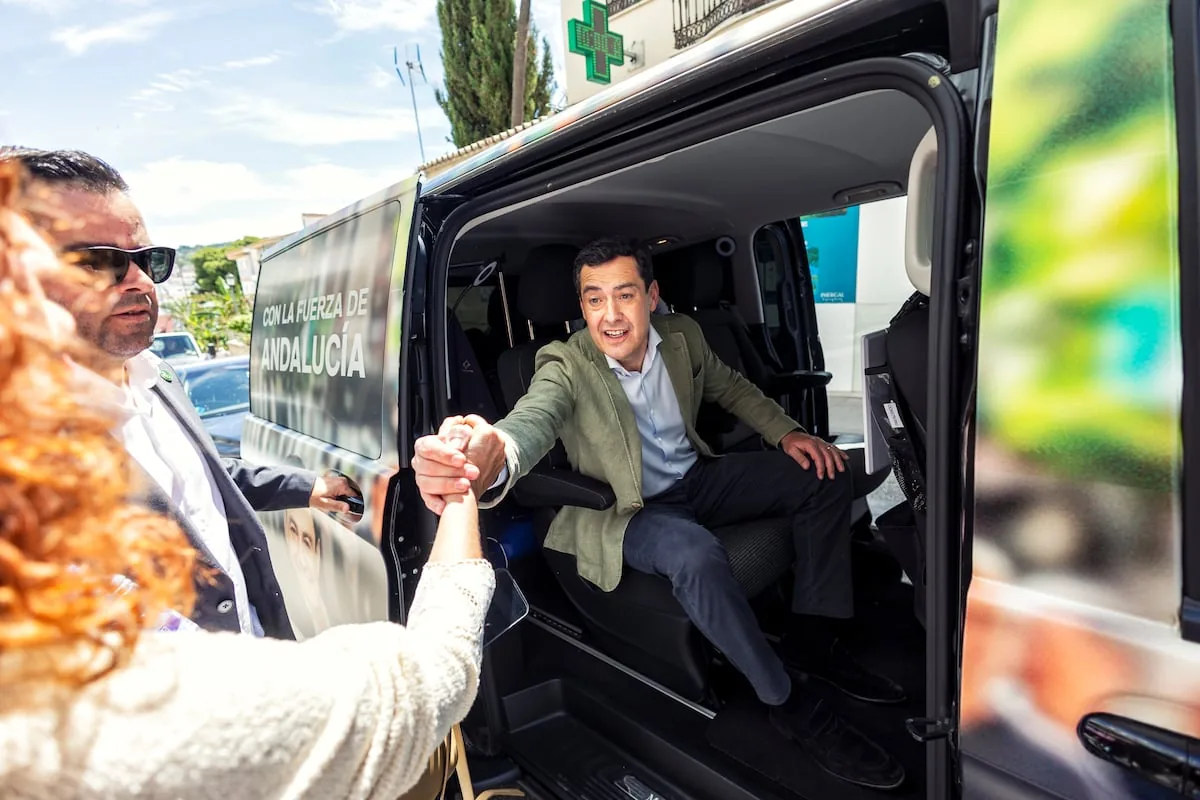
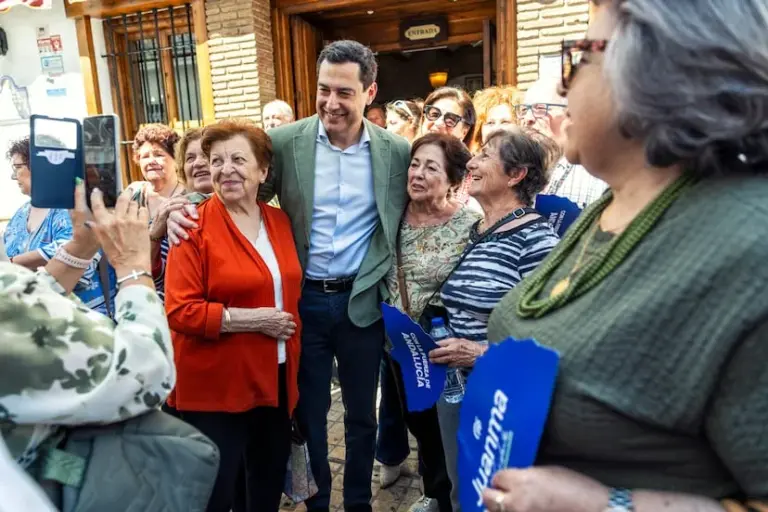
You just have to look up. The town’s residents have come out to the street, local police disperse cameras and microphones so traffic can resume, and the president of the Junta and candidate for re-election smiles here and there carried on high. They call him Juanma. And he takes some molletes from Coín that a man gives him. “I’m going to get fat.”
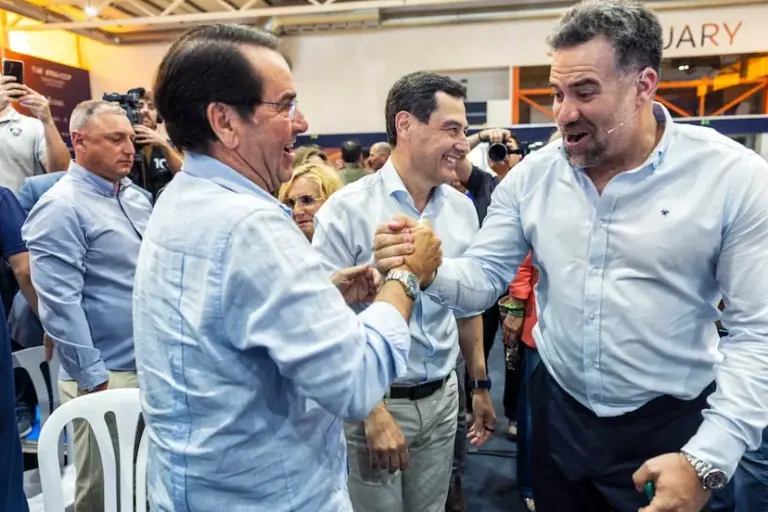
Moreno is the type who greets people he hasn’t seen in a while by looking them up and down, as if measuring them to eat them, or calculating according to weight and height the probability that they will vote for him. He does that with an old friend on the way to the Remo butcher shop, and ends up saying: “How time flies,” and to another: “How old are you now?” Amid the noise and smiles, one would say Juanma is settling unfinished business. He stops before a group of people, and after chatting with the one who seems the leader, he turns to the others: “Shake his hand if you want.” The candidate, if the neighbor is well known, puts his hand on the neck while greeting him, like football coaches when a substitute is about to come on.
A good part of his family waits for him at the Sardinas bar. Some are moraos, others are verdes. Alhaurín el Grande has carried for generations a fierce rivalry between the Brotherhood of the Holy True Cross, Los Verdes, and the Brotherhood of Our Father Jesus Nazarene, Los Moraos. For decades, much of the town’s social life was marked by this symbolic division: entire families identified with one color or the other, and the brotherhood feeling worked as a hereditary belonging. The competition extends to the thrones, the bands, the bull runs. The confrontation today is lived in a much more peaceful and folkloric way, but the identity of verde or morao still carries a heavy emotional weight. And Moreno Bonilla’s family, I ask his team, where do they stand? Expected answer: some moraos, others verdes.
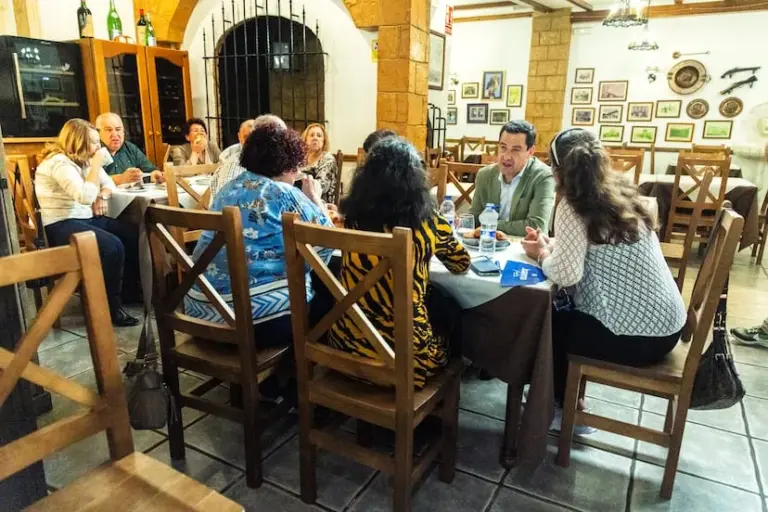
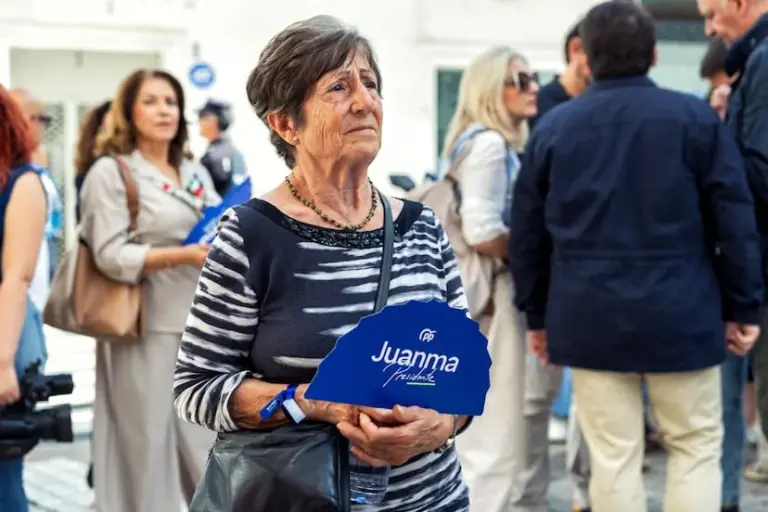
The brotherhoods also explain the president’s career always moving between shores. He has been ruling Andalusia since 2019, when he was boosted with the votes of Albert Rivera and Santiago Abascal. He was a Sorayist: he is the last Sorayist. He joined New Generations (NNGG) very young and climbed first in Málaga, then in Andalusia, and finally in Madrid, where he presided over NNGG in the late nineties. His career advanced in the warmth of Javier Arenas’ Andalusian PP, although he never belonged to the hard core of Arenism. He was a councilor in Málaga with Celia Villalobos, regional deputy, national deputy, and finally Secretary of State for Social Services with Mariano Rajoy. By then he had already earned a reputation in the PP: hardworking, loyal, and efficient. Of course, from there to governing, and moreover in the sanctuary of Spanish socialism… There were those in the PP who interpreted his appointment as candidate in 2014 as an elegant renunciation of the community.
It could be said that his great merit has been to appear moderate in the eyes of voters while ruling with the support of the far right without being perceived as radical. He manages perception well. He rarely conveys a sense of conflict even when he is fully involved in it, as happened with the cancer screening crisis.
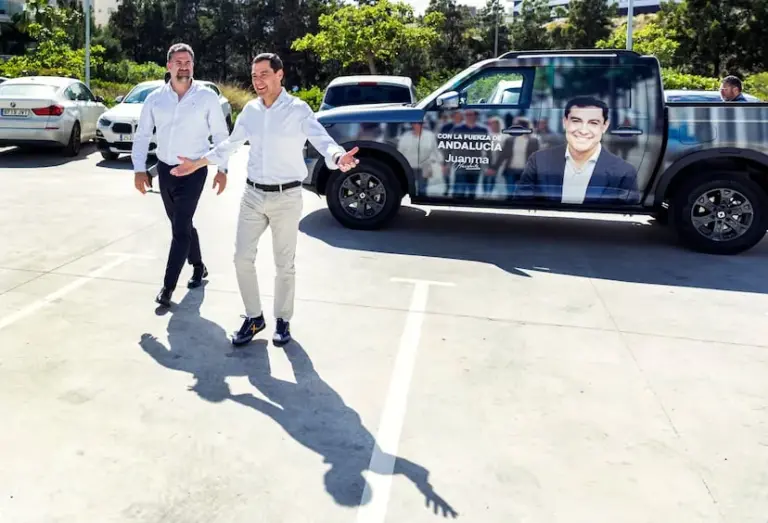
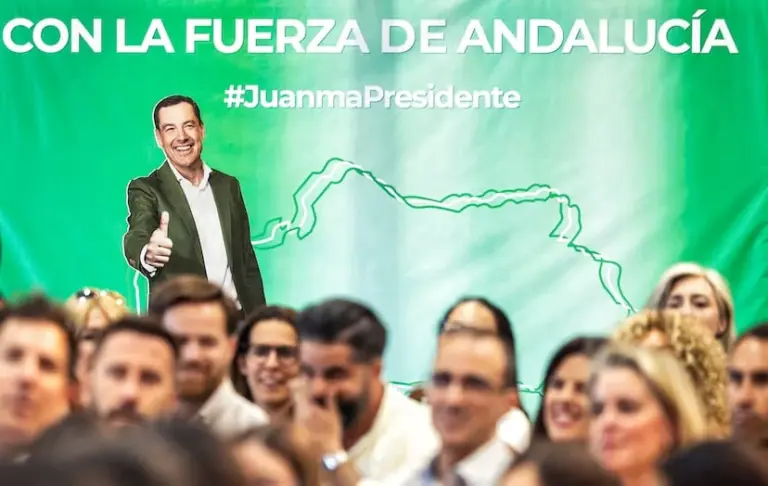
“This life is very intense,” Juanma says into the microphone, already in the Plaza Baja of Alhaurín el Grande. “I wouldn’t be president without having lived here,” he blurts out. Ovation. Let’s study the image. He looks like a canonical candidate, Kennedy-Suárez school: dark hair combed with a part, permanent smile, affectionate manners that are not affected. He got out of the van wearing a reversible green blazer: it could be for Andalusia but, if things get tough, it also works for Vox.
Moreno visits the Guadalhorce valley, a very fertile land that welcomes him with artichoke plantations. He no longer has the blazer and gets out of the car with his white shirt sleeves rolled up. He talks with the farmers, promises things, smiles all the time; it’s a commercial-like smile. He will end the day in Fuengirola giving a rally at The Embassy, a high-performance basketball center. There the audience is already something else, at least the majority. It is detected in the shoes and perfumes, the feet, the hands, and the neck, where you always have to look to calculate social class.
He has talked to EL PAÍS about everything so far, but, with the recorder off, he remembers his father. “I suffered a lot with the screenings because I know what cancer is. My father died 13 years ago of colon cancer as a result of a late diagnosis and one of the things I did was to incorporate screening for that cancer. It is a silent cancer that usually does not give warnings and that unfortunately, many times, already appears with metastases in the liver, as happened to my father. And then it is very difficult to treat.”
His father never saw him as president of the Junta. The PSOE is still unsuccessfully looking for the head of service who answered Juan Moreno Conejo badly that day. In any case: you never answer a man badly in front of his young son. You never know what you are unleashing.
Read more Iran seizes assets of Iranians accused of «aligning with the enemy»