






June 14 marks a century since a date that shaped the life of Salvador Dalí (Figueres, Girona; 1904-1989): his second, permanent expulsion from the Special School of Drawing, Sculpture, and Engraving of the prestigious Royal Academy of Fine Arts of San Fernando in Madrid. In such a regulated environment, he felt uncomfortable and, perhaps because of this, this academic training has been overshadowed in scientific literature. His escapades during those years in Madrid ―the happiest of his life, according to his own account― alongside Federico García Lorca, Maruja Mallo, or Luis Buñuel, his companions at the Student Residence and mutual sources of artistic inspiration, dominate.
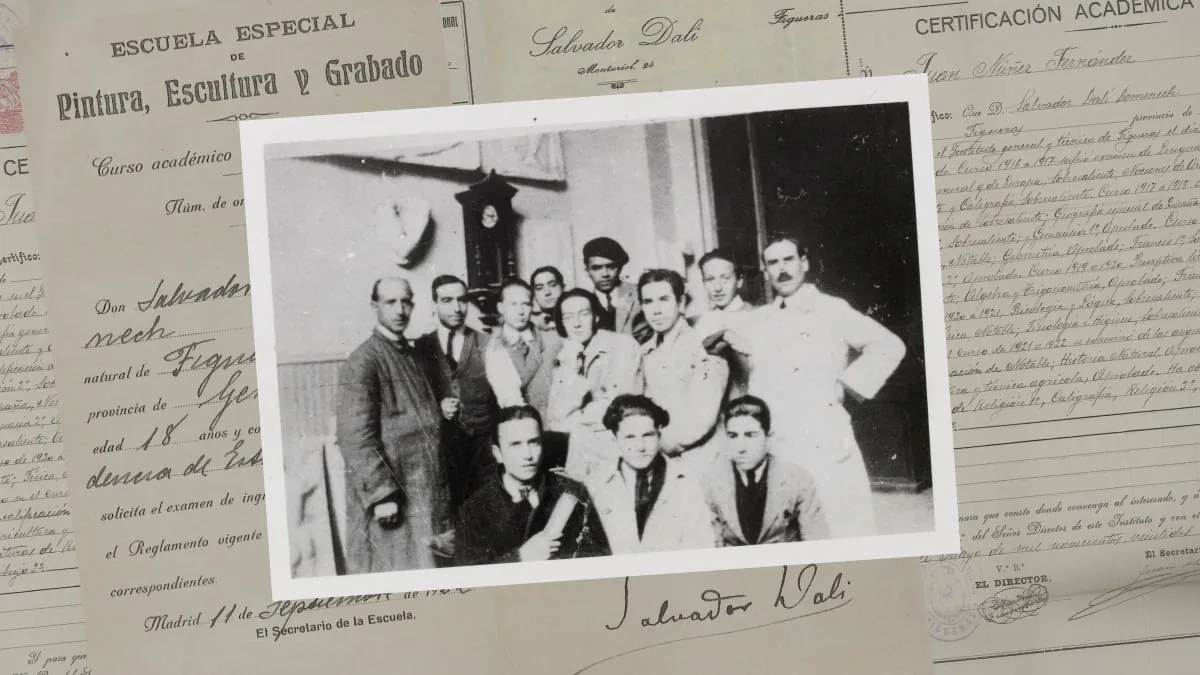
But thanks to the archives of the Complutense University (UCM) ―in 1970 the school became its Faculty of Fine Arts― EL PAÍS can now reconstruct Dalí’s adventures in the classrooms through grade certificates, letters from his father, or an almost unpublished disciplinary file. The dissemination is scarce. There are records of consultations by students or researchers ―such as the Hispanist Ian Gibson―, a request from the Reina Sofía Museum for an exhibition, and some Korean filmmakers making a film about the genius.
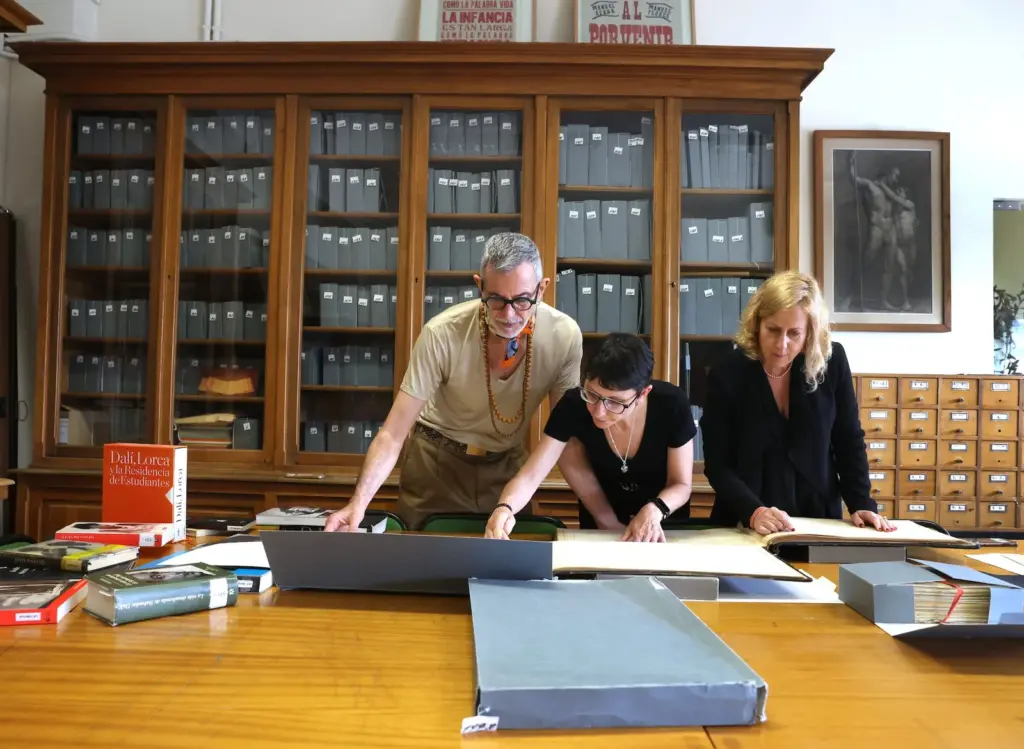
The file (AGUCM 136/06-17, 40) and Dalí’s grade records (AGUCM 107/09-08) are kept in the UCM Historical Archive, while the enrollment books, one of the father’s letters, and the expulsion ruling can be consulted in the Historical Archive of the Faculty of Fine Arts Library. Both spaces have minimal staff, so no one can dedicate all their time to digitizing and promoting this invaluable material. The inquiry made by this newspaper about Dalí has led to its digitization and it will be exhibited on their page.
“We provide a transversal service. We have an administrative function, but also a historical background. Not many people come here for consultation as if it were a museum,” says Ana Rocasolano, director of the UCM General Archive, which is in the Law faculty. “This university has a vast, overwhelming heritage due to its longstanding importance; but its strict function is not heritage, but education.”
Dalí settled in the Residence in September 1922. From there, he processed his admission to the school. The letter in which he requests to take the test is preserved, a drawing of a chiaroscuro sculpture, and the receipt of the fees. Until 30 years ago, the Faculty of Fine Arts maintained an identical exercise. Since 2008, there is no specific test, but the PAU cutoff score is very high: 9.9 out of 14 this academic year.
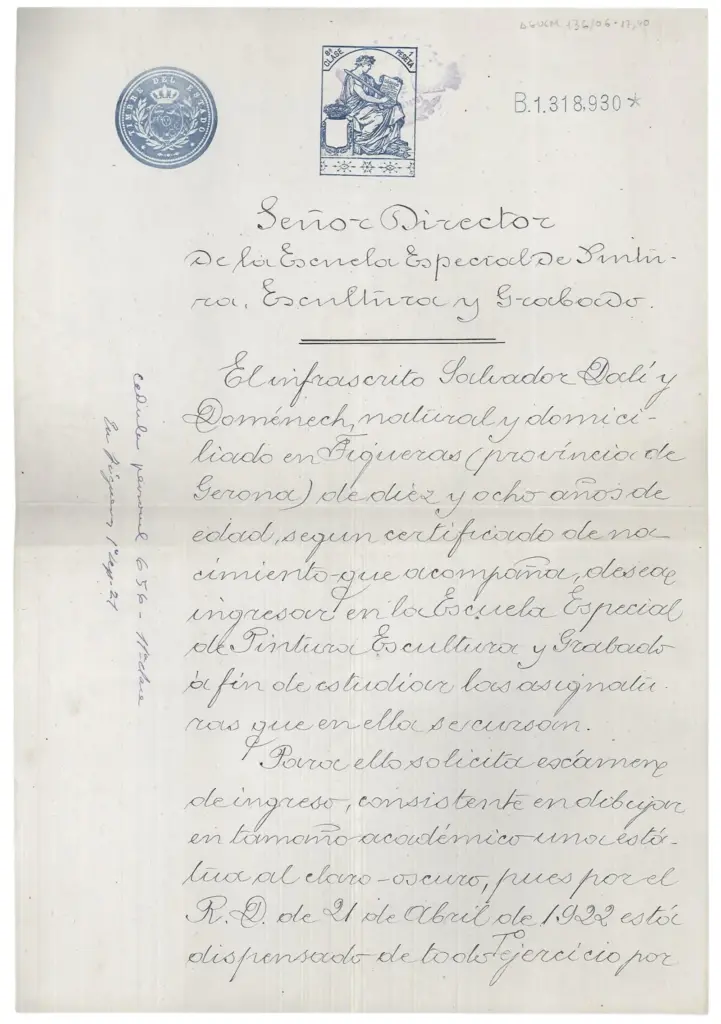
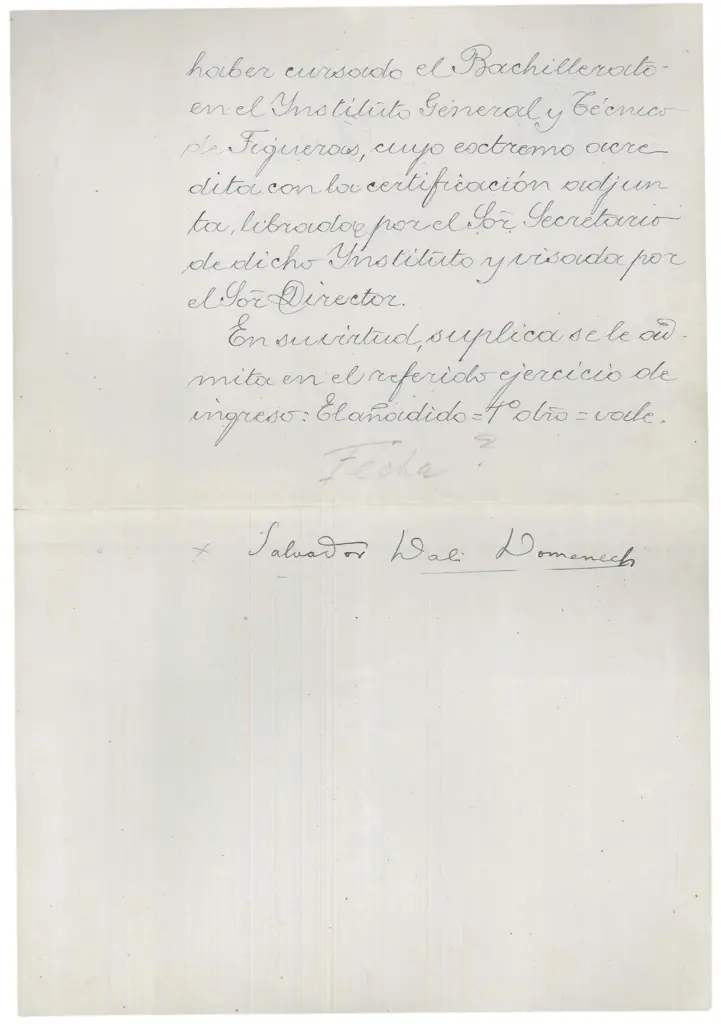
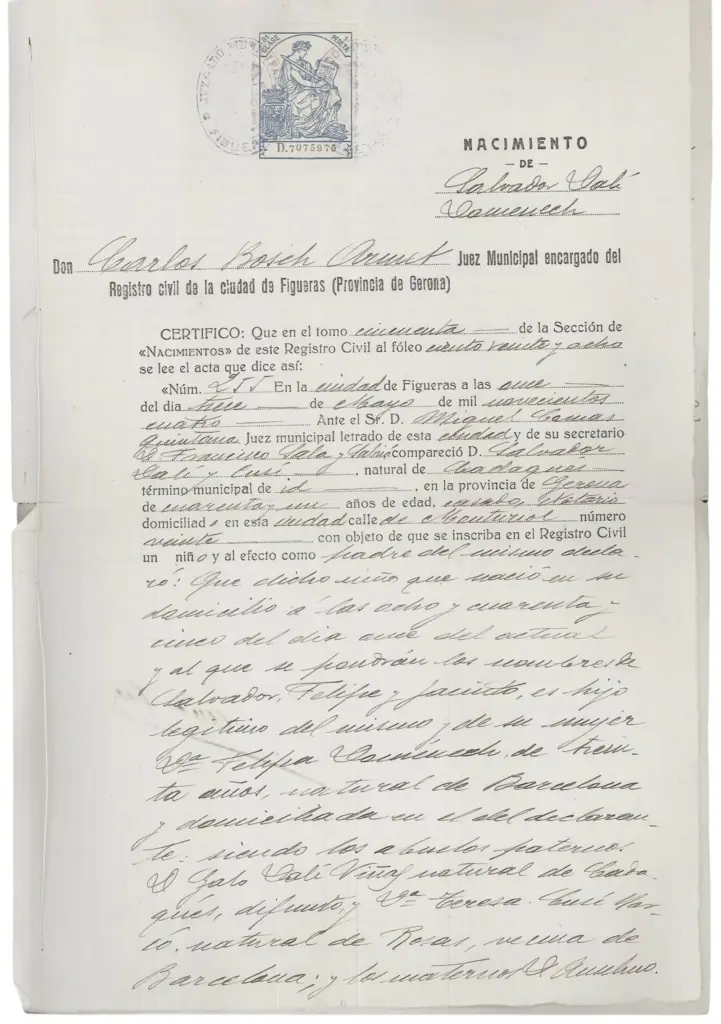
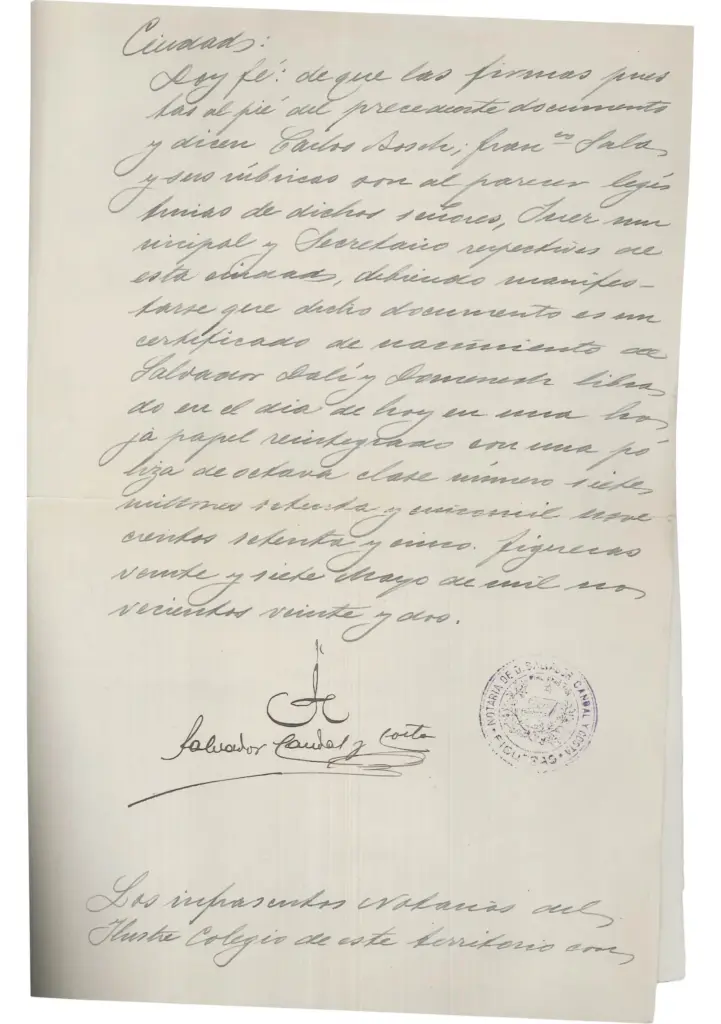
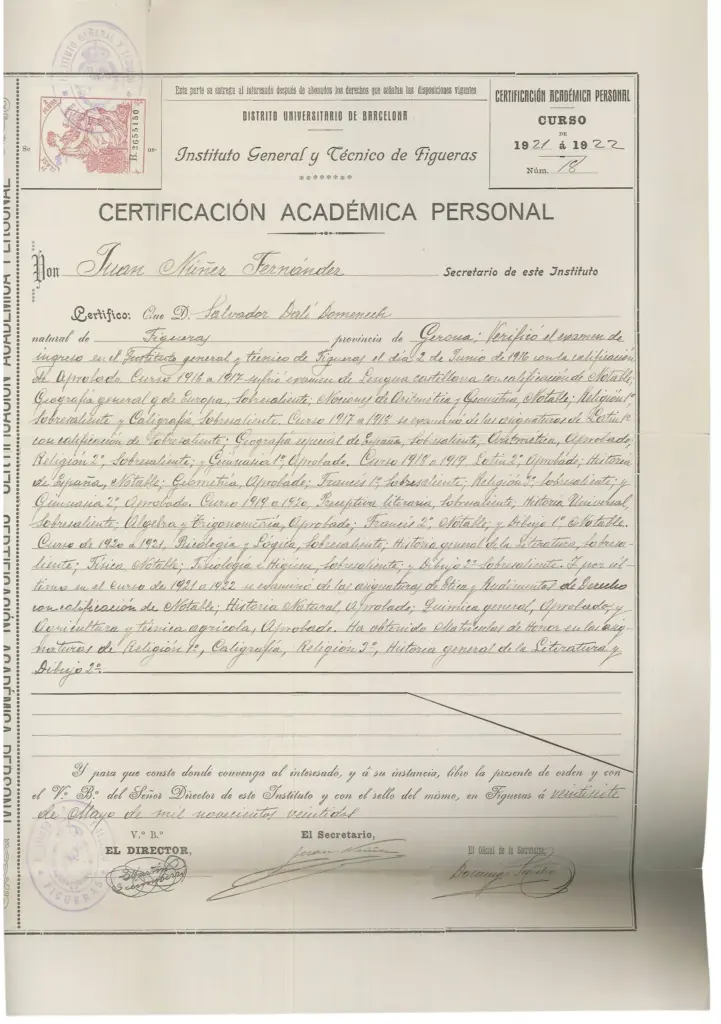
Given Salvador Dalí’s artistic qualities, his father agreed that he should train as a painter at the Special School of Painting, Sculpture, and Engraving in Madrid, 700 kilometers from his home in Figueres. On September 11, 1922, he paid the entrance exam fees and was already staying at the Student Residence.
Dalí sent a letter with his application to the director “begging” to take the exam with a beautiful handwriting praised by his high school teachers. It is undated.
He attached his birth certificate and his Baccalaureate grades to be exempt from further entrance tests except the chiaroscuro sculpture drawing exercise, as this demonstrated he had “sufficient” academic training. He was 18 years old and his mother had died a year earlier.
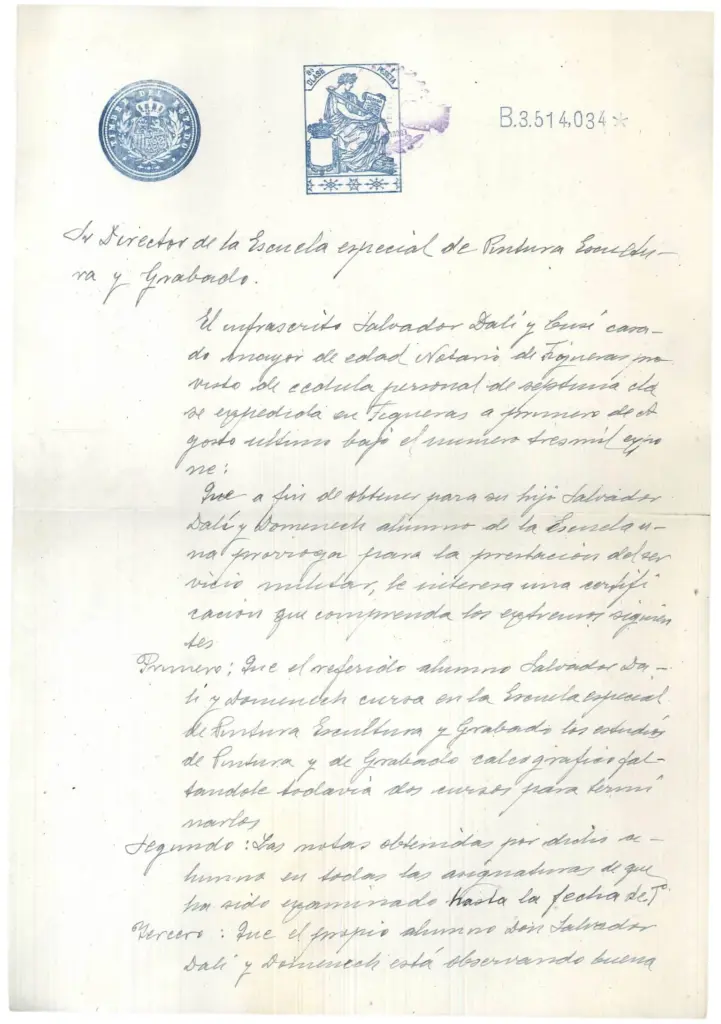
Dalí also included a notarized public faith signed by his father, Salvador Dalí i Cusí, who was a notary in the town and with whom he had a stormy relationship. He even disinherited him.
He added what was known as a personal academic certificate. This document included his grades, very varied, at the General and Technical Institute of Figueres over six courses (from 1916 to 1922). He was a mediocre student in sciences and outstanding in Drawing, Religion, Calligraphy, or History of Literature. Since adolescence, he proclaimed in his diary that one day he would be a star of art, as indeed happened.
Dalí was then 18 years old and his mother, Felipa Domènech, had died a year earlier. That is why he traveled to Madrid accompanied by his father, the notary of Figueres Salvador Dalí i Cusí ―with a prominent role in this story― and his sister Anna Maria. Given his artistic skills, his father, who hoped his son would have a profitable profession, gave in and encouraged him to enroll in the school to become a Drawing teacher in the future. He passed and enrolled in the five first-year subjects.
Two years before Dalí arrived at the school, in 1920, female students had managed, after signing a protest letter, to enroll in all subjects. Until then, they could not take life drawing, for fear of nudes, nor paint outdoors because they did not leave home without a family member’s company. Maruja Mallo was also enrolled.
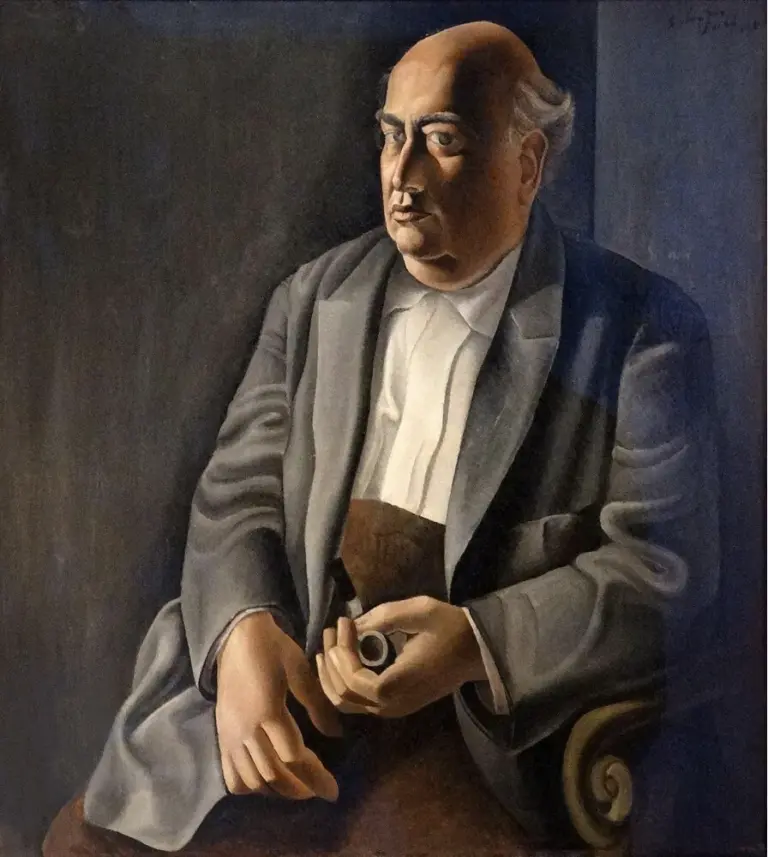
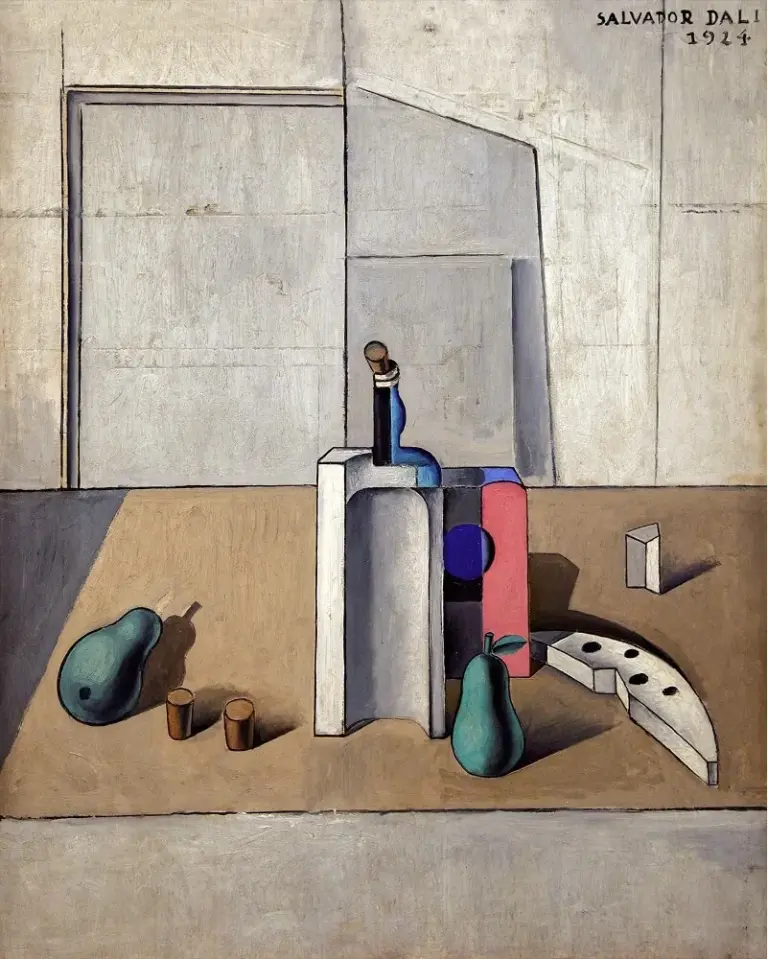
Dalí spent the first months in Madrid commuting by tram to the San Fernando Academy ―at Alcalá Street 13, where the institution continues without the school― barely socializing. His residence companions would later remember him as an extremely withdrawn, almost mute young man who locked himself in his room to find his own pictorial style. He moved between cubism, futurism, and metaphysics and made, besides self-portraits, many still lifes, like those presented in the 1925 Iberian Artists exhibition.
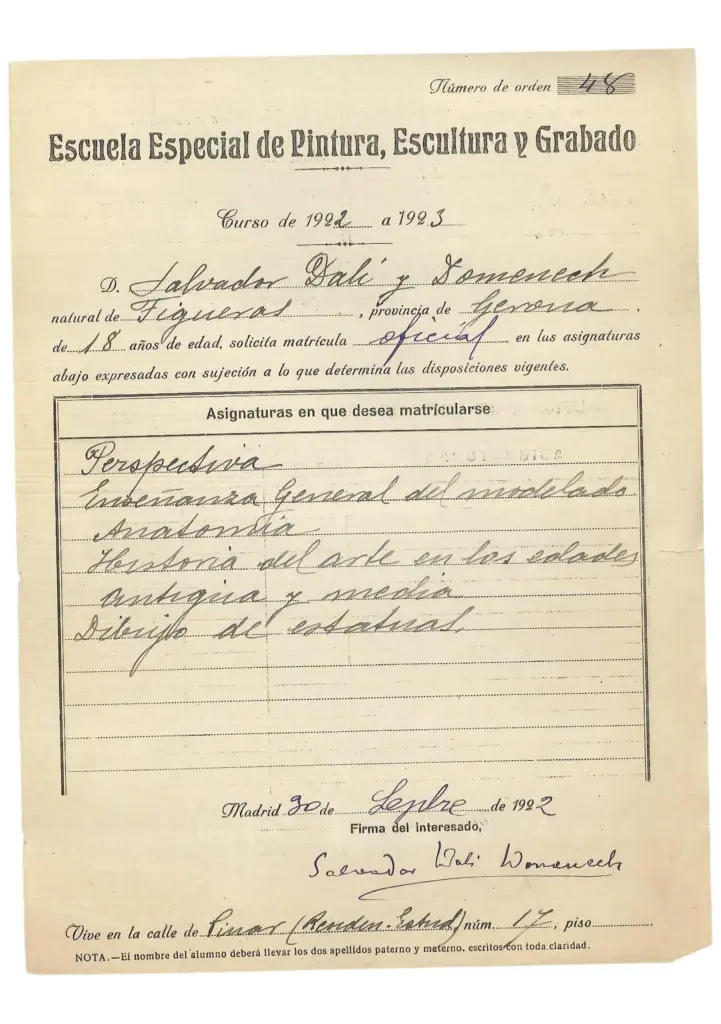
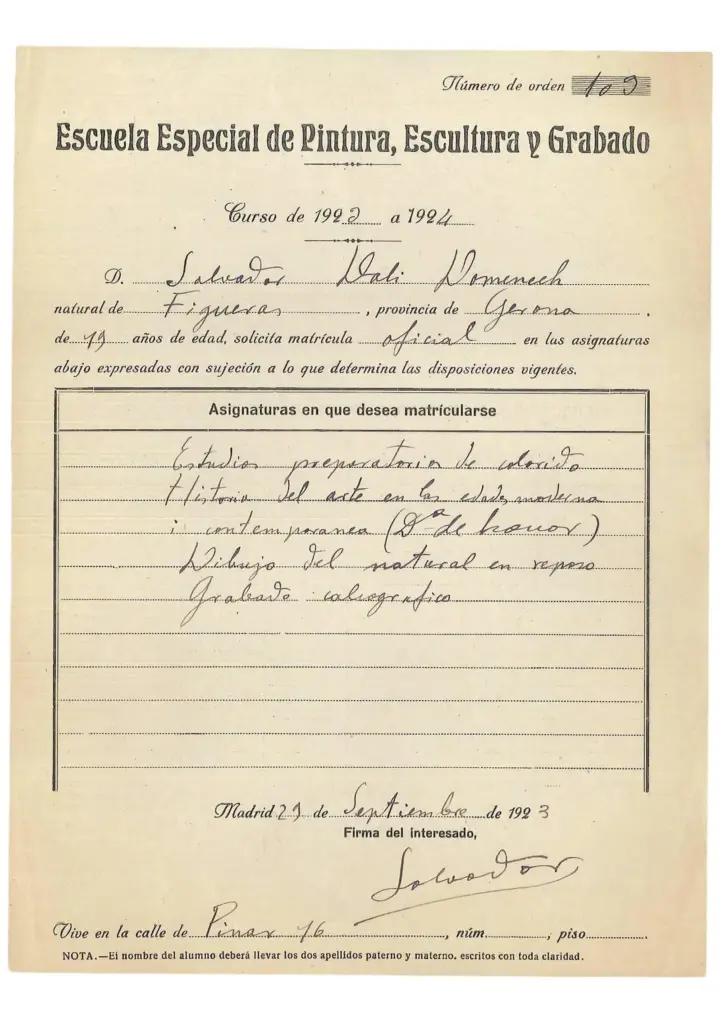
There is no document certifying that Dalí passed the entrance exam, but he must have passed it because he enrolled in the school. On September 30, 1922, he registered for five subjects: Perspective, Modeling, and Art History in the Ancient and Medieval ages, and Statue Drawing.
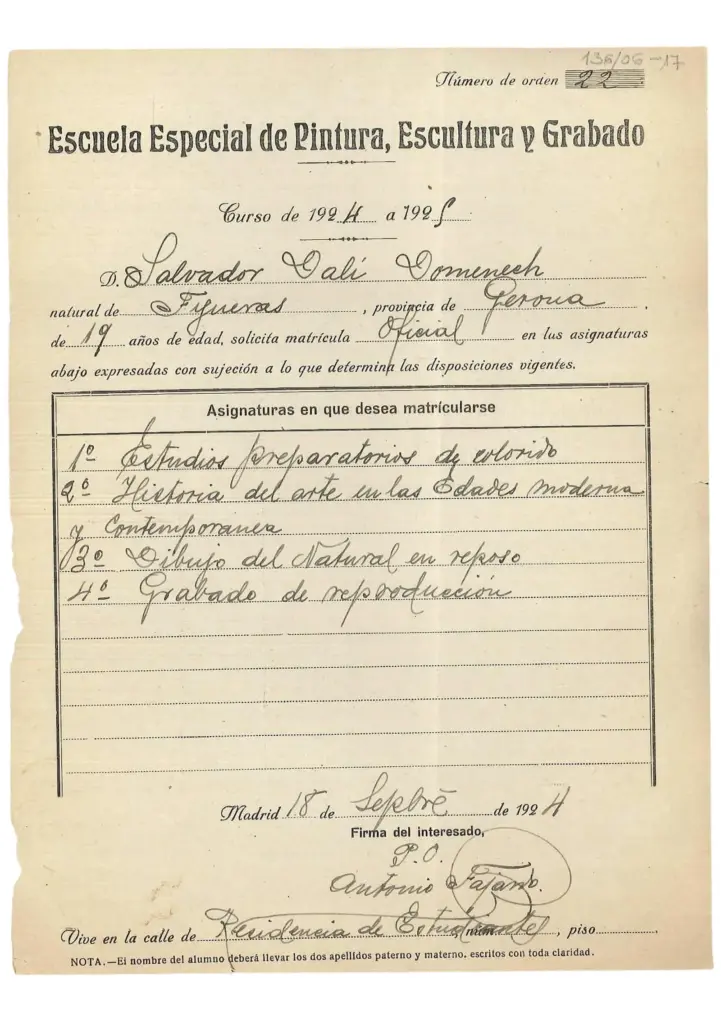
In the 1923-1924 academic year, Dalí enrolled in new subjects, which shows he passed the first year: Coloring, Life Drawing at rest, Engraving, and Art History in the Modern and Contemporary ages. He presumably did not pay for the last subject, having earned an honors grade in the Ancient and Medieval ages. That is why the previous grade is noted in the enrollment. Each subject cost between 10 and 25 pesetas (equivalent to six to 15 euro cents). He continued living at the Student Residence.
After the first expulsion in 1923, motivated according to his account by a student riot so that painter Daniel Vázquez Díaz would be their teacher, Dalí enrolled in the 1924-1925 academic year in the same subjects as the previous year. He started the second year of studies from scratch. During the months he was out of the drawing school, he studied with Francisco Bores, Moreno Villa, and Benjamín Palencia at the Free Academy, directed by Julio Moisés.
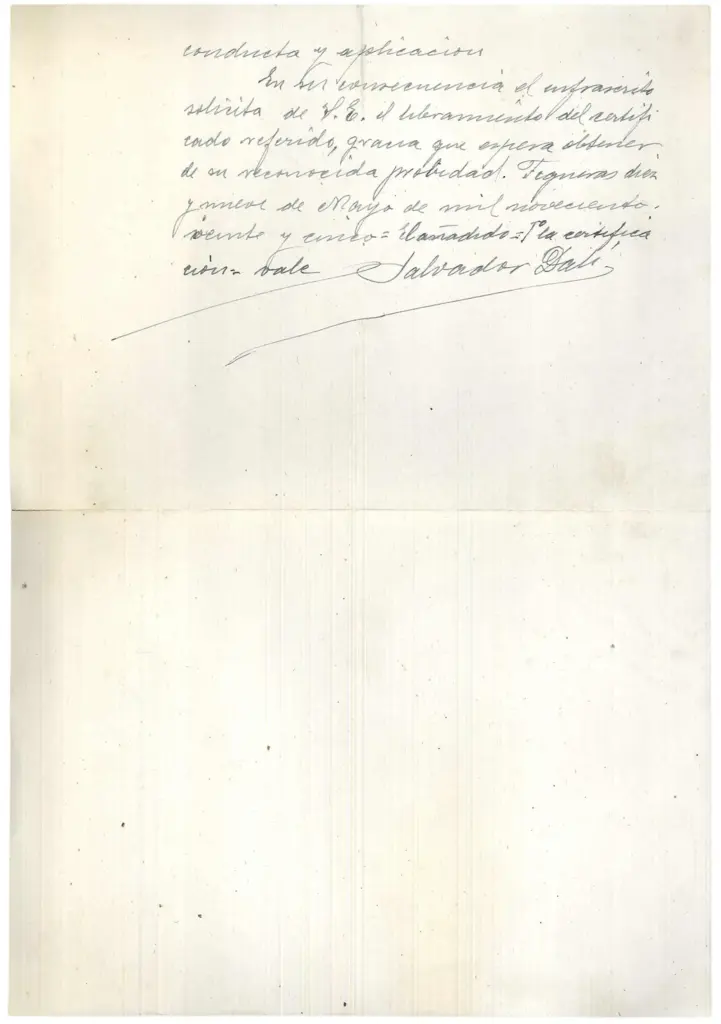
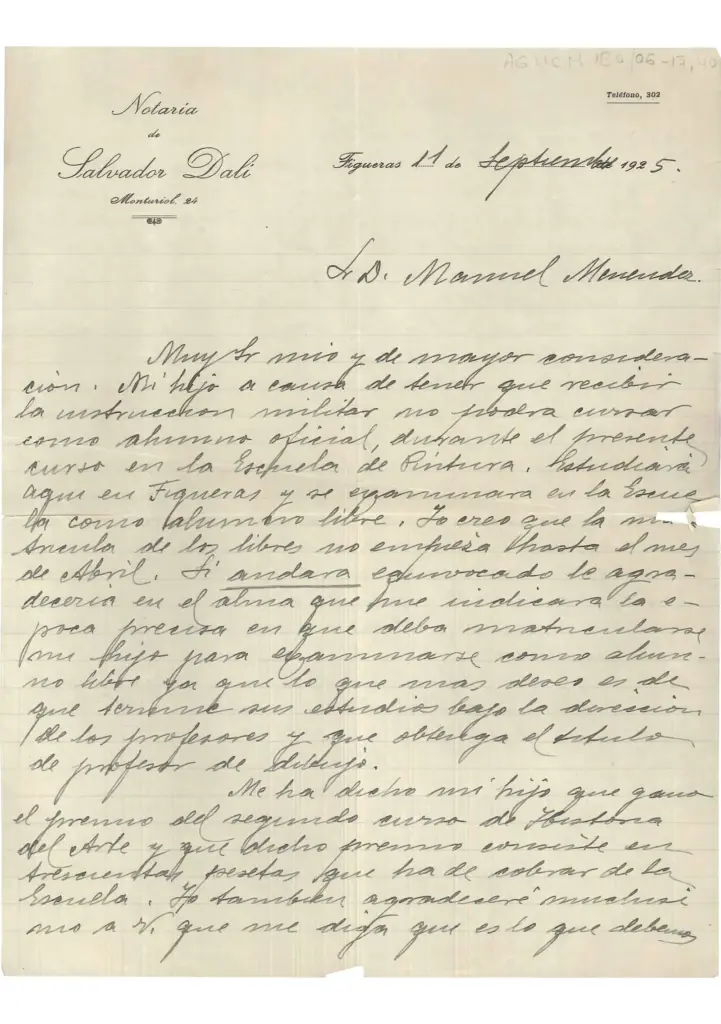
In an undated letter, Dalí’s father requests a study certificate from the school so his son can postpone military service.
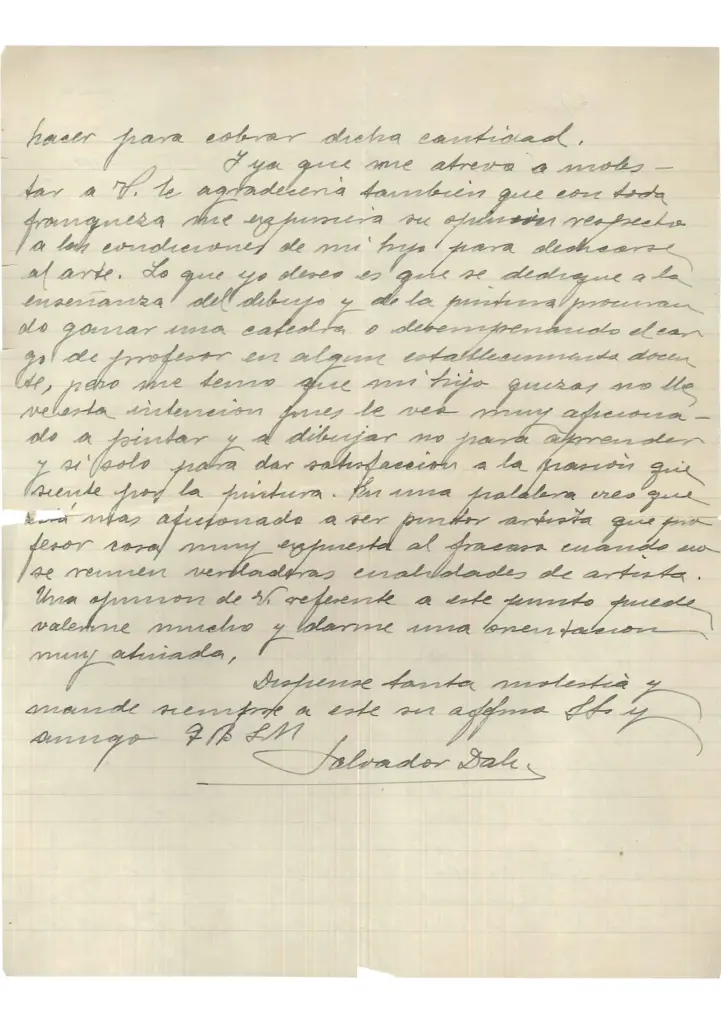
Finally, on September 11, 1925, Dalí’s father writes on his notary’s letterhead to the school secretary to inform him that his son would study in Figueres that academic year and take exams independently in Madrid: “Due to having to receive military instruction, he will not be able to attend as an official student this year.” And since he “dares to bother,” he asks Manuel Menénez about “his son’s conditions for art. What I want is for him to dedicate himself to teaching drawing and painting to earn a chair (…)”.
He was very influenced by what he read in books, catalogs, and magazines, and his studied look prevented him from going unnoticed. Extremely thin, he wore long hair with sideburns, huge shoes, a trench coat, stockings, and gaiters in the style of Victorian painters. Later, he cut his hair and, after discovering Velázquez, El Greco, and Bosch at the Prado Museum, he began to grow his characteristic mustache at ten past ten.
After a few months, he began socializing with the students, and the school took a back seat that it never abandoned. “At the Residence, Dalí and Maruja Mallo found many things and many people to talk to that made them rethink,” reasons essayist Estrella de Diego, a full academic member for a decade.
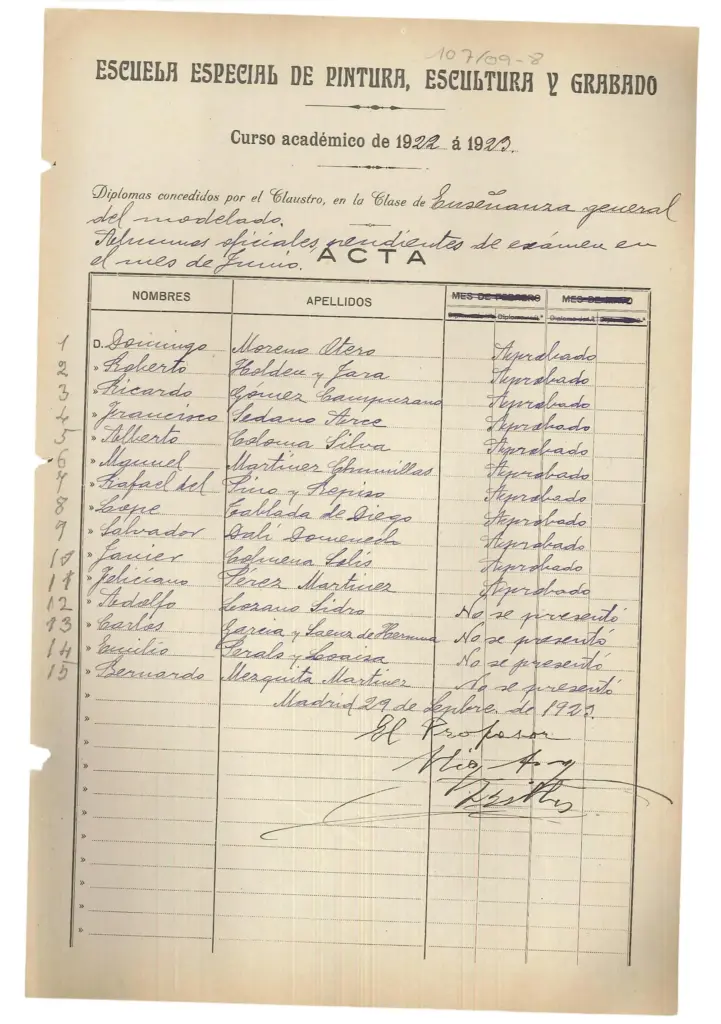
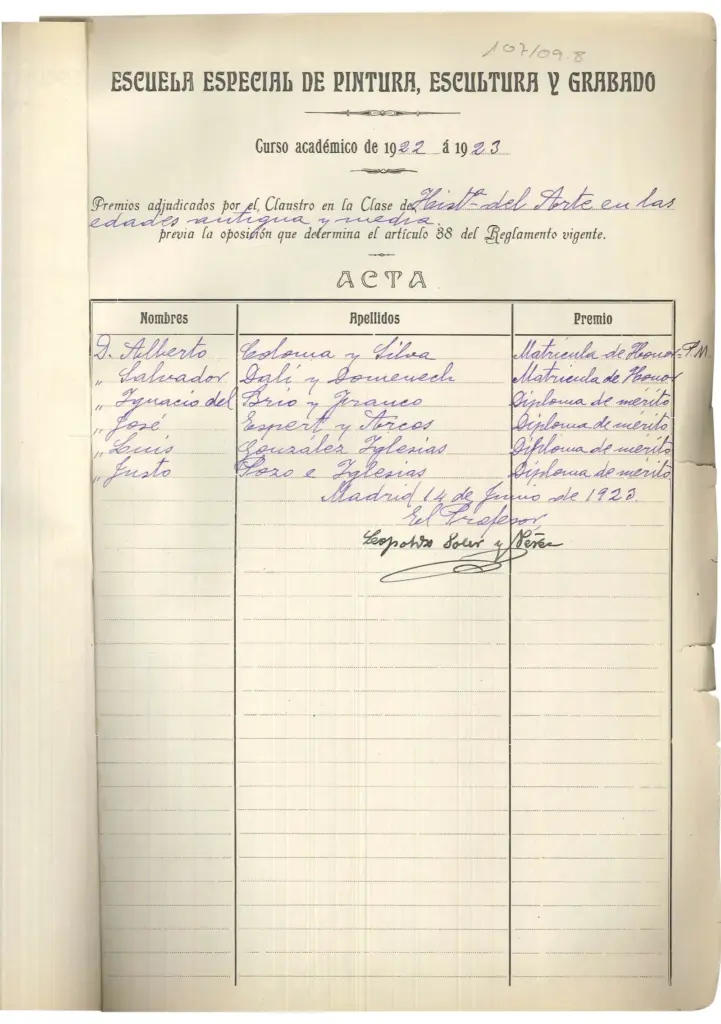
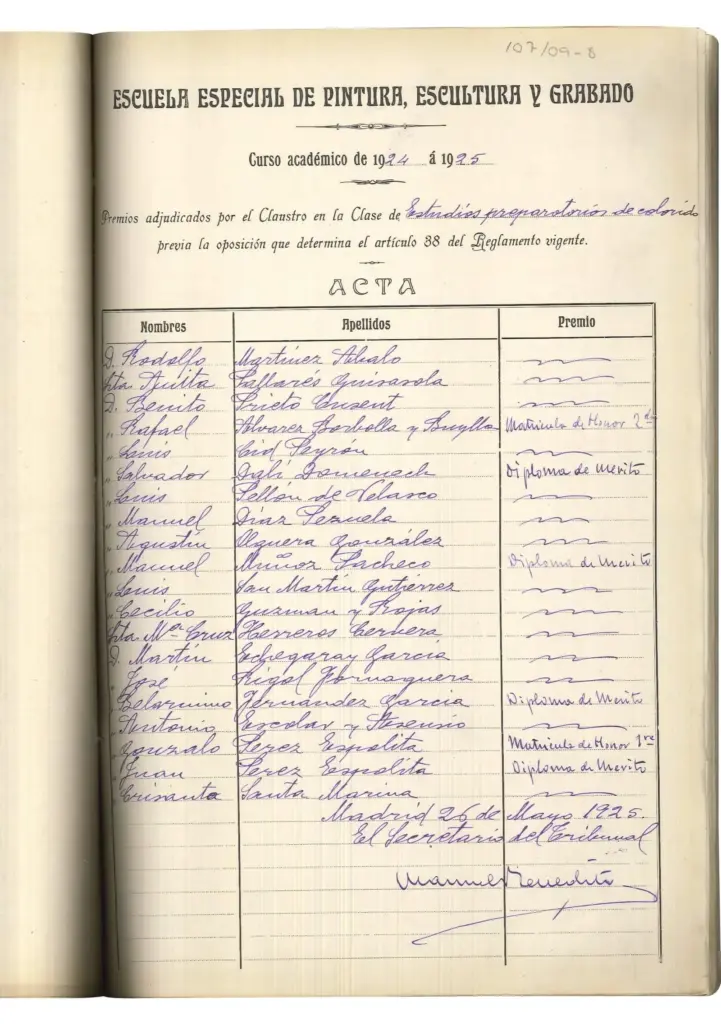
In the first year, Dalí enrolled in five subjects and passed all except Modeling in the February session. Along with him, five other classmates failed, which was unusual.
This forced him to retake the Modeling exam in June 1923, although the professor did not sign the record until September.
Dalí earned an honors grade in Art History of the Ancient and Medieval Ages in the first year. During his Baccalaureate, taken in Figueres, he already demonstrated great knowledge in art history.
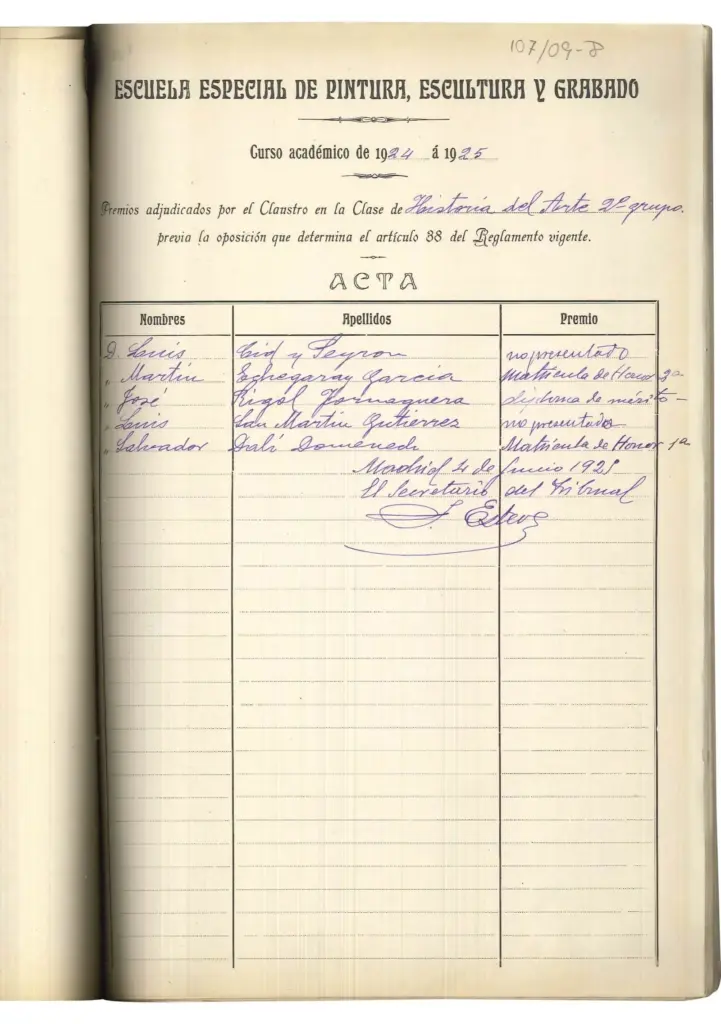
Presumably, the honors grade in first-year Art History allowed Dalí not to pay for the Modern and Contemporary Art History enrollment in the second year (1924-1925). He again obtained the highest grade.
In a letter to the school director dated September 11, 1925, Dalí wants to ensure that his son won “the second-year art history prize and that this prize consists of seven hundred pesetas to be collected from the school” and wants to know how to do so.
There are no records for the 1923-1924 academic year because he was expelled. The following year, he had to re-enroll in the four subjects. He obtained a “merit diploma” (outstanding) in Preparatory Studies of Coloring.
“At that time, even the most traditional painters complained that the school was too academic. The Residence gave them complicities that the Academy did not, which must have been boring,” emphasizes De Diego, UCM Professor of Contemporary Art. “However, the school gave them very important drawing tools. Picasso, Maruja, and Dalí were taught the basics.” Raquel Monje, dean of Fine Arts, agrees: “The school was a very conservative space. It took many years to stop being so! Our great wealth now is that the academy coexists with what happens outside.”
Dalí passed the first year (1922-1923) without problems, except Engraving, which he passed in the retake. He even earned an honors grade in Art History of the Ancient and Medieval Ages. What the documentation does not testify is the failed assassination attempt on Alfonso XIII on March 3, 1923, the day the king inaugurated the school library; Gibson states in two books that a tragedy could have occurred. According to his writing, Dalí ―until then anti-monarchist― planned with his companion Josep Rigol to make a “protest bomb, not to kill,” according to Rigol, filling an empty milk bottle with gunpowder. They placed the explosive in a vase on the stair railing, but luckily the fuse did not ignite. Estrella de Diego does not confirm the failed attack: “There is no evidence.”
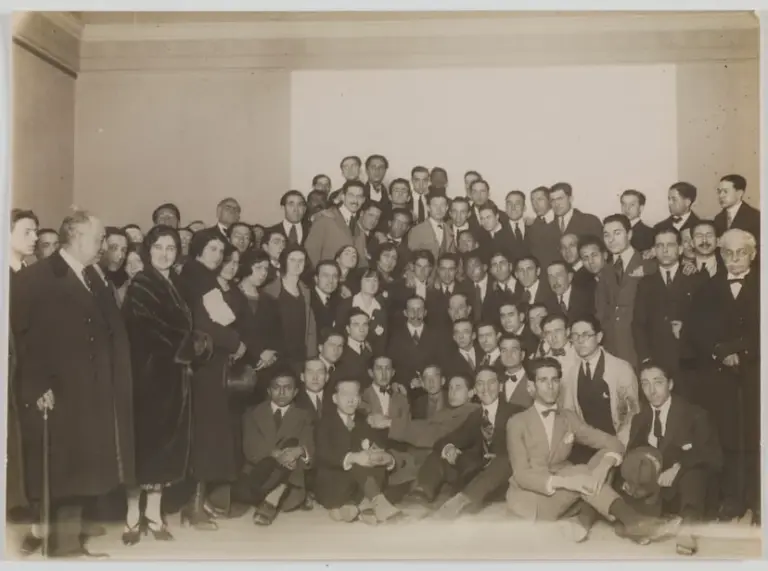
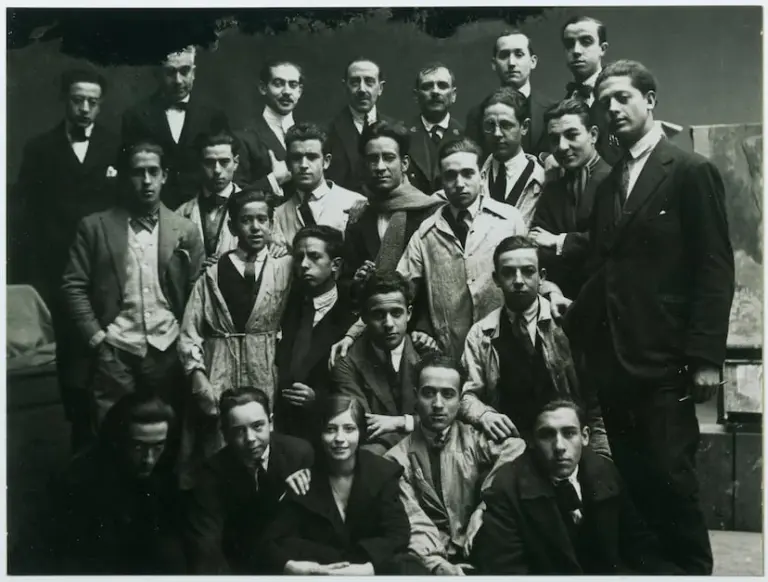
The Prado keeps the photo of a visit by Dalí and Mallo’s class to the art gallery with the king. If the bomb existed, no one found out, so that March 1923 Dalí was neither sent to jail nor home. But in September, his academic progress was indeed frustrated. He was expelled for a year for leading a student riot against the school’s very conservative decision not to accept painter Daniel Vázquez Díaz, considered too avant-garde, as a professor.
A furious letter to the school director from the painter’s father is preserved: “Dear Sir and of highest consideration. After speaking with the students, teachers, and employees of the school, I have fully confirmed my completely favorable opinion of my son,” his letter begins. “Unable to accept the Disciplinary Council’s decision, I have no choice but to resignedly accept the punishment.” And he prophesies: “An impeccable school and academic conduct will be observed so that they will regret having punished him so severely.”
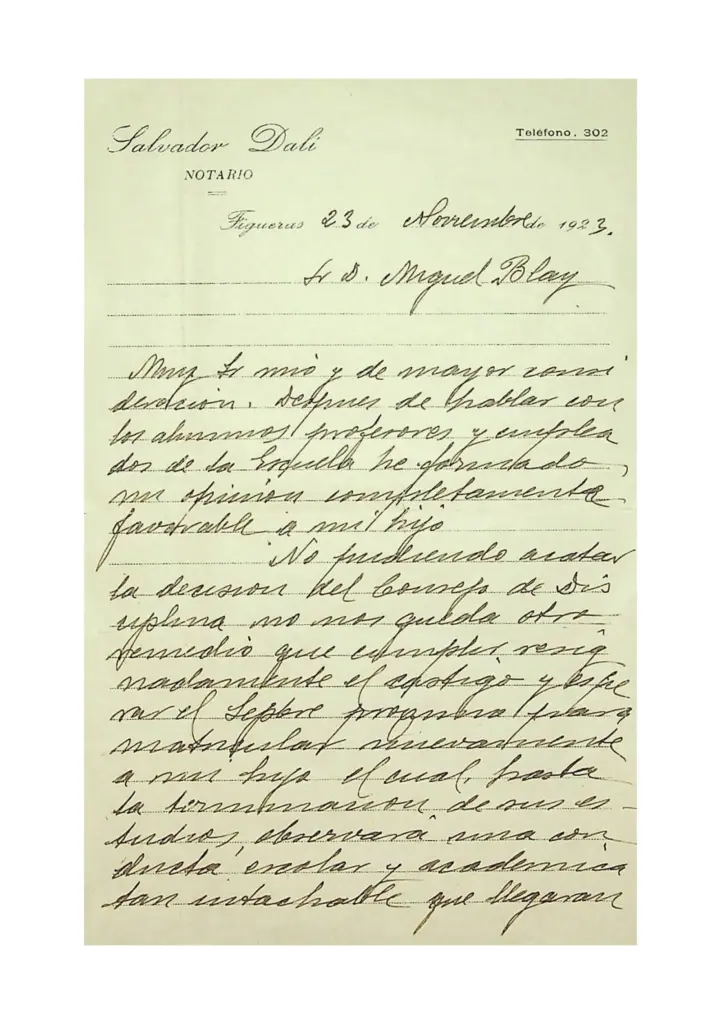
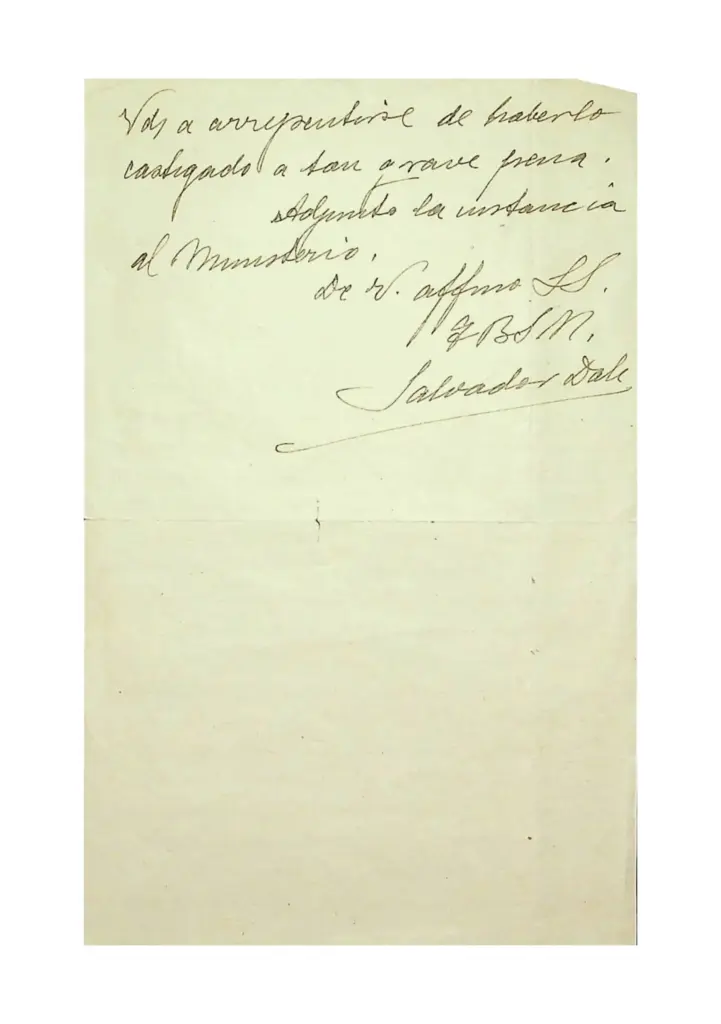
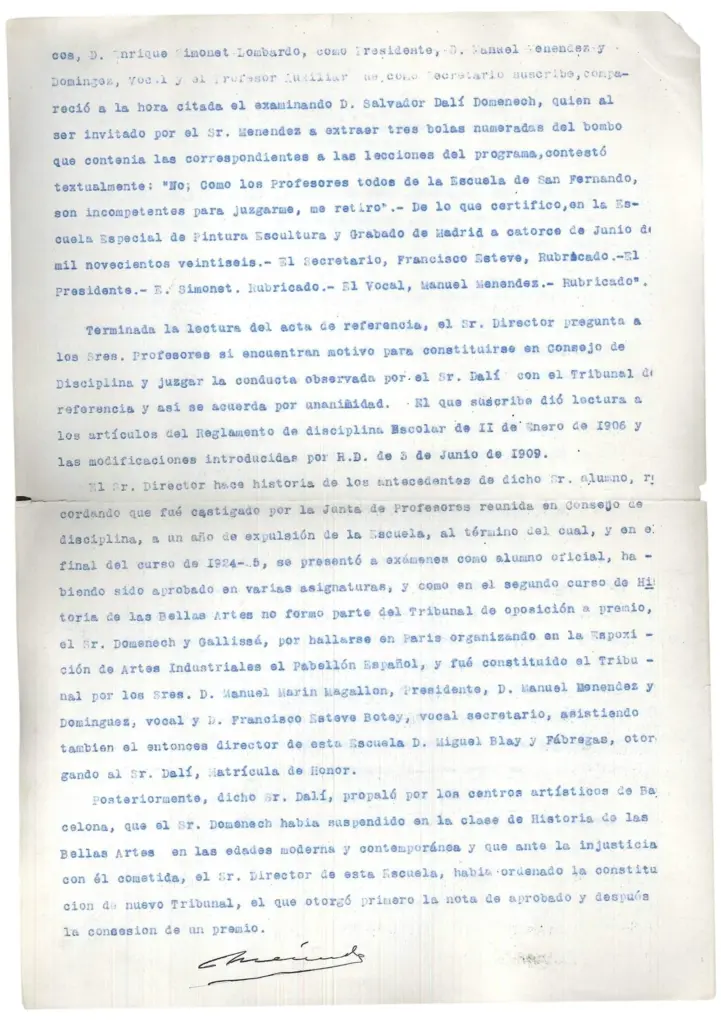
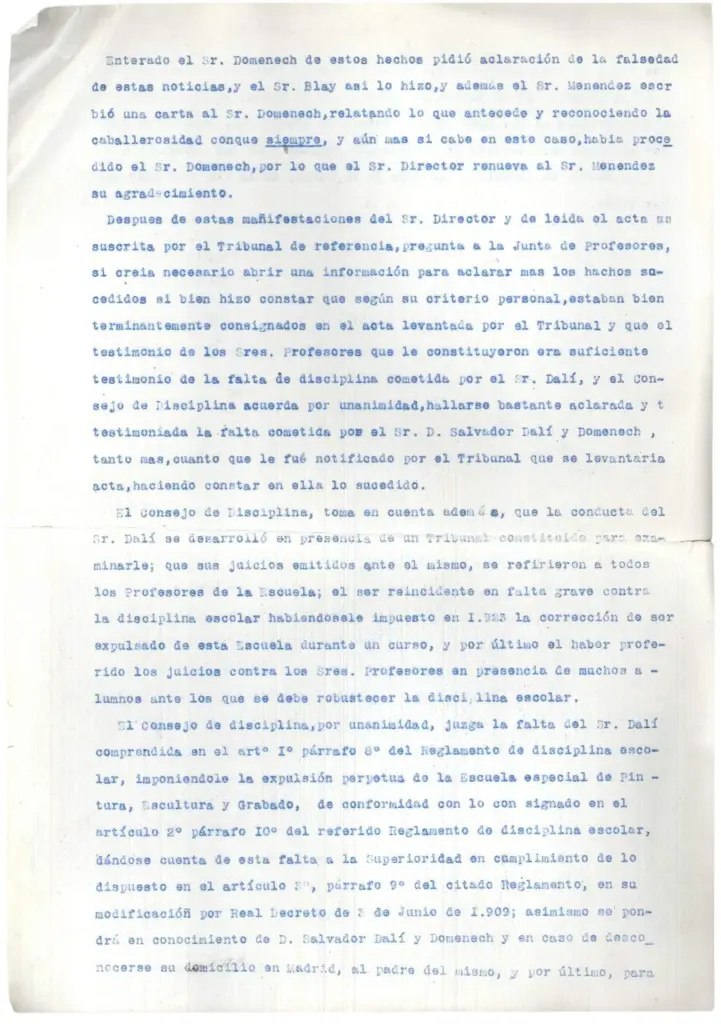
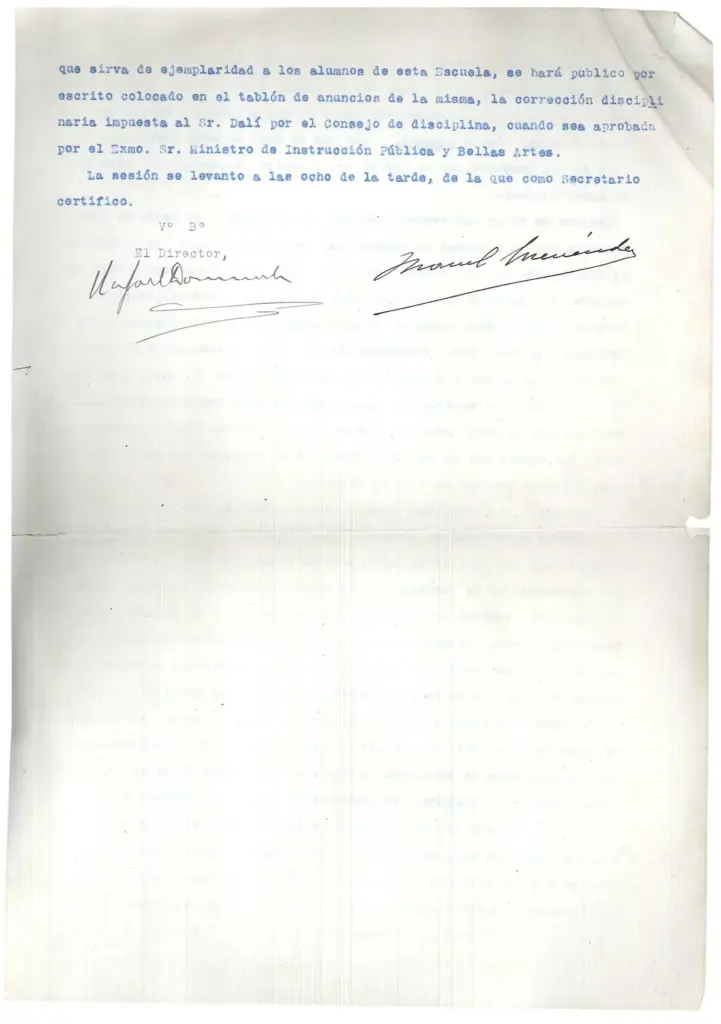
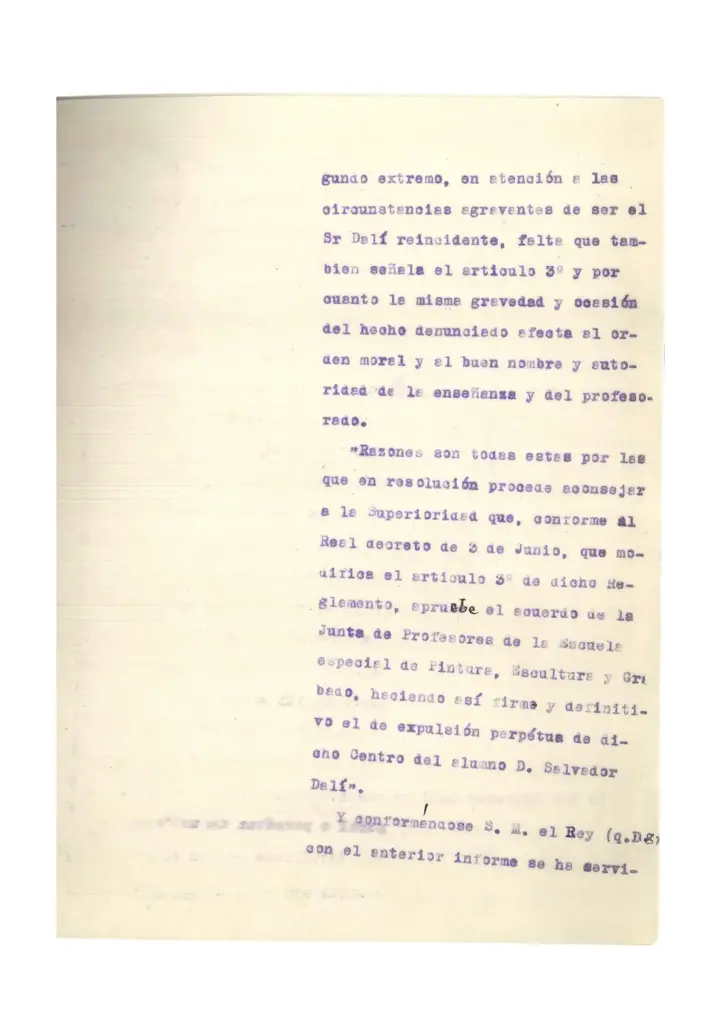
There are no administrative documents in Dalí’s file proving his first expulsion from the school in 1923, but they are cited in those of 1926, coinciding with the lifetime punishment. What is found is a letter from his father. It is dated November 23, 1923, so his son must have been expelled at the beginning of the academic year for leading a protest because painter Daniel Vázquez Díaz was not accepted as a school teacher.
The tone of his father is angry: “An impeccable school and academic conduct will be observed so that they will regret having punished him so severely.”
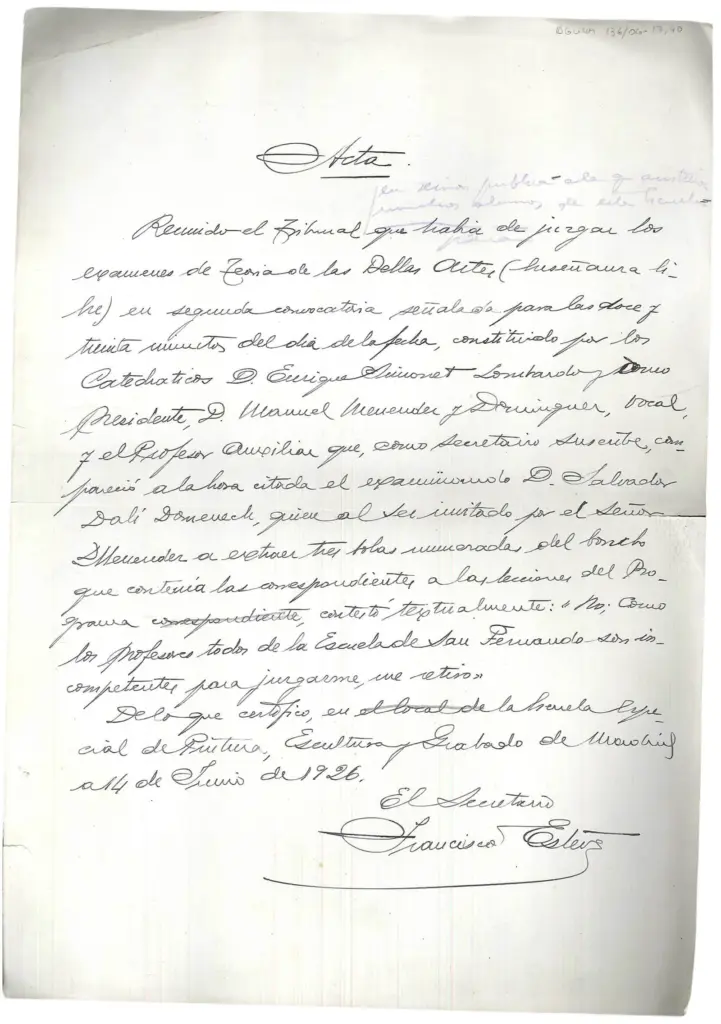
The three professors who were to examine Dalí in Fine Arts Theory on June 14, 1926, drafted a record that led to his expulsion. According to their account, at half-past twelve in the morning, when invited to draw three balls with exam questions, the painter from Figueres replied literally: “No. Since all the professors at the San Fernando School are incompetent to judge me, I withdraw.”
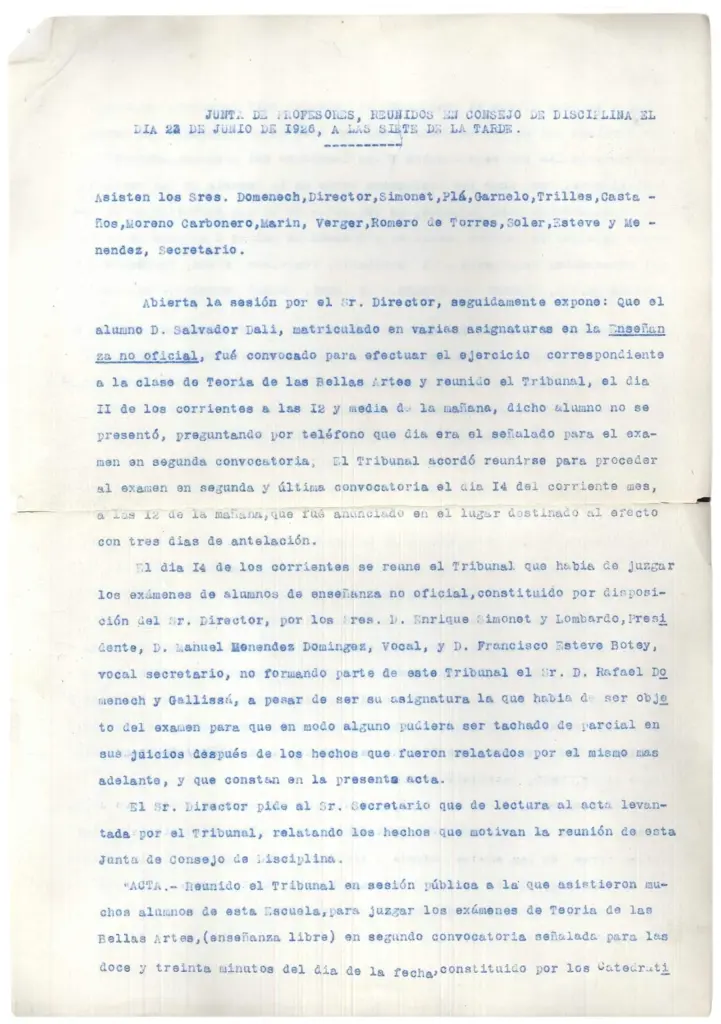
Nine days after the incident, which caused Dalí’s expulsion, the board of professors met. The record recalls that Rafael Domènech i Gallissà, despite being the Fine Arts Theory teacher, was not part of the examining board to avoid accusations of bias. He preferred to be absent after a strong clash with Dalí who, according to the Disciplinary Council, was proclaiming in Barcelona that he had earned a grade in Modern and Contemporary Art History and a prize even though Domènech i Gallissà had initially failed him.
According to the Catalan artist, a new board was formed due to the “injustice committed.” According to the council, Domènech i Gallissà did not examine (and therefore fail) him because he was in Paris setting up an exhibition. They highlight the teacher’s “chivalry.”
The disciplinary committee agrees to inform Dalí of his permanent expulsion and to post the “correction” on the bulletin board so that it “serves as an example” to other students.
On October 22, 1926, the Directorate General of Fine Arts ratifies the penalty imposed on Dalí by the school, which acted, in its view, with exquisite correctness. It adheres to the school regulations that consider his conduct during the exam as it could cause “disturbance in academic order or discipline.”
Dalí served his year of expulsion, but during the 1923-1924 academic year, he did not stop studying. He did so at the Free Academy, directed by Julio Moisés. And in September, he re-enrolled. His grades were better than in the first year. He earned a “merit diploma” (outstanding) in Coloring and for the second time an honors grade in Art History.
This subject strained Dalí’s relationship with the school to the extreme. According to the Disciplinary Council’s account, the painter “spread through Barcelona’s artistic centers” that the subject’s teacher, Rafael Domènech i Gallisà, had failed him and that due to the “injustice,” a new board was formed that passed him and awarded a prize of 700 pesetas.
But according to the commission, Domènech i Gallisà never examined Dalí because he was in Paris organizing the 1925 Industrial Arts Exhibition. The slander reached the teacher, who was supported by the school. But Dalí’s insolence did not end there. He studied the 1925-1926 academic year independently while doing military service in Girona and enrolled in April for the exams.
There are two versions, one presumably embellished, of what happened on June 14, 1926. According to Dalí’s later writings, after drawing the topic ball for his Fine Arts Theory exam, he told the board: “I know more about Rafael than you three together. I refuse to answer.” And, according to his friend Antonio Pitxot in About Dalí, the examiners replied: “Well, then come back next year, because you have already failed and, moreover, been expelled.” And Pitxot wrote that the man from Figueres always ended the anecdote with “Imagine, asking me about Rafael…”. A boutade typical of the character.
However, the tribunal and disciplinary commission records and the Directorate General of Fine Arts ruling describe a very tense clash that culminated in permanent expulsion, not temporary. Dalí made a first snub by not attending the first exam call ―there were only two opportunities then― and was informed by phone of the next date. Domènech i Gallisà, despite being the subject teacher, chose not to examine him to avoid being labeled partial after their previous confrontation. So, three other teachers formed the tribunal. According to their record, Dalí stated: “No. Since all the professors at the San Fernando School are incompetent to judge me, I withdraw.”
Fine Arts holds “hundreds of thousands of documents” that librarians Javier Pérez Iglesias and Laura Bonati would like to digitize because they have many inquiries; especially from unknown local artists and, lately, mostly female. They would start, if they could, with the registration books. “What is done in this faculty is because people put their heart into it,” says the dean. “For example, a professor with a group of students gets involved in a small project. But, as always, we would need a budget to do more.”
Read more The consequences of Trump’s war