







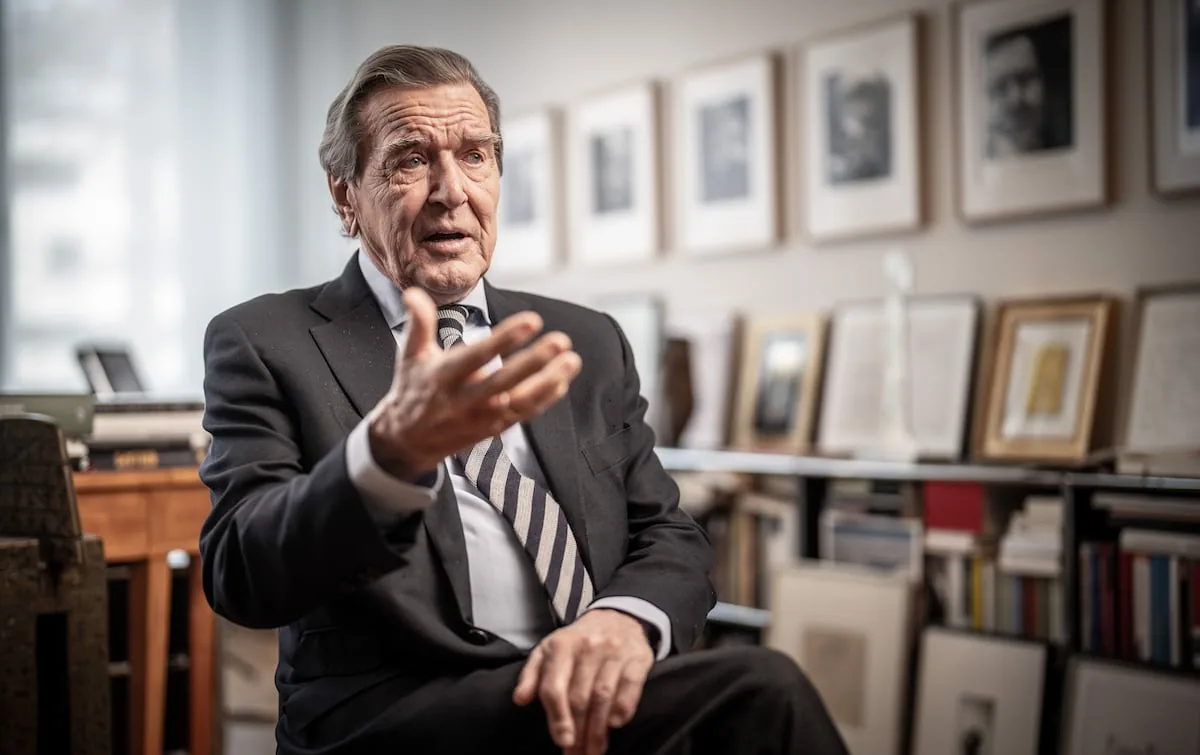
Russian President Vladimir Putin raised the possibility last weekend that former German Chancellor Gerhard Schröder, with whom he has always had a special relationship, could act as a mediator in future talks between Russia and the European Union to end the war in Ukraine. But this proposal has been firmly rejected by both Brussels and Berlin.
The EU High Representative for Foreign Affairs, Kaja Kallas, dismissed Putin’s proposal on Monday to appoint Schröder as the European representative in future talks with Moscow. “It would not be very wise to grant Russia the right to appoint a negotiator for the EU,” she said before the start of the Foreign Ministers’ summit of the Twenty-Seven held in Brussels. Given that the former German chancellor has defended the interests of Russian state companies, the Estonian politician recalled, “he would be sitting on both sides of the table.”
The German government also opposed it. The offer, government sources in Berlin reported on Sunday, is part of a series of fictitious offers and is part of Moscow’s well-known hybrid strategy. “Germany and Europe will not be divided by this,” they stressed. “The negotiation option is not credible, since Russia has not changed its conditions. A first test of credibility would therefore be an extension of the ceasefire by Russia.”
Read more Eugenia Martínez de Irujo: “Neither ostentation nor pretensions suit me at all”
The Kremlin had recently declared that it was up to the European governments to take the first step, since they were the ones who, in 2022, after the start of the invasion of Ukraine, broke all contact with Moscow.
Closeness to the Kremlin
In Germany, Schröder has been censured for years for his closeness to Putin and his work in Russian energy companies, always within the Kremlin’s orbit. These criticisms intensified after the Russian invasion of Ukraine in February 2022 and led to several motions to expel him from the Social Democratic Party (SPD), which failed. Schröder, 82, was chancellor of a coalition government between the SPD and the Greens from 1998 to 2005 and has since maintained a personal friendship with Putin.
Read more The PP is close to an absolute majority in Andalusia with twice as many seats as the PSOE