







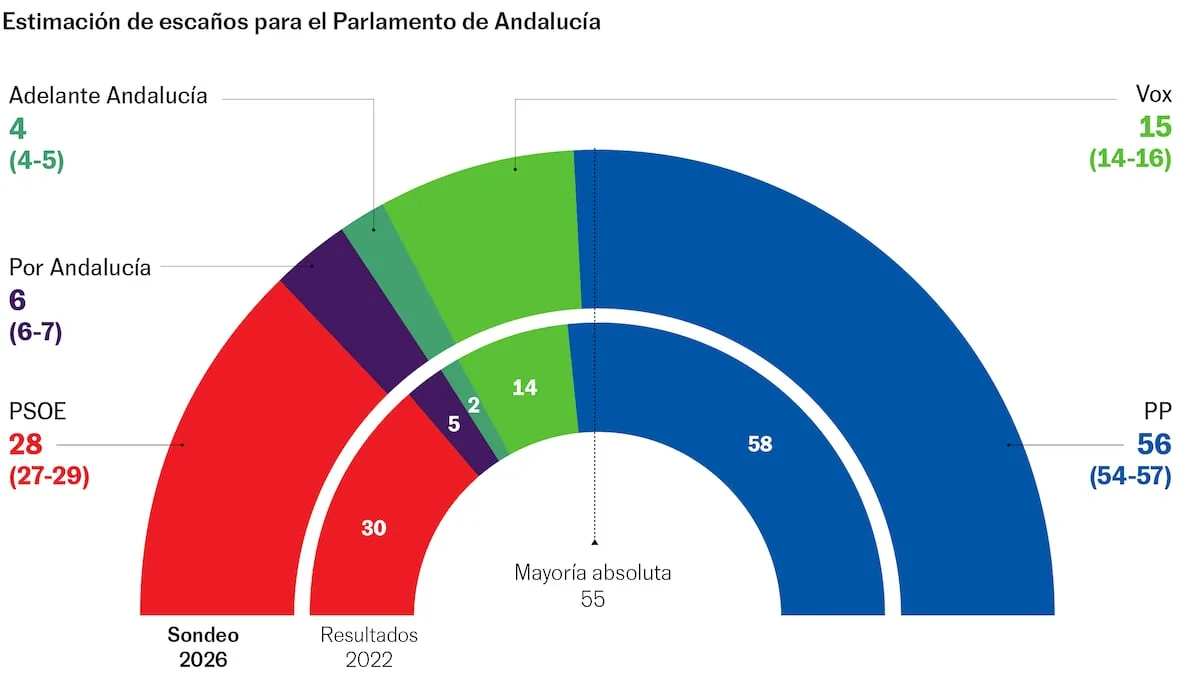
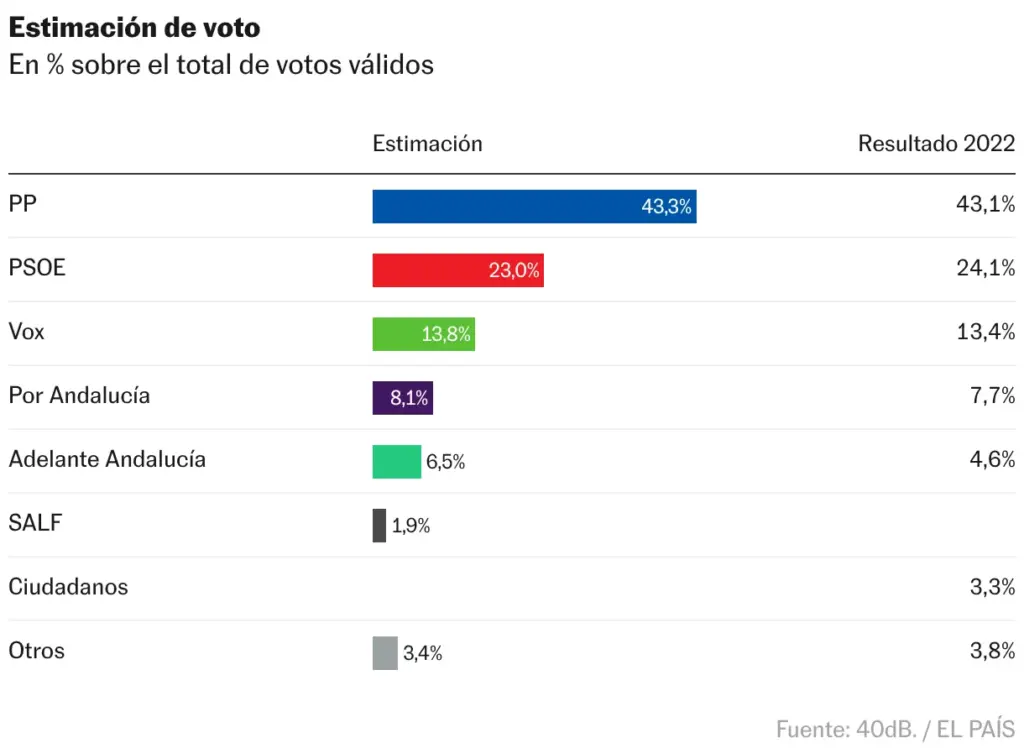
One week before the Andalusian elections next Sunday, the study by the 40dB. institute for EL PAÍS and Cadena SER shows the most likely option is that the PP will renew its absolute majority, although with two fewer seats (56) than it had and doubling the number of deputies of the PSOE, with an estimate of 28 deputies, two less than those obtained at the polls in 2022. Vox, which first entered a regional parliament precisely in Andalusia in 2018, gains one seat, up to 15, which is five more than the left-wing formations Por Andalucía (6) and Adelante Andalucía combined (4). By blocs, the right and far-right gather 71 deputies, 33 more than the left (38).
The survey consolidates the PP as the hegemonic party in Andalusia, with a 43.3% vote estimate, that is, 20 points more than the PSOE, which governed the community for 37 years until January 2019, and reached percentages of 52.5% of the ballots in 1982; 50.36% in 2004; 49.6% in 1990 and above 44% in the 2008, 2000, 1996 and 1986 elections. The 23% estimate given by the 40dB. study for next Sunday’s elections represents the electoral floor of the socialists, whose worst result to date had been 24.09% in the 2022 elections, with Juan Espadas as candidate.
The survey also shows some stagnation of Vox after the good results achieved in Extremadura, where they gained six seats last December; and in the regional elections in Aragón in February, when they doubled their representation in the Cortes (from 7 to 14 deputies). The Castilla y León elections already showed a halt in that rise (they gained one seat) and the latest barometer from the 40dB. institute for the general elections confirms the downward trend of the far-right party, which loses almost one point in vote estimate in a month, although it remains the fastest growing formation since 2023: 5.5 points. The Andalusian survey (1,200 online interviews) was conducted between May 4 and 6. You can consult all the data here.
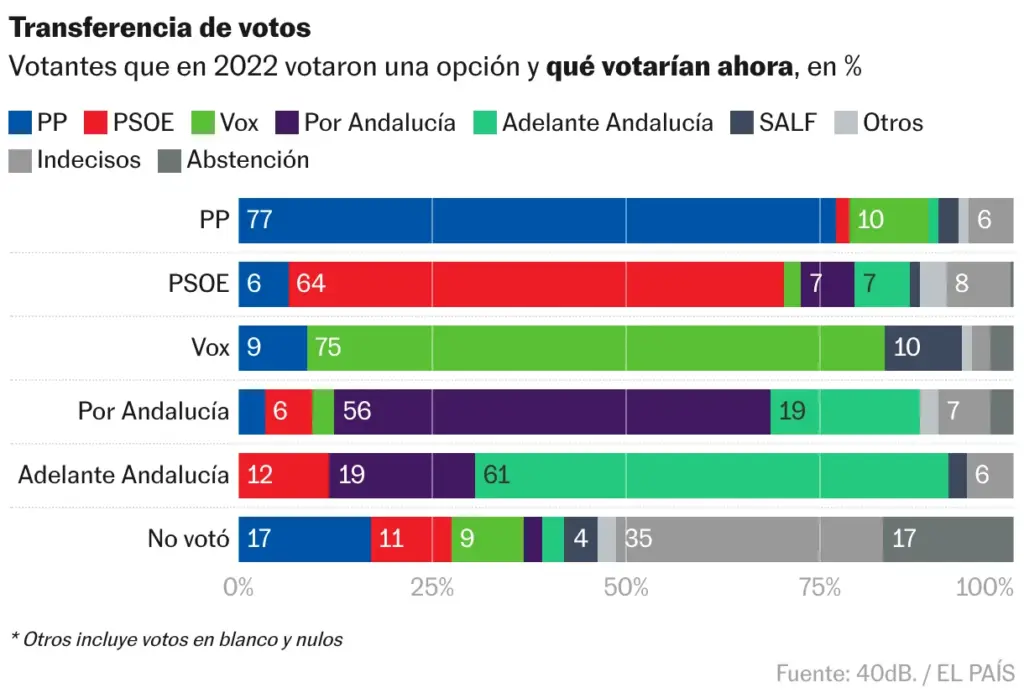
Vote Transfers
The voting loyalty of the electorate that supported the PP in 2022 is today (77.1%), thirteen percentage points higher than that of the PSOE (63.9%). According to the study, the Populars give Vox 10.3% of their support from the last elections and have almost 6% undecided. The socialists have leaks in several directions: 6.4% of their voters now prefer the PP ballot; 6.9% Por Andalucía; 7.1% Adelante Andalucía and 8.3% remain undecided one week before the elections.
Vox retains 74.6% of its 2022 voters, gives up almost 9% to the PP and about 10% to SALF, the brand of the ultra agitator Alvise Pérez.
The left-wing Andalusian formation Adelante Andalucía keeps 61% of its support from the last elections, gives up almost 12% of its voters to the PSOE and about 19% to Por Andalucía, which includes IU, Podemos and Sumar.
The party that attracts the most voters from abstention is the PP (preferred by 17% of those who did not vote in 2022). One week before the elections, 34.5% of that electorate who did not go to the polls in the last regional elections remain undecided about what to do next Sunday.
Knowledge and Evaluation of the Candidates
The best-known candidates are the current president, Juan Manuel Moreno Bonilla, of the PP (known by 93%) and the socialist aspirant, María Jesús Montero, former vice president of the central government and former finance minister (92.1%). From there, knowledge among the Andalusian population drops to 64.7% in the case of Antonio Maíllo, candidate for the presidency of Por Andalucía; 39.4% for José Ignacio García (Adelante Andalucía); 38.2% for Manuel Gavira (Vox) and barely 12.3% know who the SALF candidate, Adrián Yacar, is.
As in other regional elections, Vox capitalizes on the brand over the candidate. Gavira is the least known among his own voters (66.3%), of the five formations that will obtain parliamentary representation, according to the survey.
Asked who they think would be the best regional president, Andalusians place the PP candidate for re-election first (37.1%), who obtains 20.4 percentage points more than the socialist Montero (16.7%). Gavira, from Vox, occupies third place (10.8%), followed by Maíllo (8.6%); García (7.9%) and Yacar (2.6%). 8.8% of Andalusians are not convinced by any.
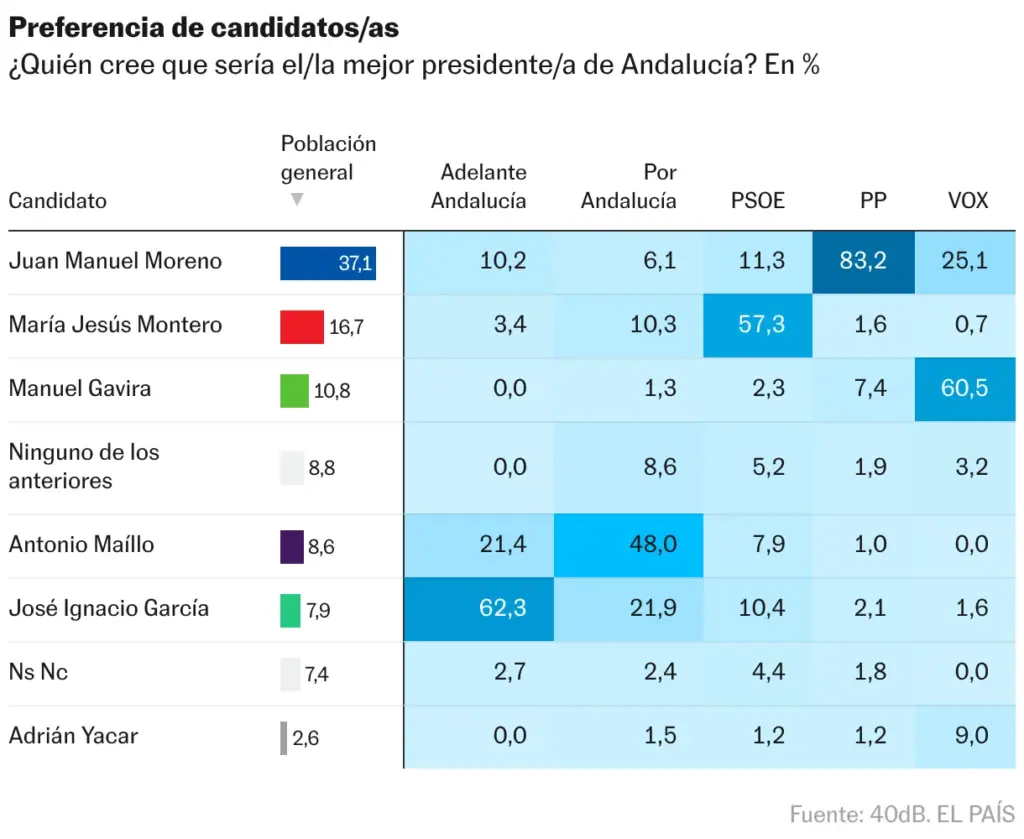
The candidate who generates the most enthusiasm among his own electorate is the PP’s Moreno Bonilla, preferred by 83.2% of Popular voters, while that percentage drops to 57.3% in the case of Montero and the socialist electorate. The second preferred option by PSOE voters is not any of the aspirants from other left-wing formations, but the current Popular president (11.3%). Among their own electorates, Gavira is preferred by 60.5% of Vox voters; García, the favorite for 62.3% of Adelante Andalucía supporters and Maíllo barely obtains 48.4% as the preferred candidate among voters of his formation, Por Andalucía. The Adelante Andalucía electorate prefers the Popular Moreno Bonilla as president (10.2%) rather than the socialist Montero (3.4%).
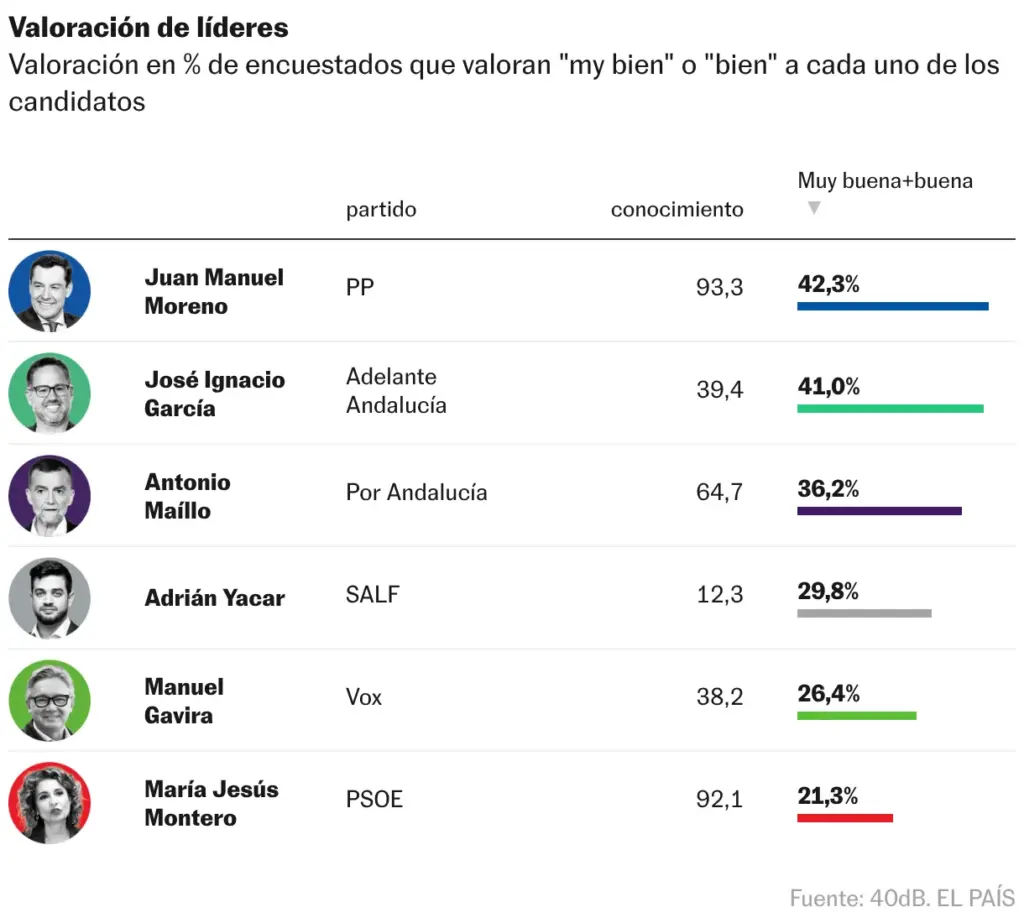
Moreno Bonilla achieves a positive balance (difference between those who have a good and bad opinion of him) of 7.6 points and his main competitor, Montero, a negative one of -34.6, since there is a high percentage (55.9%) that has a “bad” and “very bad” opinion of her. The candidate who obtains the best score in this operation (positive balance of 20.5%) is the Adelante Andalucía candidate, followed by Maíllo, leader of Por Andalucía, with 10.2%. The balance of the Vox aspirant is -10.7.
Preferred Form of Government
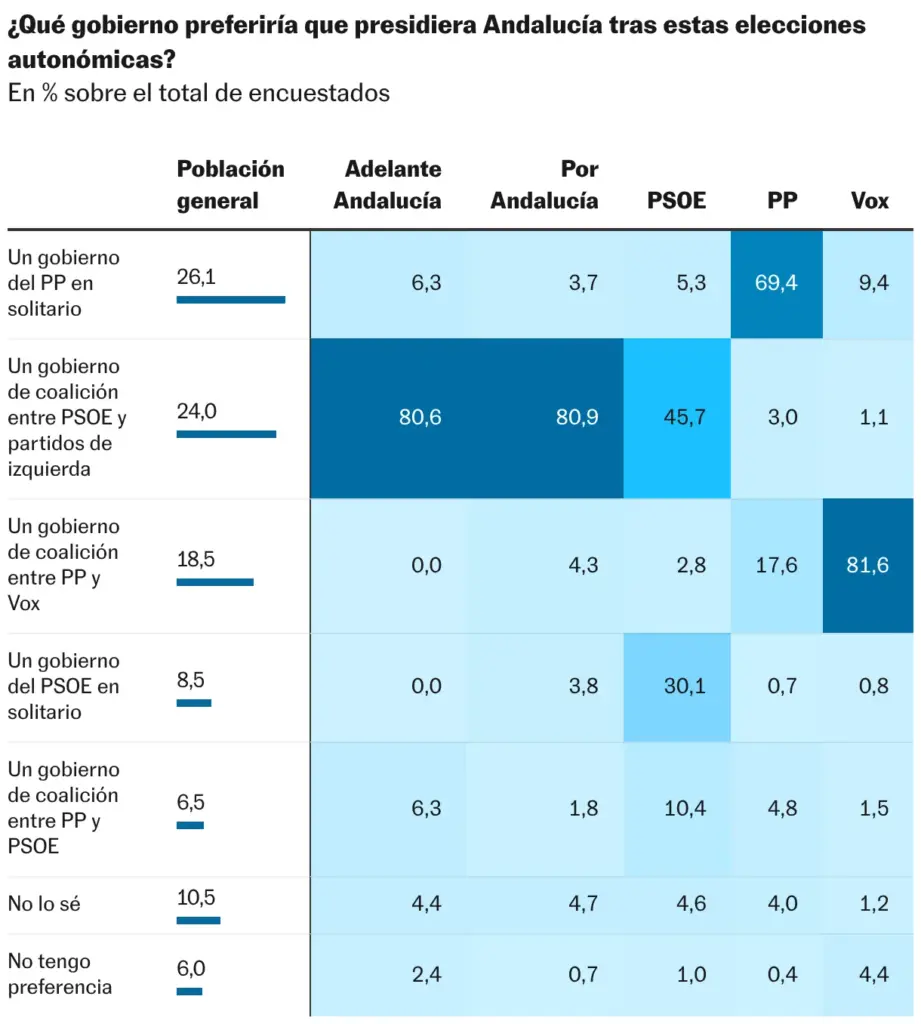
Asked which model of government they prefer, the first option (26.1%) is the PP alone, followed by a coalition of the PSOE with the rest of the left-wing formations (24%). The modality that has prevailed after the last regional elections in Extremadura and Aragón, that is, a coalition government between the Populars and Vox, occupies third place (18.5%), ahead of a purely socialist Andalusian Junta (8.5%). The preference for an alliance between the PSOE and the PP is a minority (6.5%).
These percentages vary significantly according to the voter. Thus, 69.4% of PP voters would like their party to govern alone, while among the socialist electorate more prefer the PSOE to govern with other left-wing formations (45.7%) than alone (30.1%). The option of a coalition with Vox that the PP has renewed in Aragón and Extremadura only convinces 17.6% of Andalusian Popular voters.
Evaluation of the Situation of the Country and the Community
The performance of the Government of Spain receives a worse evaluation than that of the Junta of Andalusia. In the first case, 53.5% of the general population believes it has been “bad” or “very bad” while in the second, that percentage drops to 34%.
By voters, up to 47.6% of PSOE voters believe that the situation in Andalusia is today “worse” or “much worse” than four years ago; 35% rate it as “regular” and 16.9% as “better” or “much better”. The PP electorate is mostly satisfied with Moreno Bonilla’s performance: 69.7% consider that the community is now “better” or “much better”, while Vox voters are much more critical of the Popular baron’s performance: 34.4% believe Andalusia is “worse” or “much worse”; 35.5% rate the situation as “regular” and 30.2% as “good” or “very good”.
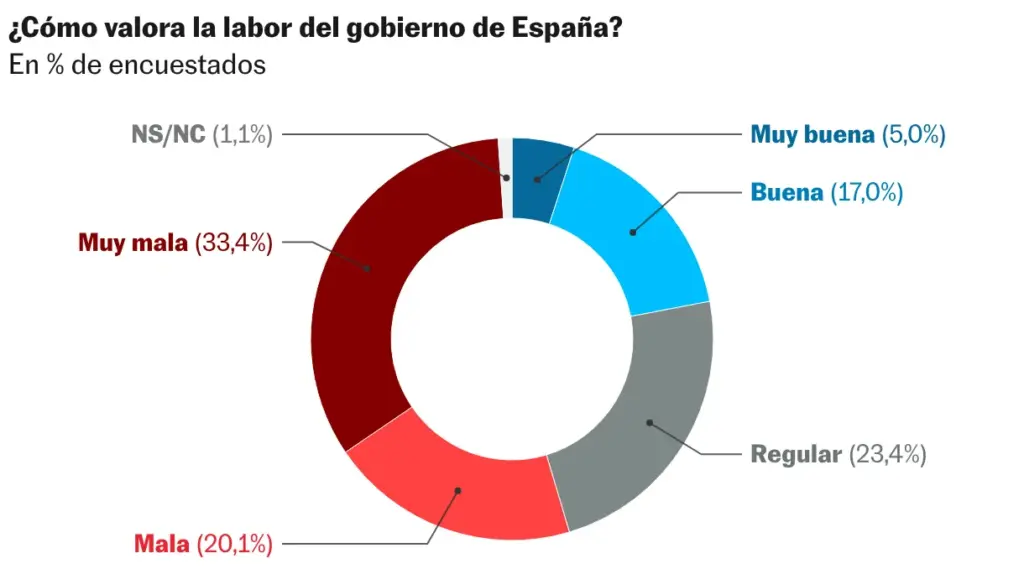
The evaluation of the Government of Spain according to vote recall shows that the socialist electorate does not view the central Executive as favorably as PP voters view the Andalusian Junta. Thus, for 51.4% of PSOE supporters, Spain has gone “better” or “much better” with Pedro Sánchez’s Cabinet; 34.2% rate the situation as “regular” and 14.4% believe it has gone “worse” or “much worse”. Adelante Andalucía voters are very divided: 35.9% consider Spain to be “better” or “much better”; 33.3% describe the situation as “regular” and 30.7% believe it has worsened.
The problems that most concern Andalusians are, in this order, “inflation and the cost of living”; “public health”; “unemployment and working conditions”; “housing” and “the quality of other public services, such as education”, all concerns marked as very worrying by more than 50% of the population. From there, social inequalities and poverty worry 43.3% of Andalusians; “immigration”, 39.5%; “water management”, 32.7%; “territorial inequalities within Andalusia”, 31.5%; “climate change” 29.3%; “regional financing” 29% and “depopulation” 22.3%. Inflation and the cost of living is a transversal concern across the entire electorate. Health and the quality of public services in general worry PP and Vox voters less than those of the left, unlike immigration, which worries the right much more.
Canal Sur hosts this Monday the second and last electoral debate with the lead candidates of the parties currently holding parliamentary representation: PP, PSOE, Vox, Por Andalucía and Adelante Andalucía.
Read more Mexican economy: mixed signals