








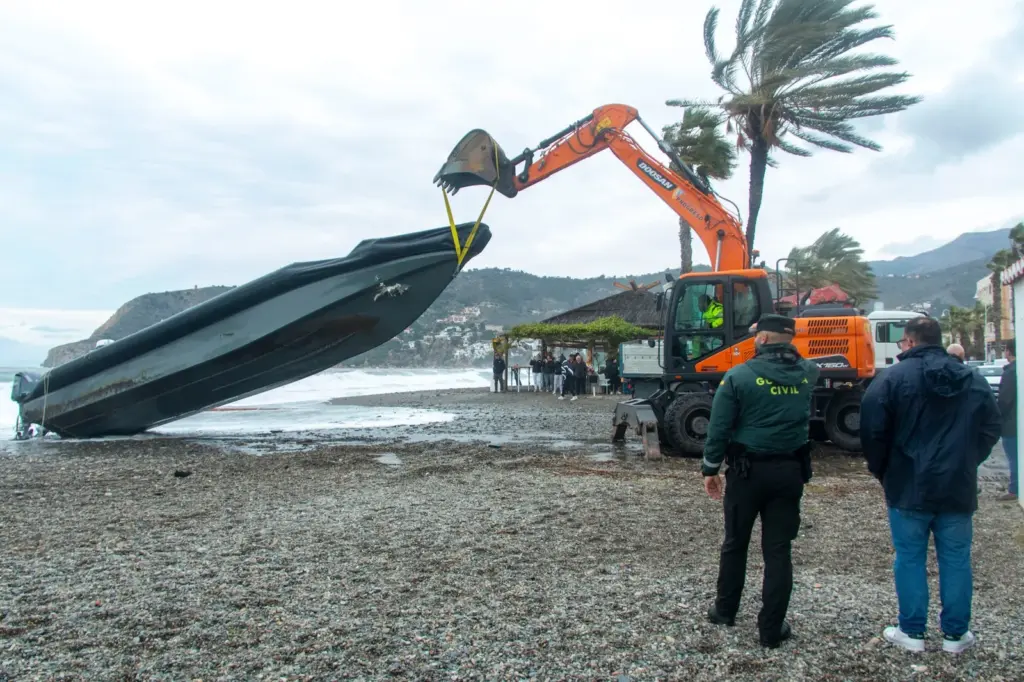
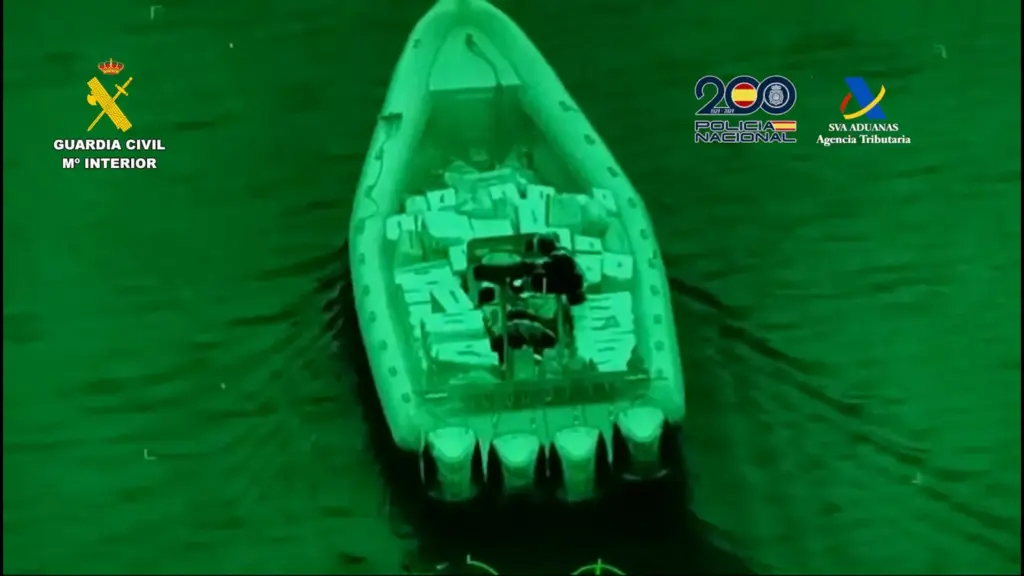
“More than 600 go-fast type boats [fast boats], suspected of carrying out drug trafficking operations” off the Spanish coasts, mainly in the Strait of Gibraltar, have been identified by COVAM, Spain’s main maritime surveillance center, dependent on the Navy, based in Cartagena (Region of Murcia). This is reported in the latest National Security Annual Report, submitted to Congress. The document, prepared by the National Security Department of the Presidency of the Government, with contributions from 17 ministries and the National Intelligence Center (CNI), does not mention the death of two civil guards last Friday while pursuing a drug boat off the coast of Huelva, as it was approved on April 21. However, it does warn that police pressure in the Campo de Gibraltar, where the Ministry of the Interior has deployed a specific plan since 2018, “has substantially modified the operations of criminal groups dedicated to drug trafficking,” who have moved to neighboring areas, such as the Huelva coast or the Portuguese Algarve.
Read more Cuba announces that it has exhausted all its fuel reserves: “We have absolutely nothing”
“Drug traffickers do not hesitate to ram land vehicles and boats when they perceive a risk of interception or loss of drugs, showing greater aggressiveness towards agents,” it warns. The report highlights “greater offensive capacity,” including the “use of war weapons,” by the traffickers and recalls last year’s death of a Portuguese Gendarmerie agent when his boat was rammed by a drug boat on the Guadiana River, a similar incident to the one that cost the lives of two civil guards in the port of Barbate (Cádiz) in 2024.
The document emphasizes that organized crime, especially drug-related, is “a central threat to national security due to its flexible, opaque nature and great destabilizing capacity.” A large part “of the episodes of violence in Spain are directly linked to drug trafficking and manifest through armed confrontations, settling of scores, kidnappings, threats, or attacks on security forces, directly affecting, in some cases, the public,” it adds. At this point, it warns about a rising phenomenon: “The recruitment of minors by criminal organizations for committing crimes, ranging from minor offenses to subcontracting violent acts, such as threats, assaults, and even murders in exchange for appropriate remuneration.”
These are other key points from the National Security report:
Russian ‘ghost fleet’. The aforementioned Naval Maritime Surveillance Operations Center (COVAN) has also monitored the weekly passage of about 50 ships from the so-called Russian “ghost fleet” near the Canary Islands and transiting through the Alboran Sea and the Strait of Gibraltar. This fleet, which transfers crude and refined oil from smaller to larger vessels of Russian origin, although also Venezuelan and Iranian, serves the Kremlin to evade international sanctions due to the invasion of Ukraine. “In the last year,” it warns, “the presence of Russian ships near the Canary coasts has quintupled,” although they have also been detected transiting the Mediterranean, based on the EU’s list of sanctioned ships. “The legal possibility of acting against them is difficult to resolve,” it admits. Their presence “adds risks of accidents, pollution, damage to underwater infrastructures [such as communication cables], and a possible, though unlikely, use as a platform for drone launches,” warns National Security. However, in another section, the same document notes that “in 2025, at least ten European airport facilities were affected by this practice [unauthorized drone overflights], seriously affecting air safety and causing serious damage to national economies, including Fuerteventura airport,” in the Canary archipelago. “Additionally, incidents have been reported in Poland, Romania, Lithuania, Latvia, and France, although not all resulted in complete closures.” It adds that the Interior Ministry has made available to the State Security Forces and Corps the Siglo-CD System (Global System Against Drones) for “remote detection, identification, and, if necessary, neutralization.” “A decision is pending to install this system in airport environments, starting with Madrid-Barajas,” it adds. The ghost fleet, it concludes, “constitutes a platform from which Russia can launch hybrid actions capable of compromising the security of infrastructures and strategic routes.”
Unrepentant jihadist prisoners. National Security is “particularly concerned about the volume of inmates with firm jihadist ideology released in 2025 or close to being freed.” The document stresses that since 2022, at least 176 prisoners linked to terrorism or jihadist radicalism have been released after serving their sentences or exhausting the maximum preventive detention period. “After release, it has been found that a significant portion of these individuals maintain their ideology. In cases where expulsion from the country is not applicable, control measures are established within the framework of supervised freedom to reduce the risk of recidivism and limit their influence capacity,” it adds. At the end of 2025, there were 85 terrorism inmates and another 152 who had adopted extremist postures already in prison in Spanish prisons. The profiles of these inmates, it explains, “are diverse and range from those convicted for self-indoctrination to inmates with established trajectories in membership or recruitment crimes.” It adds that radicalization inside prisons — a concern repeated for years in official documents — “responds to several factors, such as social isolation, contact with radicalized inmates, influence of leaders with influence capacity, or ethnic or religious fragmentation.” This phenomenon, it emphasizes, remains “a priority area of attention.” Not only “because of the possible formation of organized groups with operational capacity inside [penitentiary] centers” to act, but also because of “the risk posed by those inmates who, once their sentence is served, maintain extremist links or convictions likely to foster recidivism.” The document does not provide recidivism figures among former jihadists but does quantify the so-called “foreign terrorist fighters” (FTF) who traveled from Spain to conflict zones. The total amounts to 288, of whom 105 are believed to have died, 72 returned, and 111 remain in the area. “Several of them, with close ties to Spain, as former residents or having family” in the country, are believed to have joined the Islamic State (ISIS) branch operating in northern Somalia.
The Sahel, terrorist hub. The Sahel has consolidated as “the main hub of global” jihadist terrorism activity, which has shifted from Iraq and Syria to this African region, where these groups use “advanced weaponry,” such as drones and anti-aircraft systems. In Mali, “there has been an unprecedented expansion” of the Group to Support Islam and Muslims (JNIM), Al Qaeda’s regional franchise, which recently launched an offensive on the country’s main cities; and, to a lesser extent, the Islamic State in the Greater Sahara Province (ISSP), an ISIS affiliate. Jihadists control large areas of neighboring Niger and Burkina Faso, and their spread to the coastal countries of the Gulf of Guinea “is already a reality.” Additionally, the Islamic State has instructed its militants to recover their networks in the Maghreb, from where many jihadists come. The report warns that the Sahel’s stability “is key to the security of Spain and Europe,” as it directly influences migratory flows, arms and drug trafficking, and terrorism export. After closing its military mission in Mali, Spain advocates “a programmatic position that allows the EU to be present in the region.”
Far-right violence and 23 fugitive ETA members. National Security also warns about violent far-right extremisms that, it highlights, “continue to show capacity for growth and adaptation in a context marked by increased fanaticism and social polarization.” Experts consider that this scenario “has favored the emergence of groups that, with an increasingly younger militant base, articulate calls to violent action around campaigns linked to political, social, or economic events.” And although it believes their activity is currently “concentrated in occasional mobilizations,” it warns of the need to “monitor mobilization dynamics that may act as catalysts for violent behavior.” In this line, it highlights the arrest last November in Spain of three alleged members of a The Base cell, an international accelerationist terrorist group, the most extreme version of white supremacism. Regarding what it calls “domestic terrorism” — referring to the now dissolved ETA, Grapo, and Resistencia Galega — National Security stresses that its threat level is “residual” and that “the dynamics associated with the former ETA environment focus on the dispute over the narrative and mobilization actions aimed at projecting claims related to the situation of prisoners, the return of fugitives, and the political claim for independence, without showing organized operational capacity.” However, it recalls that investigations into unresolved ETA attacks remain open and that the Intelligence Center against Terrorism and Organized Crime (CITCO, dependent on the Interior Ministry) holds a list of 23 fugitive ETA members with active judicial warrants who are allegedly spread across Brazil, Cape Verde, Cuba, France, Mexico, Uruguay, and Venezuela.
Read more Xi Jinping warns Donald Trump that relations between China and the US depend on Taiwan
Russian disinformation and Torre Pacheco. The so-called disinformation campaigns were the second most intense threat during 2025, only behind cyberattacks, according to National Security. The document describes them as a “prominent vector of instability” and points to Russia as the main actor seeking to “influence political processes, erode trust in institutions, shape public opinion, and weaken international cooperation.” “A significant part of the Kremlin’s interests has focused on influencing the elites and political leaderships of states, to reduce support for Ukraine, generate distrust in democratic institutions of Western countries, and spread pro-Russian stances,” it adds. In this regard, it highlights that artificial intelligence has allowed Russia to increase the volume of disinformation by facilitating the “translation, creation, and massive dissemination of content,” while “making it difficult to verify the truthfulness of information.” The report cites as an example of a disinformation campaign the one recorded last July following the events in Torre Pacheco, when an attack on a neighbor triggered a “hunt” for immigrants. According to the document’s authors, that event “showed the capacity of disinformation to transcend dimensions. There was an increase in digital activity about illegal immigration where the narrative intensity preceded the escalation of physical violence, establishing a direct correlation between cognitive saturation on networks and the materialization of risks to public security.” The report recalls that in 2025 the National Security Council approved the procedure to develop a specific strategy against disinformation campaigns that seeks to address “the phenomenon as a high disruptive capacity threat requiring the collaboration of all relevant actors in society.”
2.795 billion for Ukraine. That is the amount of Spanish military assistance to Ukraine since the Russian invasion in February 2022, placing Spain as the eighth largest NATO donor. Additionally, it is the fourth contributor to the EU’s EUNAM Ukraine mission, with 8,699 soldiers trained by the end of last year. European aid and the increased production capacity of Kiev’s military industry “have helped reduce the imbalance between both sides, although not to the extent necessary for Ukraine.”
Gaza and Lebanon. The National Security Department warns of the risks posed by the future multinational force for Gaza, in which Spain has shown willingness to participate if a peace agreement in the Strip is consolidated. “The disarmament of Hamas will be the main challenge for the countries contributing troops to this new mission, which will operate in a highly unstable scenario where threats to participating forces will be very high,” it emphasizes. It also highlights the uncertain outlook that will open for Lebanon when, on December 31, the UN Interim Force in Lebanon (UNIFIL), to which Spain contributes 650 soldiers, ends after more than four decades.
The great blackout. The “energy zero” that occurred on April 28 last year “highlighted the exposure of certain systems and the importance of having effective response mechanisms for high-impact incidents.” “In particular,” the report acknowledges, “the need to have uninterruptible power supplies and alternative energy sources that guarantee the autonomy of infrastructures in case of main grid failures.” Although the coordinated response, the action of crisis committees, and the Security Forces managed to limit the impact of the widespread blackout, “the experience has revealed necessary areas for improvement,” it admits.
The warmest summer. Global warming is a fact, the document states. “The summer of 2025 consolidates as the warmest in the historical series since 1961, surpassing the record set in 2022.” The thermal anomaly began in July, the warmest month ever recorded. There were 3,832 deaths attributable to excess temperature, 87.6% more than in 2024. Although the number of forest fires decreased, the affected area (354,746 hectares) is 235% higher than the average of the previous decade and the fifth largest since 1969. The cause of two-thirds of the fires is unknown, and only 10% of the total are known to be intentional, it highlights.
Read more The South Carolina Supreme Court orders a retrial for the Murdaugh murders