
Arturo Pérez-Reverte (Cartagena, 75 years old) warns from the beginning of the interview: “I never intended to be a photographer. I was just a guy who took pictures.” The conversation, in the bar of the Palace hotel in Madrid, with a coffee and a glass of milk in between, is marked by a deep respect for photojournalism and the writer (formerly journalist) and academic of the RAE reveals a certain impostor syndrome, despite the fact that PHotoEspaña now exhibits his work.
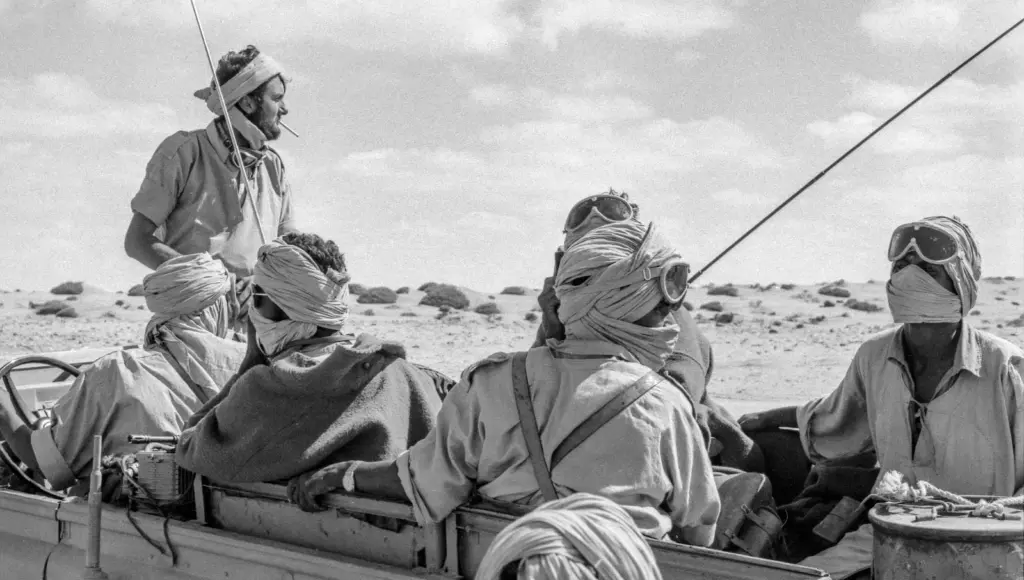
The exhibition ―War Photographs 1974-1985, until May 30 at the Ateneo de Madrid― covers his photographic work, which coincides with the publication of Special Correspondent, a war biography, a book published by Alfaguara that brings together a notable selection of chronicles, reports, and columns. The level of the selected photographs, both for the exhibition and the catalog (published by La Fábrica), would delight any press editor, historian, or art curator.
The interview is exclusively focused on photojournalism. Neither Captain Alatriste, nor the RAE, nor the various controversies that usually accompany the academic appear.
Question. Without wanting to be a photographer, why did you take photos?
Answer. I worked for the newspaper Pueblo and traveled alone through Africa, Asia, and America. Pueblo had a large circulation, it was spectacular. If I wanted to publish my reports, I had to bring images. I didn’t want to take photos: it was a necessity to be able to publish. Without a photo, there was no text. You loaded a 36-exposure roll and started shooting… some had to come out well. But I sent the rolls without knowing what I had done.
Q. But didn’t you develop the rolls?
A. No. I know how to develop, but in the middle of the war you didn’t do it. You befriended some pilot or flight attendant who was returning and sent the rolls with them to the newsroom. I didn’t see the result of my photos or my reports because I was still in the war: I spent months there and kept sending material. There was no immediacy like now; what you had taken weeks before still had value. I never gave importance to my photographic archive. When Pueblo closed, I went to collect all my material and stored it in some boxes. Until a few years ago, when with the help of my friend the photographer Jeosm I started looking for some family photos and he told me: “There is very good material here.” There are images I hadn’t seen until recently.
Q. What equipment did you work with?
A. My main camera was a Nikon F2, a great and very reliable machine. It was all mechanical, except for the light meter. Then I carried two lighter Pentax cameras. My favorite lens was the 50 mm; in combat, I mounted a 35. That wide-angle, in the middle of the scuffles, helped you get something good, because with one shot you covered the whole scene. My photos are of real combat because I was there with them, living with them. I carried a 135 mm, but I never used it: the action was too close. And I used 400 ASA film. You took 10 or 20 rolls and, when they ran out, you shot with whatever you could buy there, so imagine.
Q. Who are your references in photography? In Special Correspondent you mention that the film Blood in Indochina motivated you to become a war journalist.
A. Yes, the film by Pierre Schoendoerffer, a formidable Frenchman, fascinated me. Then, at 14 or 15 years old, I got hold of the magazines Life and Paris Match. The photographers of those publications were my teachers. We talk about Gilles Caron, Catherine Leroy, Larry Burrows, and many others with whom I later coincided in the war; knowing their work helped me connect with them. I remember being very excited that, in the first war I covered, the Cyprus war (July 1974), Paris Match published a photo of what Manu Leguineche called the tribe, that group of about 30 journalists who coincided in different conflicts, and I was there among them.
Q. At the presentation of the exhibition and in the book that compiles your chronicles, you stated that war now pixelates…
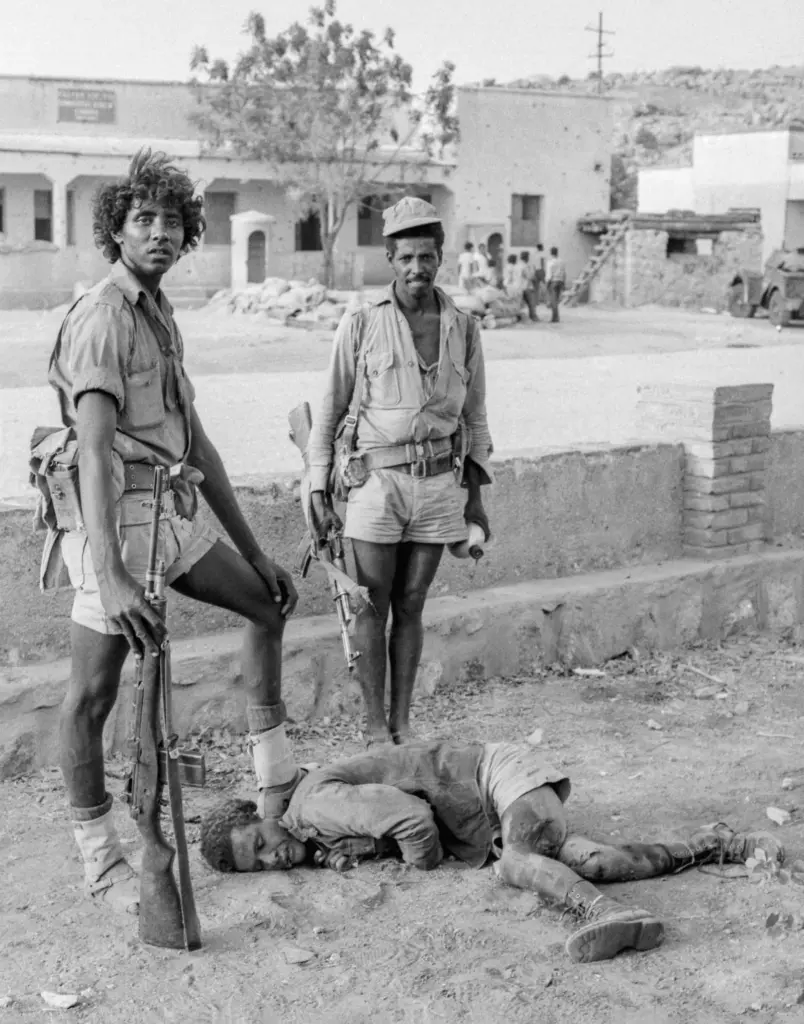
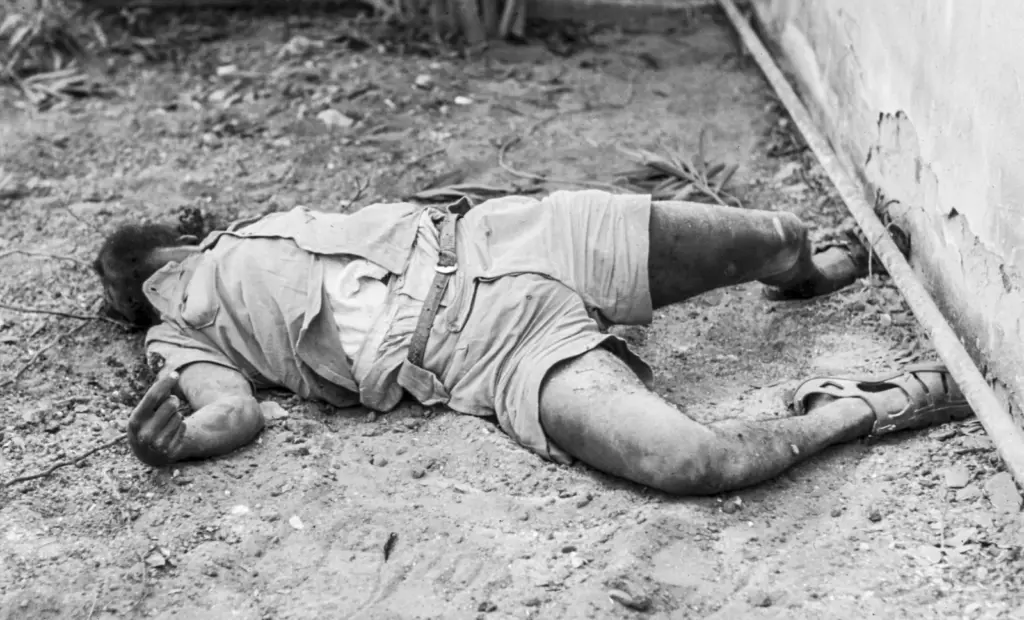
A. Many of my photos are now unpublishable. That happened to us with the exhibition, although I was quite detached from the selection process. The catalog has about 50 or 60 photographs; the exhibition was reduced to 20. They only chose two photos of dead people, and it was because I asked for them to be included. In the exhibition, they are smaller in size: they didn’t dare, instinctively or deliberately, to give them a larger format.
Q. Why do you think this happens?
A. Human beings now deny pain, especially in the West. Our parents and grandparents had the certainty of pain and death. There was no penicillin, there was hunger, there were wars… there was a natural, biological, and social acceptance of what they were. Now the grandfather dies and we tell the child that he is in heaven and he hasn’t even gone to the wake, so he won’t be traumatized. That overprotection is typical of the West, because in the rest of the world people still live with that certainty. And the role of the war reporter was precisely to stir consciences. The press helped end the Vietnam War with photos like Eddie Adams’, in which General Loan executes a man in the street without a trial. Now we no longer see those images of real war.
Q. However, we are surrounded by video games with explicit violence where, in a sense, you play at killing…
A. They take the player to a virtual reality that is not exact. So they believe that violence is that. No, violence smells, bleeds, hurts, hits, kills… Forty years ago, when someone killed, they knew what they were doing. Now people can kill for fun and believe that in real life it is just that.
Q. It is surprising that you are so precise in dating the texts of Special Correspondent and yet, in the photos, there is neither date nor place.
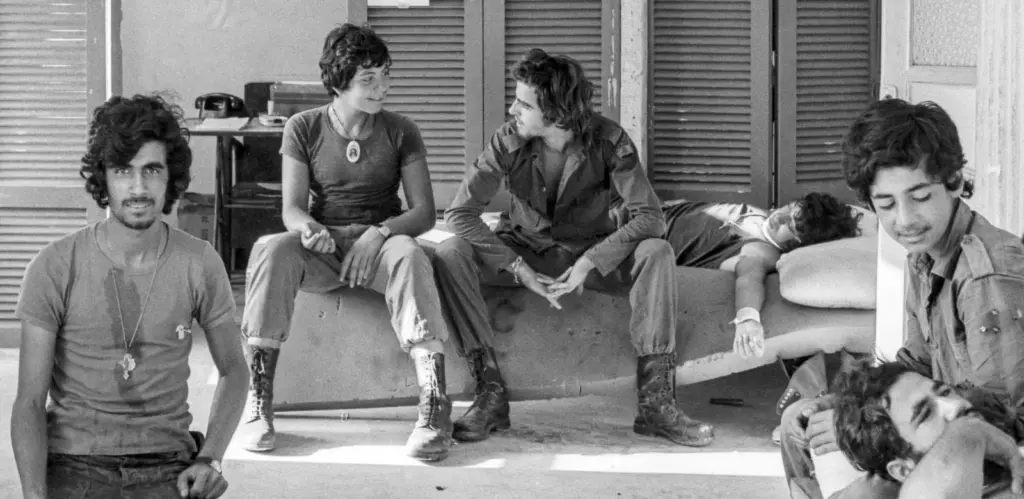
A. I didn’t remember precisely the places or the dates. I insist, I never gave importance to my photographic archive. I am not a photographer. The proof is that I left the camera as soon as I arrived at television and went to war with great professionals who took the images. And, in the end, all wars are the same war.
Q. Did the camera serve as a shield for you?
A. No, not at all: the camera put you in danger. They saw you take a photo they didn’t want you to take and… The Nikon was a good camera, but not discreet. It made a lot of noise and more than once I had to take out the roll and fog it because they didn’t like what I had photographed. You had to earn their trust. Keep in mind that I spent days with them on the front. In Africa, cigarettes and carrying a Polaroid helped me a lot: as soon as I arrived, I took a photo of the chief and gave it to him. You recognized their authority. But, in general, you were welcome. They were all more innocent, they didn’t see the consequences of the photos. There was no immediacy: if you took a photo of them, it meant recognizing their heroism. Now everyone knows what a photograph is and, therefore, the access we had before no longer exists.
Q. Your novel The Painter of Battles features a retired photojournalist obsessed with the geometry of chaos… did you also have that fixation?
A. Over time I discovered that in war there is a geometry: there is the parabola of a shell, the straight line of a bullet’s trajectory, or the very formation of a group of soldiers… everything is curves, rectangles, lines. Most of my photos are taken from the ground. That vision of the geometry of chaos allows you to move the camera: it gives you the axes, the point, the place. You are on the ground and a guy runs by. It’s not the same as standing, because if you stand you get shot. That position forces you to make a certain framing because the photo imposes itself. But you never rationalize that geometry of chaos. Even today, at 75 years old, I walk down the street and I keep seeing the good and the bad: where the sun is, how the wind blows, the rain, the traffic light, or the traffic. It is the geometry of the world. And that perception was given to me by the war.
Q. What else has the war taught you?
A. Those of us who have seen war are different from those who are here, because they have no awareness of fragility, of uncertainty. But there is something I learned very young: professional humility. I arrived somewhere and looked for the journalist who knew the most. That guy, that old man who was with the prostitute, drunk, was the one who knew the most about that country. I approached him and said: “Hi, my name is Arturo, I invite you for a drink. I have no fucking idea. I know you are the one who knows the most and I want to learn.” And always, always they helped me. With them I learned the trade: that professional humility of learning from those who know the most. You can be the coolest guy in the world, but working you have to learn. It was the same with photographers.
Q. It may seem that now we do everything wrong in photojournalism…
A. Not at all! I have never said that! Quite the opposite. Photojournalism is a choice of the reality you want to show. And, if the journalist is a trained, intelligent guy, with vision, of a high level, the result is splendid. The framing already denotes talent, an intention, and it is one of the few things that still retain personalization. It doesn’t deceive: it is the litmus test. There is a problem, and it is the saturation of rear images, which anyone can take with their mobile phone… but compare it with what a photojournalist does with intention. And spectacular photographs still exist.
Q. Do you remember any?
A. I remember a magnificent but silly photograph. Three guys in the war in Ukraine, university students, who had been equipped with uniforms and rifles. They were leaving the barracks at an age when they should be leaving school. From school to the trench. It is not a typical war photo, but it is an extraordinary image. No television or amateur image achieves that.
Q. Koudelka says a good photo is one that cannot be forgotten… which is yours?
A. One of my mother. She was beautiful. My mother was the most beautiful woman in Cartagena. In the photo, she looks like an Italian actress, from the movies: slim, tall, elegant… She is with her cats on the terrace of her parents’ house, before getting married. When I see that image, I don’t see my mother, but the woman, with a capital W. I see beauty, elegance, serenity… Then life destroys those things as the years go by. And that photo of my mother is the one I love the most. If before dying I think of a photo, it will be my mother on that terrace.