




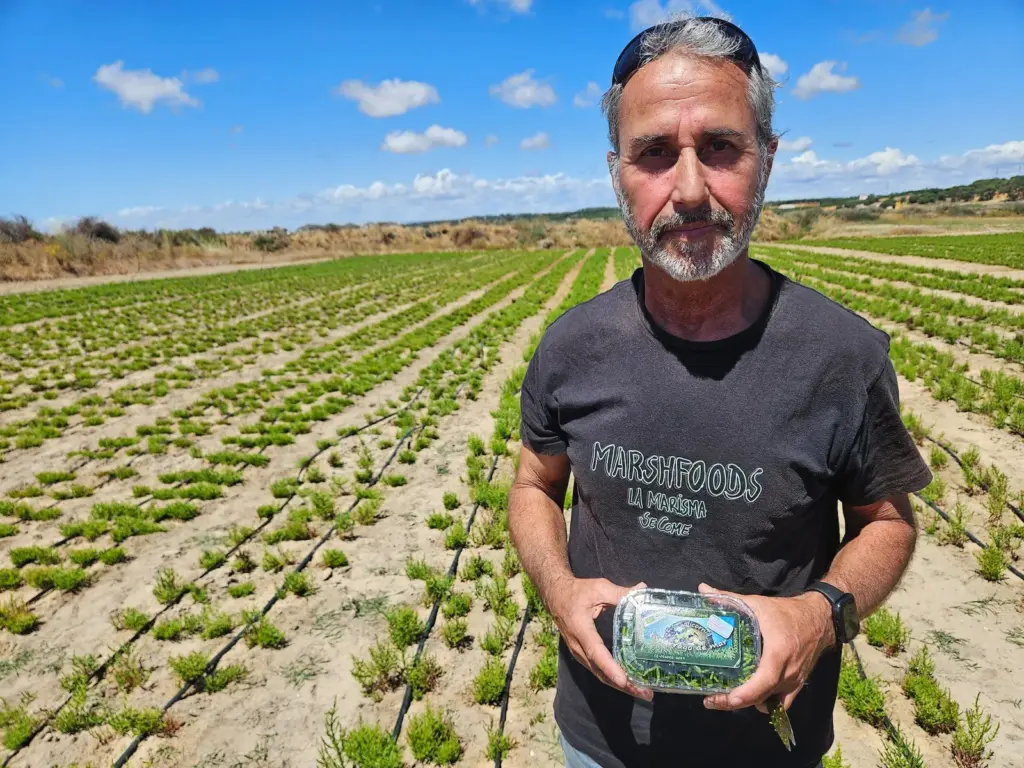
Salicornia is the botanical version of The Taming of the Shrew (The Taming of the Shrew, according to the original title of William Shakespeare’s comedy). This halophytic plant (which lives in salt-rich soils) conquered the marshes of Isla Cristina (Huelva), a protected natural area that floods with seawater during high tide and where plant life is arduous. Manuel Díaz Cárdenas, a 57-year-old forestry technician who combines his devotion to nature with his love for human life as a maritime rescue expert and volunteer, was also born and raised there. There he fell in love with this wild plant, historically disparaged in the area but with proven culinary and health properties. Díaz Cárdenas was determined to tame this species, miraculous for the impossible terrains where it grows and for its properties. He has succeeded, and his work has caught the attention of The Smithsonian Institution, responsible for the largest educational, museum, and research complex in the world.
Despite the contested term, this institution does not hesitate to classify salicornia as a “promising superfood,” nicknamed sea asparagus to highlight its culinary potential. It has high demand in the United Kingdom, the Netherlands, France, and Belgium, but in Spain, despite having suitable lands for its development, it is used minimally in gastronomy. Chef Ángel León uses it in his creations.
With this low demand, its exploitation was limited solely to harvesting. But Manuel Díaz insisted on domesticating it and became the first grower in Spain. Initiatives have emerged in other areas from his work.
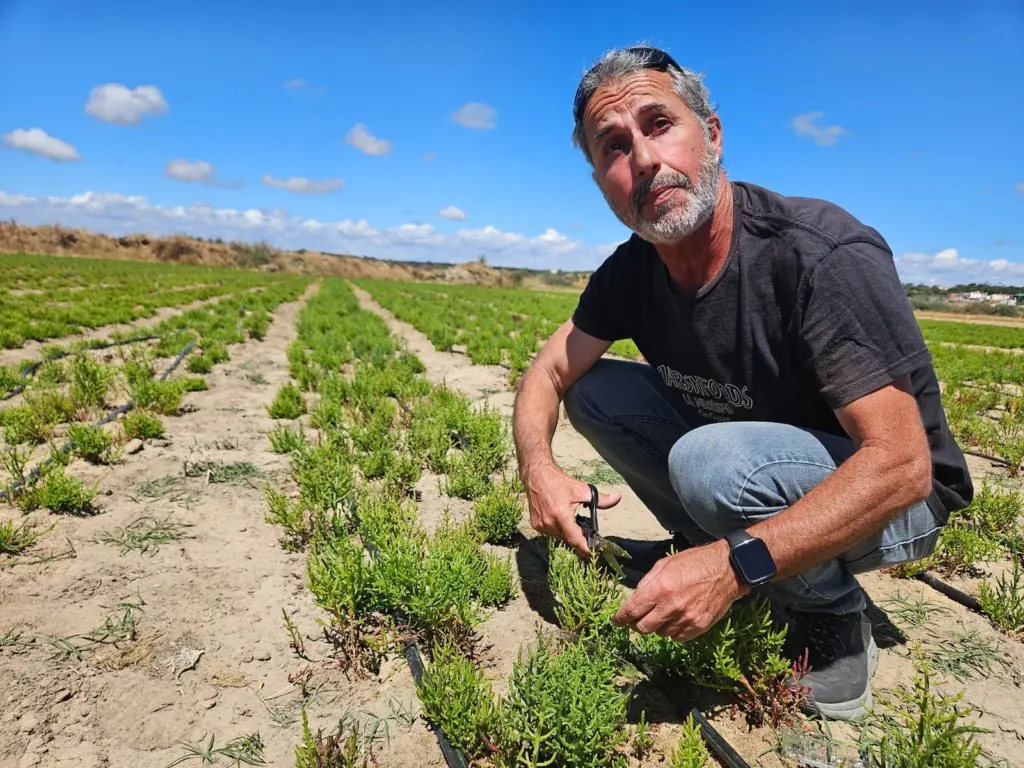
This farmer with maritime background, nicknamed El Legal and who dedicates his free time from saving lives to the field, feared that a boom in sea asparagus could affect its natural habitats. “It could impact local populations and even eliminate it if aggressive harvesting occurred,” he explains. Thus, he considered that if salicornia can grow in barren lands and withstand twice the salt concentrations per liter found in seawater, it should thrive in other areas.
After several years of trials and errors, he finally managed to gather 600 grams of seeds, each measuring between 0.7 and 1.2 millimeters. Initially on his rooftop, he experimented repeatedly until he managed to tame this stubborn wild plant. For 10 years, he has been cultivating sea asparagus with organic certification from CAAE on a plot just under one hectare, packaging and delivering it on demand through his website Marsh Foods.
Its consideration as a “superfood” has been endorsed by various scientific projects. The Virgen Macarena Hospital in Seville has completed a clinical study highlighting salicornia’s properties “to prevent and treat neurovascular diseases such as stroke.” “If dehydrated and ground, we obtain a salt suitable for hypertensive people,” adds Manuel Díaz. Companies like Bio-dis Pharma already produce products from this plant.
But this botanical miracle hides more benefits. The University of Málaga (UMA), through the Institute of Biotechnology and Blue Development (IBYDA), is researching its potential as a natural biofilter for nutrients in aquaculture, as a biological purifier.
Universities from different parts of the country, from La Laguna to the Balearic Islands and Madrid, have taken an interest in this plant. “We are involved in very interesting research projects in the Ebro Delta, for agriculture in saline areas or rice fields, with desalination companies, with mining…,” Díaz recounts in an effort to remember all those who have knocked on his door because of the properties of this plant capable of utilizing what others discard, growing in unproductive environments (there are projects in desert areas of the United States), and regenerating degraded soils.
But just as food, it already has great potential and has been exploited so far mainly by Israel and Morocco for export, although their production is neither organic nor of the same quality as that marketed by Marsh Foods.
Although each sowing has a life cycle of about nine months, during that time it can be cut twice, and good crop management allows staggering these harvests in periods not usual for the plant naturally.
For cooking, only the tenderest tips of salicornia are cut before it overgrows, as it loses fleshiness. A well-managed hectare can provide at least 6,000 kilograms per year, and the selling price of organic, top-quality sea asparagus is around 35 euros per kilo. The rest of the plant can be used for extract [dried and ground], doubling production. “On five hectares, doing it well, you can bill up to one and a half million,” he estimates.
The nickname sea asparagus has facilitated its marketing as a culinary product, as its preparation is similar: salads, sautés, or scrambles. Its properties last about 15 days, but they have not yet found a formula to freeze fresh salicornia and multiply its marketing capacity.
Researcher Stephen Grattan already discovered, during work at the University of California Davis, that the seeds of one of the salicornia species native to North American coasts “produce oil rich in polyunsaturated fats” and that the plant could reuse water from irrigation in lands with high concentrations of salt and boron.
Salicornia has a lot of protein and contains the nine essential amino acids that the human body needs but does not produce, as well as healthy fats, vitamins, magnesium, calcium, and potassium, along with other non-sodium salts. At the end of 2024, research demonstrated that this plant is effective in reducing blood pressure and LDL cholesterol in humans.
Fifteen years of research on this modest wild plant from the marshes have increased its nutritional virtues, such as anti-inflammatory, antioxidant, antiseptic, antidiabetic, and immune system-enhancing properties, with applications in pharmacology, ecology, cosmetics, and nutritional supplements. “These so-called bioactive chemicals,” says Hedegaard Thomsen, a chemical engineer at Aalborg University in Denmark to the Smithsonian, “provide enormous health benefits.” Among them, compounds that promote bone growth and liver protection have been identified.
In short, a plant capable of living in impossible soils, regenerating both these and waters, drinking from salty sources, bringing new flavors to cooking, and benefiting consumers’ health. And this miracle was started by one person in Spain: El Legal.