






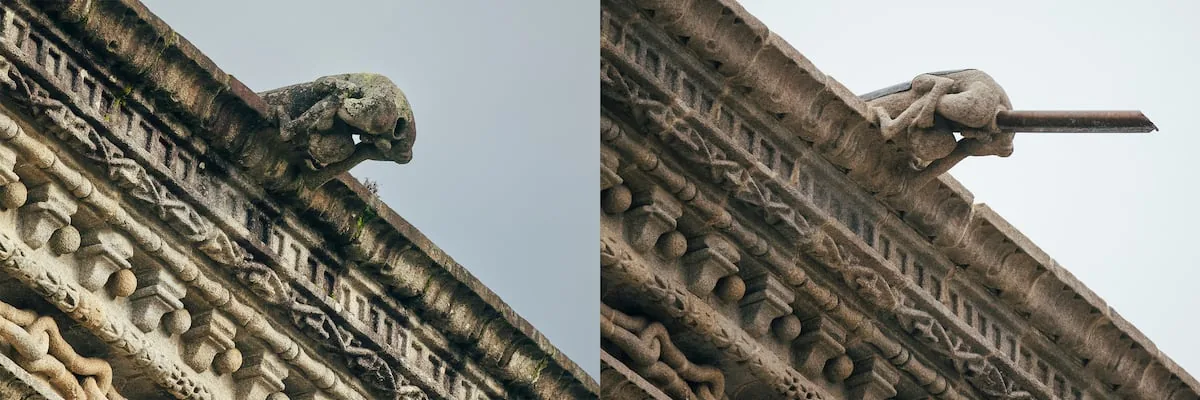
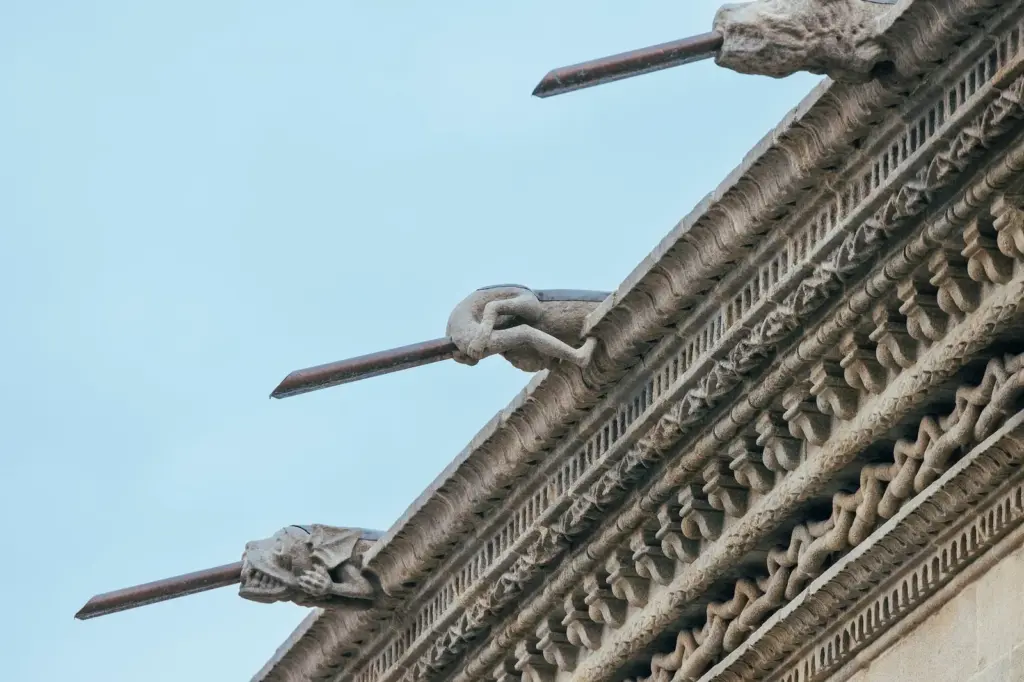
“When a brain can’t take it anymore, aberrations like these happen,” sums up a follower of Gargopedia, an online outreach space created by art historian Dolores Herrero, the leading specialist in gargoyles and chimeras in Spain. Other readers call for resignations, some demand to see “the face” of the person who decided and approved such a mess. Comments chain up in view of one of the most repeated images in the Galician press in recent weeks: a fountain in the shape of a naked man who until a few months ago (and since the 16th century) showed, bent over, his genitals while letting rainwater flow out of his anus. It was the symbolic or burlesque play of a Renaissance stonemason, but now it is, as people describe it, “impaled,” “colonoscopyed,” “sodomized” by a long copper pipe installed during the million-euro restoration of the parador promoted by Turespaña (Ministry of Industry and Tourism).
This figure offers the passerby its open buttocks on the cornice of the Hostal dos Reis Católicos, the “oldest hotel in Spain,” one of the four BICs surrounding one of the most famous squares on the planet: the Obradoiro. To the left of the Compostela cathedral as seen from the front, until Easter the gargoyles that previously flowed freely and are now piped were not fully exposed, as was justified, to save the two Baroque balconies that adorn the facade and over which, in fact, they had been pouring for centuries. The ones now appearing skewered like kebabs by the pipes (“spears,” according to the language of technical reports) are 16, eight for each balcony: fountains whimsically carved in stone in the shape of monsters, animals, or anthropomorphic figures; mouths with teeth and tongue, and the famous anus, now nailed and disfigured, but more portrayed than ever. The word has spread so much among pilgrims and tourists — who by this time of year arrive in a stream to this square that is their goal — that the gargoyles that previously went unnoticed have become a selfie background or the target of mobile phone zooms.
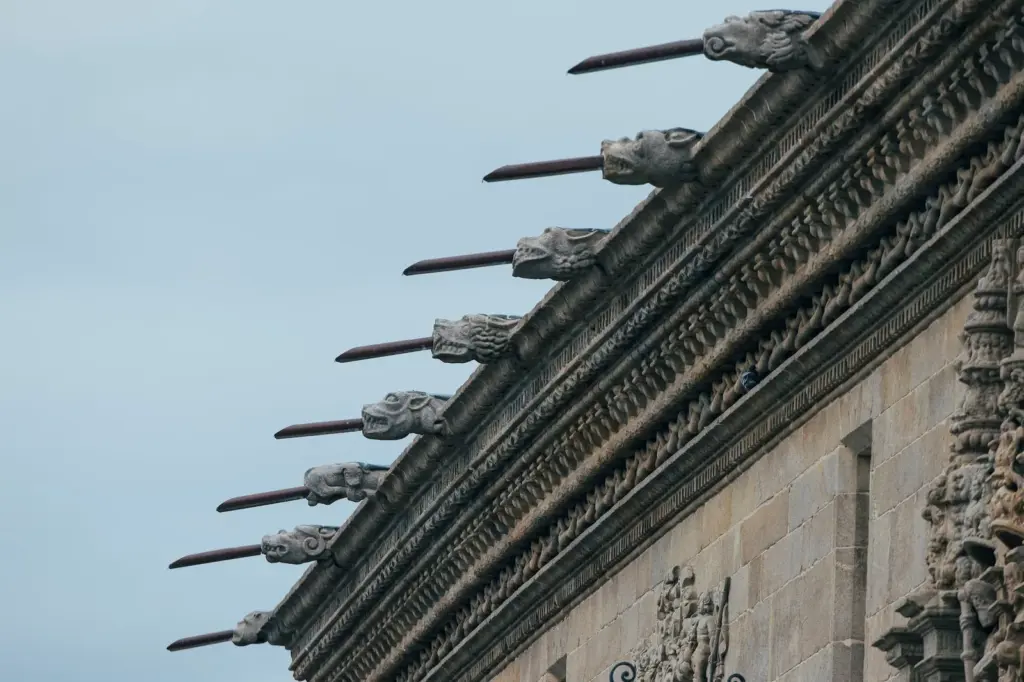
In mid-April, Benxamín Vázquez, a retired journalist, scholar of the three hundred gargoyles that Santiago has, and author of Gárgolas de Compostela (Editorial Alvarellos), was responsible for raising the alarm… or opening the floodgates of accumulated outrage. The facade’s tarp began to be removed “in February,” just as the second edition of his gargoyle guide was published, and after Easter the restoration was fully exposed, he recalls. Anger spread among the public and the veteran reporter reported the architectural nonsense to several media outlets. Soon the backlash grew like a torrent. From neighborhood groups to international architects and art historians. Among the strongest criticisms, the open letter from Carlos Henrique Fernández Coto, also an architect and president of Apatrigal (Association for the Defense of Galician Cultural Heritage). In a long text, the professional argues that the solution to the dampness undertaken by the Valladolid-based studio of Fernando Cobos for Turespaña “does not dialogue with the architecture,” “does not integrate into its material logic,” and “introduces a visually aggressive element in one of the country’s most sensitive ensembles.”
Because, if Santiago is the capital, the Praza do Obradoiro is the heart of Galicia. A space “of maximum historical and symbolic significance, in which each element is part of an extremely delicate balance.” In such a space, “which does not admit trivializations,” Apatrigal defends, “the architect should aspire to go unnoticed.” “Galicians are uncomfortable with an intervention that does not understand the place,” summarizes Fernández Coto, who reminds the experienced architect of the master plan that “in the 21st century there are technical solutions without resorting to such rudimentary expressions,” such as “hidden channels and integrated systems.” It is, he emphasizes, “a matter of social, cultural, and even civic scope.” And “it is not possible to take refuge in the technical or administrative coverage of the intervention, nor in the authorization of Heritage.”
Coto tells EL PAÍS that his group is now “calmer, but vigilant of the steps taken” after the meeting to which representatives of the Xunta and the Paradores project were pushed. “Are gargoyles currently necessary to pour water?” he asks via WhatsApp from Italy, “let them be left alone, as a historical testimony, and let the water be collected and expelled through hidden ducts, making the intervention at Europe’s kilometer zero go unnoticed.” The same expression, “vigilant,” is used by an official spokesperson of the Consello da Cultura Galega, headquartered in the same Praza do Obradoiro, when asked about the controversy. Apatrigal, the Santiago Athenaeum, the Association of Neighbors of the Historic City Fonseca, and the Cultural Association Casino have just sent a letter to the International Council on Monuments and Sites (Icomos) in Spain to make them aware that the figures have been distorted.
Read more A narco speedboat crashes into a Customs patrol boat during a chase in Almería
Regarding the next steps, and the three or four alternatives to the “spears” that those responsible for the work and administrative authorizations have committed to studying, the Xunta de Galicia concludes: “The technicians of the Directorate General of Cultural Heritage and Turespaña are in permanent contact. For now, we have nothing to communicate.”
The meeting between the general director of Heritage of the Xunta, Ángel Miramontes, and the responsible architect, along with several technicians, was the culmination of statements, reactions, and justifications from all administrations (ministry, consellería, and City Council) that this project has managed to get through in the last four years — which, amid mockery, anger, and sadness, the neighborhood called “sodomite.” Although the reform depends on Turespaña, the Xunta supervised and prepared a report authorizing the works but with a series of observations. The Culture conselleiro himself, José López Campos, explained before the meeting with Cobos that his technicians had warned that the issue of dampness on the facade had to be “analyzed in detail with a specific document to find the best solution; not only from the architectural and functional point of view but also from the aesthetic.” The Xunta official then assured that this documentation from the ministry-dependent body “was never sent.”
For its part, Turespaña responded in a statement that the works were contemplated in the Conservation Master Plan, which the Xunta approved in 2022 and which “establishes the guidelines for all interventions in the building.” “Like all conservation projects in cultural heritage, the different options and solutions are the result of a rigorous study by those responsible, which considers future conservation, material compatibility, and minimal intervention, aligned with national and international standards in conservation, reinforcing its quality and reliability,” the state entity justified in its statement. The installation of the pipes, according to the conselleiro, is “reversible” and there is “no irreparable structural damage.”
Dolores Herrero, author of La gárgola y su iconografía (Universo de Letras), traveled from Madrid to Santiago the weekend after the emergency meeting between Xunta and Turespaña to check in situ the dimension of the disaster. She tells this newspaper that she spoke with “horrified people,” art lovers who “literally cried,” “devastated by this horror.” “The pipe solution is not new; it has been used in Spain in other buildings, usually with much smaller nozzles, but in France you don’t see something like this… it does not respect the artwork; an exceptional iconographic ensemble has been attacked,” the specialist continues her analysis. In heritage, “it is not enough to solve a technical need; how it is solved matters,” emphasizes this doctor in Art History, already in the latest video of her Gargopedia. The gargoyle “is not just a gutter,” but “pure image,” which “provokes emotions like any other work of art” and is “worthy of respect and protection.” “Each shape, each gesture, and each detail holds a story and tells us about an era, a style, beliefs, a way of thinking and living,” she concludes: “When you touch a gargoyle, you don’t just touch a drain; you touch a part of a heritage that belongs to all of us.”
Read more The latest Russian bombing on Kiev causes 24 deaths, including three girls