









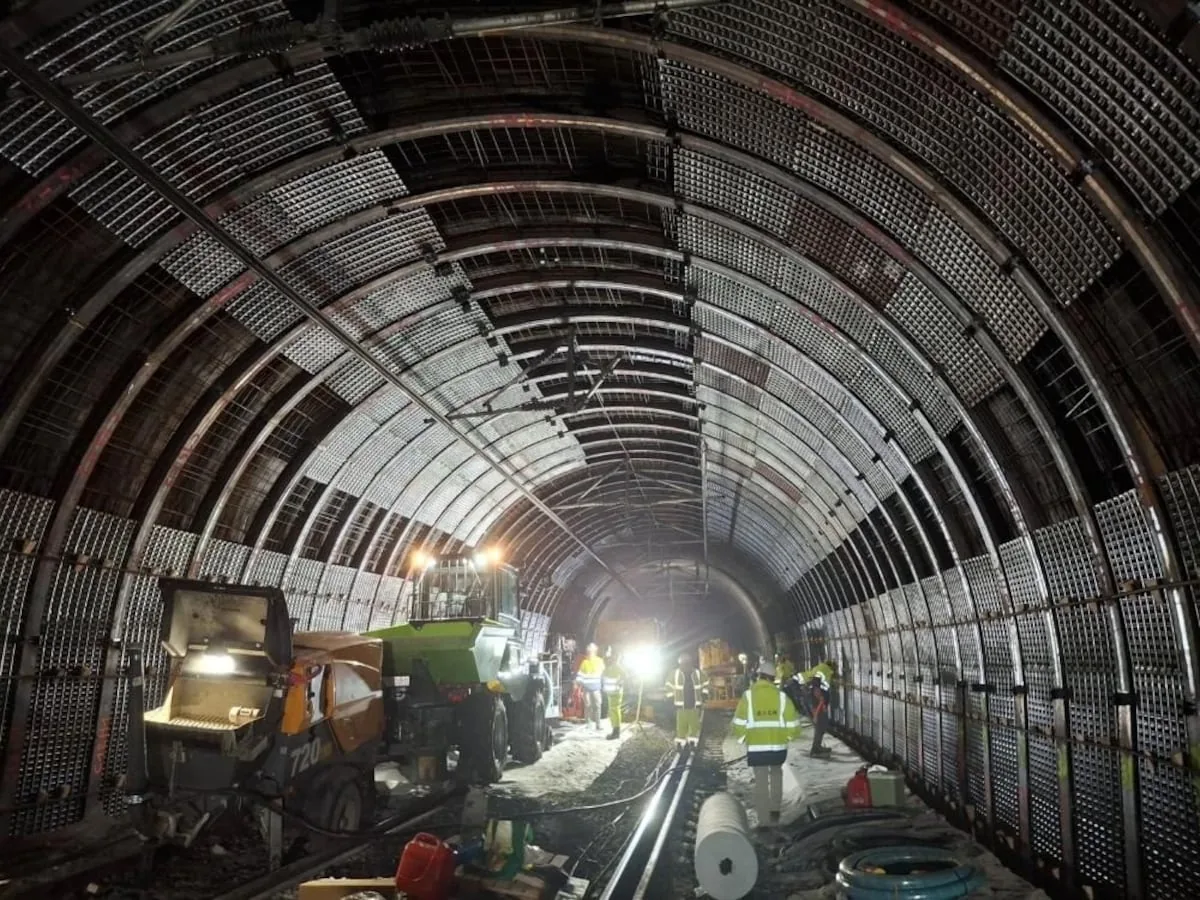
Adif expects to restore circulation for railway freight traffic through the Rubí tunnel on the night of Tuesday, April 28 to Wednesday, April 29, after the first part of the work on the gallery, which was closed on March 12 due to its dangerousness, has been completed. That day, the Minister of Territory of the Generalitat, Silvia Paneque, announced the closure of the tunnel for seven weeks. The closure of this infrastructure has meant disabling the only viable alternative for freight trains to enter or exit Europe through eastern Spain. Thus ends a collapse that has lasted a month and a half.
Read more The Supreme Court accepts Ayuso’s appeal to block Pedro Sánchez’s immigrant regularization
The same day she announced the closure of the Rubí tunnel, Paneque proposed a new route to freight companies that involved an unprecedented detour to reach the port of the Catalan capital, diverting through Manresa towards Lleida and Sant Vicenç de Calders. This meant that trains would travel an additional 330 kilometers and five extra hours. Very few companies opted for that route. Most decided to take the trains to La Llagosta (Barcelona), load the goods onto trucks to the Port of Barcelona, and then transfer them back to another train. These operations increased the price and time of freight transfers. It seems that the hardships endured by the sector are about to end.
Adif has announced the opening next Tuesday, after the first part of the main phase of the reinforcement, stabilization, and improvement work on its structure is completed.
Despite this, the tunnel will not operate at full capacity. The provisional reopening will be carried out under a single-track circulation regime between Castellbisbal and Rubí-Can Vallhonrat for 12 hours a day, from Wednesday to Sunday, and for 21 hours on Mondays and Tuesdays. This operation will remain in effect for at least one month until the pending work in this tunnel, a victim of underfunding, is completed. In fact, it is not the first time the tunnel has closed. After the railway accident in Gelida on January 20, the gallery remained closed for 15 days for emergency works, causing millions in losses to the sector.
Adif now highlights the need to prioritize the reopening of freight services and has already communicated its intention to reopen the infrastructure to the line owners.
Since the end of January, internal structural reinforcement operations have been carried out, using the emergency administrative mechanism, on 123 of the more than 900 meters of the tunnel. The action consists of implementing metal pieces called trusses, custom-made for each section of the tunnel and anchored to the base of the slab, previously excavated and concreted, to serve as a framework for a reinforced concrete strengthening ring inside the tunnel. It was already known that these works should have been carried out before the Rodalies crisis, yet they had to be done urgently due to the deplorable state of the tunnel. Since mid-March, Adif has worked on stabilizing about 60 meters of the tunnel’s length, which forced a complete interruption of circulation until next Tuesday. In the remaining 63 meters of the 123 included in the ongoing action, the foundations and a large part of the trusses will be executed. The work of placing the remaining trusses, the Bernold formwork sheets, concreting, and shotcrete will remain pending, although their execution can be made compatible with the circulation of freight trains during the scheduled slots.
Adif maintains permanent monitoring of the structure in this tunnel using more than 30 sensors to control the stability of the sections not yet repaired. Once the emergency works are completed, it will continue with the reinforcement of the remaining length through an ordinary procedure that is in the awarding phase.