









Mr. Wonderful has definitively lost the legal battle against Ale-Hop for alleged unfair competition that it initiated five years ago. The Supreme Court has rejected the claim that the mugs, notebooks, and more than a hundred products with motivational phrases and pastel colors sold by Ale-Hop under its own brand are copies of the characteristic designs of Mr. Wonderful. The Civil Chamber, in a ruling accessed by EL PAÍS, has dismissed one by one all the reasons put forward by the Catalan company, which demanded the destruction of Ale-Hop’s products and compensation for damages. The judges also require Mr. Wonderful to cover the costs of the legal process that escalated from a court in Valencia to the high court.
Read more Phenomenon Rosa Montero
The controversy now settled by the Supreme Court began in 2021, when Mr. Wonderful sued Ale-Hop for unfair competition and accused it of imitating its designs and thereby confusing consumers and taking advantage of its reputation. But the Civil Chamber’s ruling, 46 pages long and authored by Judge Fernando Cerdá, rejects this thesis, as had already been done by a Commercial Court in Valencia and the Provincial Court.
The judges note, from the outset, that even before Mr. Wonderful entered the market in February 2011, there were established trends with designs combining images of objects (mugs, fruits, sweets, stars, animals…) personalized or given human expression and brief messages with a characteristic typography incorporated into a variety of products (planners, mugs, t-shirts, hot water bottles, bibs, slippers, keychains…).
The Supreme Court emphasizes that Ale-Hop had already used these designs before the establishment of Mr. Wonderful, although not exactly in the pastel tone range later imposed by the Catalan company. “In the 2010 catalog, there is a product that combines a personalized mug with its coffee and churro, with a personalized milk brick suggesting a cow and under the Ale-Hop brand, and over the two dialoguing drawings, the expression ‘Good morning’,” the judges illustrate. Expert reports included in the case refer to these trends as coming from the Japanese kawaii movement and the hipster and vintage lettering styles, which “inspire and influence” both Mr. Wonderful’s and Ale-Hop’s designs.
The Supreme Court admits that Mr. Wonderful’s arrival brings to the market – “through the way drawings, colors, and texts are combined” – unique characteristics “that allow consumers to identify its specific products in the sector in which it operates.” But “if this has been one of the keys to its business success, it has also led to the appearance of imitators in the sector,” the court warns.
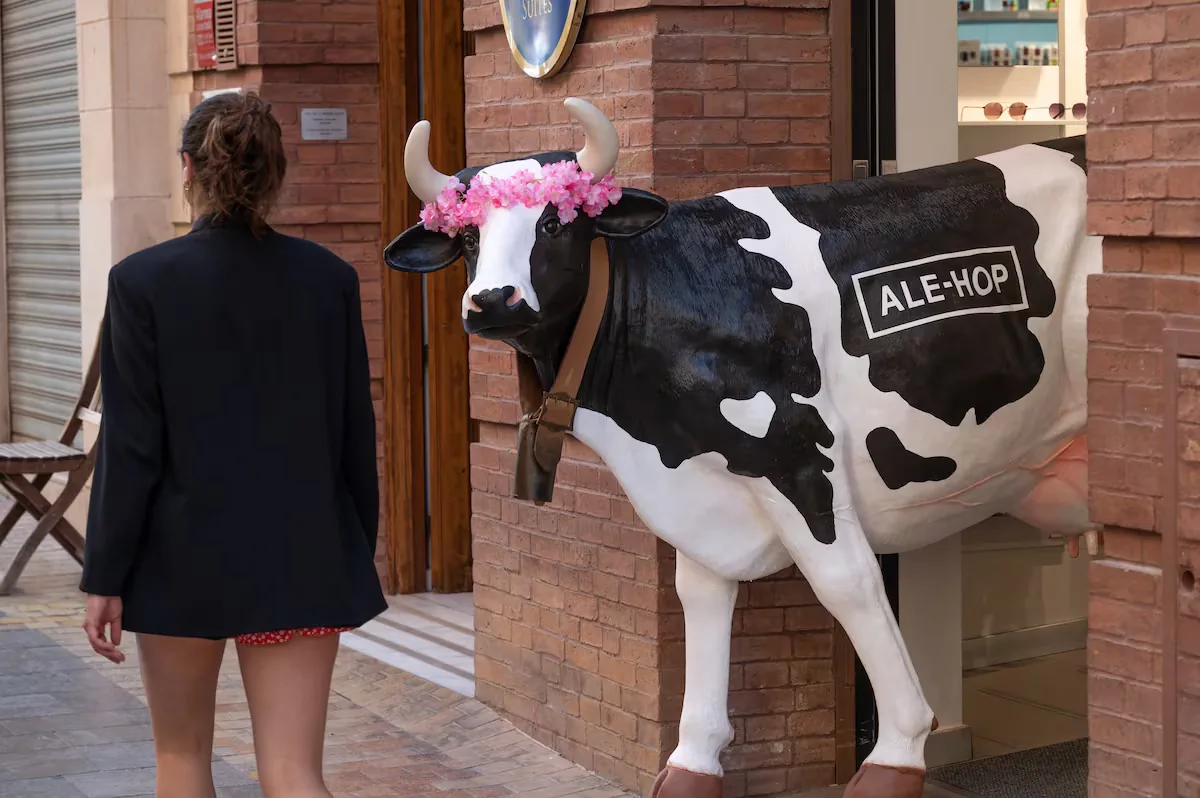
The judges recall that Spanish legislation has consciously and deliberately adopted a liberal approach to the imitation of business services and initiatives, establishing freedom of imitation as the general rule. Therefore, for Ale-Hop to have been condemned, it would have had to be proven, for example, that such imitation prevents consumers from distinguishing the products of one chain from the other. But in this case, the court notes, Ale-Hop has taken the necessary measures to prevent this from happening, and the presentation styles of both companies (the appearance of the stores and the brand) are “so different that they avoid the risk of association.” The life-size cow guarding the door of Ale-Hop stores has worked in favor of the company, as the Supreme Court understands it is such a distinctive element that it dilutes the possibility of customers confusing one store with another.
It has also not been “at all” proven, the court notes, that consumers have established any economic or legal relationship between Mr. Wonderful and Ale-Hop. “On the contrary, the opposite is demonstrated,” the judges state, referring to a tweet included in the case that serves as an example: “And now I’m going to Alehop, which is the Mr. Wonderful of the poor.”