






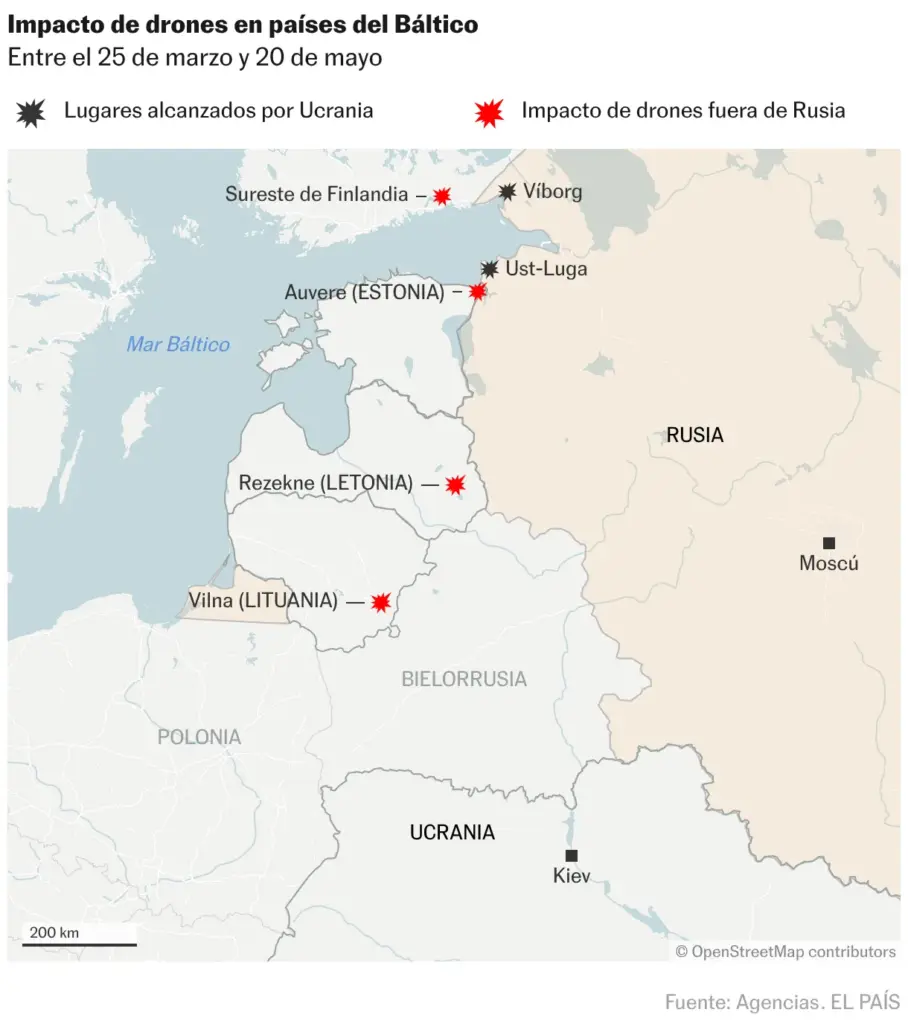
The impact, downing, or flight of nearly a dozen Ukrainian drones in the last two months has once again placed the Baltic region at the center of a gray zone where air security, electronic warfare, and strategic ambiguity blur. Ukraine claims that its attack vehicles, launched towards the ports of the Leningrad region in northwest Russia, have been diverted by the enemy army and that they are being directed against its allies.
Read more The strategy of businessman Julio Martínez will shape Zapatero’s judicial future
The situation is somewhat paradoxical. On Tuesday, a NATO air police F-16 fighter jet shot down one of those unmanned aircraft from Kiev that had entered Estonian airspace with a missile. A day later, another of these devices forced Lithuanian authorities to open the country’s shelters. The incidents are fueling political tension and public unease in a region accustomed to looking to Russia as the main threat, but which is now also beginning to monitor the risks arising from the war of its main ally.
In Brussels, both the EU and NATO insist that the origin of the problem remains in Moscow. “[The Ukrainian drones] are there [in the Baltics] because of Russia’s large-scale, reckless, and illegal attack that began in 2022,” said the Alliance’s Secretary General, Mark Rutte, on Wednesday. Russia, however, accuses Estonia, Latvia, and Lithuania of facilitating Ukrainian operations against its territory. An accusation that Rutte called “absolutely ridiculous.”
“Russia’s public threats against our Baltic States are completely unacceptable,” said the President of the European Commission, Ursula von der Leyen. “Let there be no doubt. A threat against one member state is a threat against our entire Union,” added the German on social media, emphasizing that Russia and Belarus have “direct responsibility” in the drone incidents. Allied sources consider that beyond the possible use of electronic warfare, the Kremlin seeks to strain the relationship between the Baltic countries and Ukraine.
The Armed Forces of Ukraine have had the Baltic in their sights since the beginning of the war. Kiev has orchestrated sabotage operations there against the Russian naval force, which has sought in those waters a safer transit than the Black Sea. It has been in recent months that Ukraine has stepped on the accelerator in launching bomb drones towards the northwest. Its objective: to strike the facilities of the powerful Russian oil infrastructure and stop the departure of its ships to the sea, vital for crude exports.
One of the most successful attacks by the Ukrainian army took place on March 25. The army managed to hit a Russian icebreaker in the port of Viborg, near the border with Finland, a thousand kilometers from Ukraine. That day, Moscow intercepted at least 390 Ukrainian drones, according to the Kremlin.
To stop the swarms of Ukrainian drones, the Russian army has multiplied interceptions, some through electronic means — a method infinitely cheaper than launching missiles. Since March 23, nearly a dozen of these diverted attack aerial vehicles have ended up flying over or reaching the Baltic countries and Finland.
“These drones are usually loitering munitions [the usual attack devices] and decoy systems, and can be easily diverted,” says Yasir Atalan, an expert at the Center for Strategic and International Studies in Washington, in an email. “Most of the time, Ukraine loses connection with these drones due to electronic warfare techniques. Their inertial navigation systems are almost always weak. Unlike FPV drones, which are now operated with fiber optic cables, these loitering drones can be easily intercepted.”
The attack aerial vehicles have not only affected the region’s security. The fall in early May of two of these devices in Latvia, one of them against an empty oil storage tank, caused the resignation last week of the country’s prime minister, Evika Silina.
Read more The Milei Government agrees with the United States on joint patrol of the South Atlantic
Disrupting communication
The electronic warfare systems used by both sides usually focus on disrupting communication between the operator and the drone, causing loss of control of the device. In some cases, the aircraft end up crashing after traveling long distances, as has already happened in Poland and Romania.
Other techniques include so-called spoofing, through which false navigation data is introduced to redirect or crash the drone, and the direct hijacking of the device’s communications to control its flight.
Marina Miron, a researcher in the War Studies Department at King’s College London, points out that it is difficult to determine whether the diversions of Ukrainian drones towards the Baltics are due to spoofing techniques. “In the specific case of the Baltic, it remains difficult to determine whether the alleged deviations in the flight paths of Ukrainian drones were really the result of signal spoofing,” she states in an email. “An important factor to consider is the limited battery life and range of many long-range Ukrainian drones. If their routes extended significantly through Baltic airspace, the question arises whether they would still have enough autonomy to reach targets inside Russia,” the expert continues.
Electronic warfare is not only a weapon used by the invading army. Kiev reports daily the interception of dozens of Russian drones, mostly through kinetic means such as artillery fire or missile launches, but also through signal disruption or jamming. These electronic methods, however, are unable to repel all the aircraft from the huge swarms launched by both sides.
Miron suggests that electronic warfare can function as an indirect pressure tool on NATO, precisely because of the difficulty of attribution that characterizes it. Its strategic value lies in the ability to generate an effect on the enemy and its allies without triggering a direct military response. “Electronic warfare offers a tool that can generate political and psychological effects without crossing the threshold that would trigger a kinetic response,” says the researcher.
The key lies in that structural ambiguity: when interference occurs in navigation systems, it is extremely complex to determine its origin or intention with certainty. That uncertainty amplifies its impact beyond the technical level, conditioning the perception of security, cohesion among allies, and the allocation of defensive resources. “This creates fertile ground for misunderstandings and, potentially, for dangerous miscalculations,” points out researcher Miron.
Ukrainian President Volodymyr Zelensky has offered the Baltic countries to send operators and experts in drones and electronic warfare to help train their armies. The spokesperson for the Ukrainian Ministry of Foreign Affairs, Georhii Tikhii, explains by phone that Kiev is in contact with its allies in the Baltics and Finland regarding the “incidents” linked to drones that have reached their territory. Zelensky’s government has apologized to its partners in the region. They have publicly held Moscow responsible for what happened at all times. Privately, they show concern about the succession of incidents. The Estonian Defense Minister, Hanno Pevkur, stated on Tuesday that he has asked Ukraine to keep the trajectory of the attacks as far as possible from NATO territory.
Read more Barricade yourself on the first floor or open up to the second