

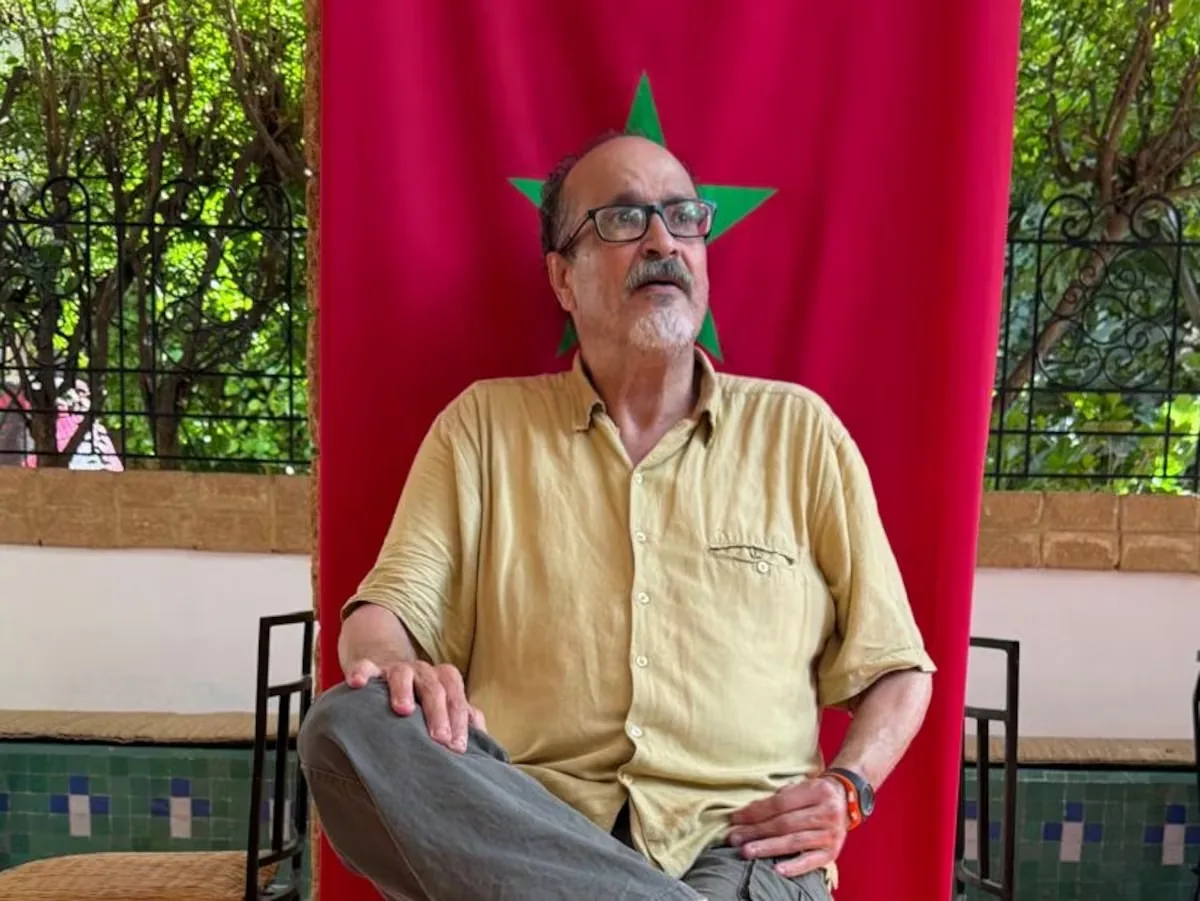
“I feared for my safety when I was transferred at dawn to Casablanca by unidentified armed men,” said Ali Lmrabet, a Moroccan journalist critical of the system, by phone on Wednesday night after being released. He was arrested on Sunday upon arrival at Tangier airport from Barcelona, where he has lived for more than two decades with his Spanish family. He speaks with the calm of someone expecting to retire soon, after a long and turbulent professional career, without ever losing his usual Riffian good humor. From a friend’s house in the economic capital of the Maghreb country, he expresses himself in fluent Spanish with a Catalan accent and some echoes of French pronunciation, inherited from a university education in Paris.
Read more The CJEU sets the path for amnesty this Thursday: key points of a decisive ruling
“’Go home,’ they told me this morning (Wednesday). They returned my passport and told me I could return to Barcelona whenever I wanted. ‘If there is a trial, we will summon your lawyers,’” he recounts in a narrative sprinkled with irony. “’But there is a lawyers’ strike,’ I replied. ‘Better call me on my Spanish number. But not in October or November, I have a scheduled surgery.’ ‘Go, don’t worry,’ Lmrabet tries to downplay the police and judicial ordeal with which his country received him after a six-year absence since his last visit.
“I don’t know who is behind the 30 charges brought by the State Attorney General’s Office for as many arrest warrants,” he explains. “There is no specific name in the nearly 700 pages of the police file.” “All the charges are related to what I call the hidden power structure in Morocco, in exercise of my freedom of expression,” he clarifies.
Hidden power structure
He refers to an alleged “deep state that runs the country in the shadows.” “I have written that there is a network of power interests and that is why they arrested me,” he details. “To name the royal advisor Fouad Alí el Himma, a former schoolmate of King Mohamed VI in Rabat, whom I attribute as the one who holds the reins of power. Also for talking about the head of state security Abdelatif Hamuchi, who controls the General Directorate of Territorial Surveillance (internal intelligence) and National Security, which oversees 30,000 police officers, as well as the Minister of Budgets and president of the Moroccan Football Federation, Fouzi Lekjaa. But they are not listed as complainants,” he breaks the silence.
“It’s nothing new. Other media have written about it in Morocco. But some think I have gone too far by naming those I believe are behind the hidden structure of a deep state in Morocco,” he argues about the reasons for his detention.
“I asked the Prosecutor’s Office if there was any charge of insults or assault on authority; if I had been offensive in my expressions. But an officer of the National Judicial Police Brigade (elite unit) confirmed that there was not. Simply, for naming members of the shadow power structure that runs the country, I have been accused of causing harm to ‘institutions protected by law.’ That’s the situation,” he relates.
-Have they not communicated any charge related to insults to the throne?
-Not at all. I am only accused of exposing certain strongmen. It is a matter of freedom of expression. An issue that concerns the Moroccan Press Code. If the people I mention believe my information is false, they should sue me for falsehood. They can also sue me in Spain, where I practice journalism,
Ali Lmrabet, 66, flew from Barcelona to Tangier on Sunday to carry out administrative procedures to document 15 years of Social Security contributions, in order to submit them for his retirement file in Spain, where he has had his residence for more than 20 years.
“I already knew I had two or three arrest warrants in my country, but I did not expect there to be 30. Anyway, I traveled with a one-way ticket only, and I left my professional phone and computer safely in Spain,” he recalls. “Everyone warned me that I was going to be arrested. I thought it would be just a few questions, as in previous private trips to Morocco in the last two decades. But it ended up being a nightmare,” he laments.
Unidentified armed men
Lmrabet claims to have suffered mistreatment by seven unidentified armed men who transferred him at dawn on Monday from Tangier airport to the headquarters of the National Judicial Police Brigade in Casablanca, where he admits he was treated properly.
“It was all very strange. First, uniformed agents took me to the judicial police offices in Tangier, but before arriving we had to urgently return to the airport. There a new report was drawn up,” he reveals. “They handed me over to some unknown people in a van without plates or police insignia. During the transfer, I suffered a contusion on one forearm. They also did not allow me to urinate for almost the entire trip,” he denounces. “I asked them who they were, but they refused to answer me. One just replied: ‘You will soon know who I am.’”
“I reported these facts to the judicial police doctor who examined me in Casablanca and then transferred me to a hospital for examination. Also to the prosecutor who interrogated me before my release was ordered,” he concludes. “Morocco has not changed, and unfortunately, I fear it will not change for me.” He thinks that mistreating a journalist for asking the people who guard and transfer him under arrest to identify themselves goes too far in a state that claims to be ruled by law.
The dissident Moroccan journalist Ali Lmrabet was imprisoned and banned from practicing his profession in Morocco in 2003 and 2005. The Casablanca Prosecutor’s Office specified on Tuesday in a statement that the police detention had taken place so that the journalist could be “interrogated” about “defamatory and insulting statements against people and institutions” and “offensive expressions directed against State bodies,” according to the state news agency MAP. The Public Ministry ordered on Wednesday that a computer, a USB memory stick, and a mobile phone seized from him upon arrival at Tangier airport be returned.
Lmrabet’s release, who also holds a French passport, took place a few hours before the official visit to Rabat of the French Prime Minister, Sébastien Lecornu, scheduled from this Thursday for a high-level bilateral meeting.
Setback for press freedom
Following the request made on Monday by the Moroccan Association for Human Rights (AMDH) for the journalist’s release, the NGO Reporters Without Borders (RSF) expanded the demand on Tuesday, calling for his immediate release.
RSF, which ranks Morocco 105th out of 180 countries according to its level of respect for press freedom, has questioned “the use of the judicial system to silence critical voices.” “Criminalizing journalistic work cannot correspond to the application of the law: it is the perversion of justice in the service of repression,” emphasizes this organization defending persecuted reporters.
A pioneer of informational openness at the beginning of King Mohamed VI’s reign in 1999, the independent journalist was imprisoned in 2003 for questioning the monarch’s figure and chose exile in Spain from 2005.
Active on social media with critical comments on Morocco’s political current affairs, Lmrabet has collaborated with Spanish and European media, including EL PAÍS. In Morocco, he directed the magazine Le Journal and founded the publication Demain, as well as various satirical weeklies in Arabic and French. All were shut down by the judiciary following complaints from authorities and pro-government associations. Among many other professional awards, in 2005 he received the José Couso Prize for Press Freedom.
Entities such as the Federation of Associations of Journalists of Spain (FAPE), the College of Journalists of Catalonia, the professional association to which he belongs, and the Autonomous University of Barcelona, with which he is linked through participation in academic activities related to information, had also demanded his release.