

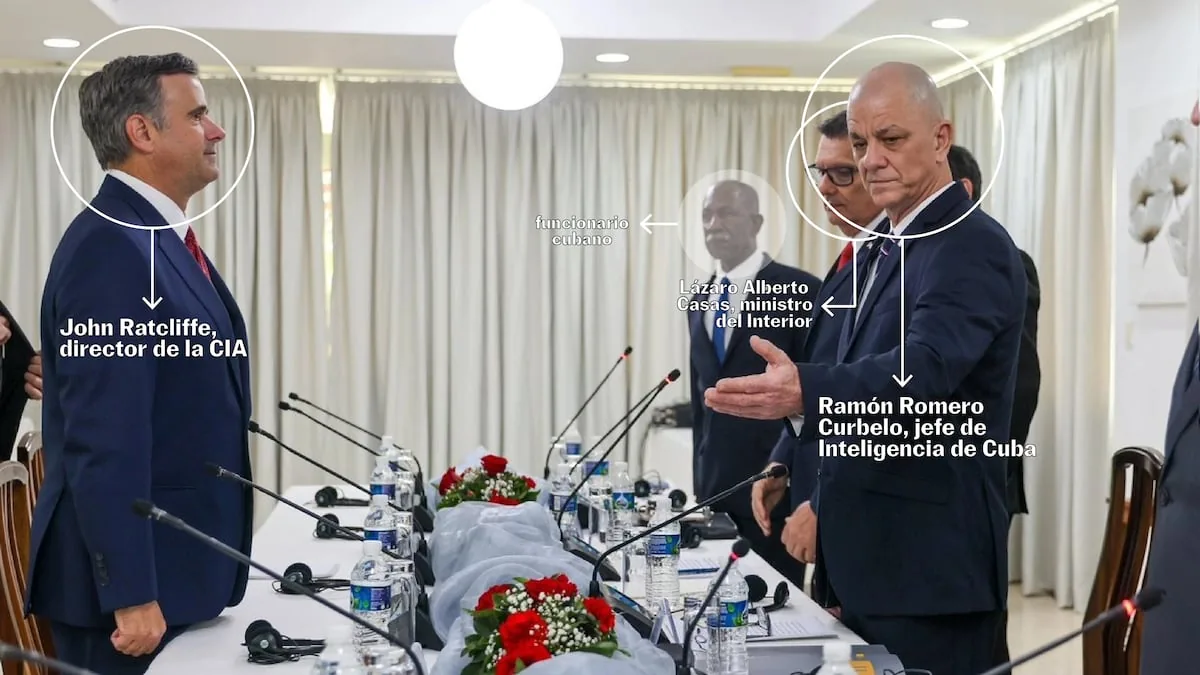
On May 14, something that seemed impossible happened: the Cuban regime received John Ratcliffe, the CIA director, in Havana. The intelligence agency that supposedly tried to assassinate Fidel Castro hundreds of times, the mastermind and financier of intelligence operations on the island, was invited to hold a dialogue with high-ranking Castro officials. Eleven years earlier, in the context of the détente achieved between Raúl Castro and Barack Obama, then-CIA director John Brennan also traveled to Cuba to talk with the regime, but he did so incognito. Therefore, what really makes Ratcliffe’s visit exceptional is that it has been public.
The purpose of the meeting, according to the CIA, was to address “economic and security issues.” But whether this statement is true or not, at least symbolically, it is the greatest milestone in the negotiations carried out by both governments since January 29, when Trump decreed a radical oil embargo against the island.
Cuba’s fate is more uncertain than ever. Trump has said he intends to “take” the island, while the Havana regime faces the greatest crisis in its history and an absolute shortage of fuels. In this context, if Ratcliffe’s visit secretly decided the course of events, the future of Castroism would have been sealed by the words of those whom the CIA has recognized as interlocutors: Raúl Guillermo Rodríguez Castro, Lázaro Alberto Álvarez Casas, and Ramón Romero Curbelo. These are three obscure and barely known figures who apparently hold much more power within the Castroist leadership than is attributed to them.
Raúl Guillermo, ‘El Cangrejo’
In Cuba, almost no one calls him by his name; instead, they call him El Cangrejo because of a deformity in one of his hands, something he has accepted without complexes. He is not a public figure, has not held any political office, and until recently was only known as one of Raúl Castro’s grandchildren, perhaps the favorite. However, today he is in charge, on the Cuban side, of the negotiations through which Castroism intends to guarantee its survival in the face of continuous threats from the United States.
Raúl Guillermo Rodríguez Castro’s (42 years old) public appearances were always limited to his role as his grandfather’s bodyguard. He opened the car door for him, organized the rest of the security team, and followed him at political events like a shadow. But it was not until 2016 that he began to gain relevance, at least formally, as Raúl Castro promoted him to lieutenant colonel of the Ministry of the Interior and put him in charge of the General Directorate of Personal Security (chief of escort). In 2021, when the old dictator formally abandoned all his government and Communist Party positions to retire from the public eye, El Cangrejo also stopped appearing before the cameras.
Cubans also know him from photos and videos leaked from his private life. According to these materials, Raúl Guillermo enjoys a life of luxury, among yachts, lavish meals, and special dealings with trendy Cuban musicians and sports stars on the island.
But Raúl Guillermo’s lineage is not limited to his grandfather. His father, General Luis Alberto Rodríguez López-Callejas, was, until his death in 2022, one of the most discreet and powerful figures in the country. Luis Alberto, considered a sort of gray eminence within Castroism, is credited with being the architect of the co-optation of the Cuban state by the Business Administration Group S.A. (GAESA), an economic and military empire that controls about 70% of the strategic sectors of the island’s economy and almost 95% of its finances.
Lázaro Alberto, the repressive minister of post-Castroism
In 2020, Lázaro Alberto Álvarez Casas (63 years old) was introduced as the new head of the Ministry of the Interior (MININT), one of the most powerful real positions in Cuba. However, for the vast majority of Cubans, he was an unknown. Later, when the government published his biography, many were surprised by the few merits he had accumulated to hold such a position. His meteoric rise within the Castroist leadership is perhaps one of the fastest in the history of the Cuban Revolution.
Lázaro Alberto trained at the Superior School of Military Counterintelligence. Then, according to his biography, he quickly progressed within the MININT structure until becoming head of the Internal Counterintelligence Directorate and deputy minister. It is also recorded that he served two years in the Cuban military mission in Angola.
Read more Soprano Felicity Lott, Carlos Kleiber’s favorite Mariscala, dies at 79 years old
At the time of his appointment as Minister of the Interior, he did not have important distinctions such as Hero of Labor or Hero of the Republic of Cuba, and he had not even been a member of the Communist Party Central Committee or a deputy of the National Assembly of People’s Power, unwritten requirements for the position met by almost all his predecessors. From then on, some of these merits were granted to him, and in 2025 he was promoted from brigadier general to army corps general.
According to several Cuban figures and exile media, Lázaro Alberto Álvarez Casas has some pedigree within Castroism, as he would come from one of the most influential families of the regime: the Casas Regueiro. Two of his supposed maternal uncles, Senén and Julio, belonged to the so-called “historical generation” of the Cuban Revolution, that is, the select group of people who fought against Fulgencio Batista’s dictatorship and emerged strengthened from the internal purges carried out by the revolutionary government starting in January 1959. Senén, who died in 1996, held the position of chief of staff of the Revolutionary Armed Forces (FAR) and Minister of Transport, while Julio, who died in 2011, was Minister of the FAR, a trusted man of Raúl Castro, and one of the architects of GAESA’s empowerment.
From his position as Minister of the Interior, Lázaro Alberto would be one of the main people responsible for repression in Cuba from 2020 to date, including the wave of arrests and imprisonments for political reasons following the popular protests of July 11, 2021. For this reason, that same year he was sanctioned under the Magnitsky Act by the United States Department of State.
Ramón Romero Curbelo, the ‘ten of spades’
Until October 14, few Cubans knew of the existence of General Ramón Romero Curbelo, although from Miami some claimed that he was none other than the head of the Intelligence Directorate of MININT. At the beginning of 2026, the American Museum of the Cuban Diaspora created a project called The Cuban Deck, which organizes the Castroist hierarchy following the logic of a deck of cards. Under this system, Romero Curbelo was represented as the ten of spades.
Romero Curbelo, the Cuban counterpart of John Ratcliffe, was not a public figure. He either appeared at regime political events as just another military man or was scarcely mentioned by official media in secondary news, without explicitly stating which MININT directorate he commanded. He was a face without a name and at the same time a name without a face or specific position. However, after the CIA released some photos of Ratcliffe’s visit to Havana, people began to connect the dots.
According to the Cuban media elToque, it is known that for several years, with the rank of colonel, he held various positions within the MININT structure in the province of Cienfuegos, and that he reached the rank of general and head of Cuban intelligence at some point after 2017. Since then, his public appearances have been very limited. In the Cuban official press, he was barely mentioned in two notes: one about the cancellation of a postage stamp and another about a political event with young people belonging to MININT. In 2024, the Nicaraguan official media El 19 placed him at a meeting held in Managua with the Secretary of the Russian Security Council, Nikolai Patrushev, which also included delegations from Venezuela and Bolivia. A year later, an official note from the National Academy of Public Security of Vietnam named him as part of a Cuban delegation visiting that institution. And nothing more.
By his position, Romero Curbelo is a key figure within the Cuban State Security apparatus, especially regarding espionage tasks. The Cuban Intelligence Directorate is one of the most efficient organizations of Castroism, which has been recently recognized by U.S. Secretary of State Marco Rubio. For decades, it has developed successful infiltration and espionage operations in the United States. Some of its best-known agents (discovered after many years) are Ana Belén Montes, Víctor Manuel Rocha, and those who made up the so-called Wasp Network.
Read more Good weather, beaches, and communions on the day of the Andalusian elections