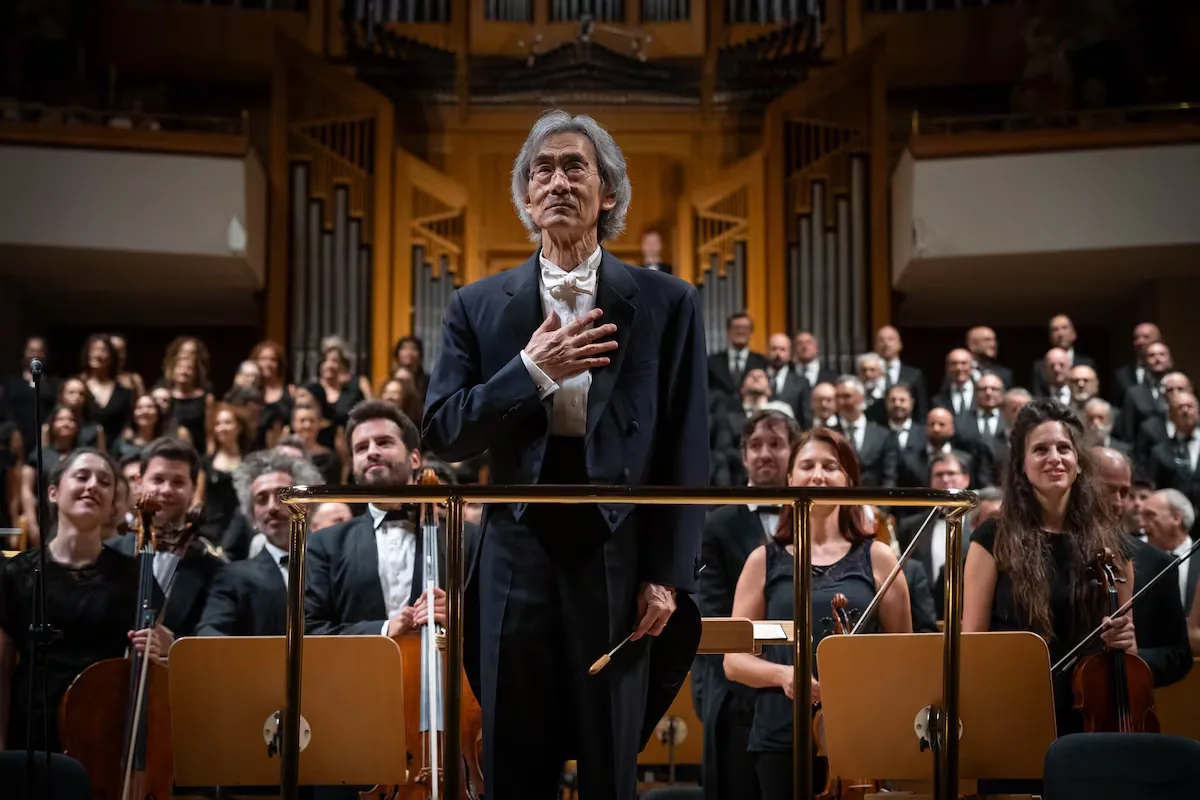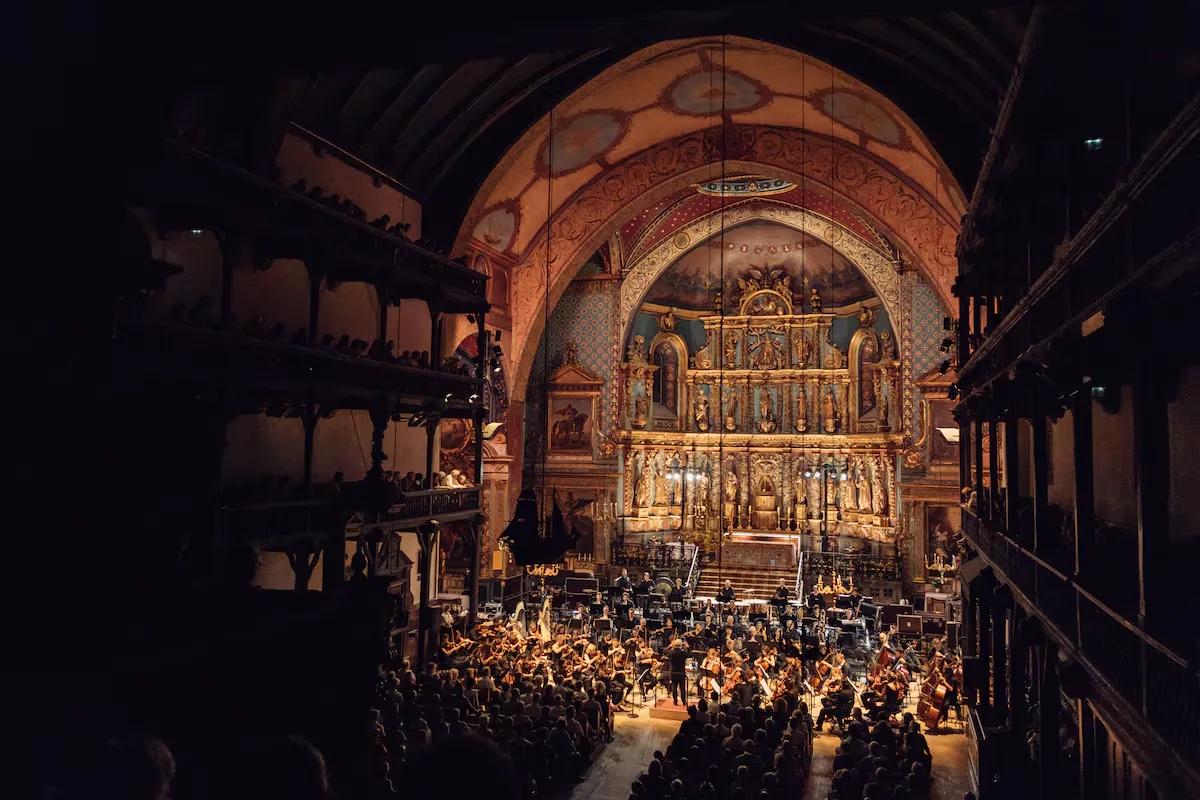
In 1928, at the Residencia de Estudiantes in Madrid, Federico García Lorca gave his lecture on lullabies. He argued there that Spain uses its saddest melodies to color the first sleep of its children, that the mother does not sing the child’s sleep, but her own sorrow, “as if she were hearing the old imperious voices skating through her blood.” Almost a century later, on the 90th anniversary of his assassination by the Francoists, that lecture has been transformed into the program of an unforgettable concert at the Ravel Festival in Saint-Jean-de-Luz.
Read more Real Madrid — Inter opens the Champions League on September 8 for Spanish teams
“Those words of Lorca have been the inspiration for this project,” confirmed to this newspaper on Friday its artistic director, pianist Bertrand Chamayou, regarding the recital he gave the day before in Ciboure alongside soprano Barbara Hannigan and other musicians. It was a sonic treatise on the Spanish lullaby that progressed from innocence to mourning: from Turina’s domestic berceuse to the cradle song Joaquín Nin wrote in the midst of war for the orphans of Spain.
The climax of that recital was the most striking event of the festival’s first three days: Ancient Voices of Children (1970), the pinnacle of the cycle that American George Crumb dedicated to Lorca’s poems, those old voices of children that cross centuries, and which he later revisited in several scattered compositions almost until the end of his days. “The child seeks his voice,” says the verse from his poetry collection Canciones (1921-1924) with which the work opens, and in the church of Saint Vincent in Ciboure, where Ravel was baptized 151 years ago, the voice was literally sought inside a piano.
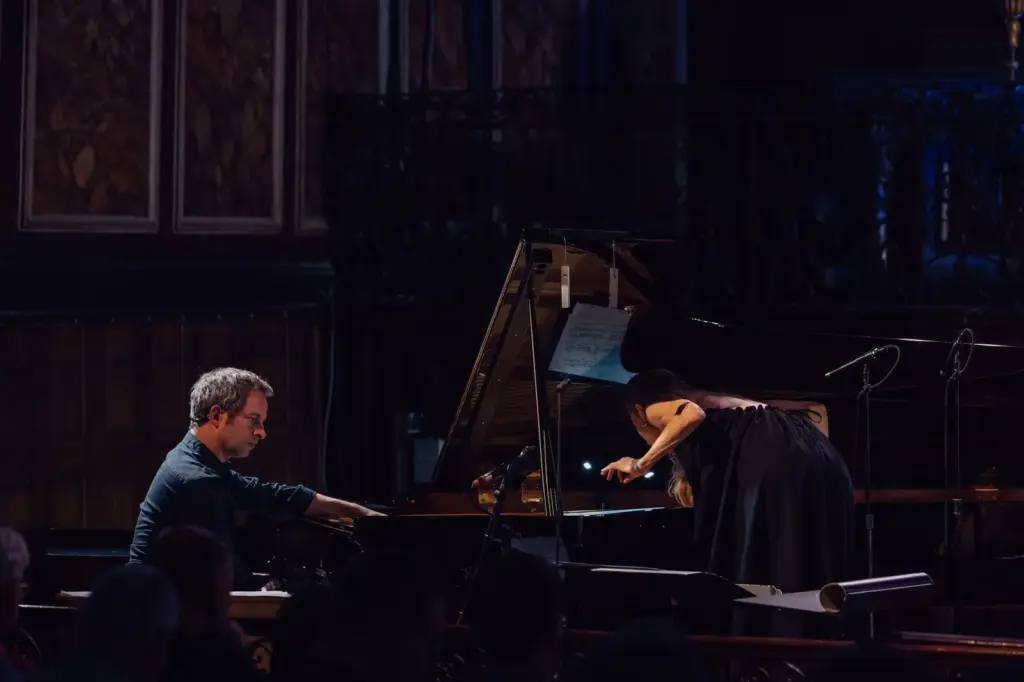
Hannigan placed her head between the strings of the open and slightly amplified piano, just as Crumb indicates with precise notation in the score, and sang into its interior a vocalise of phonemes preceding language, while Chamayou plucked the instrument’s strings. The piano returned to the singer a halo of sympathetic resonances that the temple’s acoustics extended as a second voice. “These works must be performed with the same care as a piece by Debussy or Beethoven,” Chamayou continued. The effect it produced on those of us filling the Basque-French temple proved him right.
That concert was the epicenter of four evenings in three days that offered as many images of Spain seen from the French border: the one dreamed by Ravel and Falla from Paris, the one mourned through Lorca, the 18th-century courtly one, and the one prayed in religious music of Madrid inspiration from Scarlatti to Pärt. “It’s about taking an angle from a theme linked to Ravel, opening it through his gaze and reaching another place,” Chamayou explained about his programming model around an annual theme, which this year takes advantage of Falla’s 150th anniversary. And he himself drew the border between the two Spains of the motto: “For Chabrier it was a fantasy, an orientalism without the East; the first non-Spanish composers who understood the roots of Spanish music were Debussy and Ravel.”
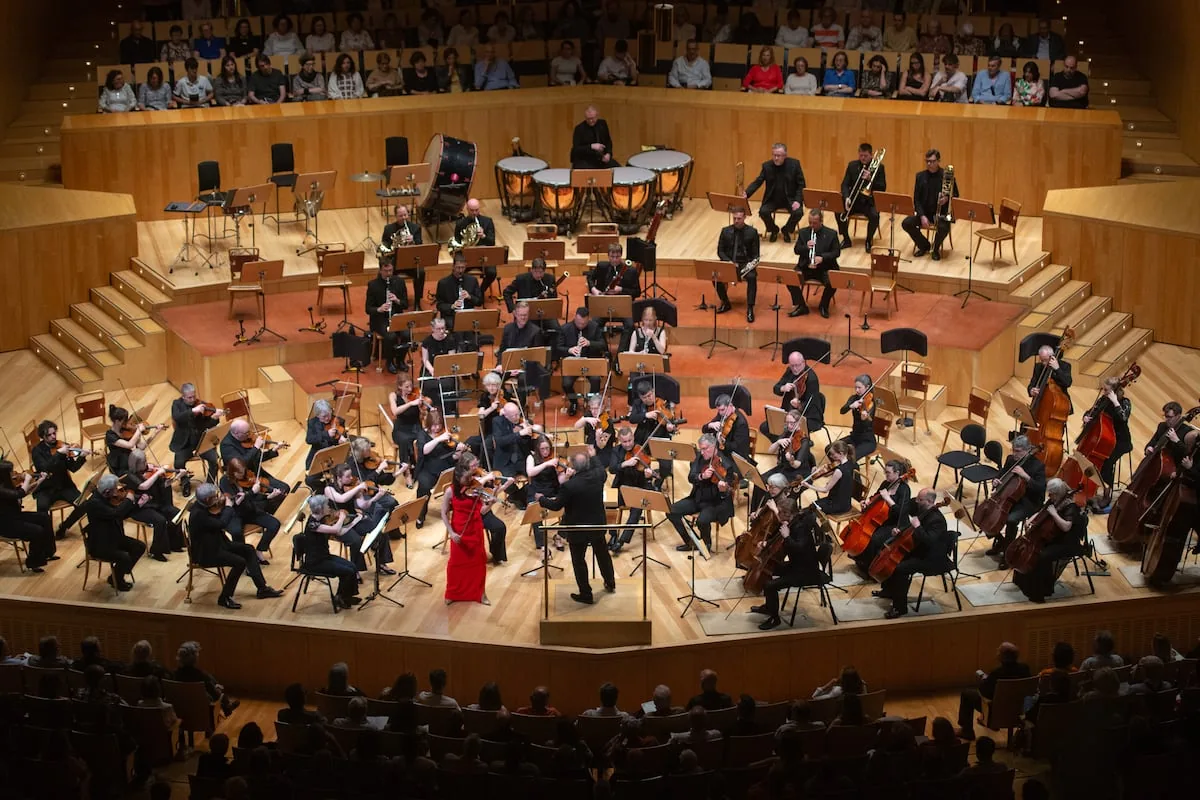
It’s hard to imagine a better lineup to illustrate that thesis than the opening concert last Wednesday in Saint-Jean-de-Luz: an orchestra, the National Capitol of Toulouse, which has recorded all of Ravel’s symphonic work; a conductor, Josep Pons, a regular interpreter of Falla; and a pianist, Chamayou, now the great specialist of the composer from Ciboure. Falla himself certified in his day the authenticity of the Hispanicism of the Rapsodia española, which he discovered upon arriving in Paris in 1907, in its version for piano four hands, played by Ravel and Ricardo Viñes: not a collection of popular documents, he wrote, but the free use of rhythms, modes, and ornamental turns of our popular lyric.
Pons honored that endorsement: his was an excellent Rhapsody, full of exquisite sound planes and admirable timbral details. The obsessive four-note motif ran through the score like a constantly present thread, but without any emphasis, while he drew true dynamic delicacies from the strings, with the violas leading. In Nights in the Gardens of Spain, Chamayou played a Falla very close to Ravel, short on fantasy where it is most needed, in the final gypsy party. But Pons integrated his contribution so naturally that the work remained as its author conceived it: not a concerto, but the piano as the “main instrument” that reinforces the rhythmic outline and the orchestra’s color.
The French pianist topped it off with the encore, his piano version of the Alborada del gracioso, laid out as a bridge to the second part and, indeed, superior to the orchestral version that would sound half an hour later. Because after the break the evening declined: Pons failed to get the French orchestra to connect with the second suite of The Three-Cornered Hat and inaccuracies appeared in the Alborada and the Bolero, although the arc of the famous crescendo was admirably traced. Two worthy soloists stood out in the orchestra: flutist Sandrine Tilly, in the first exposition of the initial theme, and bassoonist Estelle Richard, in the gracioso’s monologue. The concert ended in a violent musical explosion, which, as the program notes recalled, links the Bolero with the rage that closes the Alborada itself.
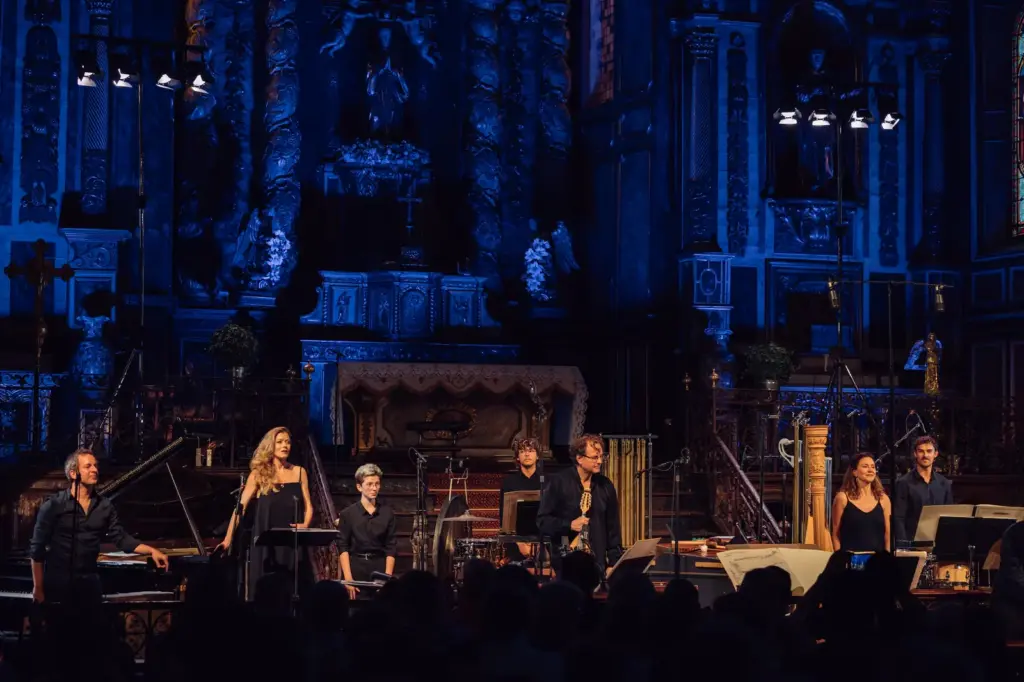
The path to Crumb, in Thursday’s first concert, was traced with uncommon programming intelligence. The evening opened with the world premiere of Ancient Sounds, a commission from the festival to young Spanish composer Álvaro Pérez Sánchez, winner of the Académie Ravel Composition Prize 2025. “I asked him for a piece that would be both a tribute to Crumb and to Lorca,” Chamayou explained, who imposed as a template the ensemble of Ancient Voices stripped of voices and piano: oboe, two percussionists, mandolin, and harp. Far from pastiche, the work functioned as a deliberate gateway. Pérez Sánchez connects Crumb’s sound world with his own interest in timbral and microtextural exploration, and dialogues with the American by inverting some of his gestures: his oboe begins behind the audience and ends up joining the stage, just the opposite path of the oboist in Ancient Voices, who leaves the scene quoting La despedida, the theme of the final movement of Mahler’s Das Lied von der Erde.
Followed the rosary of lullabies that Chamayou picked, as he confessed, from a systematic search for cradle songs in the Spanish repertoire. At its heart, the Nana de Sevilla that Lorca himself harmonized and recorded in 1931 alongside La Argentinita, with the poet at the piano in the only sound trace we have of his musician facet, and which here sounded in the voice of boy soprano Arson Marin, fading into the interior of the temple. Around it, an archaeology of the lullaby with programmer’s discoveries: Turina’s Berceuse from Niñerías and Mompou’s almost silent Cuna as a threshold of innocence; the Berceuse d’Aitacho Enia that Szymanowski composed in 1925 for violin and piano precisely in Saint-Jean-de-Luz, the only non-Spanish piece in this rosary of lullabies and a local nod with a Basque title; and the final darkening that prepared for Crumb, with the Cradle Song for the Orphans of Spain that Joaquín Nin wrote in 1938, an elegy for the children of war, and City Without Sleep (2024) by Francisco Coll, based on one of the most visionary poems from Poet in New York, where the lullaby no longer puts anyone to sleep but watches over an insomniac world.
When Ancient Voices of Children arrived, with an exceptional cast around Hannigan and Chamayou, from Gabriel Pidoux’s oboe to mandolinist Florentino Calvo passing through harpist Sandrine Chatron, three excellent percussionists and boy soprano Marin, Alphonse Cemin’s direction made everything fit like a rite: the Sprechgesang from Yerma over an unusual bolero rhythm; the Bach quote on the toy piano; and the final entrance of the boy from silence to ask, with Lorca, to be returned his ancient soul. Hannigan, who like all the performers except Calvo faced the score for the first time, made it her own as if she had premiered it.
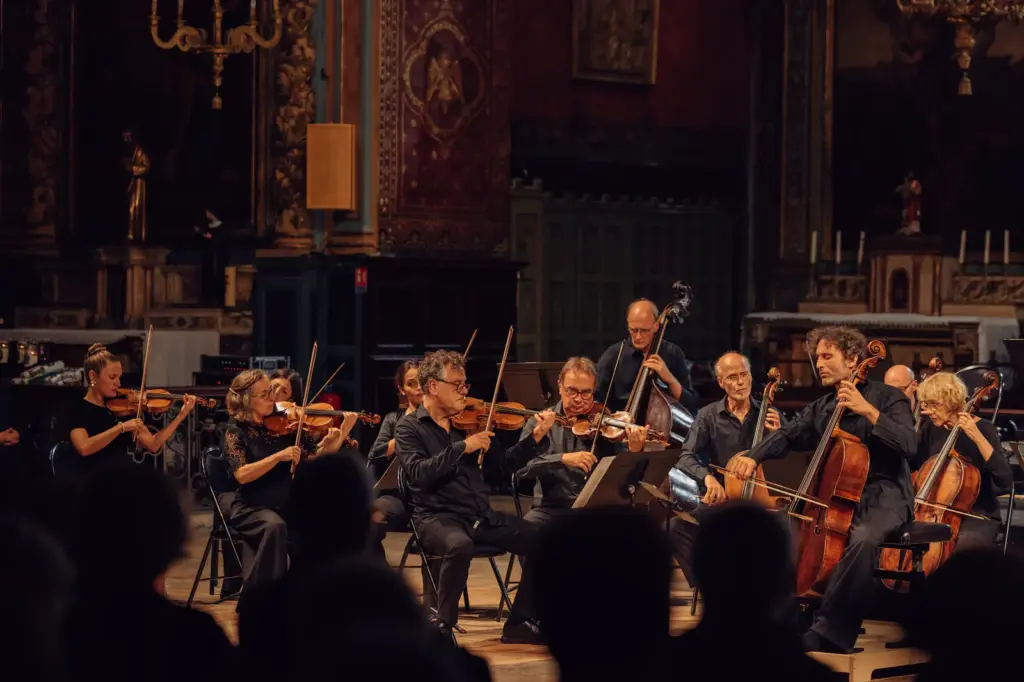
The third Spain, the 18th-century courtly one that welcomed composers like Boccherini and Scarlatti, arrived Thursday in Saint-Jean-de-Luz with period instruments from the Orchestre des Champs-Élysées and cellist Nicolas Altstaedt, who commanded the center at all times, whether playing or conducting. He does both well, but not at the same time: slight inaccuracies appeared in the accompaniment of Boccherini’s Cello Concerto No. 7 in G major, G. 480, despite the solid leadership of concertmaster Alessandro Moccia. Altstaedt compensated with exquisite sound warmth, without vibrato, a fluid technique that added bite to the most virtuosic passages, and a musicality especially evident in the slow movement.
To conduct, Altstaedt would punctually rise from the bench or play the cello part of the accompaniment. That facet shone more without cello in Boccherini’s characteristic symphony La casa del diavolo, and especially in its tense and vibrant final movement, where the composer from Lucca pays homage to the chaconne representing hell in Gluck’s Don Juan. It was the best moment of the night, and there the ensemble founded by Philippe Herreweghe displayed the quality of some of its most veteran stands, like oboist Taka Kitazato.
Next, and without pause, the program traced another interesting arc, opened with the introduction of Haydn’s The Seven Last Words of Christ on the Cross, in its original string version, written for the Devotion of the Three Hours of the Brotherhood of the Holy Cave of Cádiz, and closed with the final Earthquake. But in between almost nothing shone. The very difficult Aria accademica, G. 557, with obbligato cello, showed soprano Anna-Lena Elbert somewhat overwhelmed by the vocalizations and an orchestra in need of a conductor who was playing the intricate solos of the work. The situation was not improved by Bilbao guitarist Enrike Solinís, who mounted a personal improvisation on Scarlatti’s Sonata K. 32 and Gaspar Sanz’s canarios. The famous Boccherini fandango, extracted from his Quintet G. 341, full of fantasy and with well-known soloists from the ensemble, like cellist Ageet Zweistra, was somewhat better. But Altstaedt broke the final effect of the Earthquake with an unnecessary encore: the slow movement of Haydn’s Symphony No. 13, an aria for solo cello where the warmth of his vibrato-free sound shone again.
The prayed Spain closed Friday in Ciboure, again in Saint Vincent, this first segment of the festival. Léo Warynski struggled to elevate his ensemble, Les Métaboles: Arvo Pärt’s Da pacem Domine, written in memory of the victims of March 11, sounded too flat and, despite the excellent acoustics of the temple, the antiphon never managed to float. Followed a too sober and little theatrical Salve Regina by Alessandro Scarlatti, and the mass in severe style that his son Domenico wrote for Madrid at the end of his life. It also failed to rise, despite the excellent intonation of the ten mixed voices, among which two countertenors, Julien Freymuth and Gabriel Jublin, stood out. The central creed, moreover, was entrusted to the organ alone, without voices.
The best of the night was the other Da pacem Domine, written in 2024 by French composer Philippe Hersant, a composition in Pärt’s orbit, but without the Estonian’s asceticism: the consonance of a non-believer appealing to collective memory. The composer was present in the church, and perhaps for that reason Warynski chose to repeat the piece as an encore. Before that, Domenico Scarlatti’s Stabat Mater composed during his Roman period, leading the Vatican’s Cappella Giulia, had sounded, where the ensemble showed its ability to combine ten solo voices in a score in which the famous sonata author shines more for the architecture of counterpoint than for theatrical affect. It was supported by a continuo that added cello, double bass, and archlute to the organ.
The festival continues until September 5 with an overwhelming weight of piano, faithful to the profile of its artistic director. Nelson Goerner faces today, the 29th, the complete Iberia by Albéniz in Ciboure, on a day dedicated to Ricardo Viñes that includes a lecture by musicologist Màrius Bernadó and restores to the great mediator between Ravel and Falla the place the anniversary owes him. On the 31st, Yulianna Avdeeva pairs Chopin’s 24 Preludes, written in Valldemossa, with the 19 Preludes of Basque Ramon Lazkano. On September 1, Javier Perianes stars in a double day in Urrugne: a Falla monograph culminating in the Fantasía bætica and a chamber evening alongside violist Tabea Zimmermann and the Quiroga Quartet, with Arriaga’s Quartet No. 3 and Granados’s Piano Quintet. On the 2nd, a Granada night for two pianos brings together Chamayou and Neuburger in a journey from Debussy and Albéniz to the Ravelian homages of Nin and Montsalvatge, with Constellations d’après Joan Miró by Hèctor Parra, composition professor at the Académie this year, as a contemporary contribution.
The second week also offers the only staged Ravel in the program: the opera L’heure espagnole, in concert version, with the Bordeaux Aquitaine National Orchestra and Valentina Peleggi, on the 3rd. It is preceded that same afternoon by a program by Benjamin Alard that traces the sources of Falla’s neoclassicism, from Victoria and Scarlatti to Soler’s Fandango, before culminating in his Harpsichord Concerto, one of the central works of the commemorative year. Completing the journey are the Buñuel-Dalí cine-concert, with scores by Martin Matalon and Ensemble 2e2m, on the 2nd; Mompou’s Música callada by Jean-François Heisser, a living memory of the festival, on the 4th; and a closing, on the 5th, that brings together harpist Xavier de Maistre with legendary castanet player Lucero Tena before a surprise flamenco evening.
It will surely not be the only surprise. The four concerts of this start have already been, to some extent, and everything points to the rest of an edition that looks to the neighboring country as Lorca said mothers sang: pouring into the melody, along with sleep, their own sorrow and their own celebration.
Read more The summer Queen Sofía could marry Harald of Norway