









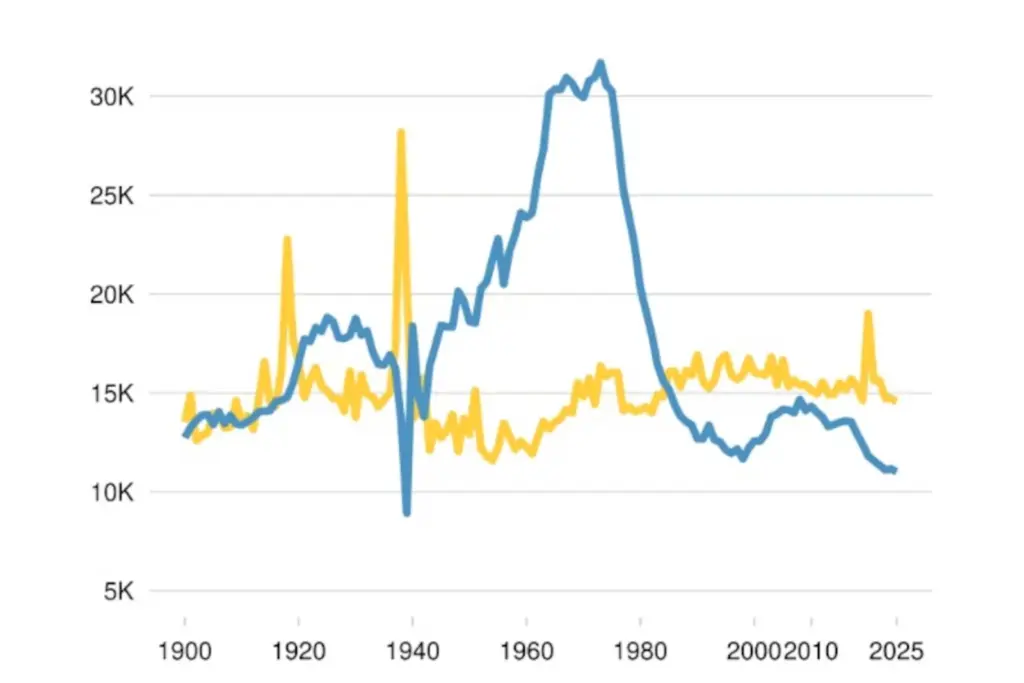
Birth rates continue to fall in Barcelona. The reading of the register as of January 1 this year shows that in 2025 it was the second lowest since 1900: 11,012 children were born, 1.3% less than the previous year. The first was 1939, the last year of the Civil War (about 9,000), when the city’s population was around one million people. The decline has been steady since the late 1970s, with a slight rebound in the first decade of this century. In contrast, deaths in 2025 were 14,557, 1% less. The drop in birth rates consolidates as one of the main factors of demographic transformation: households without minors continue to decrease and represent only 21.4% of the total, and almost a third of households are single-person. The population is aging and the average age rises to 44.6 years. Centenarians also increase, now nearing 1,200 people, of whom 82% are women.
Read more A judge orders the removal of Trump’s name from the Kennedy Center, Washington’s major arts center
The register shows a city where the population remains stable at 1.7 million people. Exactly 1,729,963 residents, 0.1% less than the previous year, 2,000. It is the second highest figure in 41 years. “But beneath this apparent calm, the data show an interesting undercurrent given by migratory movements, which, although not at their peak, remain relevant. Entries were 150,000 people and exits, 135,000,” explained María Jesús Calvo, head of the Statistics and Dissemination department of Barcelona Dades, the Municipal Data Office of the City Council.
“These very high migration flows are stabilizing: there are many removals because situations of registration of people who did not live in Barcelona but had arrived in Barcelona are being regularized. This shows that the city continues to function as a physical and administrative entry point but that many people do not settle,” she highlighted. Another relevant fact is that the educational level of the population continues to increase: 37.4% of residents over 16 years old have a university or higher degree. This percentage is two points higher among women. Among the foreign-born population, those who declare having higher education rise to 42.7%, and among new residents it reaches 44%, “evidencing the growing weight of qualified human capital,” notes the city council.
The native population continues to decrease and represents 44.6% of the total, in a steady trend for more than 20 years. The foreign-born population approaches 630,000 people and the main nationalities are Argentina, Colombia, and Pakistan.