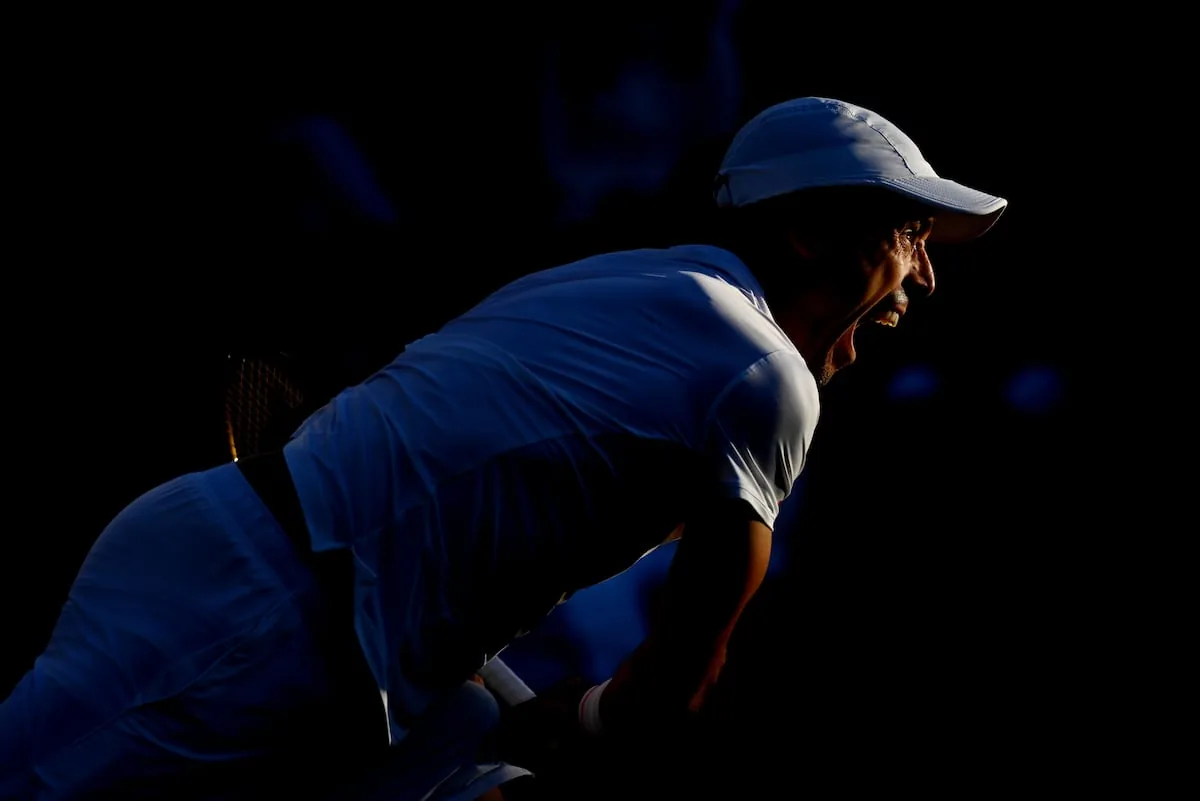





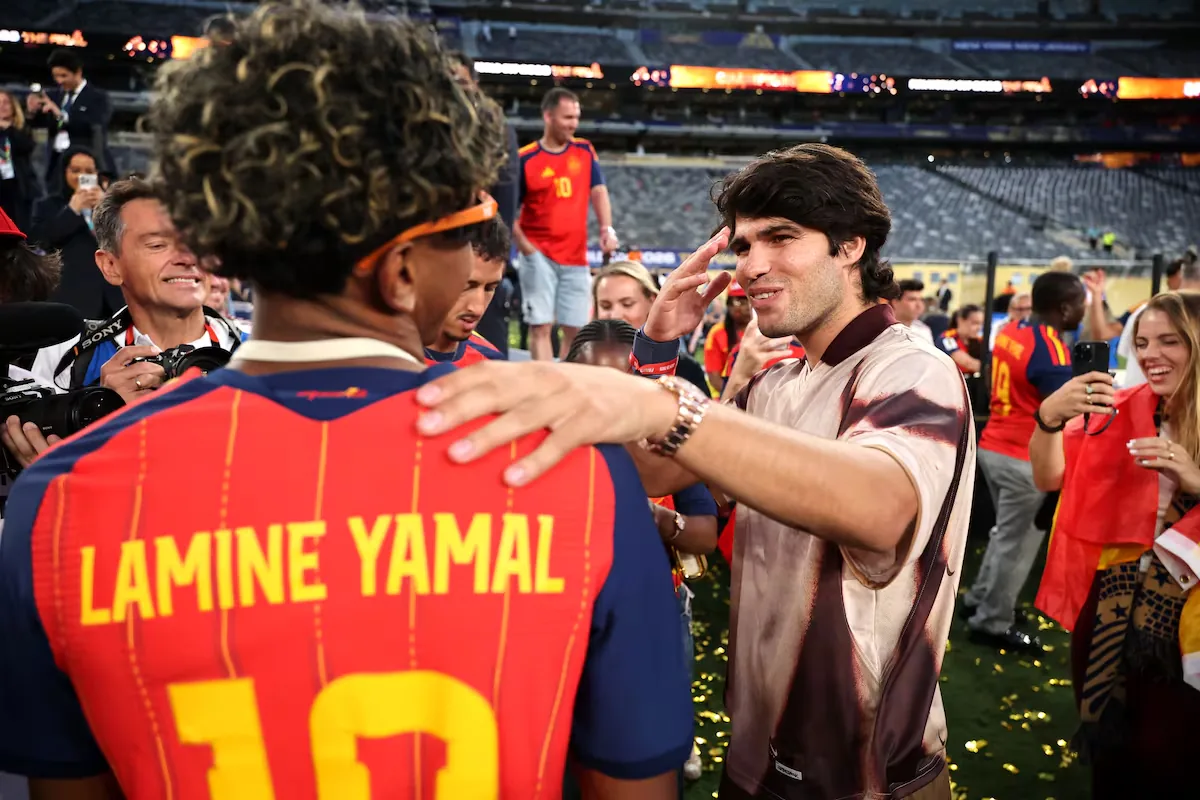
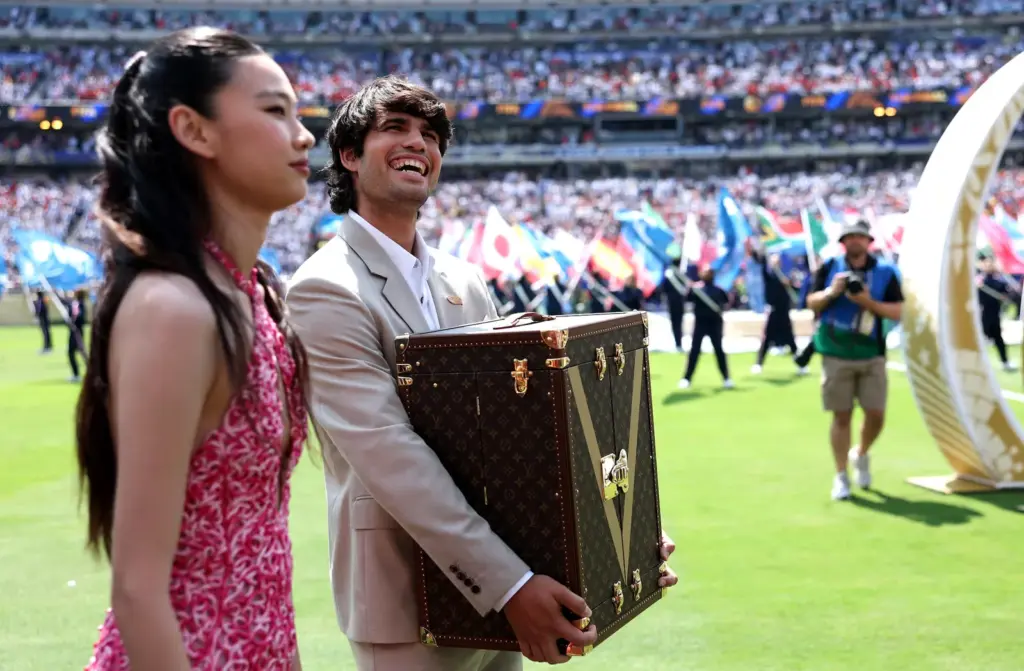
Last Sunday, Carlos Alcaraz burst into MetLife Stadium in New Jersey, dressed in an ivory suit and carrying a small chest containing the Football World Cup. Also, with a smile from ear to ear. A magnificent sign in a special and different athlete, who lives, dreams, and competes in the same way: under the motto of fun. After more than three months on the sidelines, due to the injury he sustained to his right wrist in the last edition of the Godó, the tennis player (23 years old) is finally starting to see the light, and the good progress is reflected in his face. Nothing to do with the expression on April 15 (in Barcelona) compared to July 19 (in New York).
“You guys made me go through it, man… oh my goodness! It felt like I was playing a Grand Slam final and everything, seriously…”, he told Lamine Yamal in the fleeting encounter between virtuosos, after bouncing a few times in the celebrity box —accompanied there by Álex Sánchez (physio and close friend) and footballer Sergio Reguilón (close friendship)— and after having previously unveiled the golden trophy on the pitch. In doing so, the Murcian also revealed the wristband that now wraps his right joint, significantly different from the one he wore at the beginning of his recovery. From that bulky immobilizing splint, he moved to a more ergonomic one, finally adopting a brace that limits rotation to a lesser extent.
In other words, good news following the optimistic message Alcaraz himself issued on the 10th, when he assured via his social media that the process was “on the right track.” He was then seen hitting the ball softly and performing a series of simulation exercises, with the aim of progressively recovering the reflexes, mechanics, and automatisms typical of competition: feints, touches three meters from a wall, and trajectories with a bitten racket, which was missing part of the frame and also the stringing; the latter was surprising, but in reality, it is a training technique that coach Alberto Lledó put into practice with him (and other players from the Villena academy, Alicante) since he was a teenager.
“My dream is to be the world number one, and for that, I train every day with the maximum possible intensity,” he said then. And he achieved it; in fact, before anyone else, at just 19 years old. At that moment, however, Alcaraz was still unaware of the other side of a truly erosive sport where pain, injuries, and the infirmary are a constant; the unavoidable toll that in April, without seeing it coming, abruptly took away his characteristic laugh: “It’s messed up, it seems serious…”. Now, however, the tennis player from El Palmar sees the horizon differently, after having strictly followed the prescribed medical steps and facing a decisive phase in his rehabilitation.
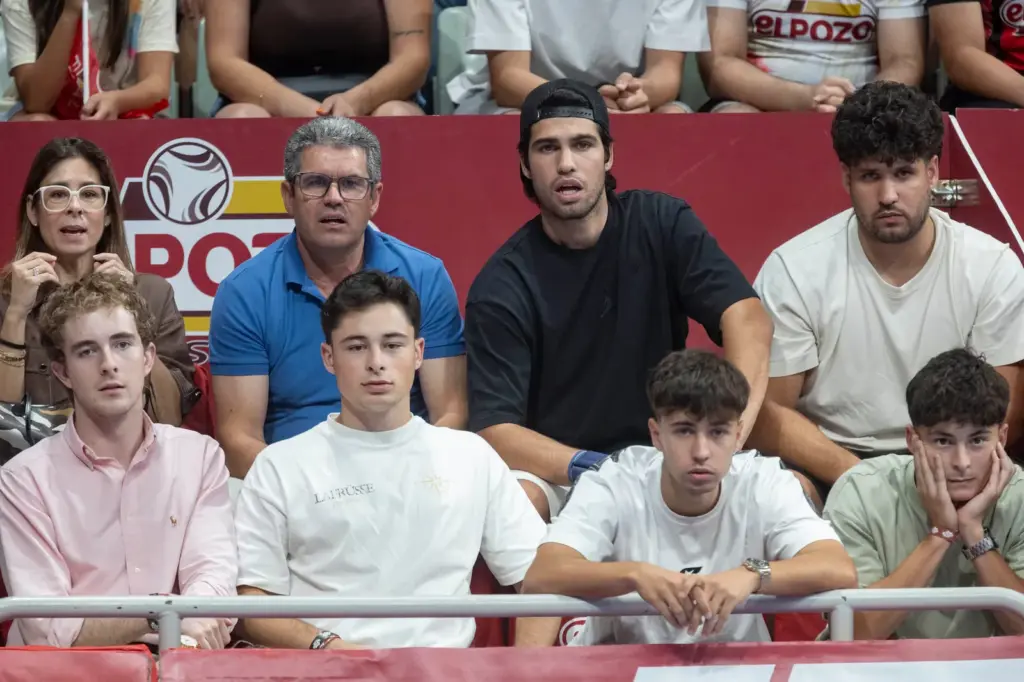
He was recently seen in a video emphasizing wrist torsion —reactivating and strengthening it with an elastic band, in the company of another highly trusted physio, Fran Rubio— and immediately after returning from New York, without delay, the world number three continued with his recovery. Until now, Alcaraz has been testing himself within a framework of absolute prevention and caution, which he will have to gradually abandon; however, always without accelerating or forcing, much less jeopardizing all the progress made to date. The joint is a treacherous and especially delicate region —as numerous examples warn, some of them close like those of Juan Martín del Potro or Dominic Thiem—, and the slightest misstep can mean a significant, if not serious, setback.
“Yes, that’s the idea. That’s the intention,” a person from his entourage corroborates to this newspaper, trusting that the upcoming twist will elicit a positive response from the wrist. The Murcian’s plan is to gradually intensify the impact on the ball over the next three weeks, which will precede the Cincinnati Masters 1000 (August 13-23) and subsequently the US Open (August 30-September 13). If the reaction is favorable and he and his team consider it so, he would travel to the United States to participate in this double event, with the idea of first doing a trial and then competing in the New York major. Logically, whenever he returns, he will prioritize readaptation and re-entry into the circuit over immediate results.
Alcaraz began the rehabilitation process in June, directed by physical trainer and physiotherapist Juanjo Moreno, and by Lledó. Since then, he has been exercising inside an industrial warehouse that the tennis player has converted into an indoor (enclosed) court, protected from prying eyes and photographers. There, at his home headquarters, he will continue with his preparation, although soon (provided everything goes well) he will move his practice sessions to the outdoor courts of the Real Sociedad Club de Campo Murcia, in El Palmar. The tennis player, supervised and guided at all times by his coach, Samuel López from Alicante, has already received the official balls that will be used during the North American tour and will be able to practice with them, which reinforces his desire to reappear in August.
For now, Alcaraz has missed two major tournaments (Roland Garros and Wimbledon) and two Masters 1000 (Madrid and Rome); almost the entire clay-court swing —with the exception of Monte Carlo and Barcelona— and the grass-court swing completely. He will not compete in Canada from August 2 to 13, but his name remains inscribed on both the official Cincinnati and US Open entry lists. Around those dates, the Winston-Salem event (August 23-29), an ATP 250 category tournament (the fourth in the tournament pyramid), also appears on the calendar. Unlike the current situation, for Roland Garros, he announced his absence a month in advance, and for Wimbledon, even earlier: 40 days.
Read more From the Ball to the Weights: Why the Gym Is Becoming Teenagers’ New Playground
What has not yet transpired is the exact extent or name of his injury, while speculation surrounds the issue —tenosynovitis? tendinitis? rupture?— and the tennis world yearns for his return because Alcaraz is the great male asset of the present along with the current world number one, Italian Jannik Sinner. “I hope he comes back soon, because we need him,” said the San Candido native after winning Wimbledon for the second time. “That he remains registered [for the US tour] is a good sign,” adds the aforementioned source, in accordance with the brief message the protagonist issued on social media a couple of days before the outcome of the British major. “They are not ready,” reacted legendary Serena Williams, a recognized admirer of the Spanish player.
The Cincinnati Masters has used his image in its promotional campaign, which does not guarantee his presence there. The willingness exists, but until the intensity of training increases and the joint’s response is medically interpreted, how it reacts to real demands, Alcaraz and his team will not be able to draw a more or less clear conclusion. The premise is non-negotiable: no rushing. He is a tennis player who frequently relies on power —shots close to 180 km/h from a static position— and generates a lot of force with his wrist, in addition to his distinguished use of the drop shot. Zero risks, then, although also aware of that uncontrollable threshold that will always pose a threat.
SINNER’S LONG RUN
Alcaraz has lost a substantial number of points since his April injury. Specifically, 5,080 points, which has caused him to drop from second to third place in the world rankings. Thanks to his success at Roland Garros and progress at Wimbledon, Germany’s Alexander Zverev overtook him.
The Spaniard started the season like a shot, winning the Australian Open and triumphing shortly after in Doha. However, from March onwards, Sinner grew stronger and prevailed in the three events where they both met from then on: Indian Wells, Miami, and Monte Carlo, all ATP 1000 category tournaments.
In Barcelona, he could have regained the throne, but the wrist setback coincided with Sinner’s overwhelming surge. The Italian then won Madrid, Rome, and Wimbledon; only Roland Garros eluded him, due to the physical collapse he suffered when he was the clear favorite.
Since Indian Wells, the circuit leader has won 37 of the matches he has played. Between him and Alcaraz, there has only been one duel in 2026, the Monte Carlo final.
Read more La M.O.D.A.: heroes from Burgos who champion ‘the nobodies’ of life