








China inaugurated this Wednesday the Pinglu canal, a monumental infrastructure that alters the logistical map of the south of the country: for the first time, the extensive river network that crosses some of its inland provinces has a direct outlet to the Gulf of Tonkin, shared by China and Vietnam, and from there, to the maritime routes of Southeast Asia. The route, 134.2 kilometers long, has involved an investment of 72.7 billion yuan (around 9.4 billion euros) and is the first canal connecting a river to the sea built under national coordination since the founding of the People’s Republic of China in 1949, according to the state news agency Xinhua.
The canal begins at the mouth of the Pingtang River, in Hengzhou, a city under the administration of Nanning, the capital of the Guangxi autonomous region (southwest China), and advances south to connect with the Qin River, which flows into the Gulf of Tonkin, known in the Asian giant as the Beibu Gulf. Only 6.5 kilometers had to be excavated to cross the watershed, as most of the route takes advantage of existing channels that have been widened, dredged, or straightened.
Geography explains the relevance of this new route. Although the gulf constitutes the natural outlet to the sea for southwest China, the rivers in this part of the country traditionally flow eastward and empty into the Pearl River Delta, located in the southern province of Guangdong. Therefore, goods transported by water had to navigate to the Cantonese capital, Guangzhou, before returning westward by sea. Pinglu now allows them to be diverted southward and shortens that inland journey by more than 560 kilometers, according to authorities.
The infrastructure accommodates ships of up to 5,000 tons and has three large lock complexes (Madao, Qishi, and Qingnian) to overcome an accumulated elevation difference of 65 meters. “It is an emblematic project of the strategy to make China a transportation power,” said Yang Huaxiong, Director of Water Transport at the Ministry of Transport, during a press conference organized by the Information Office of the State Council, the Chinese Executive, in June.
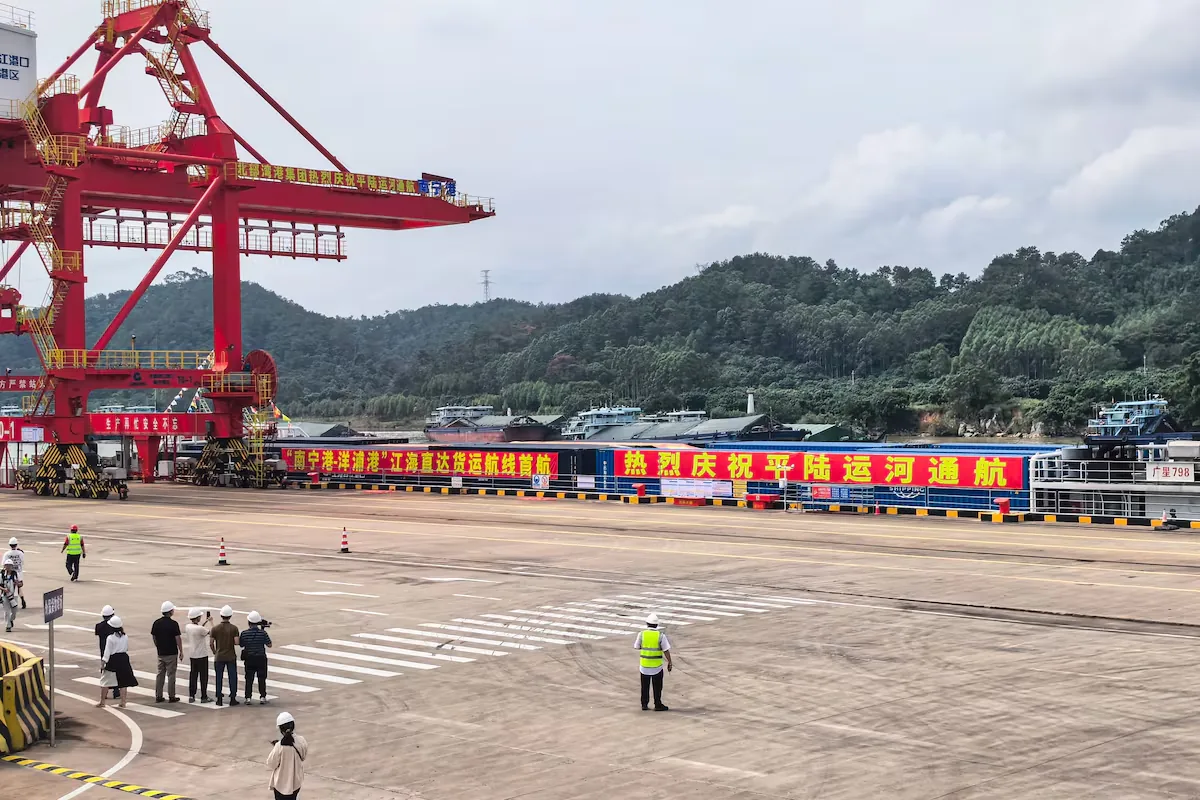
On the first day of operation, about 30 cargo ships carrying construction materials, coal, minerals, steel, and fertilizers navigated through Pinglu. An international route between Nanning and Can Tho, in Vietnam, and a national one to Yangpu, located on the Chinese island of Hainan, also began operating, according to China Central Television, CCTV. Additionally, the first of the four planned passenger lines started service.
Beijing’s plan is not limited to increasing exchanges with Southeast Asia but also seeks to provide its inland provinces, generally less prosperous than coastal regions, with faster access to global maritime routes and thus promote their industrialization. Among the main beneficiaries of the Pinglu canal are Yunnan, Guizhou, Sichuan, and Chongqing, located in the southwest of the country, and Hunan, in the center. Yan Jun, a senior official of the Water Transport Directorate of the Ministry of Transport, explained to CCTV that their goods will be able to access the canal through river and rail networks converging in Guangxi. The new route offers these regions “an unprecedented development opportunity,” Yan stated.
Read more The Ayuso Government delays the announcement of the penthouse purchase by one day
The Chinese government estimates that the new route will reduce logistics costs by between 18% and 30% and save more than 5 billion yuan annually (almost 645.5 million euros). It also expects it to strengthen the so-called New Western Land-Sea International Corridor, a network of trains, roads, ports, and waterways designed to connect inland China with the countries of the Association of Southeast Asian Nations (ASEAN), China’s largest trading partner as a bloc.
Strategically, this southern outlet allows Beijing to diversify its maritime corridors and more closely link the southwest of the country with regional supply chains. This alternative gains greater value as trade and technological tensions with the West intensify. Trade with ASEAN reached 862.75 billion dollars (747.646 billion euros) during the first eight months of the year, 25.6% more than in the same period of 2025, according to customs data cited by the Hong Kong newspaper South China Morning Post (SCMP).
In statements collected by SCMP, Zhou Mi, a researcher at the Chinese Academy of International Trade and Economic Cooperation, under the Ministry of Commerce, considers that Pinglu not only offers a more efficient sea outlet but also provides the possibility to “modernize the Chinese transportation system” and reorganize industrial chains through smart technologies.
Although the engineering work is already completed and operational, the most difficult task now begins: turning it into a stable commercial route. Lei Xiaohua, a researcher at the Guangxi Academy of Social Sciences, told The Beijing News that bulk goods will be the “acid test” of the promised cost reduction. Companies, he warned, will compare the total door-to-door price, including transshipments, storage, and the time goods remain immobilized. The greatest risk during the first months will be, in his opinion, that cargo volume, land connections, and port services do not progress at the same pace. If ships run half-empty or frequencies are irregular, the unit cost could increase and undo part of the expected advantages.
The Pinglu project is not unique. China is promoting similar ones in the provinces of Jiangxi, in the southeast, and in the central provinces of Henan, Hubei, and Hunan, with multimillion investments in waterways aimed at reducing freight transport costs and stimulating local industry, to advance its goal of bringing the country’s interior closer to international markets.
Read more The trap