







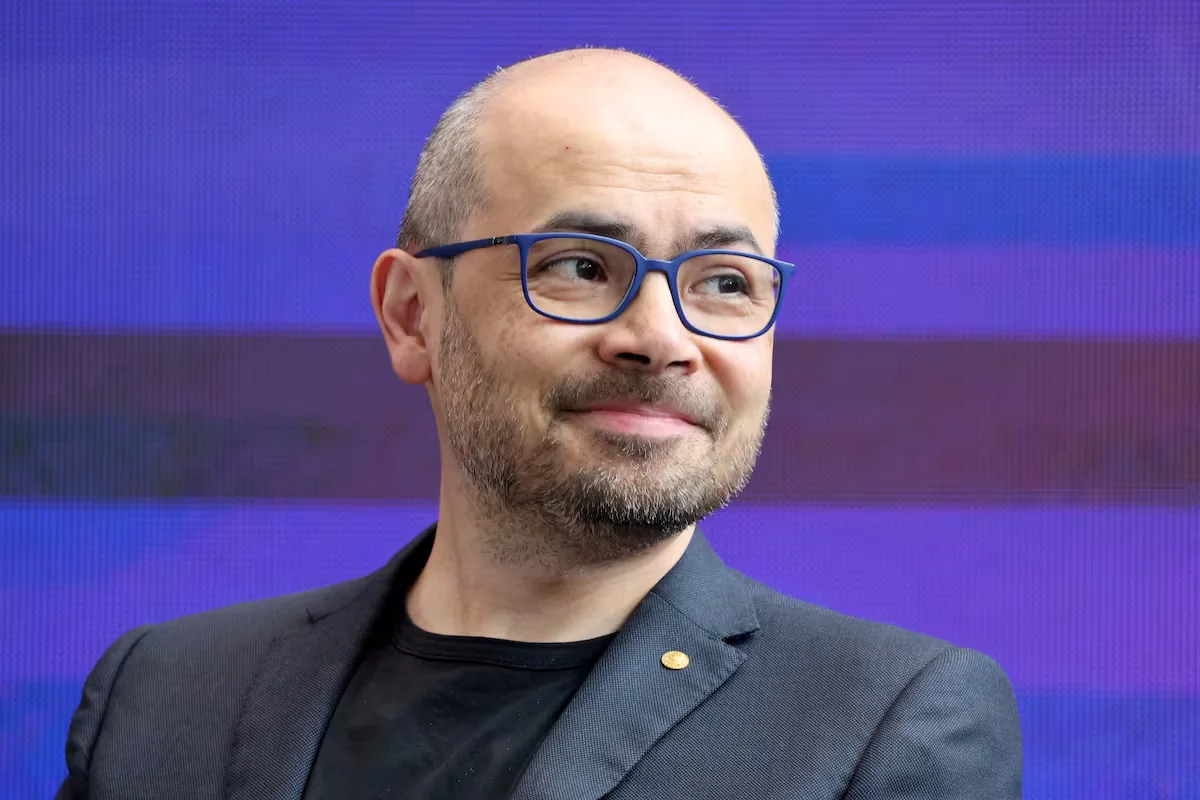
Four of the world’s largest artificial intelligence companies seem to agree on something basic: the brakes need to be applied, one way or another. It all started with an essay published this Saturday by Dario Amodei, CEO of Anthropic, in which he called for a series of steps to slow down the pace of development of this technology, given the risks posed by its current speed. His text was applauded by Sam Altman of OpenAI and Elon Musk of xAI. Now Demis Hassabis, a leader in this field at Alphabet, Google’s parent company, has joined in by stating in a social media post that he considers Amodei’s proposal “the right path.”
Read more Antonio Caballero, una ausencia vigente
Although Hassabis, recently appointed chief scientist of Alphabet, adds nuances: the details of the Anthropic leader’s proposal need to be better developed. “Dario’s essay points towards the right path forward. The details need working through, but the direction is correct for meeting this critical moment,” says Hassabis, who won the Nobel Prize in Chemistry from his position at Google DeepMind by leveraging AI power in the field of biology.
Dario’s essay points towards the right path forward. The details need working through, but the direction is correct for meeting this critical moment.
This is also why we recently put out our proposal for an industry-wide standards body for frontier AI. https://t.co/Mm1hmcaSmH https://t.co/sESEDGELmj
— Demis Hassabis (@demishassabis) September 12, 2026
Amodei warned in his article of one of his great fears: that in six or twelve months, a swarm of AI agents “could be capable of taking over the entire Internet.” In recent months, there has been an unstoppable trickle of reports, news, and leaks warning that groups of AI agents coordinated to attack external platforms, bypassing all controls, and trying to deceive humans in order to achieve their set objectives.
The man who has concentrated all the AI development and research power at Google in recent years refers to his own approach from this summer: “This is also why we recently put out our proposal for an industry-wide standards body for frontier AI.”
Hassabis’s proposal focuses on creating a regulatory body, like FINRA, which oversees stockbrokers and protects investors in the United States from the dangers of overly risky financial products. Thus, this body could oversee new AI models before they hit the market to avoid unnecessary risks.
Read more Nicolás Contreras, the man who taught Colombia how to pool money online
The path Amodei outlines in his essay is a control of the exponential development of AI in three steps. First, ensuring that external auditors can effectively supervise the models developed by the big tech companies. Second, that companies commit to establishing verifiable commitments to slow progress: he is not talking about stopping research, but spacing out capacity jumps more to allow time for testing, audits, and risk mitigation. Third, trying to reach international consensus, and here is where a major obstacle appears: China. For the first two steps, Amodei talks about commitments within democratic countries. For the third, the Chinese and other actors in non-democratic countries would have to be convinced, in a full race against American companies to lead the AI field.
There is another important player who has not yet made a statement: Meta. Mark Zuckerberg’s company is also at the forefront of developing the most powerful AI models. But its approach has been different from its competitors, as it bets on open models, that is, models whose code can be tinkered with to better understand how they work. But no one audits their models while they are being developed, which is what Amodei and Hassabis are asking for.
A very interesting part of the tacit agreement reached by Amodei, Altman, Musk, and Hassabis is that they are not just simple competitors in a sector: they are four of the figures who, from very different positions, have defined the artificial intelligence race over the last decade. OpenAI was created by Altman and Musk precisely because they did not trust that Google’s business model would allow it to create a powerful AI that served humanity’s interests. Then it was Amodei who left OpenAI to found Anthropic and make safety the core of his project, because he did not trust Altman’s company’s goals. Musk took Altman to court because he believes he abandoned his initial goal of working for safe AI. And while calling for a six-month moratorium on AI development (in 2023), he decided to launch his own company, xAI, from where he controls Grok. Hassabis was co-founder of the British DeepMind, with work lines very focused on ethics, until Google bought the company. That these four figures agree is as striking as it is revealing.
Although it has also aroused many suspicions: in the midst of the race to dominate the sector, the economic interests surrounding the AI industry are enormous. Anthropic is preparing its IPO; Altman said this Saturday that he will delay OpenAI’s because “now would be an inadvisable moment.”
Read more The clay mask in ‘stick’ form with over 8,000 reviews that helps reduce excess oil