



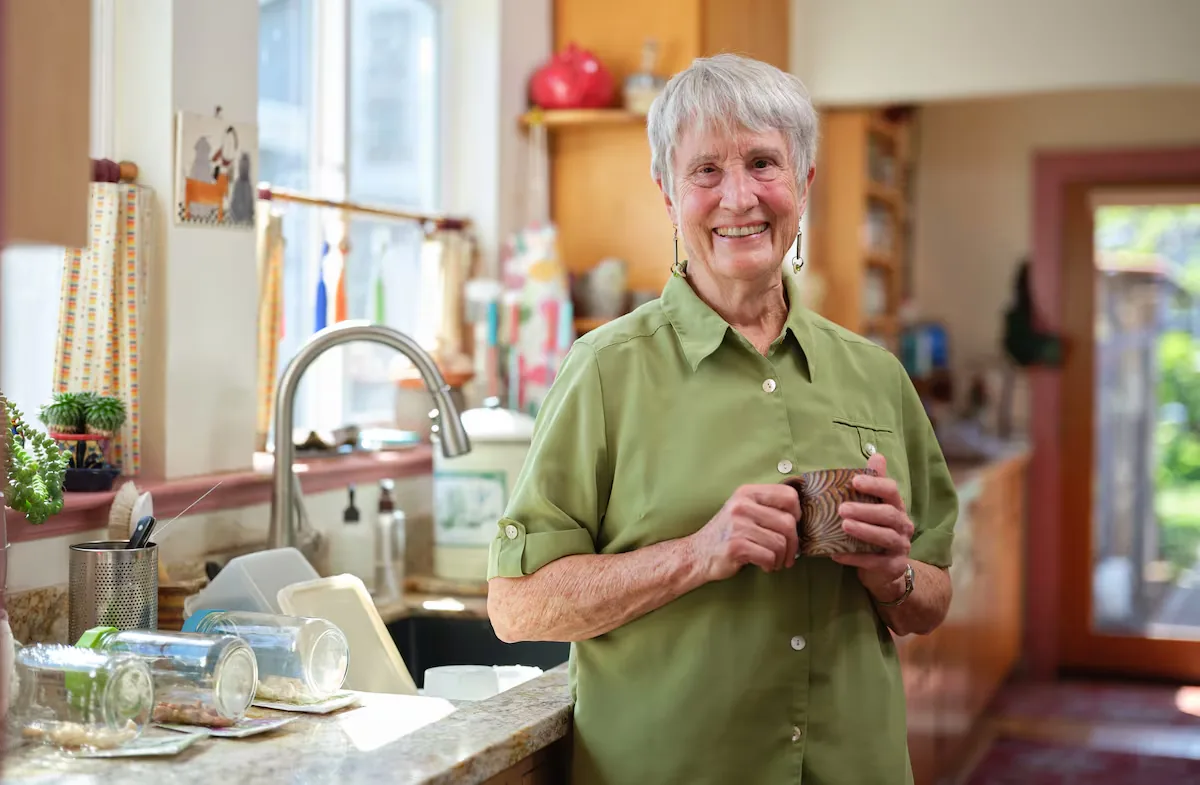
Prepare for a journey close to the sidereal. Listening to Donna Haraway (Denver, 81 years old) means entering unconventional territory. We are facing a philosopher, biologist, and feminist theorist, known for her innovative thinking at the intersection of sciences and humanities. She states that to think, she places herself in the position of decomposing matter. She is visionary, provocative, and her texts have a punk touch. Inspired by science fiction and with an ironic style, Haraway weaves stories with the intention of helping us see the hybridization between humans, technology, and other species. Chosen among the 10 most influential technological thinkers by Ideas, she became known in 1985 with her essay Cyborg Manifesto, where she pointed out that we are integrated in and with technology. Emeritus professor in the Chair of History of Consciousness at the University of California, Santa Cruz, she was the first tenured professor of the first feminist theory chair in the US, in Hawaii. Her work has been influential in feminist theory, queer theory, and cybercultural studies. She has supervised more than 60 doctoral theses in various fields and her work has inspired dozens of artists. Among other recognitions, in 1992 she received the American Book Award and the Erasmus Prize 2025, awarded by the Dutch foundation in memory of the thinker from Rotterdam. On Friday, June 5, she participates remotely in an event at La Casa Encendida (Madrid) celebrating the 10 years of Staying with the Trouble: Making Kin in the Chthulucene, published in Spain by Consonni in 2019, where she points out that the world today revolves around interconnected networks of life.
Read more Josefina Molina dies, pioneer of Spanish cinema, at 89 years old
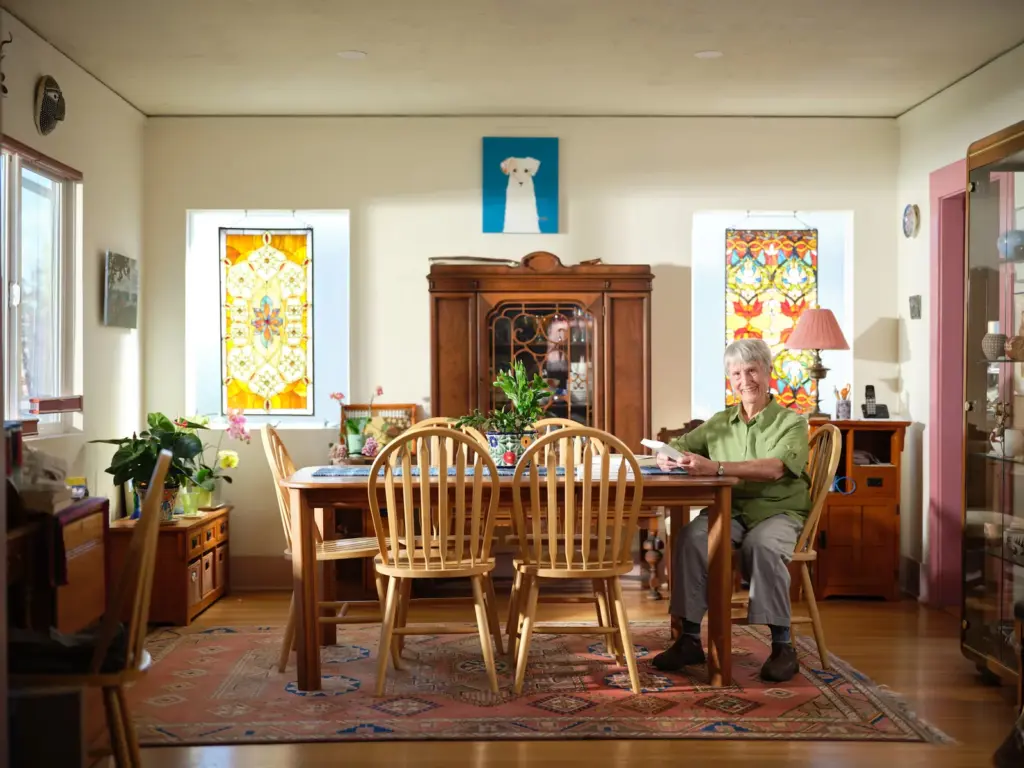
Haraway seems coherent: she shares a home with three hens, two dogs who were formerly strays, and the science communicator Rusten Hogness, her partner. She attends early in the morning by videoconference from a corner that shows a comfortable mess: a pair of glasses on a table, piles of books, clothes piled up, and a stationary bike behind. She shows a broad smile.
Question. One of your characteristics is your ability to see beyond binarism. You describe your thinking as “a tentacular choreography.” How did you begin to articulate your particular way of thinking?
Answer. It’s hard to know, our memory is faulty and we constantly reinvent it, but I can construct a story and say that I never felt attracted to defined categories. I grew up from the beginning in a dense and bodily world that did not decompose easily. The binary is useful for chemistry, taxonomy, biology… In Philosophy classrooms I learned the language that allowed me to name that we confuse representation with things in themselves. Reading Alfred North Whitehead and his Science and the Modern World was important. Also the American pragmatists Charles Peirce and William James, and later the Belgian philosopher Isabelle Stengers. They helped me name my basic intuitions about being in the world.
Q. Your Cyborg Manifesto [from the book Science, Cyborgs and Women: The Reinvention of Nature, reissued by Alianza in 2023] broke molds. In it, you state that humans are already technology. In what way?
A. I first heard the word cyborg during the Vietnam War. Then Secretary of Defense, Robert McNamara, installed the electronic battlefield in Honolulu and I was then teaching at the University of Hawaii. The military origin of the cyborg was present to me as an activist, as a biologist, and as an intellectual. Later, a student who had been in the Army told me that the term cyborg had been coined during the space race, in the effort to take man to the Moon, and that the enhancement of human beings — with tests on apes with implants of devices that control blood sugar or neural signals — was part of that same technological horizon: the technologically enhanced animal model. The cyborg for me was never simply a machine, but a conjunction of flesh and digital technology.
Q. You were never anti-technology.
A. No, never. My hand is a technology with functional uses. Technology is the functional organization of the world. But the degree to which technology was being put at the service of a militarized and male-dominated world construction was a huge problem for feminist thought. I wanted to inhabit that terrain, twist it, demilitarize it. The Cyborg Manifesto was in alliance with my ecofeminist friends, but without adopting the anti-technology position that predominated then — and for good reasons —. I wanted to defend a cyborg feminist stance.
Q. If you were to write the essay today, what would you talk about?
A. [She turns to grab a book]. Look at this painting. It’s called The Annunciation of the Second Coming, by my friend Lynn Randolph. It’s obvious that one of the two figures shown is a female cyborg resting on a chip next to an angel Gabriel, who announces a pregnancy. But pregnancy of what exactly? I have baptized the cyborg Claudette. And I think she is pregnant with Claude, Anthropic’s language model. I think what was gestating in the womb of that cyborg are the large language models, chatbots…, that kind of digital entities that now populate our world, which is full of sensors that feed real cascades of data to gigantic data centers. To support this huge amount of data and energy, what kind of action is necessary? So that, for example, the water system does not dry up and all biodiversity survives. All this depends on the same technologies as the bombing of Iran by Israel and the United States, or the drones in Ukraine… I would like to mention that I like it when technology fails.
Q. What do you mean?
A. These technologies that are so valuable fail constantly. They fail at least as much as we do. It’s important to remember that. They are moments of lucidity: in conditions of rupture is when the possibility of understanding arises. We don’t get new ideas when things work. We get them when things break. From there emerges the possibility of change. It’s just one of the reasons why I think people resist. I am currently involved with people trying to prevent the construction of more detention centers for immigrants before being deported. By resisting, we try to make the whole apparatus fail, so that it opens the possibility in the world for something different to happen. We try to collapse systems of oppression so that, from the monster’s womb, new possibilities can arise. I think the civil rights movement does that with great lucidity.
Q. Now we return to forms of resistance, but allow me to clarify a doubt: do you use artificial intelligence?
A. It’s impossible not to use it. Every time I enter Google I receive an AI summary of what I have searched. I have no choice. Do I use it actively and intentionally? No. I’m too lazy to learn to use it. I have artist friends who do very interesting things with it. At some point I suppose I will learn to use it selectively. But, again, it’s not the devil: it’s a set of tools that is being hyper-invested in, with huge amounts of capital and not for the best purposes. Causing enormous environmental damage. I am rather in favor of slow AI, developing it only insofar as there are sustainable energy relations, sustainable ecological relations, and a creative reorganization of work. I am in favor of slow AI, integrated into the construction of the world I believe in. And not the fast AI to which we are being subjected today.
Q. Let’s talk about authoritarianism. Canadian political theorist Bonnie Honig suggested living by ignoring Donald Trump. In Europe it seems we follow your path. How do we get out of stupefaction?
A. Authoritarian ethnic nationalisms are on the rise in many places. India, France, Spain, England, United States… We are inhabiting a very extended historical period, we all try to live and understand what we can do. I learned from the Spanish fight against Franco and from the fact that Spanish democracy emerged from that period bringing positive energy to the world. At the same time, Spain is trapped in neoliberalism, the contradictions of the EU, and the need to produce unity without continuing to drain the rest of the world with the resulting immigration problems. Migrants bear the weight of all disasters. The fight against authority involves learning to welcome the stranger, establishing ties — creating kinship — with people who are initially strangers, and learning to rebuild much more heterogeneous societies. Immigration is not something new; our societies are forced recompositions due to climate destruction and extractive capitalism.
“I feel I belong to the same batch as cyborgs, dogs, bacteria. We are deeply related”
Q. Can you give concrete ideas of ways to resist?
A. Let us oppose ethnic nationalist authoritarianism with all the fibers of our being. Let us align with immigrants. I am part of the network that supports them, the rapid response network. I have received training as a legal observer and to collect testimonies. I patrol places where immigration control agents may appear. I am part of a group of about 2,000 people in my city — which is small, so that’s quite a lot of people —. And I have been learning Spanish, I hope to be able to read this interview.
Read more French philosopher Edgar Morin dies at 104 years old
Q. Precisely language, and also your ability to weave ideas, play an important role in your writing. You believe in the transformative potential of a story.
A. More than “believe” I would say “hope.” I hope for a commitment. We inhabit stories as organisms: nothing living is outside the process of producing meaning over time. I call that a story. I feel in tune with science fiction writers, painters, dancers. I experience their work as a way to organize the world to make proposals. Do you want to inhabit this story? Change it? Do you want to erase it from the face of the planet? Stories are invitations to participate in a narrative.
Q. Among other terms, you have coined worlding (building world).
A. I didn’t invent it, but I have certainly appropriated it. Heidegger uses it, but I don’t use it like him, I give it an opposite meaning. His use of the term was deeply humanist, it had to do with that idea of assuming the world and making man its axis. The use I give it comes from science fiction: inhabiting the worlds that its authors propose to us. They build solid worlds that sustain a story. We are involved in processes of worlding with each other to be able to build worlds that deserve a future. And those worlds are always more than human.
“I keep reading ‘Harry Potter.’ I completely refuse to cancel someone I disagree with”
Q. You do not identify as posthumanist, you prefer a word suggested by your partner: “Compost.”
A. All the time I am described as posthumanist, but I resist that label. There are thinkers I feel close to — like the Italian philosopher Rosi Braidotti — who gladly assume that distinction. I am more in the compost, in the strata, in the matter that decomposes, in the heat of the rotting compost pile; from there is where I think.
Q. You dedicate Staying with the Trouble: Making Kin in the Chthulucene to those who generate strange kinships. What do you understand by “strange kinships”?
A. You must have noticed that I don’t feel particularly comfortable with the heteronormative nuclear family nor with its genealogies. I am interested in engaging in practices that create kinship among us. Anthropologists define kinship as a diffuse and lasting solidarity. It is something non-optional; generally, you don’t choose your relatives. If you have a cousin, that cousin has you, whether you like it or not. You can’t turn around and stop being their relative. But we also make kinship intentionally. And I am interested in the lasting — which extends, hopefully, for generations —, the diffuse — it doesn’t necessarily imply living under the same roof — and the supportive: being for and with. I am interested in making kinship with humans and with more-than-humans. I feel I belong to the same batch as cyborgs, dogs, deer, yeast, bacteria, sequoias. We are deeply related. My good friend [the anthropologist] Susan Harding and her adopted son, Marco, are a form of strange kinship along with Rusten and me for 30 years. We are an intentional family.
Q. But are you in favor of population control?
A. No, but I have a motto: “Make kin, not babies.” Institutional population control has been imperialist and racist, I reject it outright. I speak in terms of the number of human beings. Today we are 8.5 billion, a scandalous figure. It is about triple what we were in 1944, when I was born. We have gone from about 2.5 billion to 8.5 billion favoring the rich like me, exploiting most of its inhabitants. We are more than necessary for a flourishing of biodiversity and human being. I defend making kinship in other ways and caring for the babies that already exist. We live in a pronatalist and anti-childhood world. A kind of mandatory pregnancy is defended without serious care for those who have already been born, for children, without real attention to women and their families. I am pro-childhood and not natalist, but not antinatalist. I think having babies should be something scarce and valuable. Caring for babies is really important. They smell almost as good as puppies…, although not quite (she smiles).
Q. You were the first tenured professor of the first feminist theory chair in the US. How was your feminism structured?
A. I went to a Catholic girls’ high school run by nuns. They took their students very seriously: as basketball players, as thinkers, as people. It was a great gift in my life. At university I had a Philosophy professor who changed everything. We spent four years laughing with and at the most illustrious philosophers. Later, at Yale, I joined the Women in Cell Biology committee, which confronted the patriarchal structure in the study of biology. I became explicitly feminist in the sixties.
Q. In Spain, the feminist movement has been divided for years. Two demonstrations crossed several cities without touching: the pro-trans and anti-trans sectors, to summarize. I understand you would be in the pro-trans group. Could you share your arguments?
A. Feminism is not synonymous with good. It has always been full of conflicts and divisions. There have been fascist feminists, they still exist today. But I think at its base there is a love towards women and girls, and an understanding of the harm done in the name of patriarchy, of male superiority — including the harm also done to men —. For me feminism is about breaking gender, not reinforcing it. It is about understanding that gender categories are made — not just invented, but constructed — and that they could be otherwise: less violent and binary, more open and hospitable. And that gender fluidity, and a certain… let’s say, sovereignty over one’s own body — although I am cautious with that word —, are important. Gender has an evolutionary history, and today that fluidity is very intense: rivers flow strongly. Feminism is part of that river. Feminists who want to fix and define gender, to know beforehand what it is — this and not that —, I think they make mistakes with categories, in politics, and I oppose their proposals. Still, I keep reading them. I refuse to cancel them. I keep reading Harry Potter. I completely refuse to cancel someone I disagree with.
Read more Odegaard challenges King Vitinha in the Champions final