









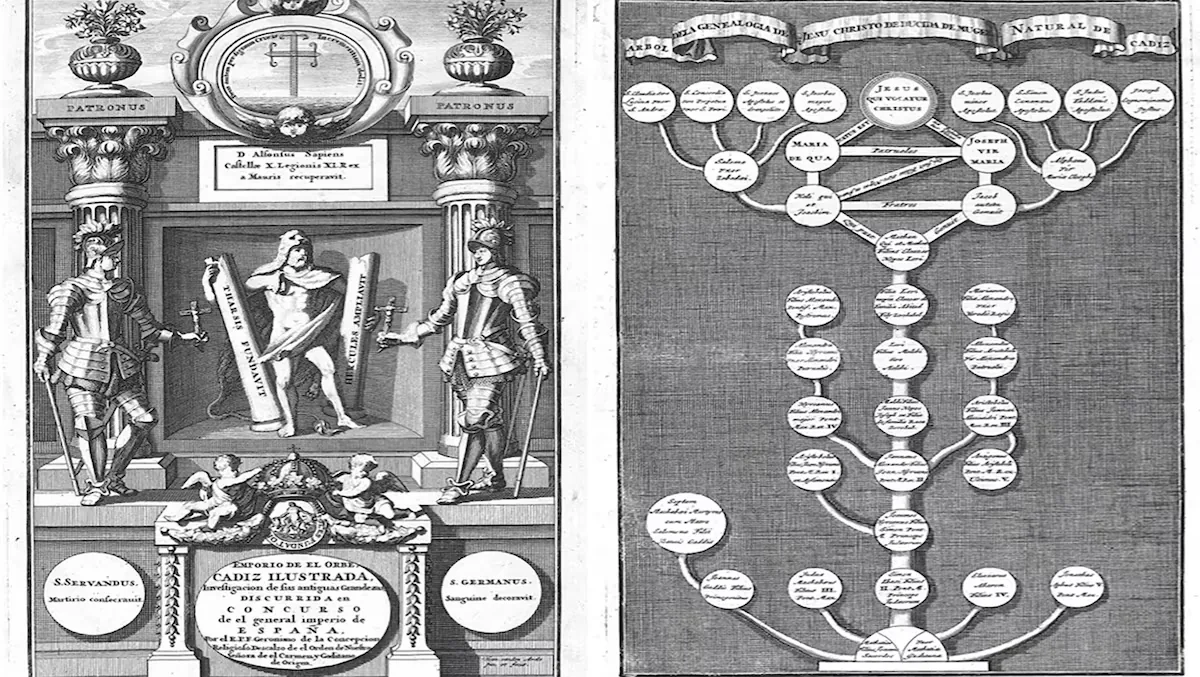
The Three Wise Men set out from Cádiz —then, Gades— to worship Jesus at his birth. The journey, by boat, lasted two years. They must have been quite surprised to learn that the honoree was also of Gaditanian descent, specifically through the maternal line of the Virgin Mary herself. Cádiz was the port of departure —then known as Gadir— from which the Phoenicians discovered America or the first place that buried its dead. Fantasies like these are part of Emporio del Orbe, Cádiz ilustrada: investigación de sus antiguas grandezas, a book written in 1690 by the friar Jerónimo de la Concepción which, aside from its extravagant theories, is an essential manual for understanding the extensive history of the city.
Read more The electric companies owning Almaraz suggest that the plant can reach a useful life of 80 years
The work, well known by all historians researching the Gaditan past, has served as inspiration for the Cádiz City Council to take it as a reference for the third edition of its Proud of Our History, an annual program that each year focuses on a moment of the city’s glorious past, to be held in September. After reviewing the Phoenician Gadir and the Roman Gades, the cultural program jumps 11 centuries forward to delve into those centuries, from the 15th to the 18th, in which Cádiz became a powerful international commercial port. And for this, it borrows that title of Emporio del Orbe, which shows that Jerónimo de la Concepción largely achieved his goal. “It has been etched deeply into the collective memory that the city was a commercial emporium,” reasons Arturo Morgado, professor of Modern History at the University of Cádiz.
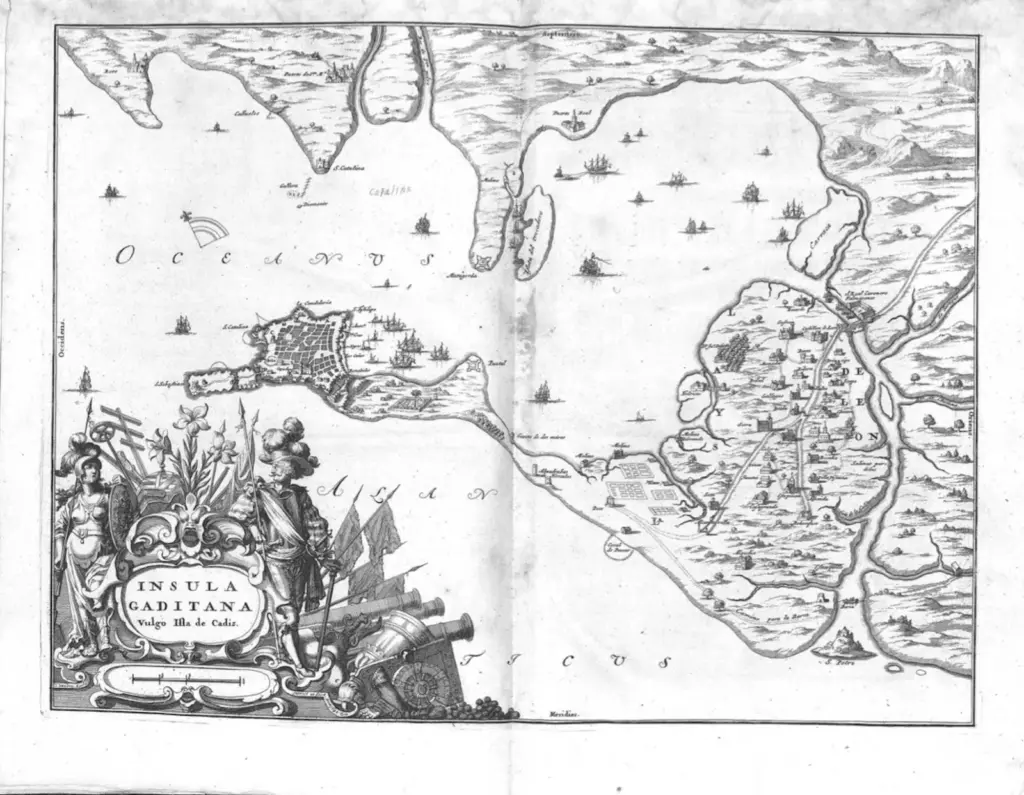
Morgado was also responsible for writing the prologue of the Carmelite’s reissue of the work in 2003. Like any self-respecting Gaditan historian —or enthusiast— he already knew it long before: “It is the only complete history of Cádiz published in the Modern Age.” That is precisely where the research value of Emporio del Orbe, a publication of more than 720 pages, produced in Amsterdam, the leading printing center in Europe at the time, and structured in two parts, divided into eight books in total, lies. The first dwells on the sacred origins of the city, containing various “delirious” attributions, as Morgado defines them, and which has “almost no documentary value.” The second focuses on what happened after the Catholic conquest, the different convents founded, and the events that occurred thereafter. “That is the fundamental part,” explains the historian.
But it is hard not to stop and scrutinize the entire fantastic epic with which Friar Jerónimo de la Concepción embellishes the ancient past of the city. For him, Cádiz was the first place to use honey for consumption, the discoverer of America long before Columbus; the inventor of the battering ram, a war device; the first to bury its dead; or the most advanced in building stone walls. Of all these theories, the most extravagant is that the Three Wise Men set sail from Gades two years before Jesus Christ was born or that he descended in the ninth generation from a woman of Gades who married Matthias, an ancestor of the Virgin. He dwells on this last claim with enthusiasm, including a family tree. “There is no implication, or indecency whatsoever, in Christ Our Lord having his origin from a Gentile Gaditan woman,” affirms the friar.
Read more A driver damages Pampa del Leoncito, a natural jewel of northern Argentina
So many praises for the city he writes about were neither an isolated fact nor a new genre. In those years, it was common to write chorographies, specialized in covering the history of a particular locality and which were popular as a genre until the 18th century. “Those who used it were very interested in asserting that their city was the best of the best,” points out Morgado. To do so, Friar Jerónimo de la Concepción relies on chronicles or historical forgeries in which their authors claimed to have discovered very ancient and apocryphal codices. The Carmelite eagerly cites one of them, that of Julián Pérez, to affirm the Gaditanity of the Virgin. It is just one of the 340 authors he uses in a work that took him almost a decade to write.
“His erudition is impressive. Another matter is how he used the sources: he had no critical sense, he swallowed what he was reading. He totally believed what he was writing,” points out Morgado. That blind faith was also supported by the historical context of a city that needed to believe in that greatness of the past. In those years when the Carmelite wrote the work, Cádiz was already fiercely competing with Seville to be the first Spanish commercial port, something that would be confirmed with the transfer of the House of Trade to the Gaditan capital in 1717, barely 27 years after the Emporio was published. “When Friar Jerónimo told the authorities he wanted to write the book, they saw the sky open and collaborated financially, hence all those delusions,” adds the professor.
Nonsense aside, the work achieved its goal: it transcended for its historical value as a reference manual and established the idea of Cádiz as that emporium of the world to which the City Council now appeals in its historical sessions. “All cities and nations need a narrative. Cádiz’s is Phoenician, Roman, we forget the later, then comes Alfonso X, the thriving trade, and everything culminates gloriously in the 1812 Cortes,” reasons Morgado. The problem, as the professor adds, is that this history “has a part of truth and others that are not so much; fairy tales are false, but we like to hear them.” Nevertheless, the historian defends the collective value of works like the Emporio: “They are narratives that fulfill a role. We will never be what we were, but we can be better than we are.”