








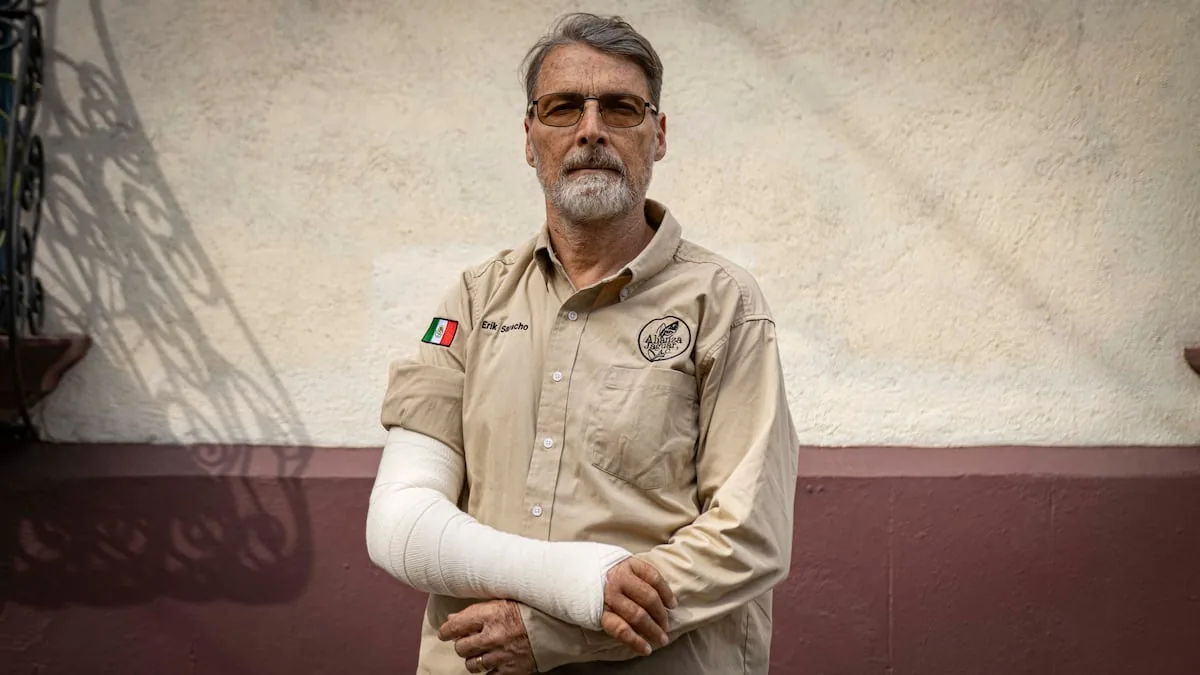
Erik Saracho Aguilar (Guadalajara, 58 years old) carries two pillows and a backpack wherever he goes to accommodate his arm, still bandaged almost to the shoulder. Since surviving an assassination attempt on March 11, when he was shot with the intention of killing him, Saracho stands firm and speaks with indescribable strength about each of the causes that he and his collaborators have led to protect the territory and environment in Jalisco and Nayarit. The activist, who for years has confronted and fought against the real estate excesses of tourism on the Pacific coast, has his right arm completely immobilized. It was the miraculous and inexplicable shield that saved his life when an armed man shot him in the face that morning outside his home. The repercussions of the attack brought him to the forefront of public attention, but Saracho insists that he is not the protagonist of the story. He reminds us that violence and abuses in the country must be fought by the State, not because an activist was spared this time, but because the Government has an obligation to guarantee security for all.
“If I am killed right now, the national message that would remain is that there is a failed state. Sorry, because it seems focused on me personally, but I am narrating what happens to the character sitting here, and who I wouldn’t want to be,” he tells EL PAÍS during a visit to Mexico City. Saracho shies away from being the center of attention or any notion of heroism derived from the attack – which was recorded on security cameras – and chooses to protect himself and his family. “I will be as prudent as possible and cross myself.” But he also knows that this episode is another example of how vulnerable citizens fighting for civic causes in Mexico are against power mafias or organized crime. “It would be very sad and catastrophic for the country if I were killed. Sorry to put it this way, but watch the movie: the mediocre activist about whom everyone said ‘what he does is great,’ they try to kill him and don’t, and he becomes a rockstar, a lead star. Everyone says: ‘Wow, what he does, how wonderful, how good you didn’t die, how brave, how transcendent, how awesome.’ And the president gives him full attention and the Army. There are the federal guards and the armored truck… And what if they kill him in the end? Tell me the moral of the story, tell me where Mexico stands,” he questions.
“We became guardians of the territory without realizing it”
The founder and director of Alianza Jaguar A.C. has been the face of several causes ranging from the defense of territory to the rights of children. In 2000, he collaborated on an investigation into child sexual exploitation that would years later lead to the arrest of American businessman and pedophile Thomas White, a wealthy man with influence in the highest spheres of power in Jalisco, who headed a network that abused dozens of minors in Puerto Vallarta.
Saracho, then 33, had to leave that state and moved to Nayarit. “It was the first time I was aware that I could roll up the window [of my truck], because I have a hand, because I am alive, because I have a body, because they haven’t killed me. It was the first time I realized that this activism could threaten my life, and that being alive is a privilege that allows you to act,” he recalls.
Before that, he already considered himself a “garbageologist” due to his involvement in environmental issues since his youth. In 2004, he joined the Jalisco Ecologist Collective and managed to promote the creation of the Sierra de Vallejo-Río Ameca Biosphere Reserve protected natural area, which comprises about 225,000 hectares between Jalisco and Nayarit. The declaration process lasted 20 years. “We saw it with Vicente Fox, with Felipe Calderón, with Enrique Peña Nieto, and it was Andrés Manuel López Obrador and the Secretary of Environment, María Luisa Albores, who told us yes.”
Years later, a friend told him that they were offering him a jaguar for sale. That’s when they began to investigate the animal and its habitat and decided to rescue it. This also required a commitment to safeguard its territory, which is the task he began with Alianza Jaguar. In addition, the communities surrounding San Pancho began to come to them to report the theft of wood, water from their streams, or fires. “We became guardians of the territory without realizing it,” he says. “We were the ones who knew the law and had contact with the Government. People came and asked us for help.” However, he assures, they soon realized that they could not lead all the complaints due to the risk it posed for them, so they guided the communities and continued to accompany several of the cases.
“We did well there saying: ‘Here we have to protect the territory because there are jaguars,’ and we put the jaguars out front. What happened? The ranchers said: ‘Ah, if there are jaguars, well, we’ll kill them all.’ Just like it would be a mistake to say: the defense of the territory is centered on its defenders, so kill them all. Dead dog, no more rabies. So the story cannot be centered on the hero, on the martyr, on the person. It is the cause, the objective, the territory,” he reflects. And he points out the weak points of the system: “It is the power structures, the investment processes, the laws that cannot defend the territory, it is the clumsy legal, civil procedures that make it difficult to file a lawsuit. Do you know how much time and money it costs you to file a lawsuit so that you, a citizen, can defend a public good?”
Read more The pact to contain diesel in Mexico is weakened by costs and specific supply problems
Then came the real estate tourism developments that have plagued the Nayarit coast for decades. First, it was the Emerald Coast company, which, according to Saracho, began selling by fax, from Mexico to the United States, land that was part of the sierra. They reported land trafficking, corruption, and real estate speculation. “They were the first to arrive at a town party to tell me they were collecting signatures for me to leave,” he recalls. After the real estate crisis, the company went bankrupt.
In 2017, a conflict arose that remains open today: the social protest of the town of San Pancho against the luxury development of Punta Paraíso. The owner filed a lawsuit against Saracho and others in neighboring Jalisco. The development comprises three luxury apartment buildings facing the beach. Part of the community and activists have denounced that local authorities approved the complex’s property advancing at least 15 meters onto the public beach, arguing that the beach has grown. They said they were “lands gained from the sea,” the activist reproaches, to privatize a federal zone.
And, finally, the Ysuri development. Last November, Saracho heard that he was being accused of extorting the owner. He says he didn’t even know the owner. The only thing he knew, as a personal assessment, was that the building planned for construction should have at least one parking space per unit. Something that was clearly not present. Then, he learned that the company had leased land next to a school to use as parking. “I just had my opinion that it was not suitable because it did not respect the law,” Saracho assures.
Two days before being attacked at his home by an armed man whose identity is still unknown, Saracho and his collaborator Indira Santos had a public meeting with the municipal president, Héctor Santana, and representatives of the Ysuri developers. They agreed to meet again on Wednesday, but the night before, Santos and Saracho, aware that they did not have the necessary information to take a position, canceled the meeting. On the morning of March 11, the day the meeting was supposed to take place, a middle-aged man dressed entirely in black approached Saracho’s house and shot him at least twice.
A video released by the Nayarit Prosecutor’s Office shows the alleged assailant shooting and running away. “Help us locate him. The person appearing in this video is wanted,” the message said, which included a reward of 100,000 pesos (just over 5,500 dollars) for information leading to the suspect. “The reward seems like a mockery to me. In reality, it is saying: ‘Your life means very little to us,’” the activist questions. And he makes a comparison: “The developer [of Ysuri] put up a sign the size of a wall on a building that says: ‘We will donate 100,000 pesos for each apartment sold to the high school.’”
The judicial investigation into the attack is ongoing. Local authorities from Bahía de Banderas, the State, and the Federation are participating in it. “I still cannot point fingers at anyone, because there has been no judicial decision determining where the attack came from, but for us it is clear that it was not a lone assassin, but that more people were involved,” says Saracho. He assures that the entire country is facing “a terrible siege by organized crime” and repeatedly asks that the focus of any story not be him, but the urgency of taking measures against violence. “I need the federal government to do it, not me; I need the government to confront the mafias, not me. What I have to achieve is for our institutions to move, so that we don’t live in a damn country of impunity, corruption, and simulation. We have to make Mexico work and we are not going to do it. Which caudillo? I am not Zapata, no, it’s not my turn; it’s theirs. They are obligated subjects; we pay them, they said they could, so get to work.”
Read more A spring essential that never fails: the most versatile Levi’s polo shirt, now with up to 38% off