









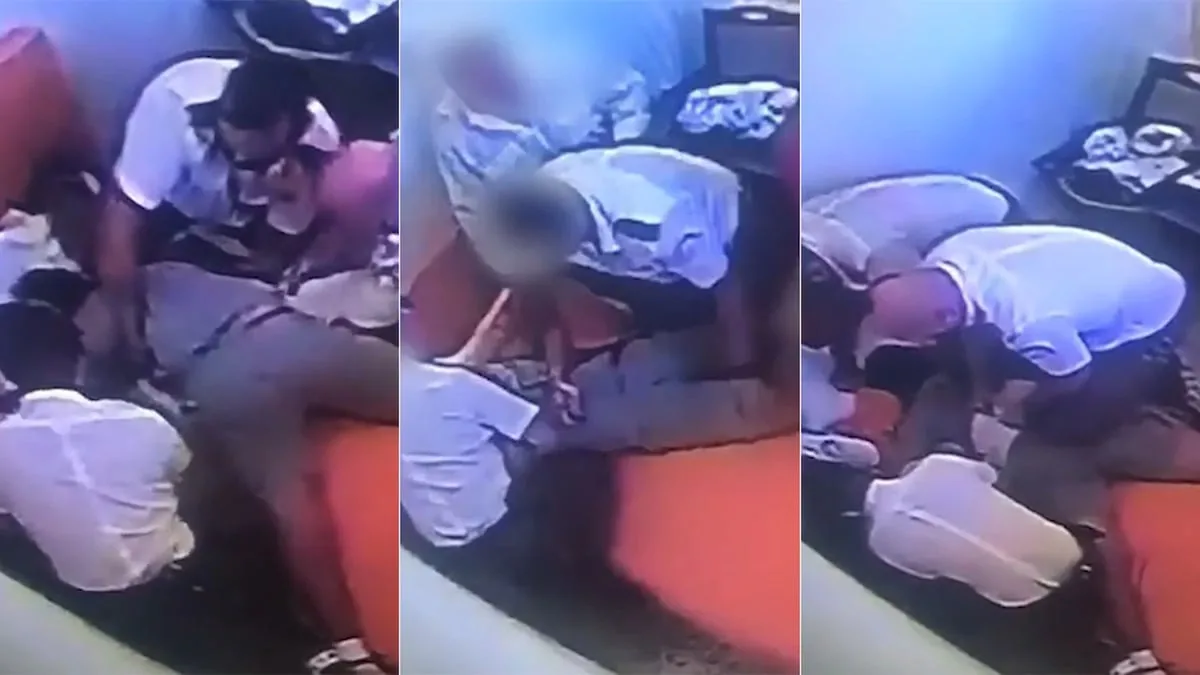
It has been almost seven years since the young Moroccan Iliass Tahiri, just turned 18, died suffocated with his head and body crushed face down against a cot, while six security guards immobilized and tied him with straps in a room at the Tierras de Oria Juvenile Detention Center (Almería). It happened on July 1, 2019, during siesta time, and the intervention was recorded by security cameras. There was no doctor to authorize that type of action, as required by protocol. And, despite the controversy and debate that those events aroused — with the intervention of even the Ombudsman — this Thursday everything could be reduced to a kind of express conformity trial or a new postponement.
Read more Ten million memories
The death of Iliass, despite not being the first to occur in Spain with these characteristics, nor the first in a center managed by the company Ginso (subcontracted by the Junta de Andalucía), brought to the forefront the use of mechanical restraint protocols in juvenile detention centers. The Ombudsman visited the Oria center and urged the prohibition of such actions, which are discouraged by international organizations due to the risk they entail.
Finally, after three attempts to dismiss the case as an “accidental violent death” and as many reopenings, the oral trial — scheduled for October 2024 — was to be held this April 23. However, in line with the delays suffered in this procedure, on April 14, Magistrate Urko Liendo, of Criminal Court number 2 of Almería, issued a diligence urging an agreement between the parties or a suspension/postponement, “in view of the fact that not all the necessary procedural steps for the celebration and eventual termination of the oral trial with a sentence have been carried out (among them, obtaining the recordings in the file in a format that allows their reproduction and viewing, or the summoning of witnesses and experts),” he justifies.
An inexplicable justification, in the opinion of Ángel Gómez San José, the Tahiri family’s lawyer, considering that the judge “has not issued an order requesting evidence in two years.” That is, now there are no videos or anything because they have not been provided or admitted in the procedure because the judge has not requested them. The accusations have already stated in writing to the court “not to desire any conformity,” but everything will be decided this Thursday depending on what the accused and the family are willing to assume, who have always demanded “that justice be done.”
“An agreement could be reached if they were declared guilty of negligent homicide,” warns Gómez San José, who appealed the order that two years ago set the date for this trial because he considered that it facilitated “the reduction in criminal reproach in case of conviction” and also recalled then that it was the death of a minor. “The enormous delays in this procedure benefit the accused,” he now insists, “they will no longer serve any of the four years in prison that we requested for ‘negligent homicide,’ they will pay a ridiculous fine and perhaps be disqualified from holding their position for a few months,” the lawyer warns.
At least four of the six guards who participated in the mechanical restraint authorized by the center’s director — without prior consultation with a doctor, as dictated by the protocol — along with the managers of the Ginso company and the Junta de Andalucía, would have to sit on the bench.
The direct civil liability of Mapfre España, Compañía de Seguros y Reaseguros and subsidiary civil liability Asociación para la Gestión de la Integración social (GINSO),” which had accumulated negative reports from the Ombudsman and the Children’s Ombudsman, was already paid (190,000 euros) as compensation to Iliass Tahiri’s mother and siblings earlier this year.
“With the purpose of attempting an agreement with the accused or, failing that, to purify the procedure,” the latest order from Judge Liendo continues, “the appropriate procedure will be followed depending on what is substantiated there, either the issuance of a conformity sentence, or the suspension of the oral trial with a new scheduling for its celebration with the admitted evidence within a period not exceeding three months, including the possibility of suspension or postponement of the session within the maximum limit of 30 days.”
Read more Why does the Bernabéu boo?
Although the facts have not changed, the Prosecutor’s Office at the time went from considering that a crime of negligent homicide should be judged, prosecuting those responsible for the Ginso company and the Junta de Andalucía — as requested by prosecutor Carlos Castresana in June 2019 — to understanding that it should be “transformed” into a “trial for a minor offense.” “We understand that the conduct developed by the investigated could constitute less serious negligence. In that case, we would be facing a crime of homicide due to less serious negligence typified in article 142.2 of the Penal Code, and punishable by a fine of three months to 18 months,” it argued. A total of 13 people were investigated in the case, including the center’s management, educators, security personnel, medical services, and representatives of the Ministry of Justice.
Despite not having the support of the Prosecutor’s Office, lawyer Ángel Gómez San José has never given up, filing appeal after appeal: when the case was dismissed, when the judge and prosecutor tried to have the case judged as “a minor offense” and not as “negligent homicide,” or when they “forgot” to include among the accused the guard who pressed his leg against Iliass’s head and back during the fatal restraint maneuver.

A death in four minutes
Iliass Tahiri took four minutes to die with the security guards on top of him. In his definitive autopsy report, the forensic doctor recalls that “all consulted mechanical restraint protocols, both medical (for medical reasons) and regimental (for security), reflect the need to place the person in a supine position [face up] on an articulated bed, unless there is an express medical indication for another position,” states Dr. Juan Luis Sánchez Blanque. “In the case at hand, the deceased was placed in a prone position [face down] following the restraint protocol provided by Tierras de Oria which, unlike others, includes mechanical restraint by default in a prone position [face down],” he adds. Furthermore, the protocol establishes fixing the abdominal strap first and then the limbs, and in this case, it was done in reverse. According to the forensic doctor, this posture could have increased the boy’s “stress” and “agitation” and caused a “massive discharge of catecholamines” that contributed to generating a cardiac arrhythmia that triggered his death. Even more so if he was medicated, as was the case.
Sources from the center, consulted at the time, argued that “the mechanical restraint protocol of the Junta de Andalucía governs all centers of the Junta, but then each one adapts it to its specific characteristics.” According to the lawyer’s accusation brief, which insists that no doctor was present, “during the prolonged, unjustified restraint maneuver, the airways were blocked against the pillow for several minutes, without any of the accused intervening ensuring the minor’s breathing, this being an intolerable lack of care that led to Iliass’s death.”
The lawyer, who details second by second in his brief the images recorded by the cameras during Iliass’s immobilization, highlights that the violence of the guards during the maneuver does not match the boy’s attitude and behavior, who is seen at all times subdued, from when he arrives handcuffed with his hands behind his back to the room where they lay him directly face down on the bed until the guards realize he is not breathing. At no time is any resistance observed from the young man while he is being tied up.
The case of Iliass Tahiri exposed the situation of helplessness experienced by inmates in some juvenile centers, brought to light other similar cases that occurred in centers managed by the same company Ginso, and led the Ombudsman to issue a report to prevent this type of restraint.