









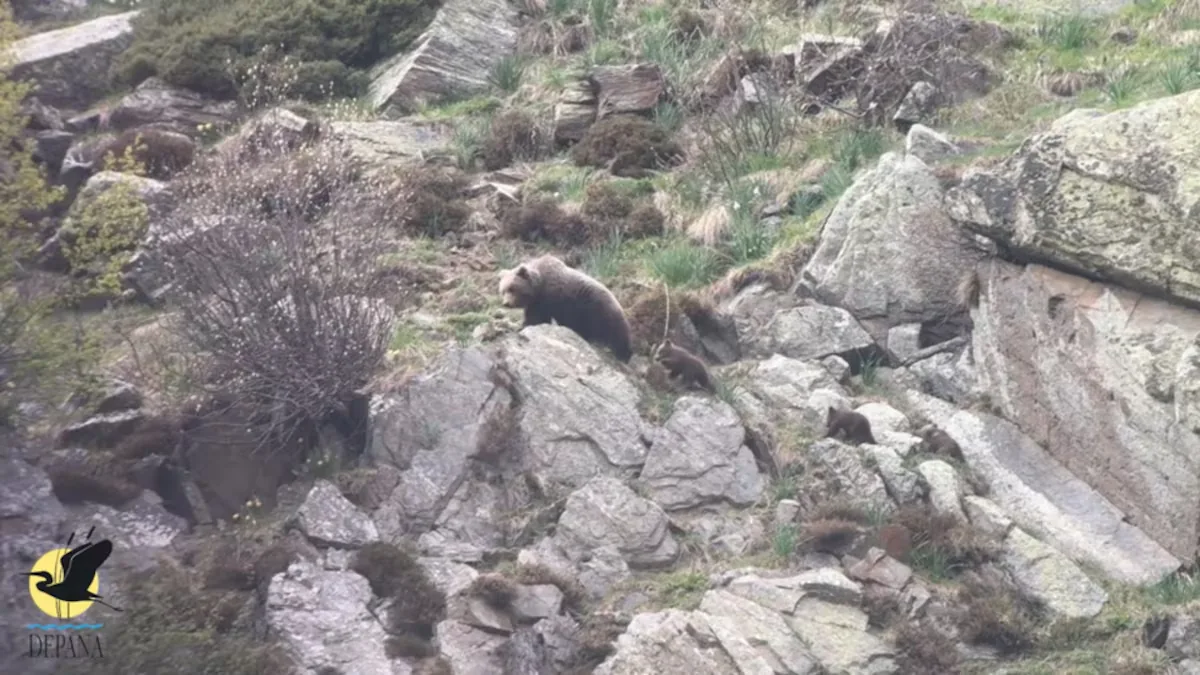
The environmental organization Depana (League for the Defense of Natural Heritage) has recorded in the Aran Valley (Lleida) two female bears accompanied by three cubs each, an unprecedented situation in the Pyrenees. The material has allowed documenting the behavior of two family groups during one of the most sensitive stages of their life cycle. Valuable images have been obtained about the daily life of this endangered species, showing relevant aspects of its biology, feeding habits, interactions between the cubs and the mother, behavior towards other species, and different moments of daily activity.
The monitoring of the two female bears with their cubs was carried out during the months of May and June. One of the females was monitored for 28 consecutive days. At the beginning of June, this family group lost one of the three cubs, the smallest of the litter. It is yet to be determined whether the animal suffered from an illness or had an accident; a possible episode of infanticide by a male is also not ruled out.
The second female bear and her cubs were located on five occasions and, until the end of the monitoring period, the family group remained complete. In total, during the spring monitoring campaign, a total of 12 different brown bear specimens were monitored in the area. These observations are the result of the monitoring and surveillance tasks coordinated by Marc Alonso, an expert from Depana and a reference in the conservation of this species in the Pyrenees.
The monitoring is part of a broader program of conservation, scientific monitoring, and awareness aimed at promoting coexistence between the brown bear and human activities in the area. According to the latest data from the Transboundary Brown Bear Monitoring Group (GSTOP), made public in March by the Generalitat, 54 brown bear specimens were identified in the Catalan Pyrenees and 108 in the entire Pyrenees during 2025, the highest number recorded so far.
The data confirm, according to Depana, the positive trend of population recovery after decades of joint work between administrations, technical teams, and conservation entities. The brown bear is listed as an endangered species in the Pyrenees and is subject to priority protection according to European regulations. Despite the population recovery, the species remains vulnerable and requires rigorous scientific monitoring, as well as the consolidation of measures that promote coexistence with livestock and other human activities.
Read more Unesco halts the candidacy of Ribeira Sacra for World Heritage status