









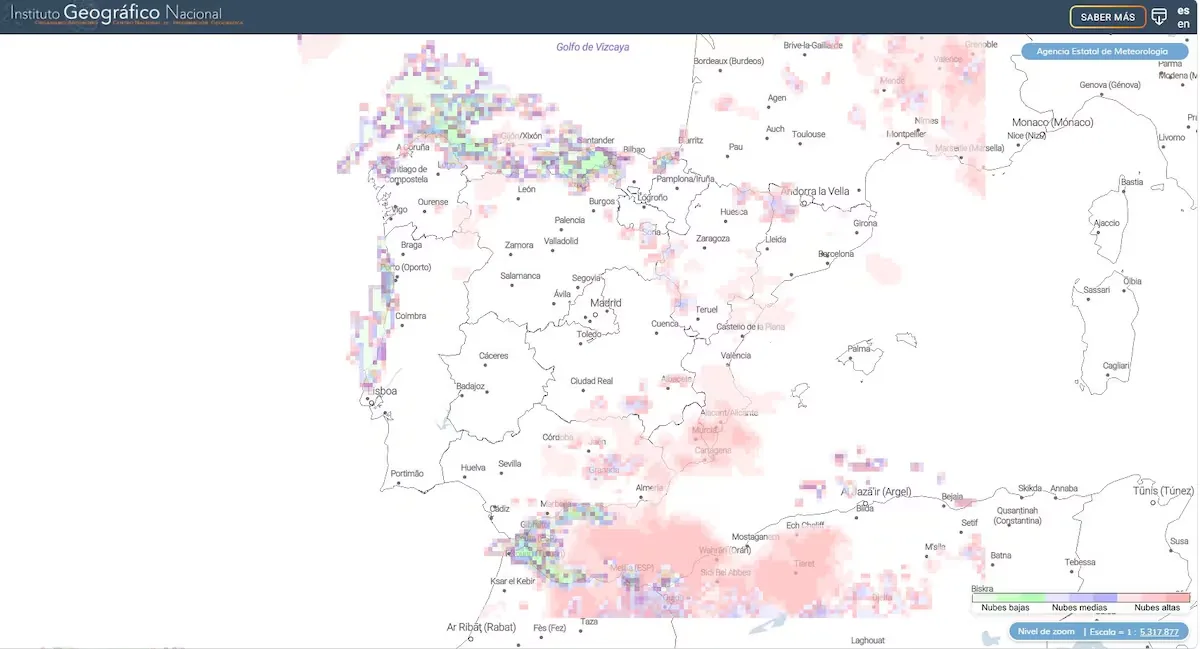
The State Meteorological Agency (Aemet) published this Friday its first and long-awaited special forecast for the solar eclipse, which brings excellent news for those who want to witness this incredible astronomical phenomenon: “Stability in most of the country, with a predominance of slightly cloudy or clear skies.” For now, and although this generally favorable scenario may change by Wednesday the 12th, the only areas that have been unlucky in the weather lottery are the Cantabrian area and parts of the Galician coast and Alborán ―coasts of Málaga, Granada, and Almería and the north of Ceuta and Melilla―, as well as the mountains of the north and east, where cloudy skies are expected.
Read more Rodri’s plot twist: from the great offer from Madrid to choosing Barça
Although the bulletin is very detailed ―820 words with eight maps― and contains other parameters such as temperatures and fire risk levels, here the determining factor is cloudiness, which can ruin even the, a priori, best observation point. From now on, in addition to updating its special bulletin daily, Aemet provides real-time cloud predictions in the National Geographic Institute viewer, to which a new layer has been added by clicking on the cloud icon located on the left.
This cloud map is for experts, as it differentiates between low clouds (green), medium (blue), and high (pink). “High clouds affect less as they let most of the sunlight through. They look like torn veils. The ones that worry are the medium and low clouds. They have enough thickness to hide the sun,” meteorologist Benito Fuentes explains to this newspaper. This map promises to be addictive, as it will be updated “twice a day until Monday and four times on Tuesday and Wednesday,” Aemet sources clarify to EL PAÍS.
With these elements, Spain is divided into three zones. On one hand, there is the comfort zone or “calm region” as Benito Fuentes has dubbed it on social media. It covers a large part of the territory, where a predominance of slightly cloudy or clear skies is expected, so it is, as of today and barring any unpleasant last-minute surprises, the area with the highest probability of getting the best views of the eclipse, which will only be total in the path of totality from west to east.
Then there is the “nervous zone” or I’m going to have a heart attack: the eastern mountain ranges ―from Sierra Nevada, through Cazorla, the interior of the Valencian Community, and the Iberian System― and the Pyrenees, where developing clouds could grow after midday, possibly causing some brief and localized showers. The clouds would dissipate by late afternoon. Coastal areas are included in this zone because to see the eclipse, one must look towards these mountain ranges.
Finally, there is the “resignation zone” in Fuentes’ terminology, which could also be called sorry zone or TV and sofa zone. It covers the Cantabrian and Galician coasts, where it is more likely to be overcast than not, although it is still to be determined if the entire area will be affected. Last-minute surprises may arise.
Cloud forecast for the eclipse on 12-Aug-2026, 20:00
🌤️ 🌘What will be the best observation areas? 👇
(Update as of 07-Aug) 🧵— Benito Fuentes (@metbeni) August 7, 2026
Temperatures “will be high,” according to Aemet spokesperson Rubén del Campo, who anticipates it will be a “very hot” day in most of the country. In the Cantabrian region, temperatures will reach between 25° and 30°, and in most of the interior, they will exceed 35°, even 38° to 40° in areas of the Ebro, Tajo, Guadiana, and Guadalquivir valleys.
The fire danger, warns Del Campo, “will be very high or extreme in most of Spain,” so “precautions must be greatly intensified to avoid causing fires.” In this regard, some municipalities have already canceled their events “out of responsibility” and to “minimize the danger,” such as Tres Cantos in Madrid. The Iberia Eclipse Festival in Babia (León) and in Vinuesa (Soria) will also not be held due to lack of permits and safety reasons.