







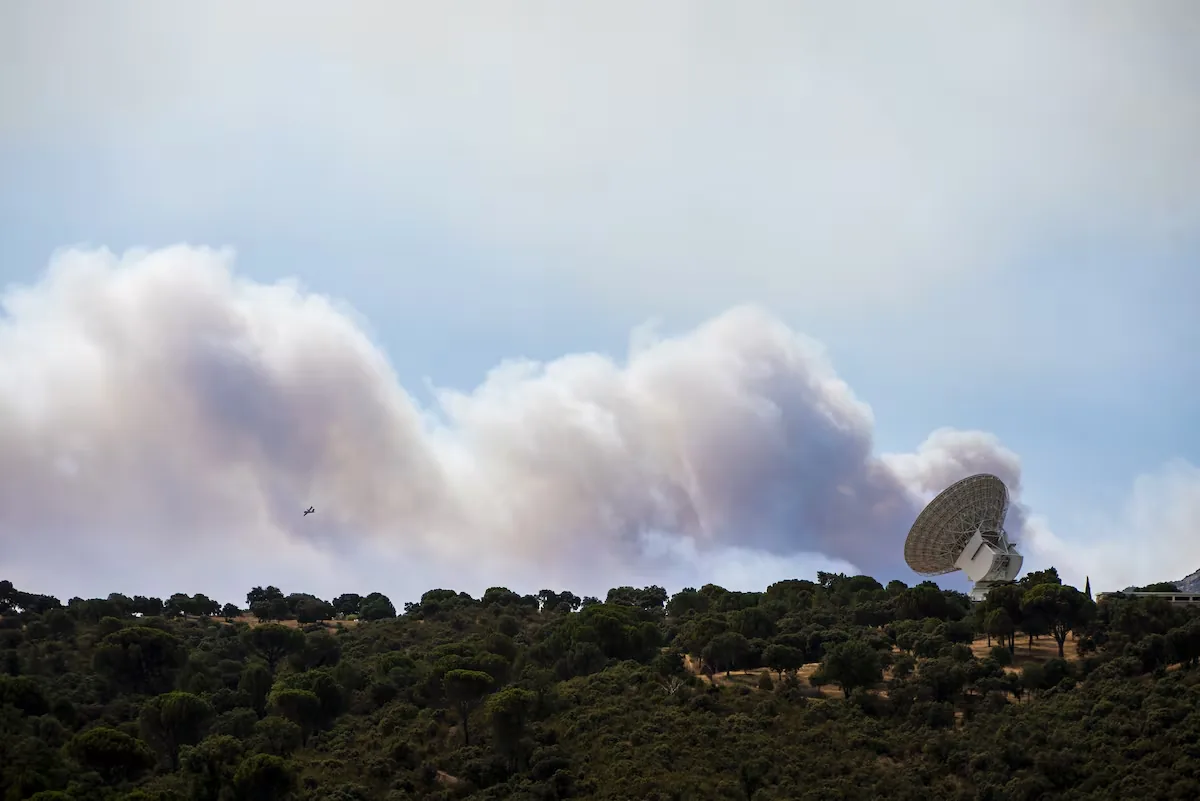
Almost a hundred employees of NASA’s Deep Space Communications Complex, located in Robledo de Chavela (Madrid), had to be evacuated this Friday due to the advance of the flames from the large forest fires declared between the provinces of Ávila and Madrid, which have burned almost 25,000 hectares and forced the evacuation or confinement of nearly 80,000 people.
Read more Atlético de Madrid signs South Korean Kang in Lee until 2031
“The situation has been very delicate. We don’t know if the flames have affected the facilities because we don’t have anyone inside, but the tracking of deep space satellite missions has been at risk. Fortunately, all workers are safe and sound,” explained NASA’s executive assistant at the Robledo de Chavela center, Lola Cadierno.
The agency has assured that it will evaluate possible damages “when it is safe to do so” in an official statement issued by a spokesperson for NASA’s Office of Public Affairs. He assured that “NASA’s SCaN [Space Communications and Navigation] Program is closely monitoring wildfire activity in coordination with local authorities and the U.S. Embassy.”
“Meanwhile, the agency has seamlessly transitioned mission operations support to the Goldstone Deep Space Communications Complex in California, ensuring service continuity and uninterrupted support for spacecraft communications,” the text continues.
The first evacuations occurred yesterday Friday morning and the last ones at five in the afternoon. Regarding the station’s fire plan, Cadierno explained that the agency clears “the entire perimeter within the station” and has “two people with a fire truck who are always there when work is done outside in case a spark jumps,” but they do not have “a group of firefighters.”
The executive assistant expressed great concern because a shutdown of the facilities “would be catastrophic for everyone.” The complex is part of NASA’s system “for tracking deep space missions at three stations worldwide, along with one in California and another in Canberra (Australia),” she explained. With Earth’s rotation, the location of the three stations allows for uninterrupted tracking of missions.
Read more Images showing the threat of fire over NASA’s Robledo de Chavela station
“If one of them fails, because deep space missions are tracked 24 hours a day, 365 days a year, tracking would not be possible in this part of the world if there isn’t enough time to develop an alternative,” Cadierno warned.
The Madrid Deep Space Communications Complex (MDSCC), in Robledo de Chavela, is a facility of the National Institute of Aerospace Technology (INTA), in collaboration with the US space agency NASA, and the European Space Agency (ESA) also participates in it.
Belonging to the Deep Space Network, this complex originated in 1964 when Spain, the United States Government, INTA, and NASA signed an agreement for Madrid to host one of the three centers that make up the aforementioned Deep Space Network. These are three equidistant stations; the other two are in California and Canberra (Australia), and are of great importance for space exploration.
The geographical location of these centers, separated by approximately 120 degrees of longitude, was chosen so that space vehicles and missions can maintain constant contact with a station on Earth, regardless of Earth’s rotational movement. The antennas have been monitoring the Curiosity rover (Mars), missions such as Juno (Jupiter), and the Kepler and James Webb telescopes.