


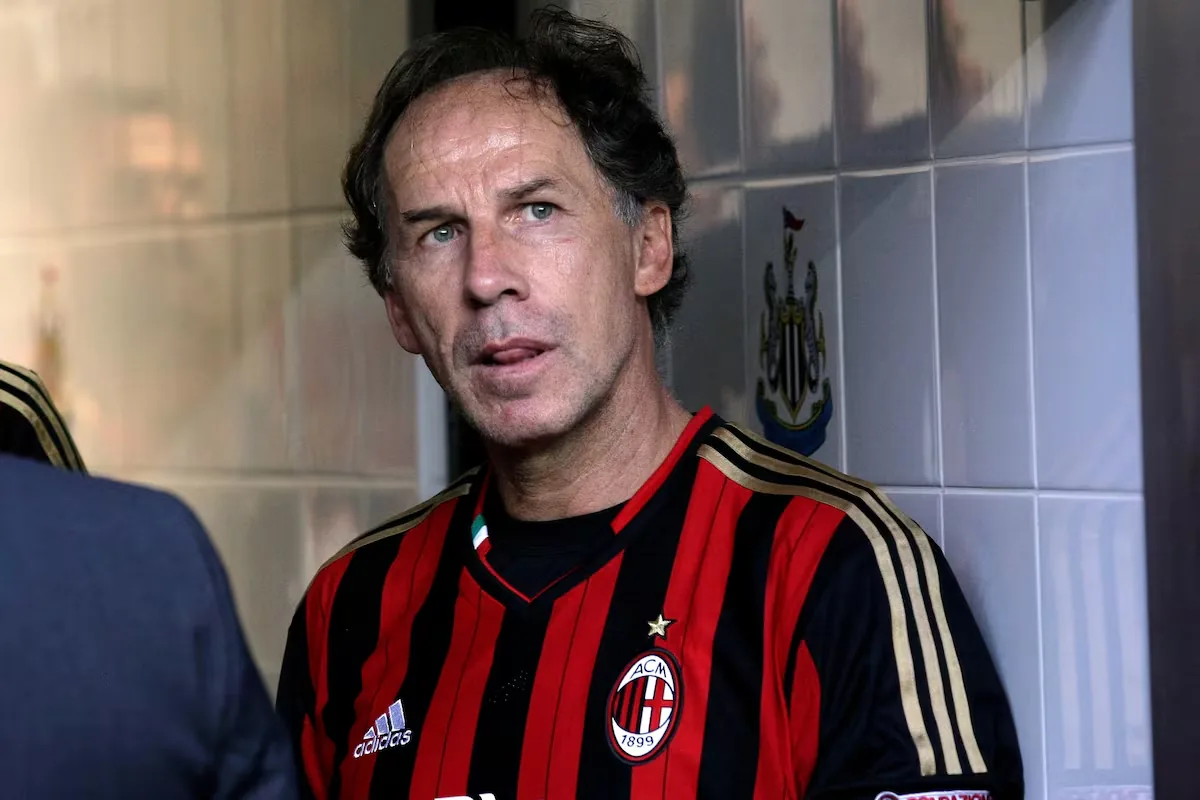
Franco Baresi, legend of Milan and the Italian national team, one of the best defenders in the history of world football, died this Friday at the age of 66, according to his club. “The history of Milan is in tears over the death of Franco Baresi. His example and his depth will be, forever, just like the number 6 jersey, an integral and fundamental part of the DNA and the journey of the entire club,” announced the rossonero club. And added: “The condolences that AC Milan expresses to the entire family of Franco Baresi are the same that every rossonero fan makes to themselves in such a difficult moment as this.”
La Storia del Milan è in lacrime per la scomparsa di Franco Baresi. Il suo esempio e la sua profondità saranno, per sempre come la sua maglia numero 6, parte integrante e fondamentale del DNA e del cammino di tutto il Club. Le condoglianze che AC Milan porge alla famiglia tutta… pic.twitter.com/a8wNOCUc2o
— AC Milan (@acmilan) July 31, 2026
Any fan with some years remembers his powerful figure, his ancient gladiator face, with the shirt worn outside, his authority stealing balls, his omnipresence in the area as a libero, a term that in childhood imagination always had epic connotations. He was already a classic while young. He was a pillar of the historic Milan of Sacchi and Capello of the eighties and nineties — a legendary defensive line with Tassotti, Costacurta, and Maldini — and of the azzurra national team, until hanging up his boots no less than in 1997, at 37 years old. He was apparently indestructible, made of iron, and it is still remembered that 25 days after meniscus surgery he played the 1994 World Cup final in Pasadena against Brazil. He neutralized none other than Romario and Bebeto, but then missed the first penalty in the shootout and ended up in tears, another episode of the legend.
Baresi (Travagliato, 1960), from a humble family of peasants from the Po Valley in the Brescia area, had a tough childhood and his struggle to get ahead later marked his tenacious and tireless character as a footballer. Orphaned of both parents at just 17, he kicked the ball in his parish and caught attention, although he was short (he later reached 1.76 m) and was eventually dismissed in trials by the big clubs. They called him Piscinin, the little one, in Milanese dialect. He was also Franchino, said with all the affection in the world, because for Milan fans he was like family, he was the capitano, the myth. Baresi is one of those cases of symbiosis destined to be eternal that football sometimes produces between a player and a team, like Totti and Roma. In the end, he was at Milan for half a century, as a player and then in executive roles. It was the only jersey he wore in his life, that and the nazionale one.
He started playing football in his hometown team, near Brescia, alongside his brothers Angelo and Beppe. In the 1970s he joined Milan’s youth team and played his first Serie A match at the age of 17, on April 23, 1978. It is part of the legend that Inter did not want him and he ended up at Milan, but on the third try, because it was clear he had something others did not. His brother Beppe ended up at Inter and between the two they summed up what the derby symbolized for Milan, it was a fixed photo before each clash.
Read more Héctor Gutiérrez, an unknown and brave Mexican, wins the Chenel Cup
At the rossonero club he shone very early, much more because those were the two dark years of the team’s relegation to Serie B, one of them due to betting scandals. The club also did not have much money and they were the poor ones of the city, in hard years of crisis and violence for Milan, something that changed when Berlusconi arrived and catapulted them to glory. But Baresi was already there before, he had kept the flag and remained as a historical memory of the team of the hard years. Juventus and others tempted him, but he remained faithful to the jersey, and that also began to be part of his aura, unbreakable loyalty, along with his austere, serious, and few-words style.
His record speaks for itself: 719 matches with Milan, 33 goals, 6 leagues, 3 Champions, just to stay in the first line of trophies. There are also four Italian Supercups, three European Cups, three European Supercups, two Intercontinental Cups, and one Mitropa Cup.
He was on the bench, although he did not play, with the Azzurra that won the 1982 World Cup. He played 82 matches with Italy and in the World Cup he finished first (1982), second (1994), and third (1990), all podium places. He was seven times a Ballon d’Or candidate, when it was almost impossible for a defender to win it, only Beckenbauer had obtained it in the seventies, another legendary libero with whom he was usually compared. In fact, he was also called Kaiser Franz. Later only Sammer and Cannavaro have received it. “For me it was like playing with Michael Jordan,” said his teammate Billy Costacurta. For Marco Van Basten he was “the Johan Cruyff of defenders.”
A year ago, in August 2025, during a routine check-up, a lung nodule was detected that was surgically removed but from which he never recovered. His last public appearance at San Siro was as a torchbearer at the opening ceremony of the Milan Cortina Olympic Games, alongside the historic Inter captain, Giuseppe Bergomi. In recognition of his extraordinary career, the club retired the number 6 jersey.