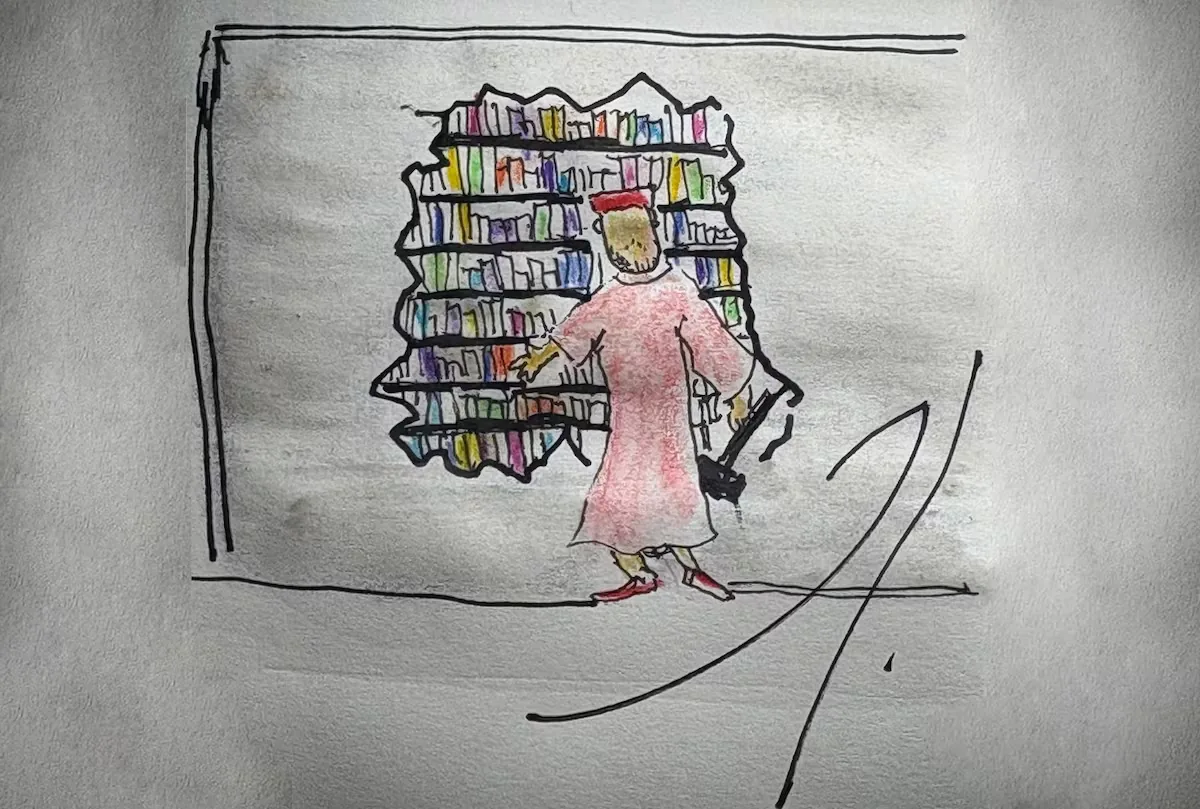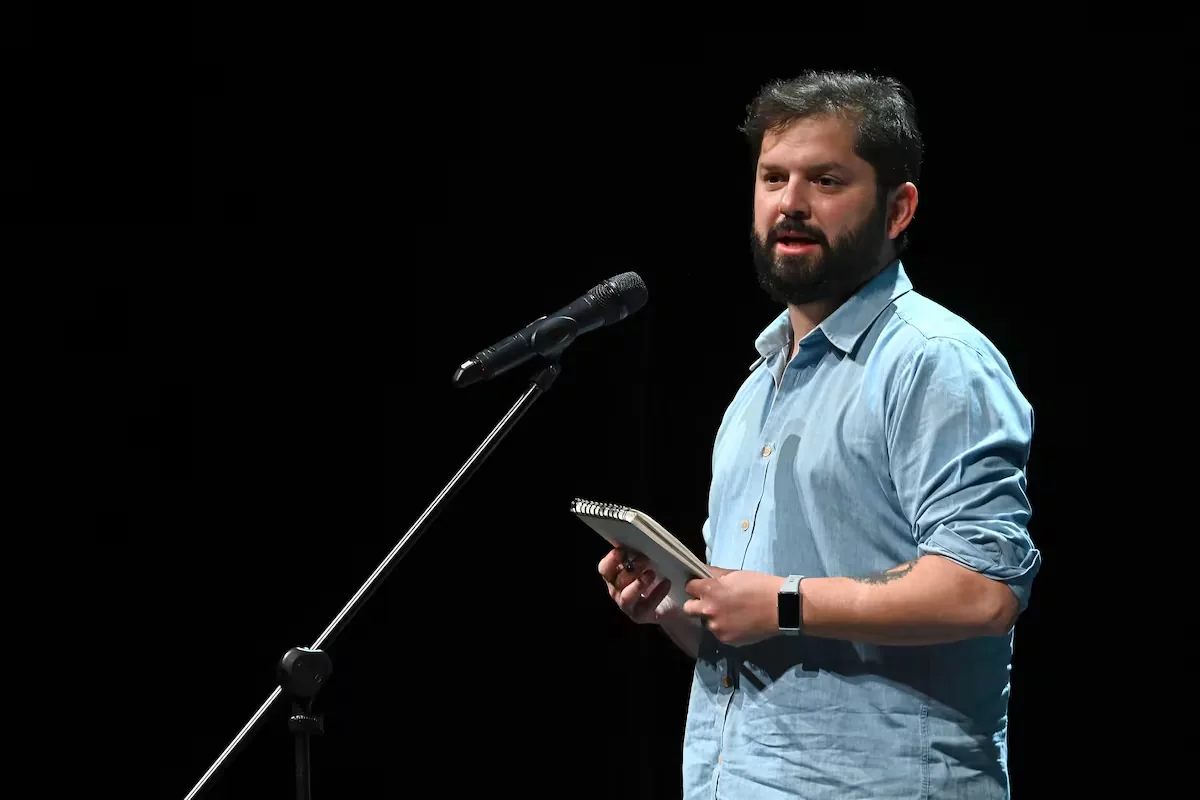
When President José Antonio Kast delivered his first Public Account in the National Congress before representatives of the three branches of government and the public on June 1, his predecessor, 40-year-old Gabriel Boric, was responding at the British Library in London about whether he planned to return to La Moneda. Less than three months had passed since the change of command on March 11, and the leftist was already giving early signs that his shadow would be present early on in the political scene, both locally and internationally, and even on social media. Since leaving the Presidency, Boric has publicly reflected on seven occasions, with a message focused on self-criticism of his mandate, but defending his project; the role the opposition should play in the Kast Administration — “they don’t have to be condescending, they don’t have to seek agreements just for the sake of it” —; and the challenges of the left in capitalist times, inviting a rethink of its “meaning.”
Boric handed over the presidential sash to the most right-wing government Chile has had since the return to democracy in 1990, with the left being a minority in both chambers of Congress, although with more balance in the Senate. The Kast Administration has already managed to push through a mega economic reform with a tax focus without complications, in record time and despite the rejection of the left. Now it is going for a package focused on security, with constitutional reforms that complicate its legislative process mainly due to disagreement within the official side, but with strong public support for most of the initiative. In this context, progressivism has had difficulties presenting a counterweight to confront the Executive’s plans. For Chilean society, according to the Cadem survey, the main opposition leader is Boric, with 25%, followed by the former left-wing presidential candidate, the communist Jeannette Jara (16%), and the Broad Front’s Tomás Vodanovic (13%). The mayor of Maipú is the only one holding a public office and one of the names mentioned for a possible Broad Front primary in the next presidential elections.
Although Boric has acknowledged that “it is not easy to find the place from which to speak as a former president,” he has done so quite a bit in these five months, something unusual compared to his predecessors. Several of these interventions have been from abroad — he has traveled three times mainly to participate in progressive meetings and at the end of the month he is going to Berlin. At the end of his term, he said he would not comment on current events, but it has happened. Through social media, he launched his darts against withdrawals from the funds of State-Guaranteed Credit (CAE) debtors and this Tuesday he accused Kast’s security reform of being “an unprecedented limitation of freedoms in Chilean democracy.” The confrontation, however, has not been his only register. When Boric visited La Moneda for the first time since leaving office, invited by Kast to the commemoration of the 200 years of the Presidency of the Republic, he said: “We have been rivals in ideas, and surely we will continue to be, but Chile deeply unites us.” This back-and-forth between republican courtesy and attack has repeated these months.
Perhaps the first sign that Boric would seek to have an active role in the opposition was that he opened his former president’s office just 48 hours after leaving La Moneda. The speed of his return is as striking as the content of his speech. His first public intervention was in mid-May, at the launch of the book Politics Got Involved With Me, about the life of his former Interior Minister, Carolina Tohá. There he debuted the self-criticism that his government had not “read well enough” the loss of majority in Congress in 2021.
On August 11, at the presentation of The Hangover by sociologist Eugenio Tironi, he stated that in terms of security “we were not credible,” and that the pension withdrawals pushed by the left were “a big mistake.” He also said that the design of his first Cabinet — loaded with the new generation of the left that has accompanied him — he would not do the same today: “Not in the sense of quotas, but in the experience in managing the State.” At the same time, he rejected the thesis that his government “waited six months to govern,” that the constitutional process was a failure — “many times the rejection of constitutional proposals is confused with a failure of the process” — or that Tohá “saved” his government after that defeat.
One of the criticisms progressivism has received during these months, even from the center-left, is that after the electoral defeat it has failed to organize itself and has remained frozen in the face of the government’s legislative offensive. Boric said last week that “they don’t have to be condescending, they don’t have to seek agreements just for the sake of it,” although he qualified that, while they should not “stop being a tough, firm opposition,” it must be done “with coherence, with institutional responsibility.” Exemplifying with the current situation, he pointed out that in the debate on Kast’s mega reform “there were no spaces for agreements.” That same resistance to give ground led him, a few days later, to an international scenario.
Read more Russia has withdrawn its ambassador from the United Kingdom
At the Progressive Pan-American Congress held in Montevideo this Thursday, he warned against “the search for the center as an automatic response to bad results.” “In Chile, there is often a kind of permanent discussion about the arithmetic of politics. As the right grows, what we should do is moderate ourselves to win the center. That idea of fanaticism for moderation, in the end, leads nowhere,” he said. “We will not apologize for being left-wing or for having convictions of social equality (…) If being socialist means that we want health to be a right and not a business, yes, I am a socialist. If being socialist means that we will defend human rights universally and therefore will very clearly establish that the State of Israel is committing genocide in Gaza, yes, we are socialists,” he added in a message reminiscent of the 2020 campaign speech of American Bernie Sanders.
While he still had the presidential sash on, Boric told EL PAÍS in January that he believed the opposition to Kast’s government should “be democratic.” “It cannot be just Twitter or political cliques, but it has to be intimately linked to the territory, to the people,” and that “the left that only blames the adversary is doomed to dissolve.” He said he wanted to travel around Chile and dedicate himself to “grassroots work,” connecting with that sector of the population that is currently on the political periphery. And that is something that has begun to be seen. At the end of July, he registered as a member of the neighborhood council in San Miguel, where he lives, and two weeks later he toured the neighboring municipality of San Ramón with its mayor, the Christian Democrat Gustavo Toro, where he talked with neighbors about the recovery of public spaces. The latest was a visit to the Public School Antarctic Territory, also in San Miguel, where he talked with students about leadership and participation. He also met with directors of various educational establishments.
One of the big questions left after the electoral defeat of the Chilean left was what path it will take. At the close of his intervention at Tironi’s event, Boric accepted that “capitalism is the historical era we live in” and that attempts at radical transformation “failed,” but he rejected resigning himself to a “historical inertia dominated today by technoligarchies in alliance with the political power of the far right.” He quoted Max Weber and the “iron cage” to argue that the left needs to rethink its “meaning,” not just accumulate specific public policies, and called for “less reels, less eight seconds of attention, less stridency, and more reflection, more debate.”
His interventions at the Pan-American Congress were about the same, although there was one especially focused on injecting optimism into the left. It was the letter he read on Friday to his one-year-old daughter Violeta, in which he narrated that he was in Montevideo with a large and diverse group of people, filling themselves “with strength, love, energy to change the world.” He said they were happy and radiant. And also dismayed and angry as well,” he pointed out. In the six-minute speech, Boric called on the regional left not to become “a wall of laments” that only manages the present. Looking ahead, he posed as pending tasks deciding “how we are going to govern new technologies” and moving towards “new development models that do not continue destroying the planet at our own expense.”
Read more Dutch GP live, the Formula 1 race live