







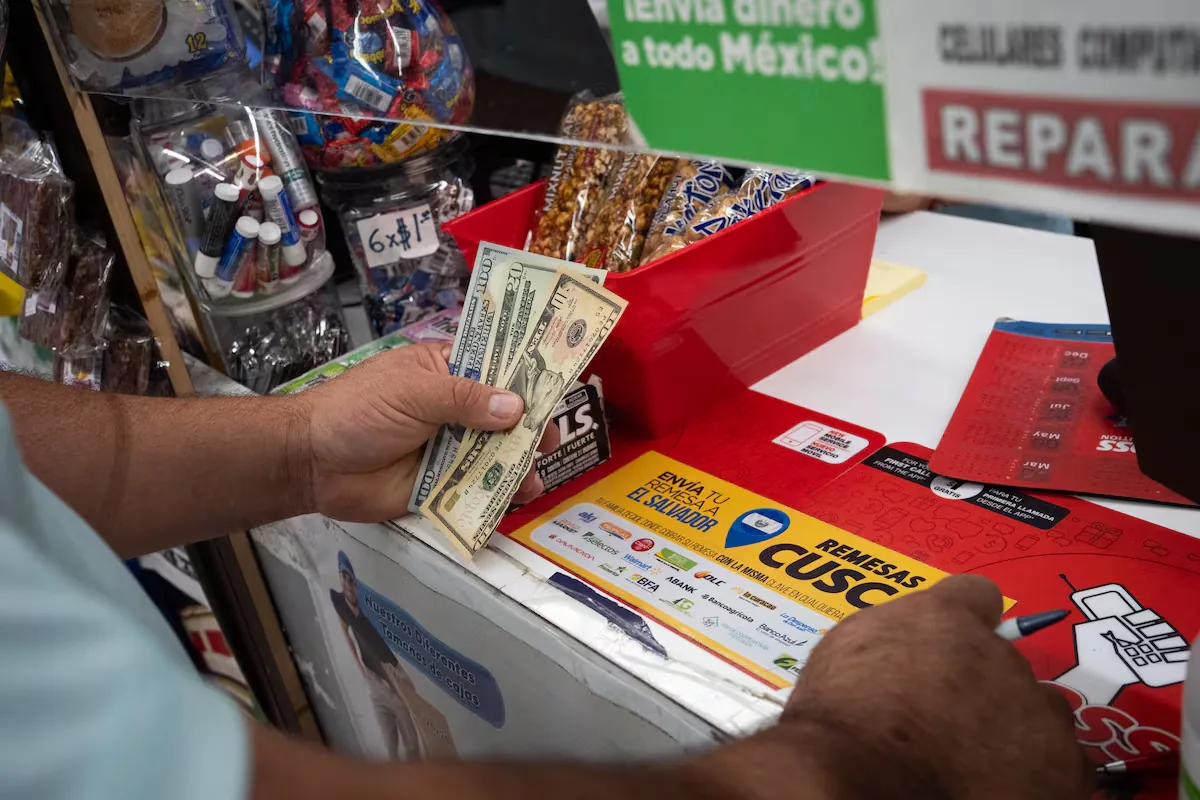
Ten years after the last major global overview of remittances, one of the largest international financial flows, the landscape has changed. The money transfers that migrants send to their countries of origin have doubled to reach $728.6 billion (about €626 billion) in 2025, a figure that far exceeds official development aid. The new report from the International Fund for Agricultural Development (IFAD), published this Monday, also reveals a geographic and technological shift: Latin America is the region where they have grown the most and half of the transfers are now made digitally, compared to a landscape dominated 90% by cash just a decade ago.
More than 1.3 billion people worldwide are part of international remittances. About 220 million migrants send money to around 1.1 billion relatives in their countries of origin, helping them cover basic needs such as food or housing. The figures, however, should be read with caution. The report does not discount the effect of inflation, so the recorded increase does not necessarily equate to a doubling of the purchasing power of families.
Still, the trend is clear: transfers have grown at an average rate close to 8% annually over the last decade. According to Pedro de Vasconcelos, manager of the IFAD Remittance Financing Fund, this increase is explained by several factors, including more constant communication between those who emigrate and those who stay. “More connection means greater responsiveness. Before it was a phone call; today there are WhatsApp conversations at any time. The person almost immediately knows that their relatives need resources to pay for school fees, repair a roof, or face a medical emergency. And they can send the money in seconds from their phone.”
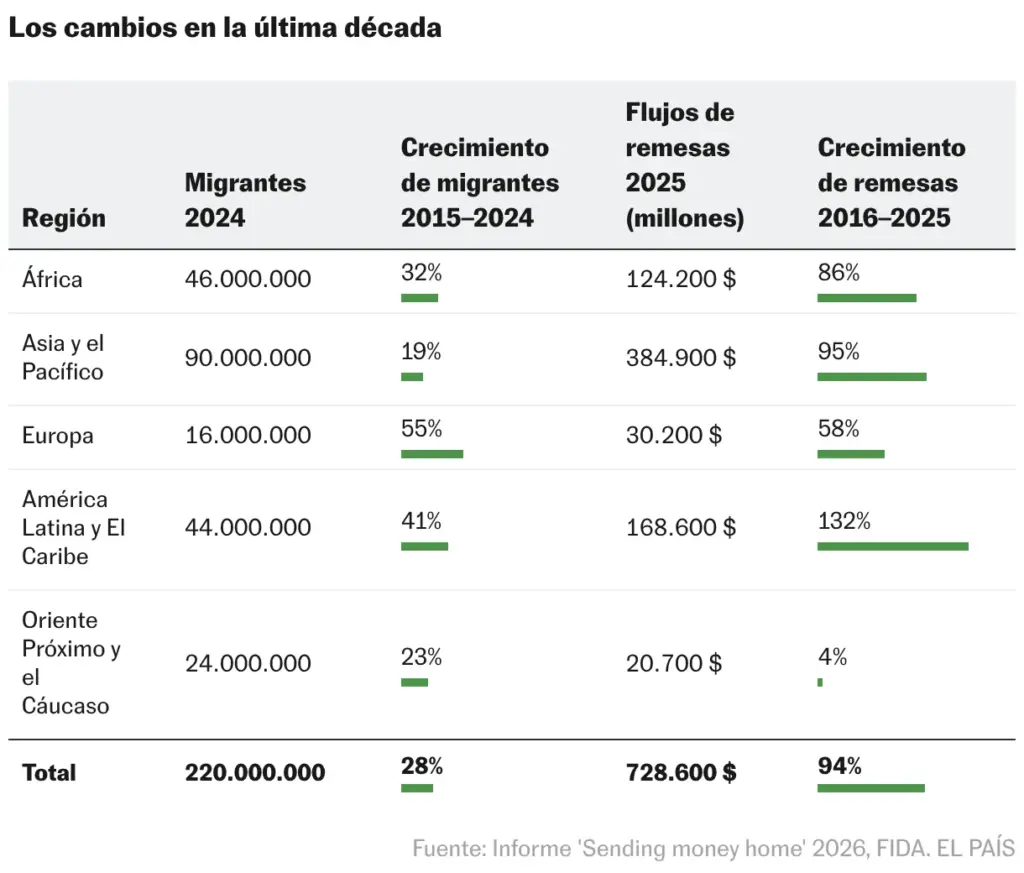
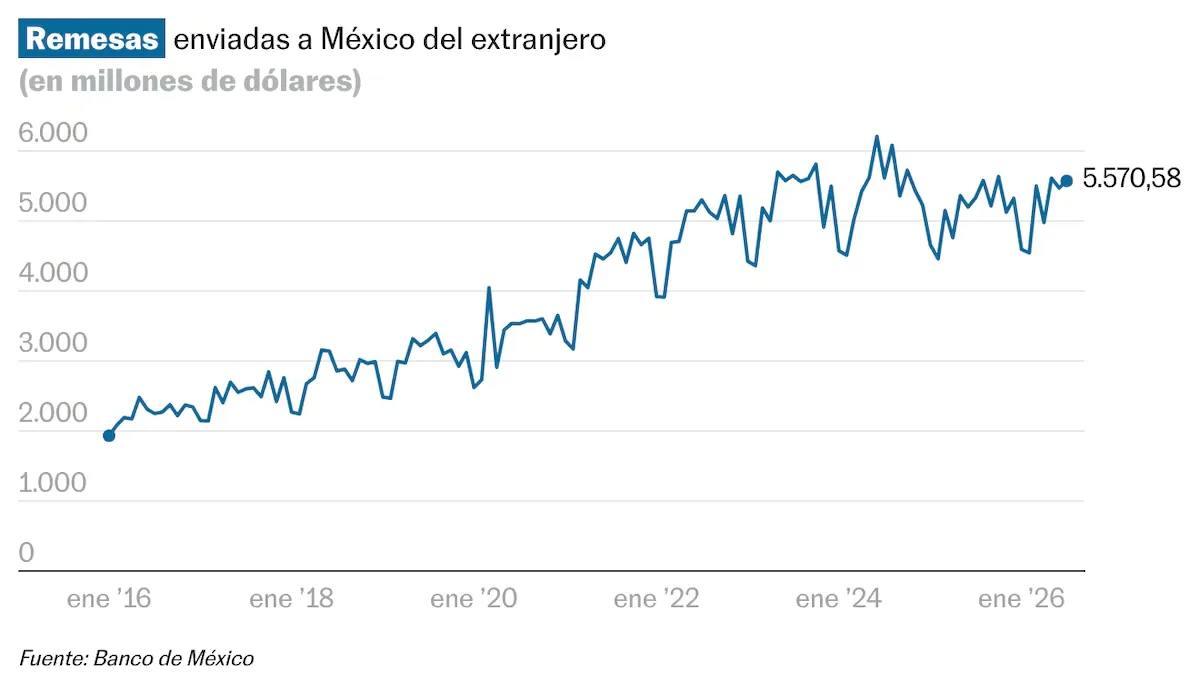
India, Mexico, the Philippines, Egypt, and Pakistan are the main recipients worldwide and concentrate 47% of the funds sent. Asia and the Pacific remain by far the region that receives the most resources, capturing 53% of the global total. However, it is no longer the fastest growing. That leadership now belongs to Latin America and the Caribbean. While remittances to the region increased by 18% between 2007 and 2016, they soared by 132% between 2016 and 2025.
One of the causes is the increase in migration, which grew by 41% in the last decade, driven by the Venezuelan exodus and by economic instability, insecurity, and climate phenomena. Vasconcelos adds that between Latin America and the US, the main source of remittances, “there are very large, liquid, and competitive sending corridors” that worked well when migrants had to respond to the region’s crises. “In many rural families, they can even help another family member avoid having to leave,” he highlights.
However, the tightening of migration policies in Washington keeps experts on alert. The Trump administration also threatened in 2025 to create a 5% tax on remittances, although it ultimately reduced it to 1%.
Vasconcelos acknowledges that a reduction in the number of migrants or their ability to generate income could seriously affect some economies especially dependent on these flows. This could be the case of Honduras, where remittances represent 30% of GDP, El Salvador (28%) or Nicaragua (27%). However, the IFAD study highlights that this type of transfer usually remains stable during periods of uncertainty.
A leap to digital transfers
Digitalization is gaining ground, although it still advances at different speeds. Half of the transfers are now initiated through digital channels, such as banks that have taken their services online, specialized mobile applications, or electronic wallets. However, only 35% complete the process fully digitally, from sending to receiving, without passing through cash at any point. “The big challenge in the coming years is to complete that digital journey,” says Vasconcelos and warns that achieving this requires much more than multiplying mobile applications.
Read more A man quadruples the maximum alcohol limit for driving and claims it was because he ate gazpacho
This is what happens, for example, in Africa, a pioneer in mobile money and in start-ups for remittance sending. The continent, which received $124.2 billion in 2025, still has problems ensuring that accounts and wallets are interoperable between countries, and not just within each national market.
Vasconcelos adds that, both in Africa and other contexts, reliable infrastructures are also needed, services adapted to the needs of migrant families, and that digital solutions reach rural areas, which receive 32% of global remittances.
Another pending task is to ensure that digitalization translates into increasingly cheaper sending fees and to reach the 3% target by 2030, set by the United Nations. The average cost of sending $200 (about €170) barely decreased from 7.4% in 2016 to 6.36% in 2025. Fully digital transfers cost an average of 4.6%.
IFAD also insists that it is urgent to improve the management of that money once it arrives at its destination. That is, the money should not simply be spent on immediate needs, but should allow building savings or accessing credit. “The opportunity is not only in transferring money faster and cheaper, but in how remittances can help build much greater resilience. That includes governments integrating them into their financial inclusion plans,” explains Vasconcelos.
The larger the remittances, the greater the temptation to see them as a source of funding that can be directed to certain development priorities. That would be a mistakePedro de Vasconcelos, manager of the IFAD Remittance Financing Fund
However, the report issues a warning: “They are private family resources, not development funds.” Although if managed, they can drive the progress of countries, they cannot relieve States and international organizations of the responsibility to make public investment or guarantee social protection, humanitarian aid, or climate financing.
“The larger they are,” Vasconcelos acknowledges, “the greater the temptation to see them as a source of funding that can be directed to certain development priorities. That would be a mistake. The role of governments and development institutions is not to direct the destination of that money, but to expand families’ options to use it. It is not about mobilizing remittances, but mobilizing opportunities.”