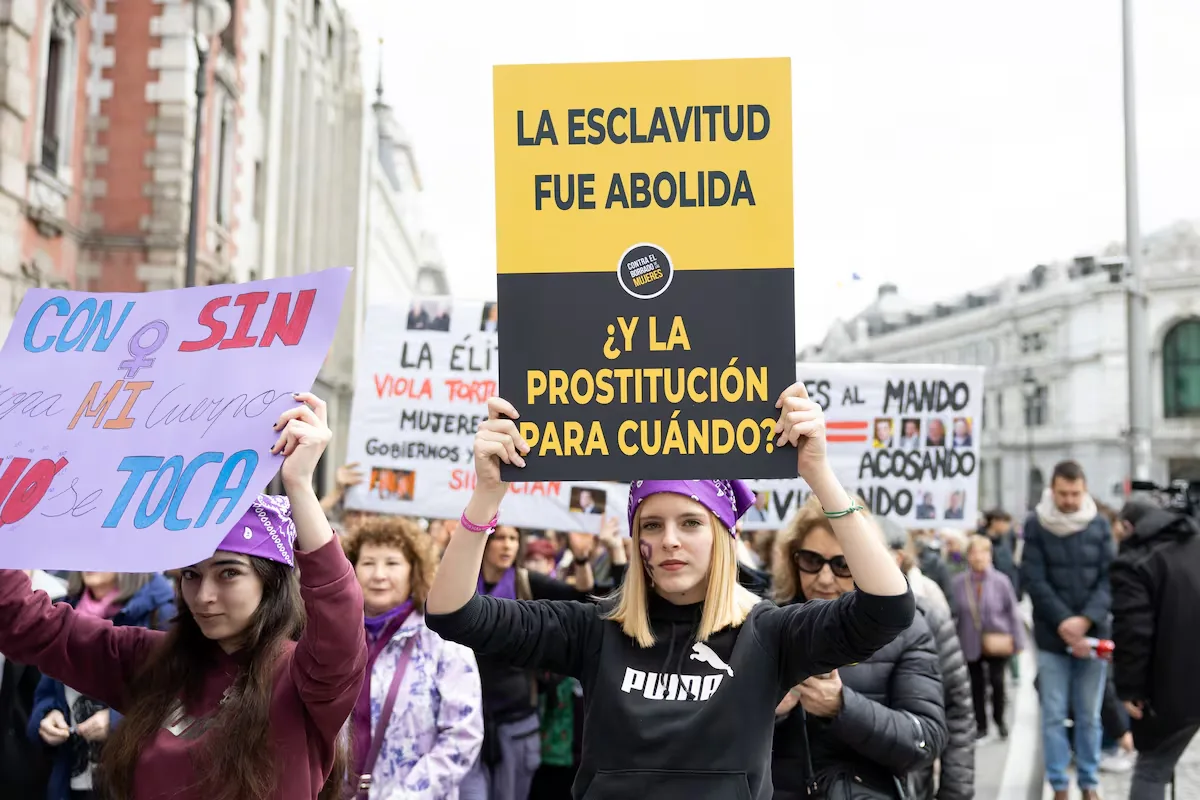
Few topics in feminism depend as much on politics as the debate around sex work. Back in 1980, the ideas of Andrea Dworkin and jurist Catharine MacKinnon laid the foundations of so-called radical feminism, then associated with the harshness of their arguments against prostitution and pornography. Their vehemence to eradicate them led Dworkin to ally with conservative groups, which caused the abolitionist current to be linked to these groups. But today, in certain European countries, the political debate is reopening and, in some cases, this alliance, which perhaps lasted too many years, is breaking.
Read more Half a year into the war, the United States still has not strangled Iran’s economy
Debate publishing house has reissued Hating Women (2026), by Andrea Dworkin, originally published in 1981, and has once again put the topic on the table, challenging the core of the feminist movement. On October 7, Hunger for Abolition (Destino), by poet and writer Noemí Trujillo, a manifesto against what she considers a serious structural injustice, will be published. The questions of the second wave return, although renewed after years of laws that have allowed different positions to be tested: is sex work a labor activity like any other or is it a form of women’s subjugation? Does it make sense to aspire to its abolition or is it better to fight for its regulation? How has it gone when it has been regulated?
Alice Schwarzer (Wuppertal, 83 years old), a historical reference of abolitionist feminism and founder of the magazine Emma, responds by email. Her diagnosis of the industry, against which she has been fighting for 40 years, is damning, and she sees no mitigating factors in the new digital forms: “Prostitution is prostitution. Whether soft or hard, it is equally destructive to women, as it infiltrates the deepest part of their being: it turns them into an object, into merchandise, into someone who can be bought.”
This theoretical argument is complemented by an empirical one based on the harm suffered by women who engage in sex work. For Rosa Cobo, professor of Gender Sociology, president of the International Academic Network of Studies on Prostitution and Pornography, and author of The Fiction of Sexual Consent, sex work “represents the absolute triumph of capitalism.” She believes that being a feminist is incompatible with supporting prostitution: “Feminism has fought for women’s sexuality to be based on desire. Prostitution is founded on male desire and denies women’s desire.”
It is difficult to prove a causal relationship between machismo and sex work, although it is one of the main reasons advocated for its abolition. In the meticulous work Is Sex Work Inherently Gendered?, English researcher Natasha McKeever dismantles the most repeated arguments: that men pay for sex because they cannot find a partner or that there is a socioeconomic asymmetry between buyer and seller. The numbers do not support these statements. Perhaps the most puzzling fact is the following: in the United Kingdom, during a period of advances in gender equality (1990-2010), the percentage of men who reported having paid for sex increased by two points. For Keever, there is even choice, and many engage in sex work for reasons beyond poverty, especially since the internet boom. “Students, for example. It is a better option to make money,” she reflects over the phone. “There are people who genuinely want to engage in sex work.”
And here lie the strongest arguments in favor of regulating it: freedom of choice and the desacralization of the body. For Martha Nussbaum, all people who work receive money for the use of their body. That certain parts of the body are used to engage in prostitution and that this is frowned upon is purely a prejudice. The problem arises when a woman in poverty has no alternatives. Therefore, “The legalization of prostitution improves conditions for women who have very few options.”
Furthermore, this position continues, coercion and exploitation can occur in any job. Erin O’Brien, PhD in Political Science, identifies as a feminist and regulationist. She believes that recognizing sex work as work allows legal protection without fear of stigma, she points out by email. She rejects laws known as neo-abolitionist, which punish clients and seek to end the demand for sex work. She considers them inefficient and “closer to symbolic politics than to real laws that protect health, provide security [to those who engage], and guarantee their human rights.”
After going through all the positions in the debate, Mabel Lozano (58 years old) is an abolitionist activist. She has filmed shorts and documentaries on the subject, and she is among those who believe, she argues in a phone conversation, that the innovative stance is to prohibit sex work and not regulate it. “There is nothing more conservative, more old-fashioned, than thinking that prostitution can be a job. That is what pimps have wanted all their lives. I worked with a pimp who told me: ‘When I hear those voices [regulationists] I think they don’t even need to be corrupted, they think the same as I do.’”
In the European political context, the debate is sounding again, although in different ways. In Spain, the PSOE has been trying for eight years to approve the abolition of sex work. After the Koldo case and its link to prostitution, the Minister of Equality, Ana Redondo, has assured that, even if the text does not pass, a public debate will be opened and perhaps even a parliamentary one. Sumar has not yet seen the project, but the party’s general stance seeks to repeal the gag law, which fines these women, and reform the Immigration Law, which “condemns thousands of women to irregularity and exclusion.” Beyond this and the willingness to listen to women who engage in this activity, there are different positions within the party.
On the other side of Europe, in Germany, regret is growing after two decades of regulation: the Christian Democratic Union advocates repealing the law because the country has become, it says, “the brothel of Europe.” And to a lesser extent, although unexpectedly, the topic also reappears in France. A deputy from the far-right National Rally party proposed reopening brothels and having them managed by sex workers, “as cooperatives.” The proposal appears as a solution to the rejection by sex workers of the law that since 2016 penalizes clients (and causes, they claim, more dangerous working conditions).
As the case of France shows, sex workers have their own interests and lean towards regulation. For Cobo, women’s self-determination and over themselves is fundamental for the advancement of feminism; for her, sex work is one of those cases where the limit of what is right is reached: “Extracting sexual surplus value from our bodies is ethically unacceptable. It would also not be acceptable for someone to decree their own slavery.” The debate is (once again) a clash between ethics and politics.