









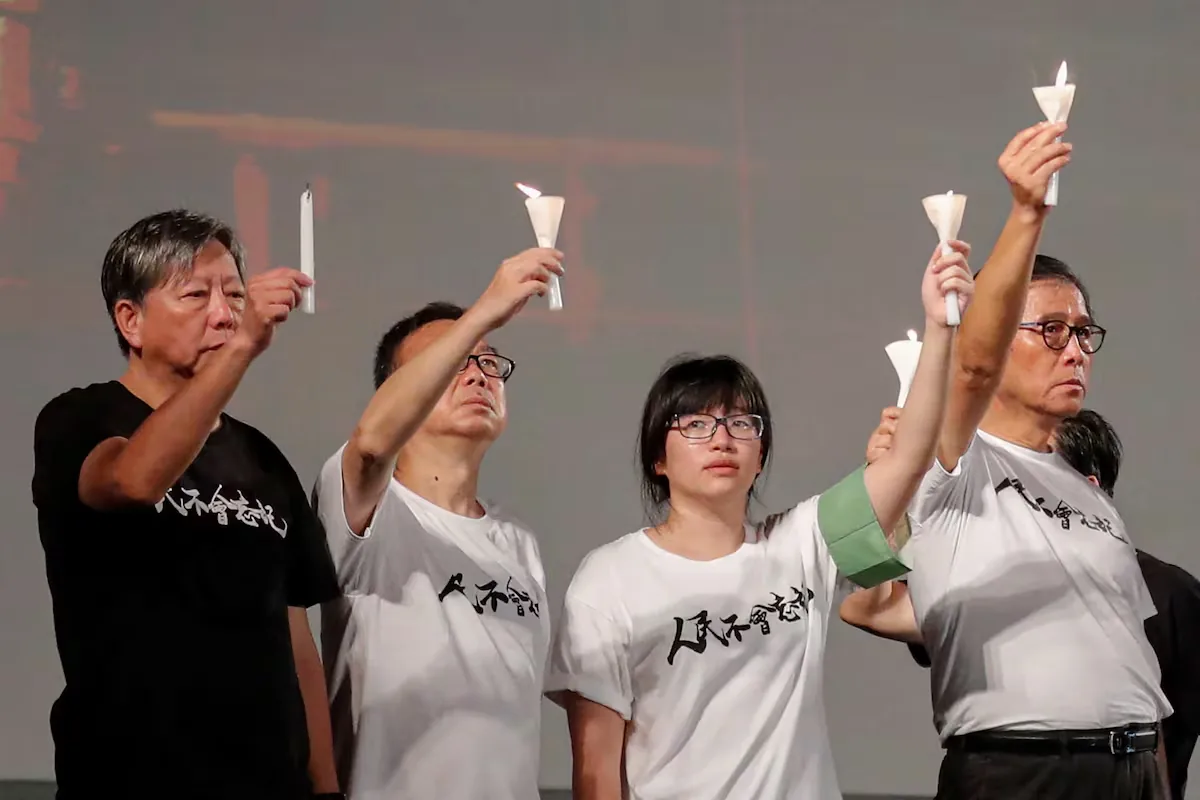
For decades, Hong Kong kept alive a memory that Beijing has tried to erase. The vigil for the victims of the 1989 Tiananmen massacre was born when the city was still a British colony and survived for more than two decades after its return to China, becoming one of the most visible expressions of the freedoms that distinguished the semi-autonomous territory from the rest of the country. In 2020, citing pandemic restrictions, it was banned. It was never authorized again. This Friday, the Hong Kong High Court found two leaders of the organization that convened that massive gathering every June 4 guilty of incitement to subversion.
The trade unionist and former legislator Lee Cheuk-yan, 69, and lawyer Chow Hang-tung, 41, former president and vice president of the now-dissolved Hong Kong Alliance in Support of Patriotic Democratic Movements of China, have been found guilty of “incitement to subvert state power” under the national security law that Beijing imposed on Hong Kong in June 2020. Both have been imprisoned since September 2021 and now face sentences of up to ten years in prison.
A third defendant, veteran lawyer and former legislator Albert Ho, 74, pleaded guilty to the same charge at the start of the trial in January. The hearings in which Lee and Chow will be able to request a reduction of their sentences will be held soon; the sentence will be handed down afterward. The United Nations Working Group on Arbitrary Detention concluded in 2023 that Chow’s detention was arbitrary and that her arrest was linked to the exercise of her freedoms of expression, assembly, and association.
The three appointed judges focused the ruling on one of the Alliance’s five historic demands: “End the one-party dictatorship.” According to the court, the repetition of that slogan was intended to provoke hostility towards the Chinese Communist Party (CCP), cause the population to lose confidence in it, and ultimately undermine the political system established by the Chinese Constitution. The verdict emphasizes that, although the defendants advocated resistance that did not necessarily involve violence, their actions could constitute a violation of the national security law.
The defense had argued precisely the opposite. Lee maintained during the trial that he was not promoting the overthrow of the CCP but was calling for a democratic transition in which citizens would decide who should govern. Chow, who represented herself, pointed out that for more than 30 years the Alliance had pursued its goals peacefully.
The organization was founded in May 1989, when Hong Kong was under British rule, to support the student protests that had shaken Beijing since April and later spread to other cities in the country. They demanded political reforms, an end to corruption and censorship, and greater civil liberties. In the early hours of June 4, troops deployed under martial law advanced toward the center of the Chinese capital and opened fire on the crowd gathered in the streets leading to Tiananmen.
The number of victims remains unknown; estimates range from several hundred to several thousand. Since then, the event has been subject to strict censorship in mainland China; the episode is invisible in textbooks, the media, and the tightly controlled Chinese internet.
In Hong Kong, however, it could be publicly remembered for 33 years, and the vigil held annually in Victoria Park gathered tens of thousands of Hong Kongers. The last large authorized event took place in 2019. The following year, the police banned it for health reasons, although thousands of people attended despite the prohibition.
Weeks later, the national security law came into effect, approved by Beijing after the massive protests that had shaken Hong Kong for several months in 2019 demanding democratic reforms. The law punishes, among other crimes, secession and subversion and has since been used against numerous opposition leaders and pro-democracy activists. The Alliance dissolved in September 2021, the same month its leaders were charged.
Amnesty International considers Lee and Chow prisoners of conscience and has called for their “immediate and unconditional release.” The NGO has described the verdict as “disheartening” and argues that it shows how the national security legislation is used to punish the peaceful remembrance of “one of the darkest chapters in China’s recent history.” “Commemorating victims of human rights violations is an act of compassion, not a crime,” said Fernando Cheung, the organization’s spokesperson in Hong Kong.