Seeing a total solar eclipse is priceless, but the rates of thousands of accommodations have been reflecting the opposite for months. This is confirmed by the daily monitoring of more than 5,500 listings on Booking, the huge vacation accommodation platform, carried out by EL PAÍS over 90 days. The increase in the price of a hotel night in Spain is concentrated almost exclusively in the band where the phenomenon will be most visible.
When the analysis began, at the end of April, staying overnight during the eclipse was already considerably more expensive in the totality band (the band where the eclipse will be seen 100%) than in the rest of Spain. To measure this, EL PAÍS compared the price of the same hotel between two dates in the 200 largest municipalities in Spain (plus Teruel). Specifically, we tracked the rates for the night of August 12 to 13, 2026 (the night of the eclipse) and August 5 to 6 (one week earlier, as a control night).
A clear pattern
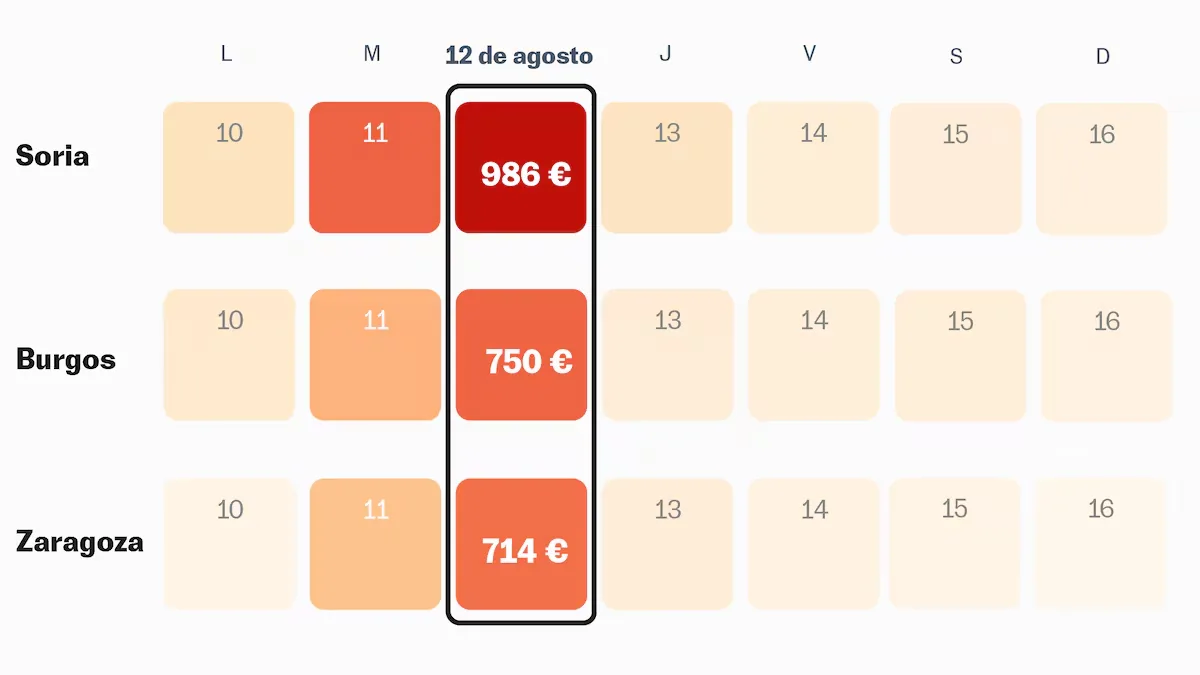
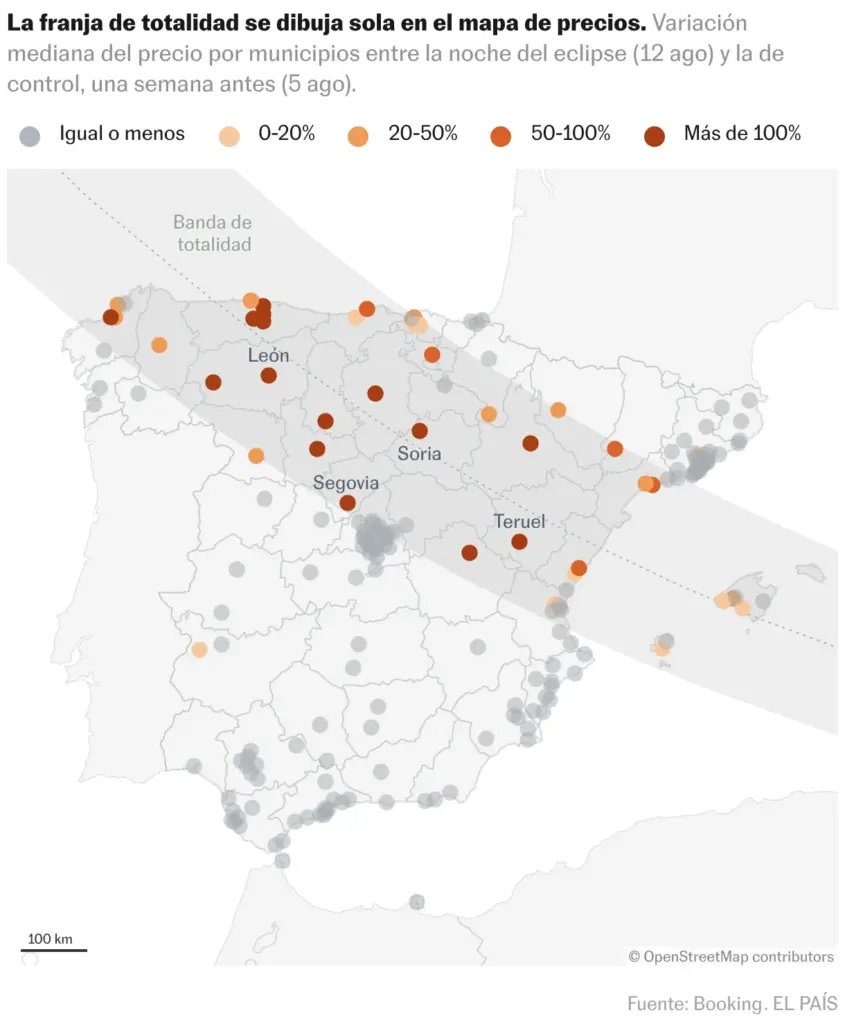
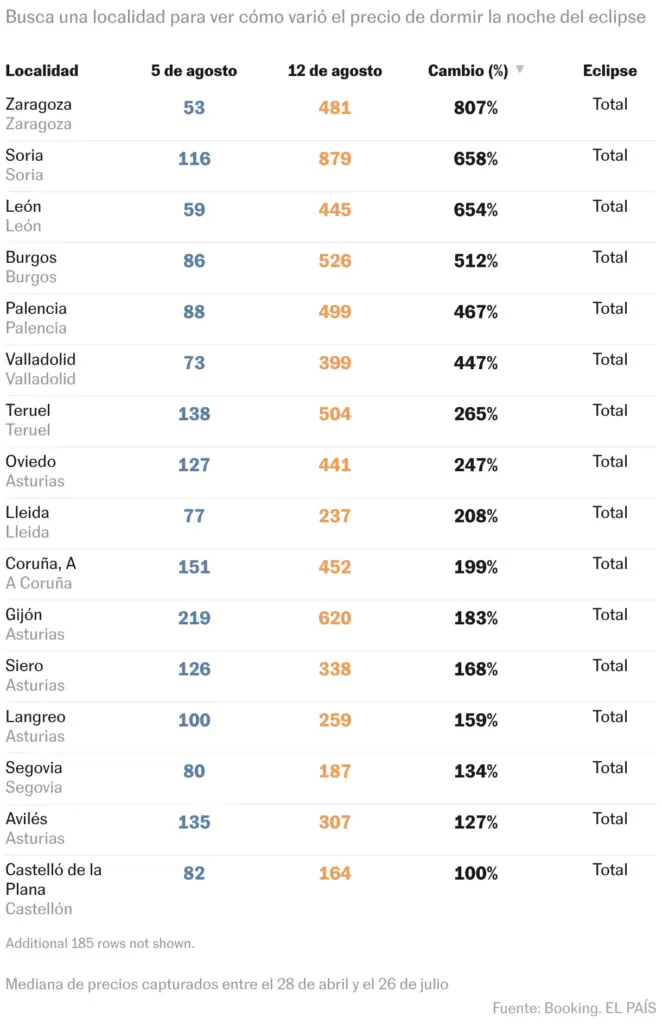
Of the 201 municipalities analyzed (60 in the totality band and 141 in partial eclipse), 104 increased prices (52%), 43 decreased (21.5%), and 53 remained the same (26.5%). In total, 15 exceed a 100% increase. In Soria, the median goes from 116 to 879 euros (+658%); in León, from 59 to 445 euros (+654%). Segovia and Teruel, somewhat more moderate, also double or triple their usual price.
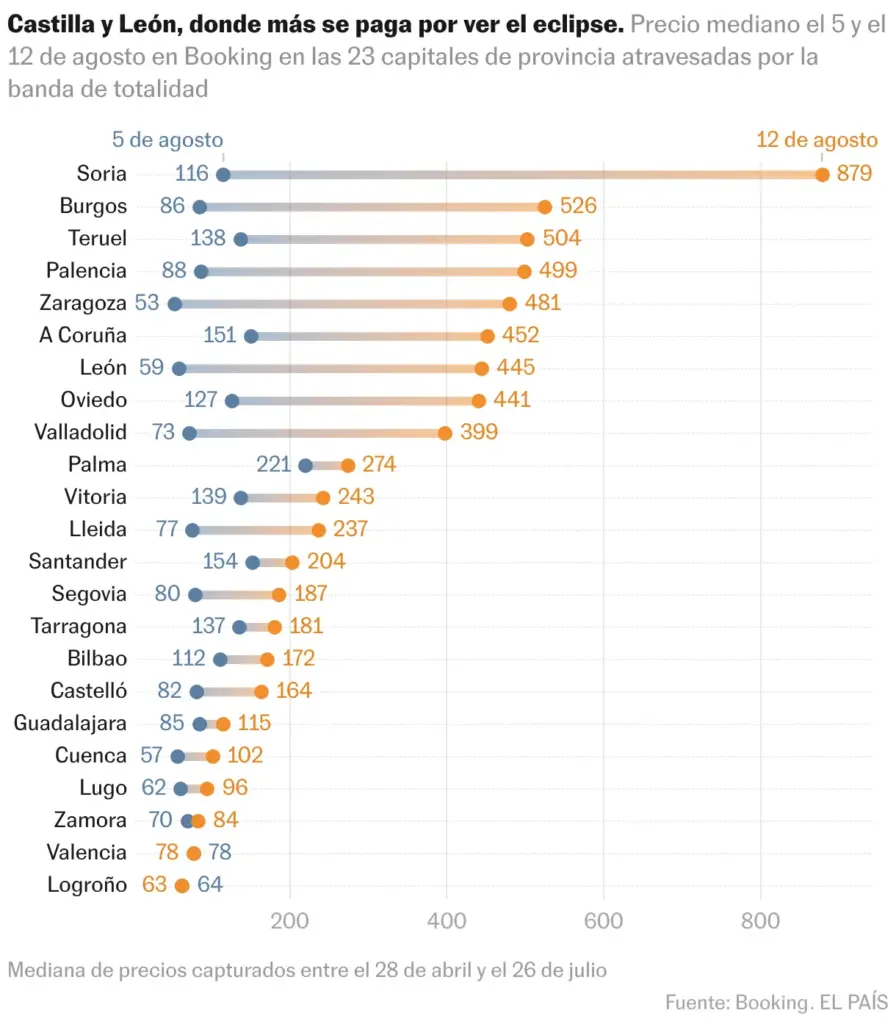
Looking at provincial capitals, 21 of the 23 raise prices on the night of the eclipse. The two exceptions are Valencia, which does not increase even one euro (78€ both nights), and Logroño, practically flat (63€ → 64€). The six capitals of Castilla y León within the band —Soria, Burgos, Palencia, Valladolid, León, and Segovia— lead the ranking, with an increase of about 400 euros in the median price per night.
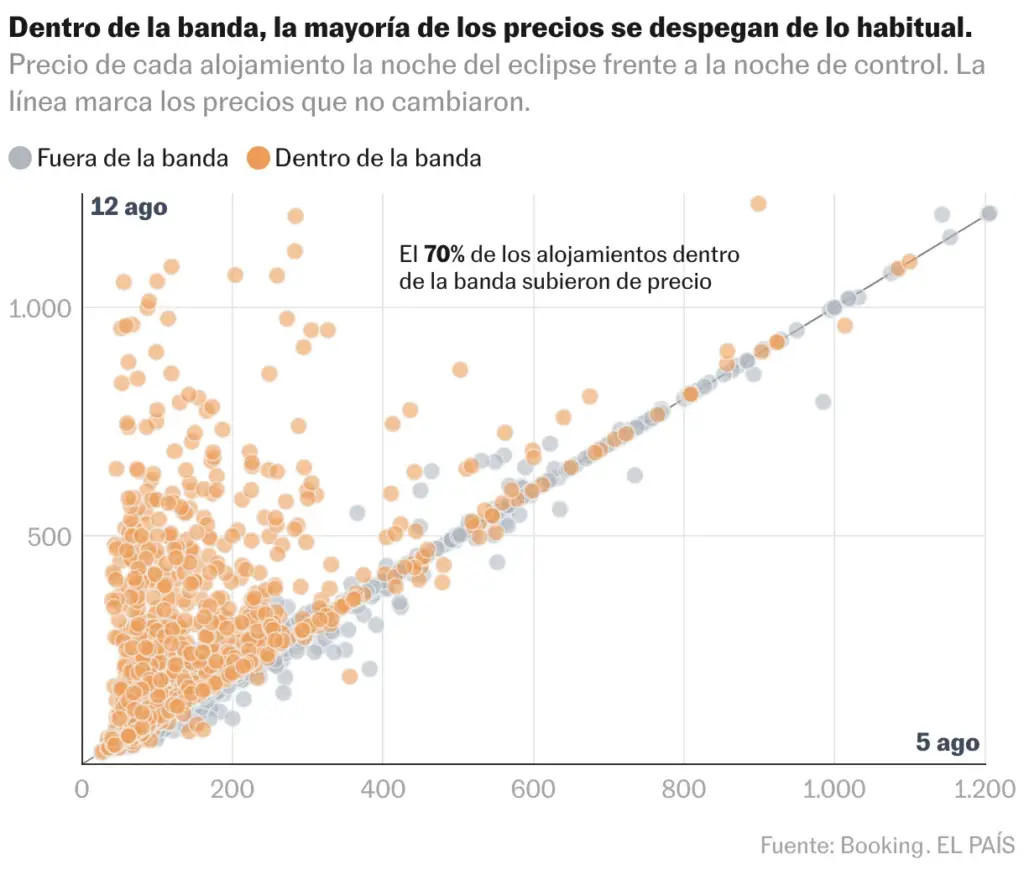
If the prices of each of the 5,574 accommodations analyzed are observed, the comparison is even clearer. As seen in the following graph, hotels within the totality band (in orange) shoot up their prices and form a compact cluster of points away from the diagonal of the graph. 70% of accommodations raised their rates for that night. Those outside, however, remain in the middle of the quadrant: they have barely moved their prices.
A clear example is seen in a hotel in Soria that on Wednesday the 5th cost on average 120 euros and the night of the eclipse staying there reached 1,090 euros.
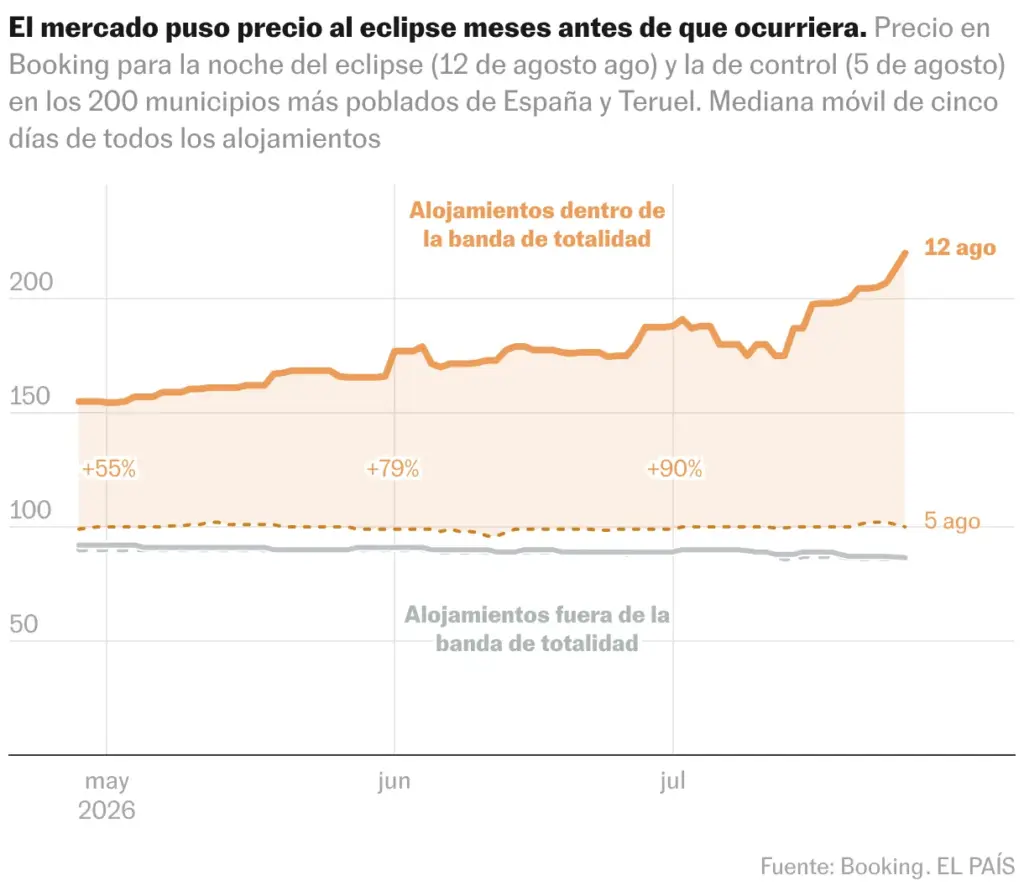
The price difference for hotels in municipalities crossed by the totality band has been widening as the date approached. At the end of April, on average, rooms were 55% more expensive on the day of the eclipse than a week before the phenomenon. In July that gap rose to 90% and by the end of that month reached 120%: the night of the eclipse thus cost on average more than double what it did a week earlier. Prices for August 5, however, barely moved.
All this price movement is not seen in hotels outside the totality band.
Although one might expect the largest increases to be concentrated in municipalities closest to the central line of the eclipse, the data does not show a clear relationship between the two variables. The price increase extends quite homogeneously along the entire totality band, suggesting that the main factor is being within the area from which the eclipse can be fully observed, rather than the exact proximity to the point of maximum duration of the phenomenon.
In total, the eclipse will be visible from 1,800 municipalities in Spain and EL PAÍS has created a map with more than 350 official sites to view the phenomenon and another that allows comparison of times, percentage of obscuration, and duration, three key factors to understand the intensity of the event.
Methodology
Source: Booking.com.
Capture period: 90 days, from April 28 to July 26, 2026.
Universe: the 200 most populated municipalities in Spain, plus Teruel (provincial capital located in the totality band, although outside the top 200 by population) — 201 localities in total. Of these, 60 are within the totality band of the eclipse and 141 in the partial zone.
What was captured: each day, for each locality, the price of available accommodations on Booking was recorded for two nights: August 12 to 13, 2026 (the night of the eclipse) and August 5 to 6 (one week earlier, as a control night). Accommodations appearing among the first Booking results ordered by price were tracked. The search always corresponds to a room for two adults.
What is considered “comparable”: not all accommodations seen in the scraping are suitable for measuring a price change — only those that appeared with a price on both nights on the same capture day count. 5,574 accommodations meet this condition and form the basis of this analysis.
How the price change was calculated: for each comparable accommodation, the ratio between the price of the night of the eclipse and the control night was calculated day by day. From this series of daily ratios, the median was taken — a measure that is not skewed by a single day’s peak in scraping. For figures by locality or provincial capital, the median of those medians per accommodation was used, not the average price nor the cheapest of the set: thus, a single extreme case cannot alone determine the result for an entire city.