









John Kenneth Galbraith published his book The New Industrial State in 1967. One of his conclusions is that in modern companies, as they grow, a group of technicians and managers, which he defines as the “technostructure,” assumes more and more power, displacing the shareholders. As a consequence of this empowerment and the atomization of corporate ownership, the technostructure has a direct influence when deciding on their own salaries. Almost six decades after the Canadian economist and diplomat warned about this phenomenon, the machinery of the executive elite remains perfectly well-oiled.
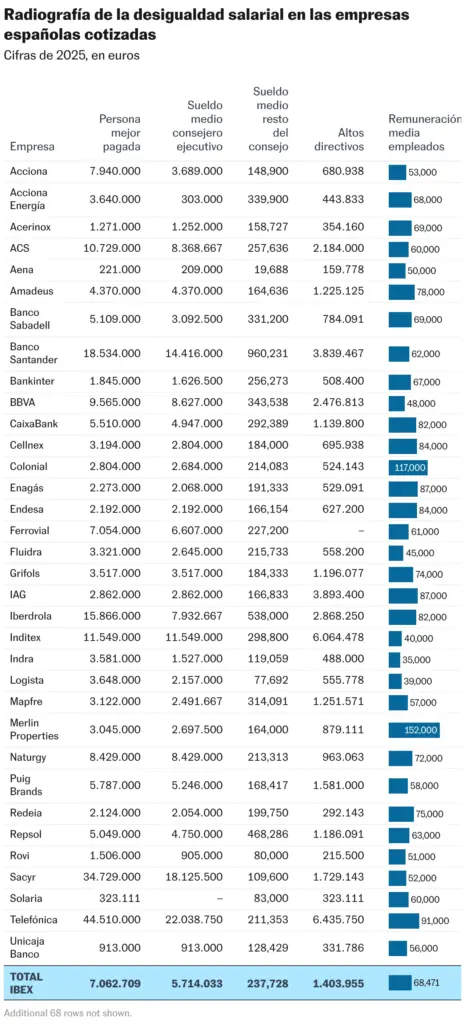
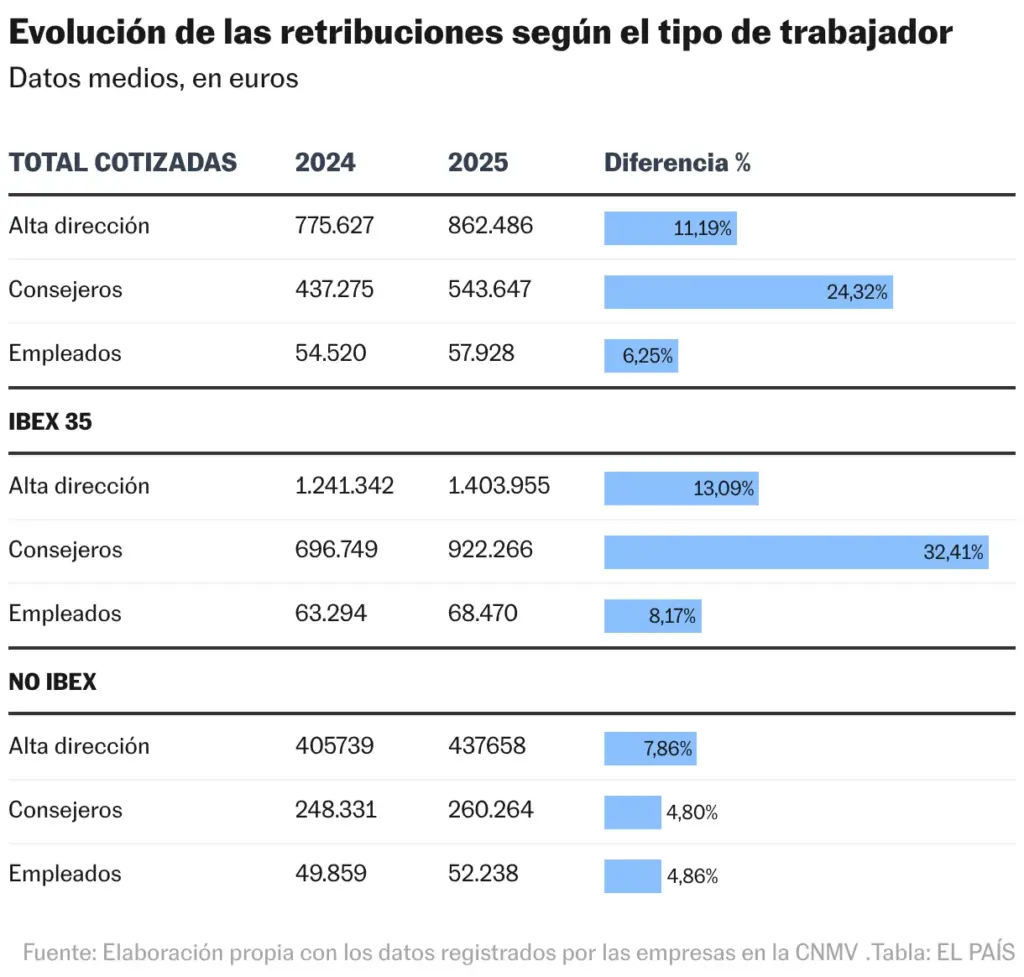
In 2025, Spanish listed companies broke their profit record. The boom was reflected in employee salaries, but the improvement was not symmetrical. According to the fourteenth edition of the compensation report published by EL PAÍS, which analyzes the payroll evolution of about a hundred companies listed on the stock exchange with data they send to the market regulator (CNMV), the average salary of workers last year was 57,928 euros, 6.25% higher than the previous year; meanwhile, senior executives earned an average of 862,486 euros, with an 11.19% increase; and board members saw their total remuneration grow by 24.32% to an average of 543,647 euros.
Extraordinary bonuses and golden parachutes are behind the notable increase in executive pay and explain why economic inequality has also soared to its historic maximum. In 2025, the highest-paid executive directors of the Ibex 35 — excluding ArcelorMittal — earned an average of 7.062 million euros. This figure is 103 times more than the 68,471 euros earned on average by the employees of the companies they lead. Considering that the average contribution period of a worker in Spain is around 36 years, according to Social Security, this differential means that employees of Ibex groups would need to accumulate three working lives to earn what their bosses make in a single year. The wage gap in 2025 represents a considerable qualitative leap compared to the inequality ratio of the last five years, which had remained relatively stable: in 2024 the gap within the Ibex was 79 times; in 2023, 77 times; in 2022, 81 times; and in 2021 and 2020, 76 and 79 times, respectively.
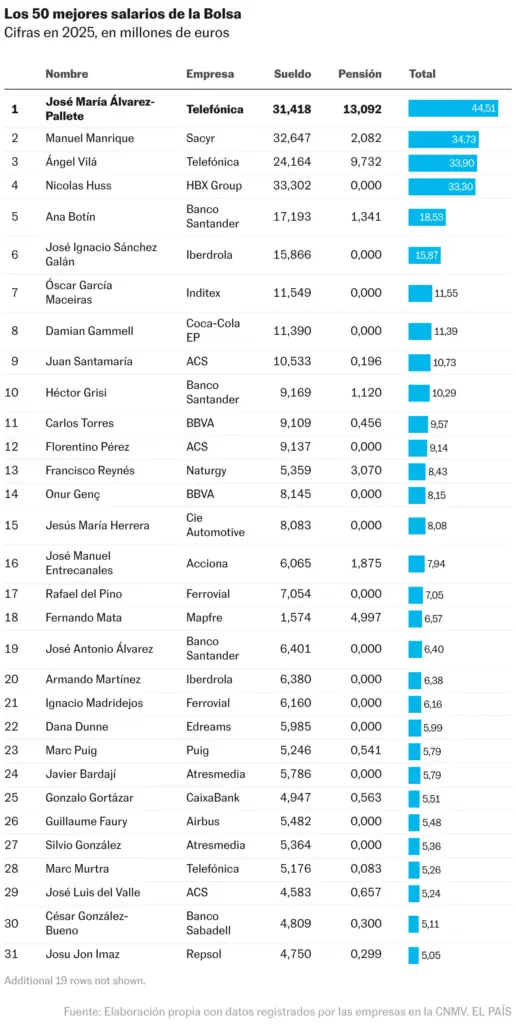
The executive who led the pay ranking last year was José María Álvarez-Pallete. The former chairman of Telefónica received a total of 44.51 million euros from all concepts — salary, pension, and severance. The second place in the salary scale went to the president of Sacyr. Manuel Manrique received 34.72 million euros between salary and pension thanks to the settlement of a variable compensation plan approved by the construction company in 2021. The bronze medal went to the former CEO of Telefónica, Ángel Vilá, who earned 33.89 million. Close to the podium was a newcomer to the stock market, Nicolás Huss. The CEO of HBX Group — formerly Hotelbeds — earned 33.3 million thanks to an extraordinary bonus of 32.7 million for taking the company public. Since its stock market debut in February 2025, HBX shares have fallen almost 40%, which also affects the variable compensation received by Huss, as a significant part of the incentive (16.5 million) was reinvested in company shares.
A huge gap
In terms of wage gap, the most unequal listed company last year was Sacyr. Manrique’s total remuneration is equivalent to 667 times the 52,000 euros average earned by his employees. Very close was the gap between HBX’s staff and its top executive: 666 times; while in the case of Telefónica, Pallete received 489 times more. Other companies with great wage inequality were Cie Automotive — the 8.08 million earned by Jesús María Herrera is equivalent to 449 times the average salary of his company — Banco Santander — Ana Botín earned 18.53 million from all concepts, 298 times more than her employees — and Inditex — Óscar García Maceiras received 11.54 million, 288 times above the average salary paid in the textile group.

The club of million-euro salaries has more and more members. In 2025, there were 101 board members in listed companies who received one million euros or more between salary and pension. The presence of women in executive board positions remains very scarce — most are independent or shareholder representatives — which explains the barely noticeable female presence in the top salary ranks. Specifically, among the 100 highest salaries of boards of listed companies in 2025, there are only seven women.
Besides executive directors, another source of astronomical pay is senior management, although in this case regulations do not require companies to itemize salaries individually. Last year, 196 professionals from 19 companies earned on average more than one million euros. The highest-paid senior management last year was not from the Ibex 35, but the seven executives of HBX who, thanks to the incentive for the company’s IPO, earned an average of 8.42 million. Following the group specialized in hotel bed management were Telefónica’s senior executives who, thanks to bonuses and severance, earned an average of 6.43 million. Third place went to the 23 members of Inditex’s senior management, who earned 6.06 million each. Generous remunerations also corresponded to the top 10 executives of IAG (3.89 million); the 15 senior executives of Banco Santander (3.83 million), while the four senior executives of Iberdrola received 2.86 million.
445 million euros in pensions
It often goes under the radar, but companies’ contributions to the pension plans of their executive directors have been gaining weight in executive compensation programs for years. Previously, this policy was limited to banks: under the pretext that they did not have severance protections, financial institutions made periodic contributions to their bankers’ pension funds. Now this system has spread to almost all sectors, although it is more common in larger companies, that is, those that are part of the Ibex 35.
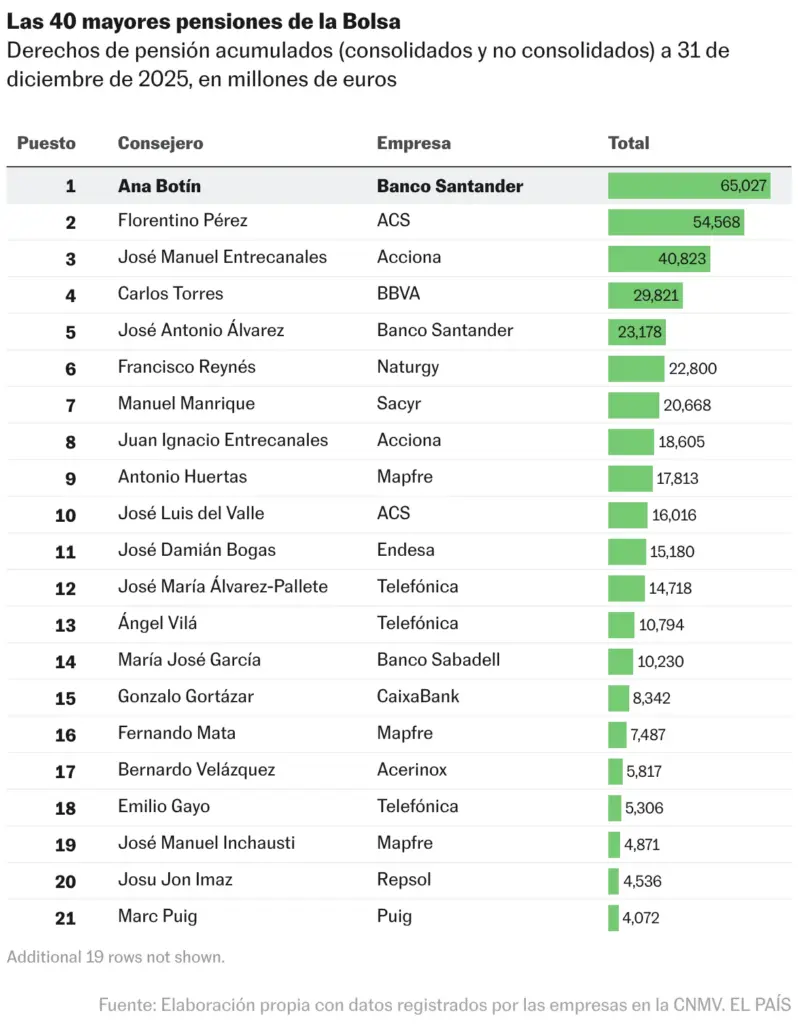
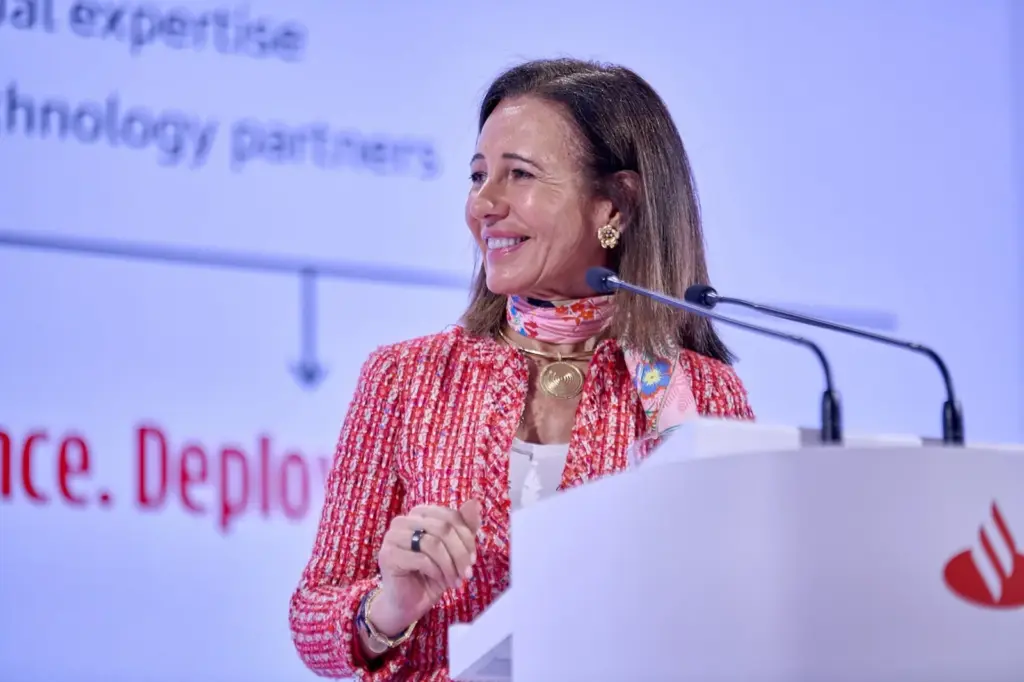
At the close of the last fiscal year, the directors of Spanish listed companies accumulated pension rights valued at nearly 445 million euros. Up to 55 directors, according to data submitted by companies to the National Securities Market Commission (CNMV), had contributions. The largest accumulated retirement sum belongs to Ana Botín. Banco Santander contributed 1.34 million euros last year to the pension plan of its executive chairwoman, and her retirement fund already totals 65.02 million euros. Although ACS did not contribute a single euro to its president’s pension system last year — after many years contributing one million or more euros each year — Florentino Pérez accumulates the second largest pension in the market with a value of 54.56 million, according to the construction and services group’s remuneration report. After Botín and Pérez comes José Manuel Entrecanales. The CEO of Acciona already has a guaranteed retirement check of 40.82 million after the construction company contributed 1.87 million last year.
Another golden retirement in the market is that secured by Carlos Torres. BBVA contributed 0.45 million to his retirement plan in 2025, and the bank’s president accumulates 29.82 million. Also notable are the cases of the former CEO of Banco Santander, José Antonio Álvarez, with 23.17 million, and the CEO of Naturgy, Francisco Reynés, with 22.8 million.
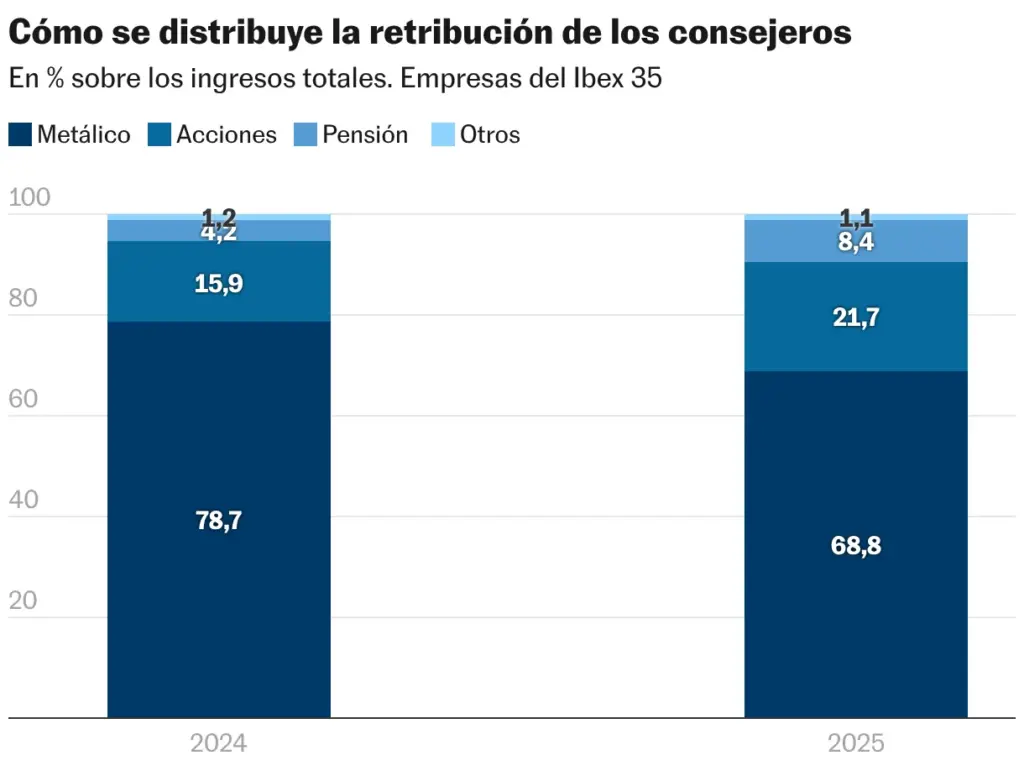
Gradually, Spanish listed companies are adjusting compensation schemes to the recommendations of the corporate governance code, which include a lower weight of cash payments (fixed salary and bonuses) to discourage short-term management that assumes excessive risks. In the case of the Ibex 35, last year 68.84% of the payroll of its boards of directors was paid in cash. This is a considerable drop in the weight of this type of remuneration since in 2024 it accounted for 78.67% of the total. Meanwhile, payment in company shares accounted for 21.69% of remuneration in 2025, up from 15.93% the previous year. Another rising item, as mentioned earlier, corresponds to contributions to pension plans (rising from 4.16% to 8.35%), while the category called others (including insurance, car, or housing for directors) represents 1.12% of the total remuneration of Ibex boards.
More golden parachutes
In financial jargon, they are known as golden parachutes. These contractual devices are deployed when the dismissal of the top executive in a company is imminent and serve to make the exit less painful. You know the saying, bread eases sorrow. The protections for executive directors and senior management allow them to receive severance payments equivalent to several years of fixed salary — the European Union recommends no more than two years, although there are cases that reach four or five — in case of breach of contract.
At the close of the 2025 fiscal year, there were 742 people with this type of protection on the Spanish stock market. This is five more than in December 2024. The company that reports the most such cases in the corporate governance report sent to the CNMV is Repsol, with 224 cases, one more than a year earlier. Following the oil company are Banco Sabadell with 42 protected executives or directors, BBVA (41 employees), and Dia (39, the company with the most protections outside the Ibex 35).
The remuneration report of the board of directors is among the agenda items that must be voted on at shareholders’ meetings, although the result of this vote is only advisory, not binding. In the meetings held in 2025 (which voted on the 2024 salaries), shareholder pressure decreased slightly. In the case of the Ibex 35, the negative vote on board salaries averaged 6.18% compared to 6.5% the previous year, and in the case of other continuous market companies, opposition was 3.97% compared to 4.88% in meetings held in 2024. The companies that faced the greatest rejection of their board salaries last year were Sacyr (29.04% voted against), OHLA (27.46%), Viscofán (23.7%), Ercros (22.37%), Grifols (20.19%), Cie Automotive (18.85%), and Banco Sabadell (18.45%).
Read more An Atlético full of substitutes and youth players dances around Valencia